Rankevra Blog
Search Engine Rank Tracking Software: How It Really Works
August 3, 2026
What Search Engine Rank Tracking Software Actually Does
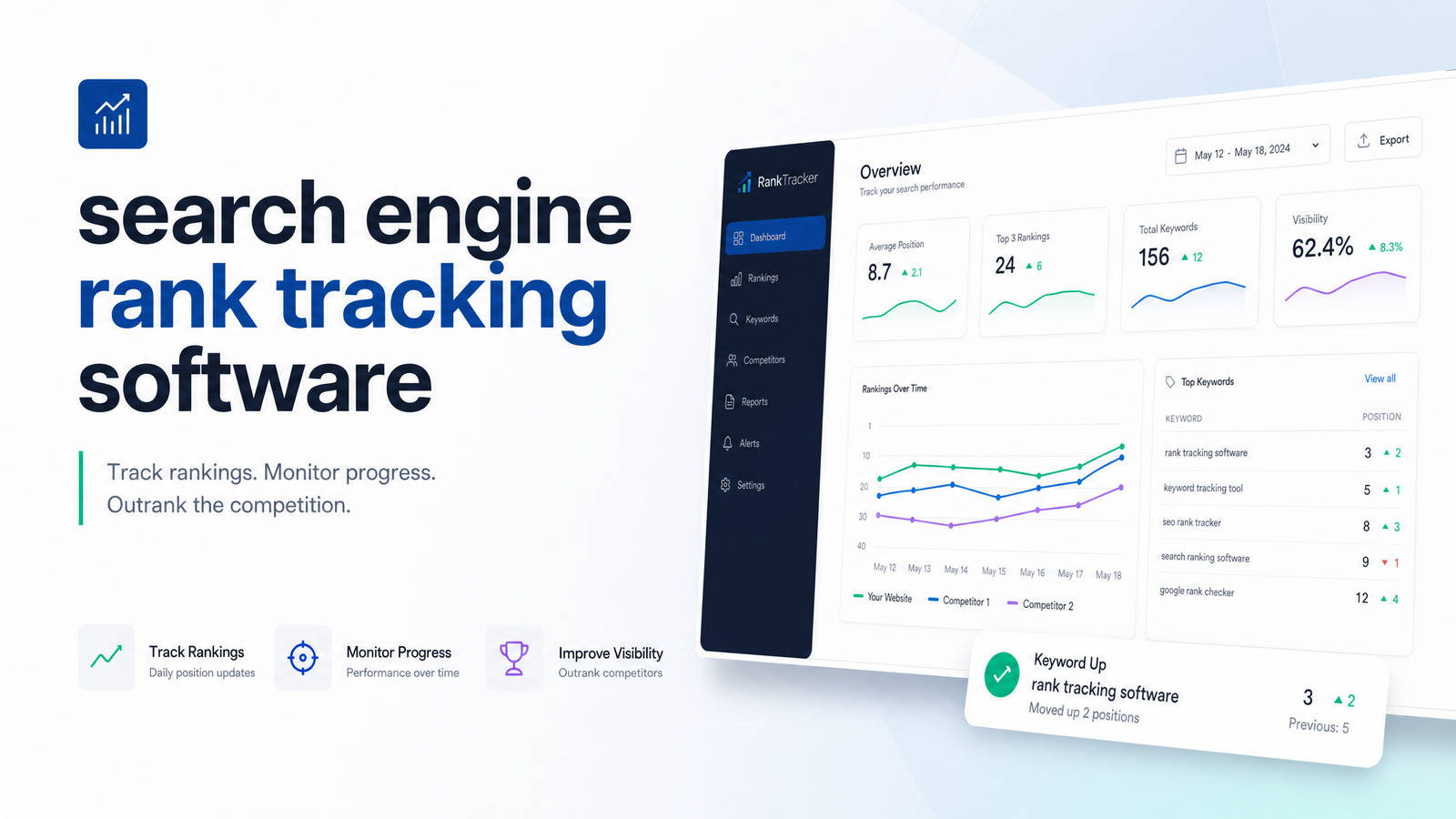
Search engine rank tracking software runs automated, repeated checks against a defined list of keywords, recording where a domain appears in search results at a given moment, from a given location, on a given device. A machine simulates a search, records the position, stores it, and repeats the process on a schedule — daily, weekly, or otherwise — so you get a position history instead of a single snapshot.
This differs fundamentally from typing a keyword into Google yourself. A manual check reflects your own browser, login state, location, and whatever Google decided to show you at that exact second. It tells you nothing about tomorrow, and it can't be compared against last month with any confidence. SERP tracking software holds the search conditions constant so the only thing that changes, in theory, is your actual position.
That consistency is the entire value proposition. Tracking keyword rankings over weeks and months builds a dataset that lets you correlate position changes with things you actually control: a content update, a technical fix, a new backlink, or a competitor's move. Without that consistent methodology, you're just guessing based on whatever Google happens to show you at the moment you look.
How the Tracking Actually Works: Geo, Device, and Search Engine Simulation
Under the hood, a Google rank tracker sends a search request that mimics a real user — but it has to specify variables a human never thinks about. Location is the big one: a search for "plumber near me" run from a New York IP address returns a completely different result set than the same query run from Chicago. Geo-targeted rank tracking software lets you pin a check to a specific city, region, or country, so the number you get back actually corresponds to the market you're trying to rank in.
Device is the second variable. Google has run mobile-first indexing for years, meaning it primarily uses the mobile version of a page for indexing and ranking. Mobile and desktop SERPs frequently differ in layout and even ordering — mobile results are more likely to surface local packs, "People also ask" boxes, and different snippet formats. Any keyword position tracking setup worth using separates mobile and desktop checks rather than blending them into one number.
Search engine choice matters too. Most rank tracking software defaults to Google, since it carries the bulk of organic traffic for most businesses, but Bing tracking exists for teams whose audiences skew toward it. The underlying principle holds across all of it: location, device, and engine have to be fixed and consistent from one check to the next. If any of those variables silently shifts between checks, the position graph stops meaning anything — you'd be comparing two different searches, not the same search over time.
Why the Position Your Tracker Shows Isn't the Position Every Searcher Sees
This is where most confusion originates. A user emails asking why their rank tracker says position 4 when they personally searched and saw their site at position 7 — or didn't see it on page one at all. Both numbers can be correct simultaneously, because Google doesn't return one fixed result set per keyword. It returns a result set shaped by who's asking, where they're asking from, and what device they're holding.
Google's own documentation confirms this: search results differ based on location, language settings, and search history, even for the exact same query typed at the exact same time. Google explains why search results differ from one searcher to the next — location and device context alone can reorder a results page. Personalization compounds it further: a signed-in user with a search history favoring certain sites can see a noticeably different order than a neutral, logged-out check would produce. There's a detailed breakdown of how personalization affects rank tracking worth reading for the mechanics in full.
Then there's the fragmentation caused by SERP features. "Position 1" used to mean something singular. Now a results page can carry a local pack, a featured snippet, a People Also Ask block, an AI Overview, and organic results all competing for the same visual space above the fold. A featured snippet pulled from a page ranking third pushes that content above the traditional first organic result — so which number is "the" ranking? Local pack listings run on an entirely separate ranking system from organic results, meaning a business can dominate the map pack while sitting on page two organically, or vice versa. AI Overviews add another layer, since they synthesize an answer from several sources without necessarily preserving a clean 1-2-3 ordering underneath.
None of this means rank tracking accuracy is broken. It means position numbers are reliable approximations under fixed conditions, not absolute truths that match every individual's screen. Coverage of why tracking tools struggle to reflect real search results makes the same point — treat tracked positions as a consistent trend indicator, not a literal promise of what every visitor will see.
The Problem with Tracking Rankings in Isolation
Here's the part that actually costs teams time: a rank tracking tool tells you a position dropped. It does not tell you why. That single alert — "you fell from position 3 to position 9 for this keyword" — could mean four completely different things. A technical issue might have broken indexing on the page. A competitor could have published stronger content. An algorithm update could have reshuffled the whole category. Or your existing content might have simply gone stale against a topic Google now expects more depth on.
Automated rank tracking, running as its own disconnected system, hands you the symptom and leaves the diagnosis entirely on you. That means opening Google Search Console to check indexing status, running a manual technical crawl, searching to see what's now ranking above you, and cross-referencing your publishing calendar — all reactive, all manual, all after the fact. For a handful of keywords this is tedious. Across hundreds of tracked terms, it's a part-time job nobody signed up for.
This is the structural gap in most rank tracker setups: they're built to notify, not to explain. A rank tracking tool that only reports numbers is solving half the problem and quietly handing you the harder half.
Closing the Loop: From Rank Change to Fixed Cause
The fix isn't a better alert — it's a different workflow. When a tracked keyword moves, that movement should automatically trigger a check against the things that actually explain movement: has a technical SEO audit flagged a crawl or indexing issue on that page recently? Does the content on that URL still match what's now ranking above it, or has a content gap opened up? Is this drop isolated to one keyword, or part of a pattern that lines up with a known algorithm update?
That's the loop Rankevra is built around. Rank tracking isn't a standalone module sitting next to your other tools — it's wired directly into the audit and content layers, so a position drop can surface the likely cause instead of just the fact of the drop. If the audit engine has already flagged a broken canonical tag or a slow-loading template on that page, you see that connection immediately rather than discovering it three days later through separate manual digging. If competitor content has pulled ahead on topical depth, that gets flagged as a content refresh opportunity tied to the same keyword, rather than a separate insight you have to notice yourself.
This is also where topical authority gets built deliberately rather than accidentally. Isolated rank tracking shows you keyword-by-keyword movement; a connected workflow shows you where clusters of related keywords are softening together, which usually points to a content or authority gap rather than a one-off issue. Fixing the root cause across a topic cluster does more for sustained rankings than chasing individual keyword alerts one at a time.
If you're methodically comparing rank tracking platforms, our guide to choosing an SEO rank tracker and the accompanying keyword rank tracker evaluation framework lay out the criteria worth weighing. Larger sites managing high keyword volumes should also see our threshold-based guide to enterprise rank tracking. And once tracking reveals an issue, the actual fix work is covered in our priority action plan for technical SEO issues — while our guide to building an SEO reporting dashboard helps you present rank data alongside the metrics that give it context.
Rank data alone doesn't fix anything — it only tells you something changed. The value comes from what happens in the minutes after that alert, and that's where most standalone trackers stop being useful. Rankevra treats rank tracking as one input inside a full SEO automation loop: a drop can trigger an audit check or a content refresh recommendation automatically, so you spend your time acting on causes instead of hunting for them. See the connected AI SEO workflow in action and decide whether your rankings deserve more than a number on a dashboard.
Frequently Asked Questions
Why do rank tracking tools show different positions than what I see when I search manually?
Your rank tracker uses a fixed location, device, and (usually) a logged-out session for every check, while your manual search reflects your actual location, device, browser history, and personalization signals. Google confirms that location, language, and search history all reorder results, so two searches for the same term rarely return an identical result set. Neither number is "wrong" — they're measuring under different conditions.
How often should search engine rank tracking software check keyword positions?
Daily checks are standard for competitive or high-value keywords, since SERPs can shift meaningfully within 24 hours, especially during algorithm updates. Lower-priority or long-tail keywords are often fine with weekly checks to conserve tracking budget. The right frequency depends on how quickly you need to react — daily tracking only helps if you also act on what it shows you.
Does rank tracking software track local pack and mobile rankings separately from desktop?
Good rank tracking software does, because local pack, mobile, and desktop results run on different ranking logic and frequently disagree. A business can rank in the map pack while sitting far lower in standard organic results, or rank differently on mobile than desktop due to layout and mobile-first indexing. Blending these into a single number hides exactly the differences you need to see.
Can rank tracking software track competitors' rankings too?
Yes — most rank tracking tools let you add competitor domains alongside your own for the same keyword set, showing their position history on the same timeline. This is what turns a rank drop into a diagnosis: if you fell and a competitor rose at the same time, that's a very different problem than a drop with no competitor movement at all.
Is a free rank checker accurate enough, or do I need paid rank tracking software?
Free rank checkers work for occasional, one-off lookups but rarely offer consistent geo/device targeting, historical tracking, or the volume needed to monitor more than a handful of keywords reliably. Paid rank tracking software is worth it once you need repeatable daily checks, location-specific accuracy, competitor tracking, or integration with audit and content data. The gap isn't accuracy on a single check — it's consistency and context over time.
What should I do after my rank tracker shows a ranking drop?
Check whether the drop is isolated to one page or spread across a topic cluster, then look for a technical cause (indexing, crawl errors, site speed), a content cause (competitor content now outranking yours), or a broader algorithm update affecting the category. Cross-referencing Google Search Console alongside a technical audit is the fastest way to narrow the cause, which is exactly why connecting rank data to audit and content systems directly saves the manual legwork.
Keep reading
- SEO Content Refresh Strategy: Update, Rewrite, or MergeA data-backed SEO content refresh strategy: diagnose decay, score priority, and decide whether to update, rewrite, or merge each underperforming post.
- Duplicate Content SEO: A Framework to Find and Fix ItDuplicate content SEO isn't one problem — it's three. Learn to diagnose parameter, syndication, and scaled-content overlap, then fix each correctly.
- Best Tool for Backlink Analysis in 2026: A Use-Case GuideThe best tool for backlink analysis depends on your job: Ahrefs, Semrush, Majestic, Moz, or an AI SEO platform. Here's how to pick in 2026.