Rankevra Blog
Enterprise Rank Tracking Software: A Threshold-Based Guide
August 1, 2026
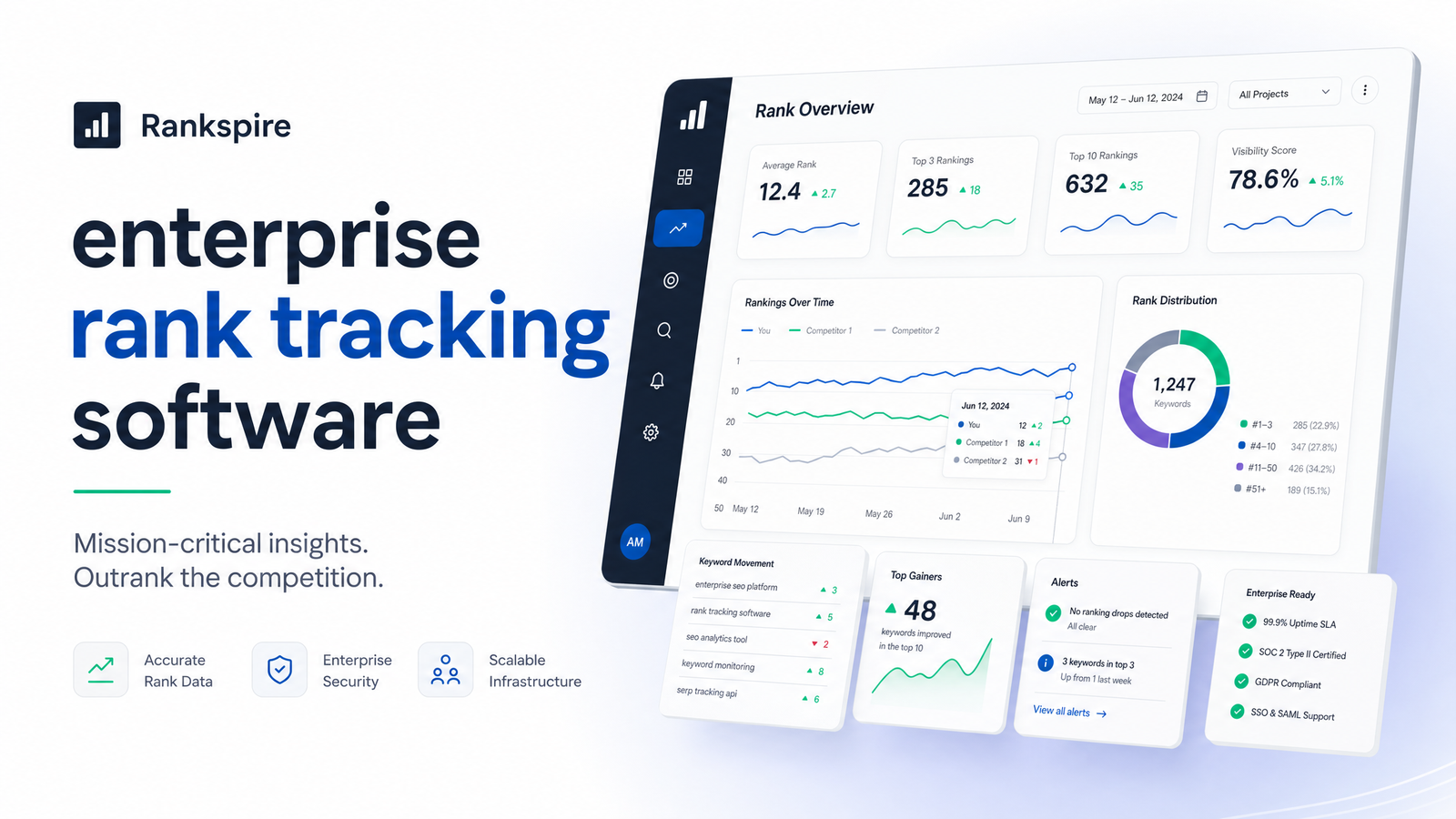
Most articles about enterprise rank tracking software are vendor listicles dressed up as buying guides. This article skips the comparison table and gives you concrete thresholds — keyword volume, refresh cadence, domain count, governance requirements — so you can self-diagnose before you sign a six-figure contract, and then connects tracking to the workflow that actually makes it valuable.
What Makes a Rank Tracker 'Enterprise' (It's Not Just the Price Tag)
"Enterprise" gets attached to pricing tiers more often than to real capability differences, and that's exactly why so many teams overspend. A more honest way to define enterprise rank tracking software is by the load it has to carry.
Keyword volume is the first signal. Tracking a few hundred or even a few thousand terms is standard-tier territory — a solid mid-market tool handles that without strain. Once you're managing 10,000 to 500,000+ keywords across product lines, geographies, or brand portfolios, crawl scheduling, data storage, and reporting all behave differently, and tools built for smaller keyword sets start to choke.
Multi-domain and multi-market portfolios are the second signal. If you're tracking one site in one country, you don't need enterprise infrastructure no matter how competitive your niche is. If you're tracking a dozen regional domains, several brand sites, or country-specific subdomains with separate teams needing separate views, rank tracking at scale becomes a data-architecture problem, not just a bigger spreadsheet.
Refresh cadence is the third. Weekly or even daily updates are fine for most sites. But if you're in news, travel, finance, or any vertical where SERP volatility moves revenue in hours, you need daily-or-faster refresh cycles with the crawl capacity to support them without falling behind during peak periods like algorithm updates or seasonal spikes.
If you're below these thresholds on all three counts, a standard rank tracker is very likely the right call — our general buyer's guide to choosing an SEO rank tracker and the standard-tier evaluation framework are better starting points than anything enterprise-labeled. If you're clearing two or three of them, keep reading.
The Non-Negotiable Capabilities at Enterprise Scale
Scale alone doesn't define enterprise rank tracking software — specific capabilities do.
Crawl architecture and refresh cadence. Enterprise tools need distributed crawling infrastructure that can pull hundreds of thousands of SERPs on schedule without queue backups. Ask any vendor what happens to refresh times when volume triples during a migration or a Google update — that answer tells you more than their spec sheet.
Multi-brand and multi-market rollups. You need the ability to view performance per domain, per market, or per brand, and then roll all of it up into a single portfolio view for leadership. Rank tracking software for multiple domains and brands should let a regional SEO manager see their slice while an executive sees the aggregate, without exporting five spreadsheets and merging them by hand.
API and BI/data-warehouse integration. A keyword rank tracking API matters because rank data rarely lives in isolation at this scale — it needs to sit alongside traffic, conversion, and revenue data in the same reporting layer other departments already use. If your rank tracker can't push data into Power BI or Looker Studio, your team will end up doing manual exports every week, defeating the purpose of buying "enterprise" software.
Access governance. Single sign-on (SSO), role-based permissions, and audit logs aren't nice-to-haves once dozens of stakeholders — legal, brand, regional marketing — touch the same tool. A lightweight rank tracker built for a five-person team won't have this layer, and retrofitting permissions later is painful.
SERP feature and AI Overview tracking. Position-one blue links are no longer the whole picture. Enterprise tracking needs to capture featured snippets, People Also Ask, local packs, and Google AI Overview appearances — both whether your brand is cited and whether a competitor is capturing visibility that used to be yours. Ignoring AI Overview visibility means you're tracking half the SERP.
White-label reporting. For agencies managing enterprise accounts, white-label rank tracking for agencies means client-facing dashboards carry your branding, not the vendor's — a small detail that matters a lot when you're managing the relationship, not just the data.
Build vs. Buy: API-First Tracking vs. Full Platforms
Once you've confirmed you're at enterprise scale, the next decision is architectural: do you plug a rank tracking API into infrastructure you already run, or do you buy a full enterprise SEO software suite?
An API-first approach makes sense when you already have a mature data team, an existing BI stack, and engineers who can build custom dashboards and alerting on top of raw rank data. You get flexibility — you control exactly how rank data joins with traffic and revenue metrics — but you also own the maintenance burden: handling API rate limits, backfilling gaps, and building your own visualization layer from scratch.
A full enterprise SEO software platform makes more sense when you need tracking, reporting, and often auditing and content workflows bundled together, with a support relationship you can escalate to when something breaks. You trade some customization for speed of deployment and lower ongoing engineering cost.
Neither choice is universally correct. A retailer with 200,000 SKUs and a dedicated data engineering team may prefer the API route, feeding rank data straight into the same warehouse that holds sales figures. A marketing team managing 15 regional brand sites with no engineering support is usually better served by a platform that handles the plumbing. If your primary need is stakeholder-facing reporting rather than raw data access, our buyer's framework for enterprise SEO reporting software walks through that side of the decision in more depth.
Why Tracking Rankings Isn't the Bottleneck — Acting on Them Is
Here's what most enterprise rank tracking conversations miss: the hard part was never seeing that a keyword dropped. Most teams at this scale already have dashboards full of red arrows. The bottleneck is the gap between spotting the drop and actually fixing whatever caused it.
That gap exists because tracking, auditing, content updates, and publishing typically live in four separate tools with four separate owners. A ranking drops on a Tuesday. Someone flags it in the rank tracker. It takes a ticket to get someone to run a technical audit. If the issue is a crawl or indexing problem, it might connect back to log file analysis that nobody scheduled recently, given how much crawl budget large sites burn on low-value URLs. If the issue is content decay, someone else has to brief a rewrite, get it through review, and get it published — often weeks after the drop was first noticed.
This is the actual argument for an enterprise SEO workflow rather than an enterprise rank tracker in isolation. Rankevra's approach ties audits, AI-assisted content creation, publishing, and rank tracking into one connected loop instead of four disconnected subscriptions. A rank drop surfaces alongside the technical or content signal that likely caused it, the fix gets drafted, and the update gets published — all inside the same system, without a ticket queue in between. Rank tracking automation only pays off when it's the trigger for action, not just another chart nobody has time to act on.
How to Evaluate an Enterprise Rank Tracker in 90 Days
Enterprise contracts are expensive enough to justify a structured pilot before you sign. A 90-day evaluation window, run properly, tells you almost everything a sales deck won't.
- Weeks 1–2: Load a real slice of your keyword portfolio — not a demo set of 500 easy terms, but a representative sample across your actual volume, domains, and markets, including your most competitive and most volatile terms.
- Weeks 3–6: Test refresh speed under realistic load, not the vendor's best-case numbers. Watch what happens to update times during a period of high SERP volatility, since that's exactly when speed matters most.
- Weeks 6–8: Verify API and export limits in writing. Confirm how many calls per day you get, whether historical data is included in exports, and whether multi-domain rollups actually work as described rather than requiring manual stitching.
- Weeks 8–10: Confirm governance controls hands-on — provision an SSO login, set up two different permission roles, and pull an audit log to see what it actually captures.
- Weeks 10–12: Measure the full loop, not just the tracking piece. When a ranking drop appears, time how long it takes your team to diagnose the cause and ship a fix using the tools you'd have in production. If tracking and action still live in separate systems, that latency will show up clearly here.
Treat any vendor unwilling to support a pilot at real volume with real users as a red flag — enterprise SEO tool evaluation should never be a leap of faith on a 12-month contract.
Rank Tracking Data Only Matters If You Can Act On It
The organizations that get the most value from enterprise rank tracking software aren't the ones with the biggest keyword counts — they're the ones with the shortest distance between seeing a drop and shipping a fix. Rankevra's unified workflow — audit, content, publish, track — was built specifically to close that distance instead of adding one more disconnected dashboard to your stack. If you're evaluating enterprise-tier tracking mainly to justify faster action on ranking data, it's worth seeing what a connected workflow looks like before you commit to a standalone tracker. Explore Rankevra to see the audit-to-publish loop in practice.
Frequently Asked Questions
How many keywords does 'enterprise' rank tracking actually need to cover?
There's no single magic number, but the practical range where standard tools start to strain is roughly 10,000 to 500,000+ keywords. Below that, most mid-tier rank trackers handle volume, crawl scheduling, and reporting without issue. Above it, you need distributed crawl infrastructure and data architecture built specifically for scale.
What's the difference between enterprise rank tracking and a regular rank tracker?
The core differences are crawl capacity, governance, and integration depth rather than just a bigger price tag. Enterprise tools support multi-brand and multi-market rollups, SSO and role-based permissions, audit logs, API access to feed BI systems, and daily-or-faster refresh cycles at high keyword volumes — capabilities a standard rank tracker generally doesn't offer or need.
Do enterprise rank trackers track Google AI Overviews and SERP features?
Yes, and this is now a baseline requirement rather than an extra. Enterprise-grade tools should track featured snippets, People Also Ask boxes, local packs, and AI Overview appearances, showing both your own visibility in these formats and where competitors are capturing space that used to belong to traditional blue links.
Can enterprise rank tracking data feed into Power BI or Looker Studio?
Yes, through API access or native connectors, which is how most enterprise teams combine rank data with traffic, conversion, and revenue metrics in one reporting layer. Without this integration, teams end up manually exporting spreadsheets, which undermines the point of enterprise-tier tooling.
Is it better to buy an enterprise rank tracker or build on top of a rank tracking API?
It depends on whether you have engineering resources to maintain a custom build. Teams with a mature data function and existing BI infrastructure often prefer an API-first approach for flexibility, while teams without dedicated engineering support are usually better served by a full platform that bundles tracking, reporting, and workflow together.
How often should enterprise rank tracking refresh — daily or real-time?
Daily refresh is sufficient for most enterprise use cases, but sites in volatile verticals like news, travel, or finance often need faster-than-daily cycles during high-movement periods. The right cadence depends on how quickly SERP shifts translate into business impact for your specific site.
Keep reading
- SEO Cannibalization Audit: Find and Fix It at ScaleLearn to run a real seo cannibalization audit: separate harmless overlap from true ranking loss, then merge, redirect, or canonicalize at scale.
- Featured Snippet Optimization: A Reverse-Engineering GuideA 4-step framework for featured snippet optimization: find winnable queries, decode the incumbent's format, rebuild it tighter, and track ownership.
- 301 Redirect Mapping: The Build-Test-Monitor FrameworkLearn how to build, validate, and monitor a 301 redirect map so URL changes preserve rankings and link equity — without a spreadsheet mess.