Rankevra Blog
SEO Review Tools Content Brief Generator vs. Full Workflow
July 26, 2026
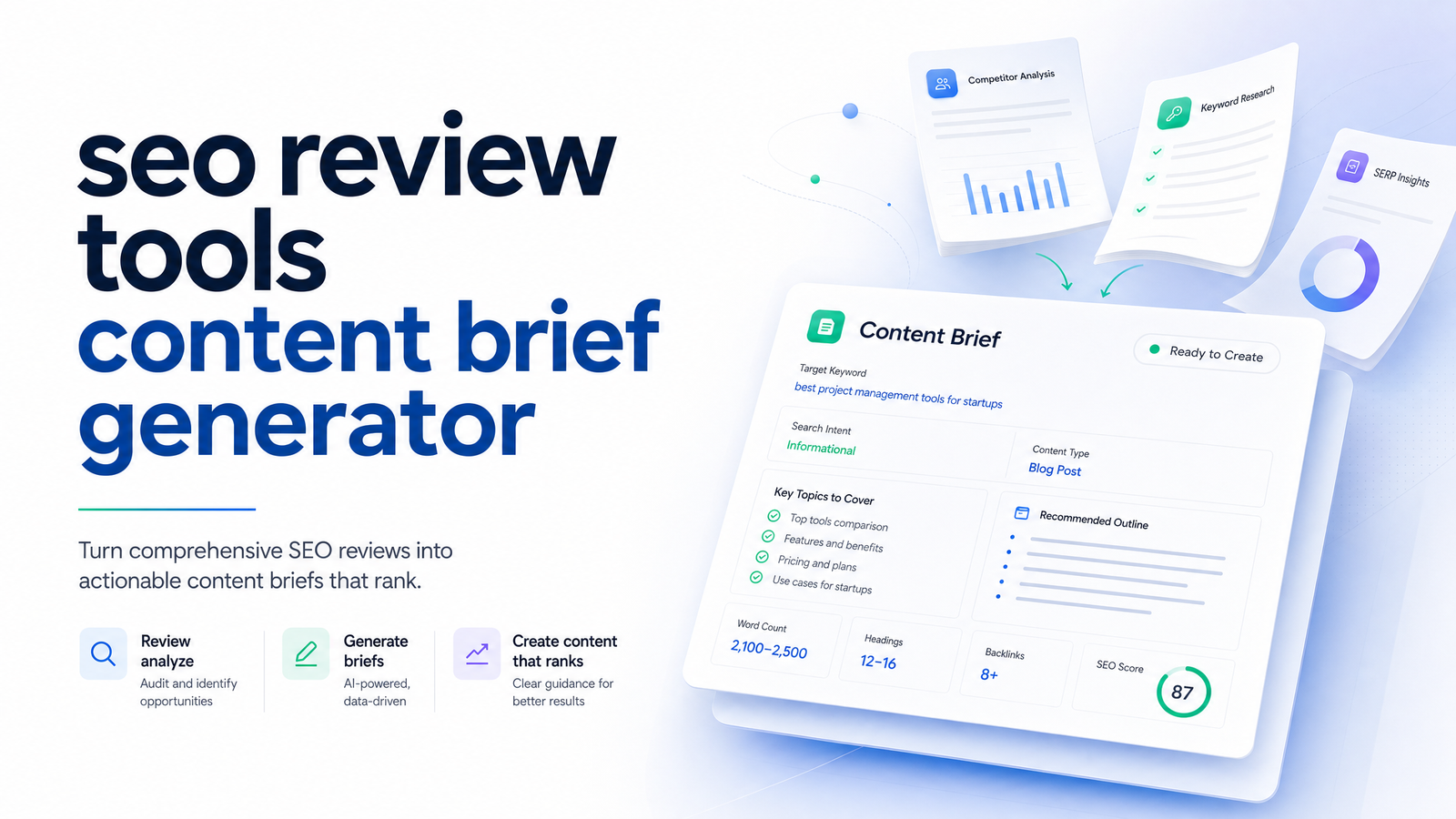
Search "seo review tools content brief generator" and you'll find a free tool that promises to save writers hours: paste in a keyword, get back a structured outline in seconds. It genuinely does that. What it doesn't do is tell you whether that outline will ever become a page that ranks — because a brief generator, by design, stops at the document.
This article breaks down what a standalone brief generator like the one from SEO Review Tools produces, what a content brief actually needs to include to be useful, and why teams that manage SEO in-house keep hitting the same wall: a good brief with nowhere to go except a copy-paste into another tool.
What the SEO Review Tools Content Brief Generator Actually Does
The SEO Review Tools content brief generator belongs to a category of free, lightweight AI tools built around one job: take a topic or target keyword and output a structured brief — a working title, a suggested outline with headers, a list of related keywords to weave in, and sometimes a rough word count target. It's a genuinely useful starting point for a writer who needs direction fast and doesn't want to stare at a blank document.
That's also its ceiling. An ai content brief generator in this class is a document generator, not a production system. It has no mechanism for drafting the article, no way to check the finished piece against on-page SEO rules, no publishing step, and no connection to whether the resulting page ever shows up in search results. You get a file. What you do with that file — writing it, optimizing it, getting it live, tracking it — is entirely on you.
This isn't a knock on the tool. A free content brief tool that did all of that wouldn't be free, and arguably wouldn't be a "brief generator" anymore — it would be a full platform. The category exists because plenty of writers just need an outline. The problem shows up when a team mistakes "I have a brief" for "I have a plan to rank."
What a Genuinely Useful Content Brief Needs to Include
According to Search Engine Land's guide to content briefs, a solid brief should define the outline, headers, and marketing objectives clearly enough that a writer unfamiliar with the topic could still produce something on-strategy. TopRank Marketing adds that briefs should be built around primary and secondary keywords derived from actual SERP and intent analysis, not just keyword-tool guesses.
Put together, here's the seo content brief checklist worth applying to any generator's output:
- Primary and secondary keywords — not just the seed term, but the semantic cluster around it
- Search intent classification — informational, commercial, transactional, or navigational, confirmed by what's actually ranking
- Target audience and reader problem — who this is for and what question they're trying to answer
- A full outline with H2/H3s — not just a title and three bullet points
- A word count target grounded in what top-ranking pages actually run, not an arbitrary number
- Internal link suggestions — pointing to related pages already on the site
- Competitor benchmarks — what the top 5-10 ranking pages cover that this draft needs to match or beat
Tools like Frase, Surfer SEO, MarketMuse, and the Semrush content brief generator all attempt versions of this checklist with varying depth of SERP analysis. The gap between a five-second free brief and a well-researched one usually shows up in two places: how deep the competitor analysis goes, and whether internal linking is addressed at all. Most free tools skip both.
The Gap: A Brief Is Not a Ranking Strategy
Even a brief that checks every box above is still just an instruction set. Getting from "here's what the article should cover" to "here's a page that ranks" requires drafting the content, optimizing it for on-page SEO, publishing it to a CMS, and tracking how it performs — four distinct steps a brief generator has no opinion about.
This is where the content workflow gap actually costs teams time. In practice, going from content brief to published article looks like this: export the brief as a doc, paste it into a writing tool or hand it to a freelancer, copy the draft into an optimization tool to check keyword usage and readability, copy it again into the CMS, format it, publish it, and then — if anyone remembers — check a separate rank tracker weeks later to see if any of it worked.
Every handoff in that chain is a place where context gets dropped. The brief's internal link suggestions don't make it into the draft. The optimization pass happens without the original SERP research in view. Nobody circles back to confirm whether the published page actually moved the needle on the keyword it was built for. Juggling SEO tools this way isn't just inefficient — it quietly breaks the feedback loop that's supposed to make each new brief smarter than the last.
For teams trying to build topical authority — publishing consistently across a keyword cluster rather than one-off articles — this disconnection compounds. Authority comes from a body of connected, internally-linked content that reinforces itself over time, and that's exactly what falls apart when the brief, the draft, and the published page are handled in three unrelated tools with no memory of each other.
How Rankevra Turns a Brief Into a Tracked, Ranking Page
Rankevra treats the brief as the first step of a pipeline, not a deliverable in itself. The same input that would produce a static document elsewhere — a topic or target keyword — feeds directly into an ai seo workflow that carries through drafting, on-page optimization, CMS publishing, and rank tracking without a manual handoff at any stage.
Concretely: the automated content brief generator inside Rankevra builds the outline, keyword targets, and competitor benchmarks the same way a standalone tool would — but instead of exporting a file, it passes that structure straight into AI drafting, which writes against the brief's outline and keyword targets directly, so nothing gets lost in translation. From there, the draft goes through on-page optimization checks before publishing, following the kind of structured approach covered in Content Optimization SEO: The 6-Step Framework for 2026. For the mechanics of how AI actually turns a brief into finished prose, SEO Writing Assistant AI: What It Really Does in 2026 covers that stage in detail.
Publishing isn't a separate copy-paste job either — it connects to your CMS as part of the same pipeline, which matters more once you're publishing regularly rather than occasionally; see Building a Content Publishing Workflow That Scales Safely for what that looks like at volume. And because the point of all this is organic traffic, not just published pages, rank tracking is wired into the same dashboard the brief came from, closing the loop the way Best Keyword Rank Tracker: A 2026 Evaluation Framework describes — you can see whether the keyword the brief targeted is actually moving, and feed that data into the next brief.
This is a content brief generator with publishing built in, not bolted on — the actual differentiator when the goal is fixing technical SEO issues and building topical authority at scale rather than producing one well-formatted document at a time.
How to Choose Between a Standalone Brief Tool and a Full Workflow Platform
Not every team needs the full pipeline, and it's worth being honest about when a free tool is genuinely enough.
A standalone brief generator is fine when: you're publishing occasionally rather than on a schedule, one person handles writing and publishing directly with full context in their head, you don't need automated rank tracking because you're checking manually anyway, and your CMS workflow is simple enough that copy-pasting a brief into a doc isn't friction.
You need a full workflow platform when: you're publishing multiple articles a week and manual handoffs are visibly slowing you down, more than one person touches each piece (writer, editor, publisher) and context keeps getting lost between them, you actually want to know which briefs turned into ranking pages instead of guessing, and CMS publishing plus rank tracking matter enough that doing them manually is a real time cost, not a minor annoyance.
A useful content brief generator comparison isn't "which tool has the nicest UI" — it's "how many manual steps stand between this brief and a tracked, published page for my team, specifically." If that number is zero or one, a free tool is genuinely enough. If it's three or four, that's the workflow gap costing you real hours every week. For teams still mapping out what to brief in the first place, a marketing content strategy template is worth filling in before you generate a single brief — it's the layer above individual articles that keeps the whole cluster pointed at the same goals.
Frequently Asked Questions
What does a free content brief generator like SEO Review Tools actually produce?
It produces a structured document: a suggested title, an outline with headers, a list of related keywords, and sometimes a word count target. It does not draft content, optimize it, publish it, or track how it eventually performs — those steps are left entirely to the user.
Is a free AI content brief generator good enough for a small content team?
Yes, if you're publishing infrequently and one person handles the brief, the writing, and the publishing with full context in their head. It becomes less sufficient once multiple people are involved or once you're publishing often enough that manual handoffs start costing noticeable time each week.
What's the difference between a content brief and a full content production workflow?
A content brief is a planning document — an outline, keywords, and intent notes for a single article. A full production workflow carries that brief through drafting, on-page optimization, CMS publishing, and rank tracking automatically, so the brief's research actually informs the finished, tracked page.
Do content briefs need to account for AI search engines like ChatGPT and Gemini now?
Increasingly, yes — a brief built purely around traditional keyword rankings can miss how content needs to be structured for answer engine optimization (AEO), where clear, directly-answerable sections matter as much as keyword placement. Briefs that include concise, quotable answers near the top of key sections tend to serve both traditional SERPs and AI answer engines at once.
How long should an SEO content brief be, and does word count actually matter?
Word count should be a benchmark drawn from what's actually ranking for the target keyword, not a fixed number applied to every topic. It matters as a directional target for depth and competitiveness, but matching top-ranking length without matching their coverage and intent won't produce a ranking result on its own.
Can Rankevra replace a standalone content brief generator entirely?
Yes — Rankevra generates the brief itself using the same kind of keyword and SERP inputs, then carries that brief directly into AI drafting, on-page optimization, CMS publishing, and rank tracking in one pipeline. Instead of stopping at a document, the same input produces a tracked, published article.
Try generating a brief the same way you would in any free tool — same topic, same keyword — and see what happens differently inside Rankevra: instead of a document that waits for the next manual step, it flows straight into a drafted article, a publish step, and a rank-tracking dashboard that tells you whether it actually worked.
Keep reading
- E-E-A-T SEO: A Checklist for Scaling Content With AIA practical E-E-A-T SEO checklist for teams scaling content with AI — what triggers scaled content abuse, and how to gate every page before it publishes.
- Schema Markup for SEO in 2026: What Still WorksSchema markup for SEO in 2026: which types still earn rich results after FAQ's removal, what's hype for AI Overviews, and how to stay current.
- How to Improve Core Web Vitals: A Measure-Fix-Verify LoopLearn how to improve Core Web Vitals with a repeatable measure-diagnose-fix-verify loop covering LCP, INP, and CLS — no developer required.