Rankevra Blog
Structured Data for SEO: What It Really Does in 2026
July 24, 2026
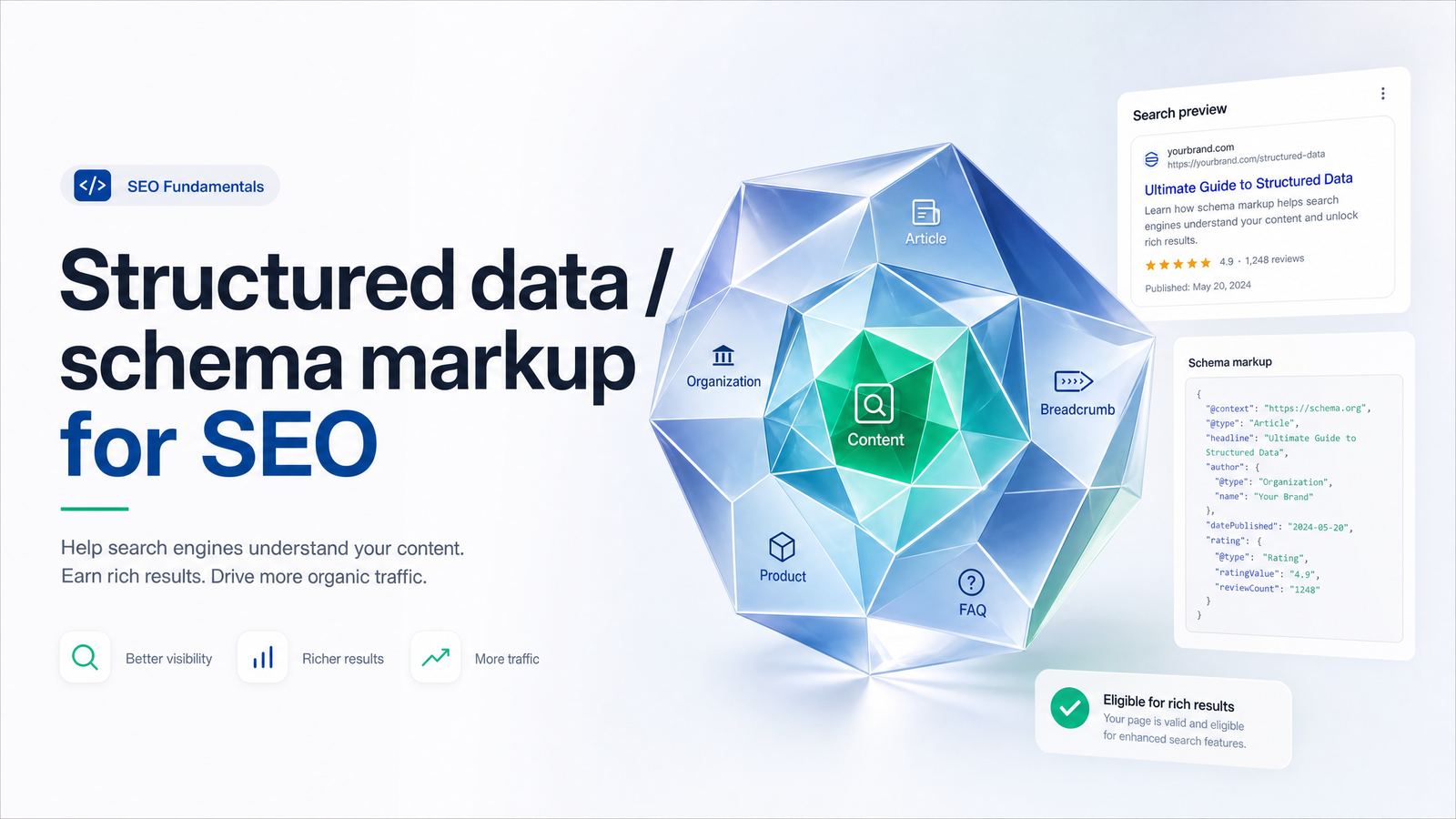
Ask five SEO blogs whether structured data for SEO moves the needle and you'll get five different answers — usually because most of them are selling either a fix or a course. The honest answer sits in Google's own documentation: structured data doesn't rank you higher, it makes you eligible for the visual features that get clicked. That distinction changes how much time you should spend on it, and where.
What Structured Data Actually Is (In Plain Terms)
Structured data is a standardized way of labeling the content on a page so machines — not just humans — can understand what it means. A recipe page doesn't just say "35 minutes"; structured data tells a crawler that "35" is specifically the cook time. The vocabulary comes from Schema.org, a shared spec maintained jointly by Google, Microsoft, Yahoo, and Yandex, covering everything from Articles to Events to Products.
In SEO conversations, "structured data" and "schema markup" are used interchangeably — same concept, two names. There are a few ways to add it to a page (microdata and RDFa still exist), but Google Search Central's structured data guidelines recommend JSON-LD, a block of JavaScript object notation that sits in the page's code without touching the visible HTML. It's easier to implement, template across thousands of pages, and validate — which is why it's the format worth standardizing on. How to actually write it is a separate topic; this one is about knowing what it does and doesn't do before you invest time in it.
Is Schema Markup a Ranking Factor? (The Straight Answer)
No — and Google has said so plainly, more than once. Structured data is an eligibility signal for rich results, not a direct ranking factor. Adding valid schema to a page tells Google "this content qualifies for a review snippet, a breadcrumb trail, a product carousel" — it doesn't tell Google's ranking systems the page deserves to rank above a competitor.
Google Search Liaison Danny Sullivan has confirmed publicly that schema markup doesn't give sites a ranking boost — a statement worth reading in full here if you want it from the source. Google's own general structured data guidelines back this up from the other direction: violating the guidelines — cloaked markup, spammy markup, marking up content that doesn't exist on the page — can trigger a structured data manual action. Crucially, that action removes rich result eligibility; it doesn't tank your rankings. Confusing "eligibility signal" with "ranking factor" is exactly how teams end up either over-investing in schema chasing rankings it can't deliver, or ignoring it entirely because "it doesn't matter" — both are wrong for the same reason.
So Why Bother? The Real SEO Value of Structured Data
If schema doesn't move rankings, the case for it rests on click-through rate. Rich results — star ratings, breadcrumbs, product price and availability, sitelinks — take up more visual space and signal relevance faster than a plain blue link. A page ranking in position 4 with a rich snippet routinely outperforms a plain-text result in position 2 on rich results CTR, because searchers click what looks more credible and specific, not just what's ranked higher.
There's also a quieter benefit: content clarity. Well-structured markup removes ambiguity for crawlers trying to parse what a page is actually about — is this a review, a how-to, a product listing, a news article? That clarity is becoming more relevant, not less, as search shifts toward AI Overviews and LLM-based retrieval. John Mueller's 2026 comments on structured data and LLMs, covered here, add useful nuance: schema can help systems understand and use content more reliably, even where it doesn't directly influence classic ranking. Treat it as a comprehension aid for both traditional crawlers and generative systems, not a scoring input.
Which Schema Types Are Actually Worth Your Time in 2026
Schema.org lists more than 800 types, and Google supports rich results for only a fraction of them. Chasing full coverage wastes a content team's time. Prioritize these:
- Organization — establishes your brand entity (logo, social profiles, official name) for Knowledge Panel eligibility and general entity clarity.
- Article / BlogPosting — the backbone for editorial content; supports headline, author, and publish-date rich features in relevant surfaces.
- Product — one of the highest-value schema types for e-commerce; enables price, availability, and review-star display directly in search.
- BreadcrumbList — cheap to implement, reliably shown, and improves how your site hierarchy is displayed in results.
- LocalBusiness — essential for any business with a physical location or service area, feeding local pack and map-based visibility.
One correction worth making loudly: FAQPage schema is largely off the table now. Google removed FAQPage rich results from regular web search in May 2026, restricting the feature to a narrow set of authoritative government and health sites. If your team is still spending hours meticulously marking up FAQ sections expecting a rich snippet, that time is better spent elsewhere — the eligibility that used to justify it is gone for the vast majority of sites.
Common Structured Data Mistakes That Cost You Rich Results
Most structured data problems aren't dramatic — they're quiet omissions that quietly cost eligibility. The recurring ones:
Incomplete markup. Google requires specific properties for each type to qualify for rich results — missing a required field (like image on Product, or datePublished on Article) simply disqualifies the page, with no warning beyond a Search Console flag.
Mismatched or nested types. Marking a page as both Article and Product, or nesting types incorrectly, confuses parsers and often invalidates the whole block rather than just the conflicting part.
Marking up content that isn't visible. Schema describing a rating, price, or FAQ answer that doesn't actually appear on the page violates Google's structured data guidelines and is a direct path to a manual action — not a ranking penalty, but a rich-result removal, which still costs real CTR.
Ignoring Search Console. The Enhancements reports and the Manual Actions report in Google Search Console are the two places these problems surface first, and both go unchecked far too often. Structured data errors don't throw a visible error on your site — they fail silently in a report most teams open once a quarter, if that.
These schema checks are one category within a much broader page-level audit; if you haven't reviewed the other six, the on-page SEO audit checklist covers where structured data fits alongside metadata, internal linking, and content quality.
Keeping Structured Data Clean at Scale
Here's the part most schema advice skips: implementing structured data once is easy. Keeping it valid is the actual job. A CMS update, a new page template, a redesign, or even a plugin change can silently strip or break JSON-LD across hundreds of pages at once — and because there's no visible symptom on the page itself, nobody notices until organic traffic or rich result impressions quietly decline weeks later.
Manual spot-checking with Google's Rich Results Test works for one URL at a time, but it doesn't scale to a site with thousands of templated pages, and most teams don't have a developer on standby to re-audit schema every time the CMS ships an update. That's the gap continuous, automated structured data monitoring is built to close — checking schema validity across a full site on a recurring basis, the same way you'd want the rest of your technical SEO monitored. It's the same logic behind a broader automated site audit, and it fits directly into the type of ongoing technical SEO audit process that catches issues before they compound.
Structured data is, in the end, just another recurring maintenance item — like broken links or a slow-loading template — that's simple to get right once and easy to let quietly break after every content push or redesign. Rankevra automates the audit, validation, and monitoring of schema markup across your whole site, alongside the rest of your technical SEO, so errors surface the week they happen instead of the quarter you finally check. If you're managing SEO in-house and tired of babysitting JSON-LD by hand, Rankevra is built to run that check continuously so you don't have to.
Frequently Asked Questions
Does adding schema markup directly improve Google rankings?
No. Structured data is an eligibility signal for rich results — star ratings, breadcrumbs, product details — not a direct ranking factor. Google's Search Liaison Danny Sullivan has stated publicly that schema markup doesn't give sites a ranking boost, and Google's own structured data guidelines describe it purely in terms of rich result eligibility.
What is the actual difference between structured data and schema markup?
There isn't a meaningful difference — the terms are used interchangeably in SEO. "Structured data" is the general concept of labeling page content for machines, while "schema markup" refers to using the Schema.org vocabulary to do it, typically written in JSON-LD format as Google recommends.
Which schema types are worth prioritizing given limited time/resources?
Organization, Article/BlogPosting, Product, BreadcrumbList, and LocalBusiness cover the highest-value, most commonly supported rich results. FAQPage schema is a notable exception to prioritize down, since Google removed FAQPage rich results from most web search results in May 2026.
What happens if structured data has errors or is misused (manual actions)?
Errors or misuse — like marking up content not visible on the page — can trigger a structured data manual action, which is visible in Google Search Console's Manual Actions report. This removes rich result eligibility for the affected markup; it does not directly lower your page's organic ranking.
Is FAQPage schema still worth implementing in 2026?
Largely no, for most sites. Google removed FAQPage rich results from regular web search in May 2026, limiting the feature to a small set of authoritative government and health sites, so the effort no longer pays off for typical business or publisher pages.
Keep reading
- Subdomain vs Subdirectory SEO: The Real Decision FrameworkSubdomain vs subdirectory SEO, resolved: what Google says, what migration data shows, and a 5-question framework to pick the right structure.
- Answer Engine Optimization: A Platform-by-Platform GuideAnswer engine optimization explained for ChatGPT, Perplexity, and Google AI Mode — with a practical, platform-aware framework to earn citations in 2026.
- SEO A/B Testing: A DIY Framework Using Only GSCLearn SEO A/B testing with just Google Search Console and a spreadsheet — hypotheses, page grouping, significance checks, and when to automate.