Rankevra Blog
Subdomain vs Subdirectory SEO: The Real Decision Framework
September 7, 2026
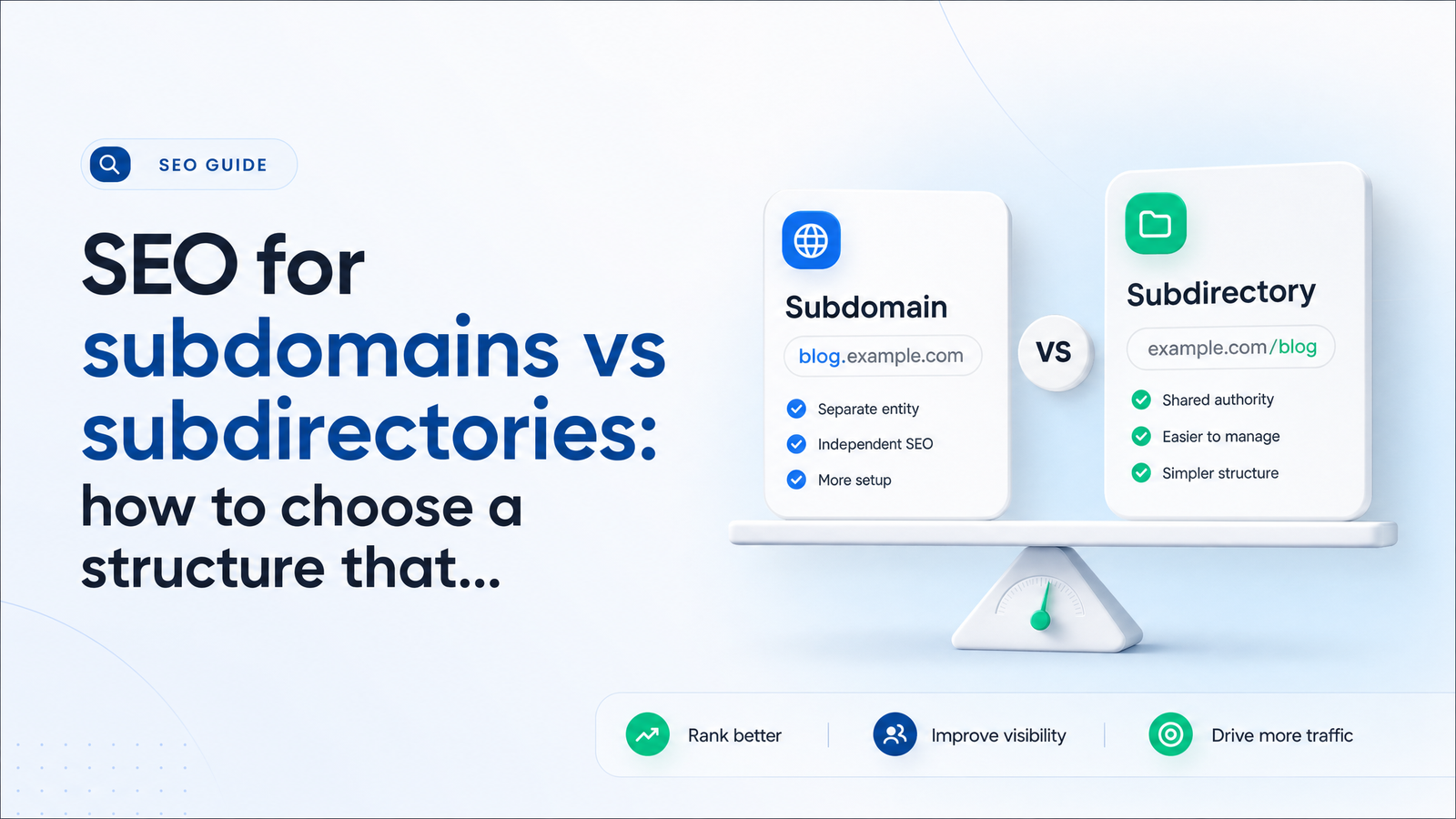
Google's official line on subdomain vs subdirectory SEO is that structure doesn't matter. The migration case studies say otherwise, often loudly. That contradiction is where most website owners get stuck, and it's the reason so many sites end up with a blog, docs, or shop bleeding authority into a subdomain that never quite catches up.
Below is the gap between Google's stated position and documented real-world outcomes, the technical mechanism that explains the gap, and a decision framework you can apply before — or after — you build.
What Google Actually Says vs. What Actually Happens
In 2017, John Mueller stated plainly that Google's systems "see these the same" when comparing subdomains and subdirectories — meaning Google's algorithms don't inherently penalize a subdomain or favor a subdirectory. Bruce Clay's writeup of the original statement captures the full context, including Mueller's caveat: subdomains work best when the content is genuinely distinct from the main site, not just organizationally separated for convenience.
That's the official position. Then look at what companies actually experience when they move content from a subdomain to a subdirectory. G2 consolidated content that once lived separately and saw measurable ranking movement. HotPads, World First, and iwantmyname are cited repeatedly in SEO migration write-ups for the same pattern: moving from subdomain to subdirectory correlated with traffic gains, sometimes substantial, sometimes within weeks of the switch.
If Google's ranking systems truly treat the two structures identically, these gains shouldn't be so consistent across unrelated companies, industries, and CMS platforms. The honest explanation isn't that Mueller was wrong — it's that "we see these the same" describes algorithmic intent, not the compounding real-world effects of crawl behavior, link consolidation, and how long trust takes to establish on a newly separated hostname. Official guidance and observed outcomes diverge because the guidance addresses one layer of the system, and the case studies capture everything else happening around it.
The Mechanism: Why Structure Can Still Split Your Signals
Even if Google's core algorithm doesn't discriminate, a subdomain can still function as a distinct crawl entity. Googlebot allocates crawl budget somewhat independently across hostnames, so a new subdomain often starts with a thinner, slower crawl pattern than a directory nested inside an already-trusted root domain. New sections buried under an established domain typically get discovered and indexed faster because they inherit the crawler's existing familiarity with the host.
Then there's link equity. Backlinks pointing at blog.example.com don't automatically consolidate with the authority signals built at example.com — search engines can, and often do, evaluate them as separate entities with separate backlink profiles. This is domain authority subdomain fragmentation in practice: your root domain might carry years of earned links, but your subdomain starts closer to zero in the eyes of ranking systems, even while living one DNS record away from a powerful site. Backlinko's analysis uses G2's learn.g2.com subdomain as a clear illustration — a site with enormous domain-wide authority still saw its educational content face a slower, harder path to top rankings simply because it lived on a subdomain instead of inside the main property.
Subdirectories don't have this problem by default. A page at example.com/blog/ sits inside the same crawl and link graph as everything else on the domain, so link equity subdomain splitting isn't a risk you have to manage — the backlink profile stays unified rather than dividing between two hostnames competing for authority under one brand.
None of this means subdomains are broken. The "we treat them the same" statement is true at the algorithm level while still leaving room for a backlink profile split, slower trust accumulation, and crawl budget inefficiencies to produce real ranking differences in practice.
The Decision Framework: 5 Questions to Ask Before You Choose
Before defaulting to whatever your last CMS made easy, run the decision through these five questions — a subdirectory vs subdomain checklist that should govern the choice, not habit or platform limitations.
1. Is the content topically related to your core site? If your blog, resource hub, or new content vertical reinforces topics your main site already targets, keep it in a subdirectory. Related content compounds topical authority when it lives in the same crawl and link structure; splitting it onto a subdomain fragments that authority instead of building it.
2. Do you need a fundamentally different tech stack or CMS? This is the most legitimate technical reason to reach for a subdomain — a help center running on Zendesk, a shop on Shopify, or an app dashboard built on an entirely separate framework than your marketing site. When to use a subdomain almost always traces back to a genuine platform constraint, not a preference.
3. Is this a distinct market or language that needs separate governance? International sections, regional pricing, or content requiring independent legal or editorial control sometimes justify separation — though as the international section below covers, subdirectories usually still win here too.
4. Do you want the new section's SEO wins to lift your main domain, or vice versa? A subdirectory shares link equity and domain authority bidirectionally by default. A subdomain requires deliberate internal linking and time before any of that lift transfers, and even then, it transfers imperfectly.
5. Can you commit to the internal linking and consolidation work a subdomain demands? Subdomains aren't automatically doomed, but they need ongoing investment — strong internal links from the root domain, a deliberate backlink strategy pointed directly at the subdomain, and patience while trust builds. If nobody owns that work, default to a subdirectory.
Scenario Playbook: Blogs, Help Centers, Apps, and International Sites
Company blog. Almost always a subdirectory. A blog subdomain vs subfolder decision rarely favors the subdomain unless there's a hard technical wall preventing integration. Blog content is inherently related to your core offering, and keeping it at /blog/ lets every article contribute directly to your domain's overall authority instead of building a second, weaker authority profile from scratch.
Help center or documentation. This is the closest call. Help center subdomain SEO setups are common because support platforms (Zendesk, Intercom, Help Scout) often only deploy on subdomains. If you have platform flexibility, a subdirectory captures more compounding value — support content frequently ranks for long-tail, high-intent queries you'd rather have strengthening your main domain. If you're locked into a vendor that only offers subdomain hosting, invest extra in internal links from your marketing site and product pages to offset the separation.
Product app or dashboard. A subdomain is usually the right call, and it's the cleanest example of Mueller's "genuinely different content" caveat. An authenticated app interface isn't organic-search content in any meaningful sense, so keeping it separate from your marketing site's crawl and structure is a technical convenience, not an SEO tradeoff.
International or multi-region expansion. Subdomain vs subdirectory international SEO decisions add another layer: ccTLDs, subdomains, and subdirectories with hreflang all handle geotargeting differently. SE Ranking's research analyzing roughly 20,000 keywords across these structures found meaningful performance differences between approaches, reinforcing that this isn't a one-size-fits-all call. In most cases, subdirectories (example.com/uk/) paired with correctly implemented hreflang tags concentrate authority most efficiently, while ccTLDs make sense mainly when local trust signals or legal requirements demand a fully separate domain. Whichever structure you pick, hreflang needs to be implemented precisely — mismatched or missing tags create their own duplicate-content and indexing problems independent of the subdomain-versus-subdirectory question.
Already Split? How to Tell If Your Current Structure Is Costing You
If you already run a subdomain and suspect it's quietly underperforming, look for three symptoms. First, duplicate or near-duplicate content on both the root domain and the subdomain — a sign canonical tags or content ownership were never cleanly resolved between the two. Second, an orphaned backlink profile: check whether valuable links point exclusively at the subdomain with no equivalent authority reaching your root domain, or vice versa, which confirms the split you're worried about is real and measurable. Third, competing pages — your root domain and subdomain both ranking (or fighting to rank) for the same keyword, which wastes crawl budget and confuses relevance signals instead of consolidating them.
If any of that sounds familiar, the canonical tag troubleshooting guide covers the specific failures that create duplicate or competing indexed pages between a root domain and subdomain. If you're scaling a large subdirectory section — think /locations/ or /solutions/ pages built at volume — the programmatic SEO guide is worth reading before you compound the structure at scale. And for migration mechanics, the SEO site migration checklist covers the sequencing and redirect strategy needed to consolidate a subdomain into a subdirectory without a temporary traffic drop turning into a permanent one.
Frequently Asked Questions
Is a subdomain considered a separate website by Google?
Not officially — Google has stated its algorithms generally treat subdomains and subdirectories the same for ranking purposes. In practice, though, Google's crawlers often handle subdomains as distinct crawl entities with their own backlink profile and trust curve, which is why real-world outcomes can differ from the stated policy.
Will moving my blog from a subdomain to a subdirectory boost my rankings?
It can, and multiple documented migrations (G2, HotPads, World First, iwantmyname) showed traffic gains after this exact move. The gain typically comes from consolidated link equity and faster crawl treatment, not from any algorithmic penalty being lifted — so results vary based on your backlink profile and how the migration is executed.
Can a subdomain rank well on its own without help from the main domain?
Yes, but it usually takes longer and requires its own backlink-building effort, since subdomains don't automatically inherit the root domain's full authority. Even a subdomain under a powerful site, like G2's learn.g2.com, has shown a slower path to top rankings compared to content housed directly in the main directory structure.
Is it ever a bad idea to consolidate everything into subdirectories?
Yes — content requiring a fundamentally different tech stack, like an authenticated app dashboard, is usually better left on a subdomain. Forcing genuinely distinct, non-organic-search content into your main directory structure doesn't help topical authority and can complicate crawling and site architecture unnecessarily.
How long does it take for a new subdomain to start ranking?
There's no fixed timeline, but subdomains generally take longer than subdirectories because they start with a thinner backlink profile and a less-established crawl pattern. Expect the timeline to depend heavily on how aggressively you build internal links from your root domain and acquire dedicated backlinks pointed at the subdomain.
Should ecommerce sites use subdomains or subdirectories for different regions?
Subdirectories with correctly implemented hreflang tags typically concentrate authority most efficiently for regional targeting. Research analyzing thousands of keywords across ccTLD, subdomain, and subdirectory structures found meaningful performance differences, so ccTLDs are usually reserved for cases with strong local legal or trust requirements rather than used by default.
Picking a structure is easy. Undoing it isn't — months of content and backlinks built on the wrong foundation turn a simple decision into an expensive migration project. Before you commit either way, run a proper audit to see whether your current setup is already fragmenting authority through duplicate ranking pages, orphaned backlinks, or split domain trust; the site audit tool guide walks through exactly what to check. Rankevra automates that audit alongside your rank tracking, so structure-related issues surface before they cost you another quarter of organic traffic.
Keep reading
- Answer Engine Optimization: A Platform-by-Platform GuideAnswer engine optimization explained for ChatGPT, Perplexity, and Google AI Mode — with a practical, platform-aware framework to earn citations in 2026.
- SEO A/B Testing: A DIY Framework Using Only GSCLearn SEO A/B testing with just Google Search Console and a spreadsheet — hypotheses, page grouping, significance checks, and when to automate.
- SEO Content Calendar: A Data-Driven New/Refresh/Prune PlanBuild an SEO content calendar that allocates effort across new pages, refreshes, and pruning using real performance data — not gut feel.