Rankevra Blog
Answer Engine Optimization: A Platform-by-Platform Guide
September 7, 2026
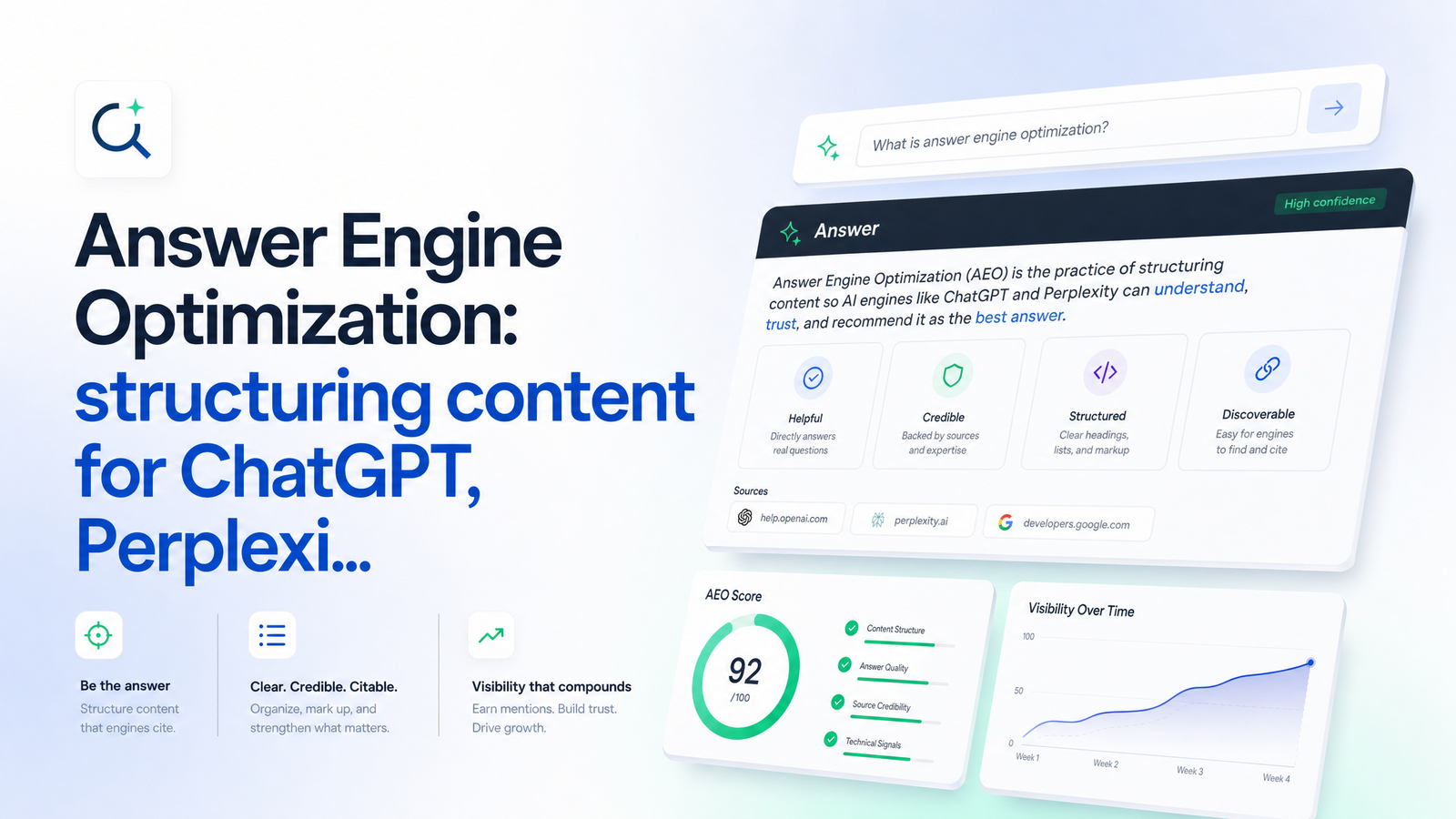
What Is Answer Engine Optimization (AEO)?
Answer engine optimization is the practice of structuring content so AI systems — ChatGPT, Perplexity, Google's AI Mode and AI Overviews, Gemini — can extract, trust, and cite it directly in a generated answer, rather than merely rank it in a list of blue links.
Direct answer: AEO is the discipline of making a page machine-quotable — answer-first, semantically complete, entity-precise, and well-sourced — so it gets pulled into AI-generated responses. It doesn't replace SEO; it extends it, since you still need crawlability, authority, and relevance before an answer engine considers citing you.
Traditional SEO optimizes for a ranking algorithm that returns a list of documents. AEO optimizes for a synthesis layer that reads several documents, decides which claims are trustworthy, and stitches them into a single generated answer with (sometimes) a citation attached. SEO gets you into the candidate pool; AEO decides whether you get quoted from it. A page with zero organic authority rarely gets cited, but plenty of well-ranked pages never get quoted at all — which brings up the more uncomfortable finding in the data.
Why Ranking #1 on Google No Longer Guarantees a Citation
Organic rank and AI citation are decoupling, and the overlap is smaller than most teams assume. Studies tracking citation sources against organic SERPs consistently find that a meaningful share of AI Overview and AI Mode citations come from pages outside the top 10 — sometimes outside the top 20 — of the corresponding organic result. The page Google shows a human searcher and the page its AI layer chooses to quote are frequently not the same URL.
This happens because ranking algorithms and citation-selection layers optimize for different things. Rank considers backlinks, historical authority, click behavior, and hundreds of signals aggregated over a domain and query. Citation selection is closer to a retrieval-and-verification task: the model is looking for a passage that directly answers the query with enough semantic completeness to lift verbatim, regardless of whether that page has ever cracked page one. A well-structured subsection on page 14 of an old cornerstone article can lose the rankings battle but win the citation.
Teams chasing AI visibility purely through rank are solving the wrong problem half the time. You need the structural and topical depth covered in how to measure topical authority, but you also need passages engineered for extraction — which is what the rest of this framework covers. For Google-specific citation mechanics, including how AI Mode's query fan-out differs from AI Overviews, see our dedicated citation framework for AI Overviews; the section below only summarizes the distinction.
The Structural Foundation Every Answer Engine Rewards
A handful of structural habits consistently correlate with higher citation rates across ChatGPT, Perplexity, and Google's AI surfaces, before you layer on platform-specific nuance.
- Answer-first paragraphs. State the direct answer in the first one to three sentences of a section, before supporting explanation. Answer engines extract the highest-density passage; if the answer is buried after three paragraphs of preamble, it's less likely to be selected.
- Question-based headings. Headings phrased as the actual question a user (or an AI model's fan-out query) would ask — "How often should content be refreshed?" rather than "Maintenance Considerations" — map directly onto how retrieval systems match headings to sub-queries.
- Semantic completeness. Each passage should stand alone as a full answer. If understanding it requires reading three prior paragraphs, a model can't cleanly lift it.
- Entity precision. Name specific tools, standards, or concepts precisely (schema types, platform names, metric names) rather than vague references — models verifying claims favor content that's specific and checkable.
- Evidence and sourcing. Cite data, name your methodology, and show your work. This is E-E-A-T in practice: expertise demonstrated through specificity, not just claimed in an author bio.
Getting subtopic coverage right also means knowing what's missing from your existing content. A structured content gap analysis is the fastest way to find subtopics that query fan-out will expect you to cover but that your current pages skip entirely.
How ChatGPT, Perplexity, and Google AI Mode Differ
A single generic checklist breaks down here — each engine has distinct, persistent citation behavior.
ChatGPT leans toward established, editorially structured sources and favors content with clear authorship, dated publication, and comprehensive single-page coverage. Its retrieval behavior (when browsing is active) rewards pages that answer the full breadth of a query in one place rather than requiring the model to stitch together multiple thin pages. Prioritize depth and completeness over many short pages on the same subtopic.
Perplexity behaves like a real-time research assistant: it retrieves fresh, frequently updated pages and shows a visible preference for sources with clear timestamps, transparent data, and citation-friendly formatting (numbered lists, labeled statistics, direct comparisons). To get cited, structure content in comparison and data-forward formats and keep dates current — Perplexity's retrieval index seems to weight recency more heavily than ChatGPT's.
Google's AI Mode and AI Overviews rely on Google's index plus a query fan-out mechanism, where a single question is broken into sub-queries retrieved separately and synthesized. AI Mode's fan-out tends to pull from a wider set of pages per answer than AI Overviews, which leans on a smaller set of high-confidence sources — meaning coverage of adjacent sub-questions on your page (or site) matters more for AI Mode specifically. The full breakdown of fan-out behavior and citation patterns lives in our AI Overviews citation framework.
Does Schema Markup Still Matter?
Schema markup still helps, but it isn't the deciding factor readers often assume. The 2026 evidence is more nuanced than "add FAQPage schema and get cited." Structured data helps engines parse a page's intent and confirm content type faster, and remains a solid signal for eligibility in traditional rich results. But citation selection by generative engines seems to depend more on whether the underlying content is genuinely structured as a direct Q&A — clear question, clear answer, minimal fluff — than on whether that structure is also marked up in FAQPage, HowTo, or Article schema.
In practice: a page with a clean, answer-first Q&A section and no schema markup frequently outperforms a page with technically correct FAQPage schema wrapped around vague, marketing-toned answers. Schema is a confirmation signal, not a substitute for the underlying writing. The pragmatic approach for 2026 is to write the Q&A content properly first — direct questions as headings, direct answers underneath — then add schema as reinforcement, not as the primary strategy. Treat it as a hygiene factor you shouldn't skip, but not the lever that moves citation share on its own.
Freshness and Maintenance: The Part Most Teams Skip
AI citation isn't a one-time achievement — it decays. Content cited today can lose that citation within a quarter if a competitor publishes a fresher, more complete treatment of the same question, or if the facts inside your page go stale and a model's verification layer starts preferring a newer source. This pattern shows up across engines but is especially visible with Perplexity, given its real-time retrieval bias.
The practical response is a quarterly refresh cadence rather than publish-and-forget: revisit cited pages, update statistics and dates, tighten answer-first passages, and check that new subtopics haven't emerged in the query fan-out since you last touched the page. This is the same discipline behind good long-term SEO maintenance — our content calendar framework for new, refresh, and prune decisions applies almost directly to AEO, just with a shorter refresh clock and citation tracking layered on top.
How to Measure Whether Your AEO Efforts Are Working
Structure and freshness only matter if you can tell whether they're moving the needle. Track these:
- Citation frequency — how often your pages appear as a cited source across ChatGPT, Perplexity, and Google's AI surfaces for target queries, checked on a recurring schedule rather than once.
- Share of voice across engines — of the queries where any citation appears, what percentage cite you versus competitors, broken out per platform since the leaders differ engine to engine.
- Referral traffic from AI platforms — segment analytics for traffic originating from AI answer surfaces specifically, distinct from organic search, to see whether citations convert into visits.
- Citation decay rate — how long a page holds its citation before losing it, telling you whether your refresh cadence keeps pace with the platform.
Manually checking three or four engines against a growing list of target queries every week is not sustainable for most teams — exactly the gap automated tracking needs to close.
Turning AEO Into a Repeatable Workflow
Structure gets you the initial citation. Freshness keeps it. Measurement tells you whether either is actually working. Treated separately, these become a manual burden that scales badly — someone has to audit pages for answer-first structure, someone has to remember which pages are due for a quarterly refresh, and someone has to check citation status across multiple AI platforms with none offering a unified dashboard.
Treated as one workflow — audit for structural gaps, refresh on a schedule informed by decay data, republish, then re-check citation status — AEO becomes maintainable even as a site grows into hundreds of pages. That loop is exactly what Rankevra automates: it audits existing content against the structural checklist above, flags pages due for refresh before citations decay, and tracks citation and ranking signals across engines so your team isn't stitching together spreadsheets and browser tabs to know what's working. If you're researching AI-driven tooling for this kind of workflow, our breakdown of AI tools for SEO keyword research covers the adjacent research layer as well.
Frequently Asked Questions
Is answer engine optimization the same thing as SEO?
No — AEO extends SEO rather than replacing it. Traditional SEO gets your page ranked and indexed as a candidate document, while AEO focuses on whether an AI system chooses to extract and cite a specific passage from that page. You typically need solid SEO fundamentals in place before AEO tactics have anything to work with.
How do I know if ChatGPT or Perplexity is citing my website?
Check by running your target queries directly on each platform and noting whether your domain appears in the cited sources, then repeat on a recurring schedule since citations shift over time. Segmenting referral traffic in your analytics for AI-platform sources also reveals citation-driven visits indirectly. Doing this manually across multiple engines and many queries is tedious, which is why automated citation tracking tools exist.
Do I need FAQ schema to get cited by AI search engines?
Not strictly — the underlying Q&A content structure matters more than the schema markup wrapping it. FAQPage, HowTo, and Article schema help confirm content type and support traditional rich results, but a well-written, answer-first Q&A section without schema often gets cited over a schema-marked page with vague answers. Add schema as reinforcement after the content itself is structured properly.
How often should I update content to keep AI citations?
A quarterly refresh cadence is a reasonable baseline, since citation decay tends to show up within a few months as competitors publish fresher or more complete coverage. Perplexity in particular favors recently updated sources due to its real-time retrieval bias. Pages on volatile or fast-moving topics may need more frequent updates than that baseline.
Can a page rank low on Google and still get cited by AI Mode?
Yes — research on citation overlap shows a meaningful share of AI Mode and AI Overview citations come from pages outside the top 10 or even top 20 organic results. Citation selection relies more on passage-level relevance and semantic completeness than on aggregate ranking signals. This is a key reason AEO requires its own structural approach rather than relying on rank alone.
What's the difference between AEO and GEO (generative engine optimization)?
The terms overlap heavily and are often used interchangeably in current industry usage, both referring to optimizing content for citation within AI-generated answers. Where a distinction is drawn, AEO is sometimes used more narrowly for direct-answer and featured-snippet-style optimization, while GEO is used more broadly for the full range of generative AI surfaces, including conversational and multi-turn contexts. In practice, the structural tactics — answer-first writing, semantic completeness, freshness — apply under either label.
Keep reading
- Subdomain vs Subdirectory SEO: The Real Decision FrameworkSubdomain vs subdirectory SEO, resolved: what Google says, what migration data shows, and a 5-question framework to pick the right structure.
- SEO A/B Testing: A DIY Framework Using Only GSCLearn SEO A/B testing with just Google Search Console and a spreadsheet — hypotheses, page grouping, significance checks, and when to automate.
- SEO Content Calendar: A Data-Driven New/Refresh/Prune PlanBuild an SEO content calendar that allocates effort across new pages, refreshes, and pruning using real performance data — not gut feel.