Rankevra Blog
How to Write an AI SEO Content Brief That Needs No Rewrite
September 13, 2026
Why Most AI Drafts Still Need Heavy Editing
An editor hands an AI tool a brief with a keyword, a word count, and a one-line topic description — then wonders why the draft reads like it could apply to any company in the industry. The problem usually isn't the model. It's that the brief was written the way you'd brief a freelance writer: loosely, with room for judgment to fill the gaps. Human writers fill those gaps with research, experience, and context. AI tools fill them with statistically likely, generic phrasing.
An AI SEO content brief has to remove ambiguity rather than leave room for interpretation, because an AI drafting tool doesn't know what you meant to imply — it only knows what's on the page. A content brief for AI writers has to specify intent, required entities, section purpose, and boundaries explicitly, or the draft will default to safe, generic filler that technically covers the topic without saying anything specific. Fixing that starts with how the brief itself is built, not with switching models or tweaking prompts.
Step 1: Separate Search Intent From Answer Intent
Search intent tells you why someone typed the query — informational, commercial, navigational, or transactional. Answer intent tells you what specific format and content actually satisfies that searcher once they land on the page. Briefs that treat these as one variable produce drafts that are topically correct but structurally wrong.
Take "AI SEO content brief" itself: the search intent is informational — someone wants to understand the concept. But the answer intent is more specific: they want a definition, then a template or process they can apply immediately. A brief that only states "informational intent" leaves the AI to guess whether to write a conceptual explainer, a listicle, or a step-by-step guide. State both explicitly. Note the intent category, then describe the answer format the top-ranking pages are actually using — comparison table, numbered process, checklist, FAQ block — so the AI drafts toward that shape instead of a generic essay.
This distinction matters most on queries where competitors have already converged on a format. If every ranking page for a query uses a step-by-step structure with a downloadable template, a brief that doesn't specify that will get a draft shaped like a blog post when the SERP demands a tool.
Step 2: Build an Entity Map, Not Just a Keyword List
Most briefs list five to ten secondary keywords and expect the AI to weave them in naturally. That treats topical depth as a phrase-matching exercise, and it shows — drafts stuff keywords into sentences without actually explaining the concepts those keywords represent.
Entity mapping for SEO content works differently. Instead of listing phrases, list the concepts, tools, standards, and related terms a genuinely knowledgeable article would have to reference — and require the AI to explain each one's relevance, not just mention it. For an article on content briefs, entities like search intent, entity coverage, heading hierarchy, and E-E-A-T aren't secondary keywords to sprinkle in — they're required-coverage items with a note on what claim or explanation needs to accompany each one.
This is also where topical authority gets built or lost. Google's helpful content guidance rewards pages that demonstrate real subject command, and an entity checklist is how you operationalize that for an AI tool with no independent judgment about what "command of the subject" looks like. Good keyword research is the raw material for this step — this AI tool for SEO keyword research explains how to surface the terms and concepts worth feeding into both your keyword and entity fields before the brief is written. Pair that with a proper SEO content gap analysis to see which entities competitors already cover well and which ones are thin — those gaps are exactly where your entity checklist should apply the most pressure.
Step 3: Set Outline Depth With a Purpose Per Section
Outline depth is where briefs quietly sabotage themselves in both directions. Too shallow — three H2s with no sub-structure — and the AI pads each section with restated points to hit the word count. Too deep — H3s under every H2 regardless of whether the subtopic warrants it — and the draft repeats the same idea across three headings because there wasn't enough distinct material to fill the structure given.
Treat outline depth as a design decision, not a formatting default. For each H2, write one line stating its specific purpose — what question it answers that no other section answers — and a rough word allotment. Only add H3s where the H2 genuinely splits into distinct sub-questions with their own answers; if you can't write a one-line purpose for an H3 that's different from its parent H2, don't include it.
This habit is what separates AI content brief structure that produces tight copy from structure that produces bloat. An outline with six H2s at 150–250 words each, each with a distinct one-line purpose, will consistently out-perform a nine-H2 outline where three sections restate the same point in different words. When deciding how deep to go, cross-reference against a gap analysis of top-ranking pages: if competitors already cover a subtopic exhaustively and there's no new angle, compress it into a sentence rather than give it its own heading.
Step 4: The Brief Template Fields That Make Drafts Publish-Ready
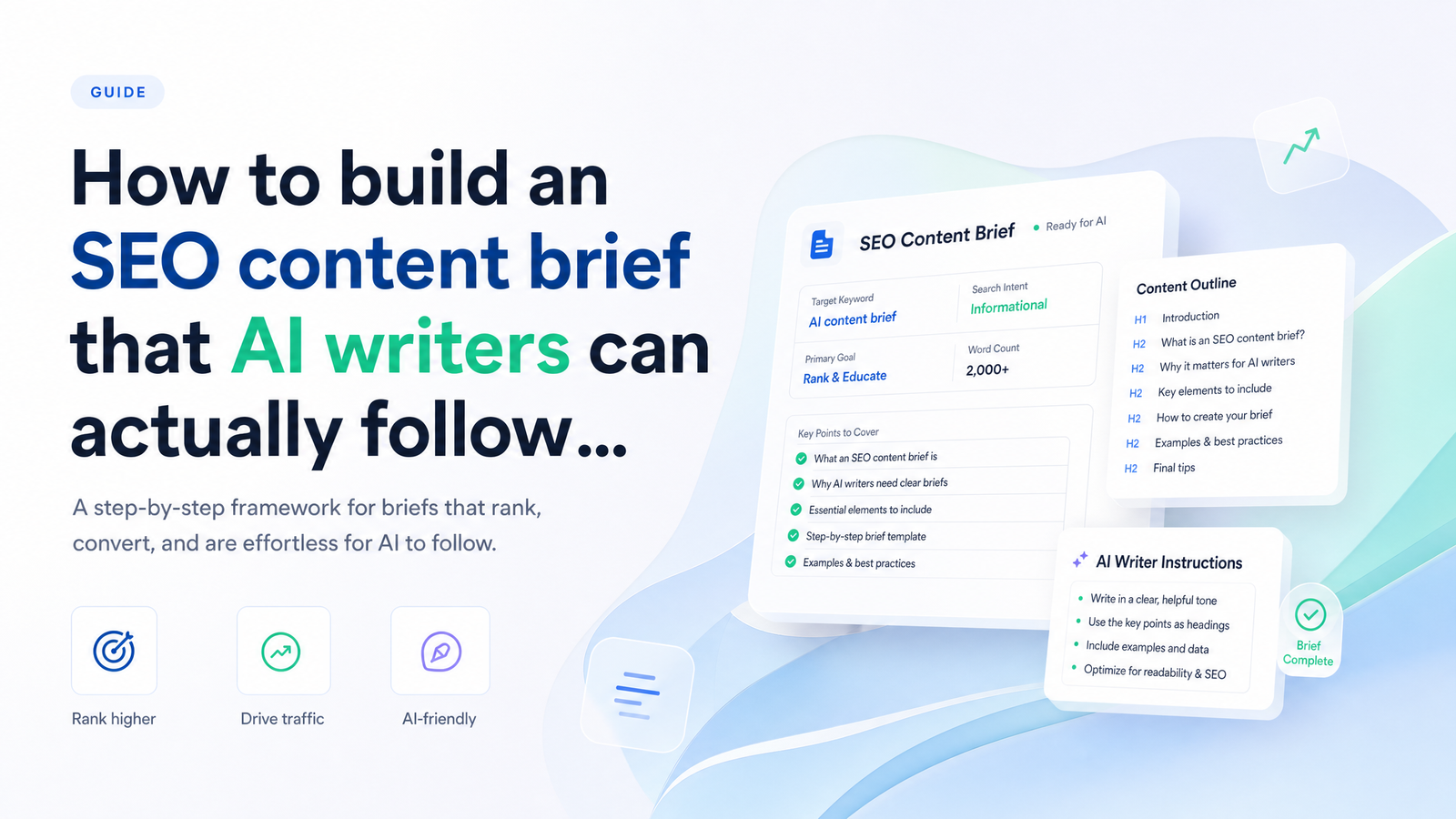
A machine-followable SEO content brief template needs specific, non-overlapping fields — not a paragraph of notes. At minimum, include:
- Primary keyword and natural variations — with placement guidance (title, intro, at least one heading, scattered through body).
- Search intent and answer intent — stated separately, with the expected format named explicitly.
- Entity checklist — each entity paired with the specific claim or explanation it needs, not just the term.
- Heading skeleton — every H2/H3 with its one-line purpose and word allotment, in the order they should appear.
- Internal links — specific URLs to include and the anchor context they belong in.
- Tone and voice notes — sentence length preference, first- vs third-person, formality level.
- Exclusions — topics, claims, or phrasing explicitly off-limits, so the AI doesn't wander into a competitor's territory or make an unverifiable claim.
- CTA — what action the piece should drive and where it belongs.
Every field earns its place because it removes a decision the AI would otherwise make on its own. Skip the entity checklist and you get keyword stuffing. Skip exclusions and you get scope creep. Skip the heading purpose lines and you get restated points dressed up as new sections.
Where Briefs Still Break Down
Even thorough-looking briefs still produce generic AI content when a few specific things go missing. The most common failure point is a purpose line that's descriptive instead of functional — "discuss the benefits" tells the AI nothing it couldn't infer from the heading itself. A working purpose line names the specific claim, comparison, or example the section must contain.
The second common break point is missing exclusions. Without them, an AI tool will often default to covering whatever adjacent subtopic it's seen most often in training data, which is usually the most generic angle available — not necessarily the one your competitors miss.
The third is missing proof requirements. If a section makes a claim, the brief should state what needs to back it up — a specific statistic, an example, a named tool — or the AI will state the claim in the abstract and move on, which reads as thin. These failure points are worth checking against a completed draft before publishing, and they're also the reason risk questions come up around AI-assisted content — a well-sourced, specific draft reads nothing like the thin, keyword-stuffed pages that raise real concerns, a distinction covered in more depth in this piece on whether Google penalizes AI content.
From Brief to Published Draft Without Switching Tools
A well-built brief is only half the job. Someone still has to turn it into a draft, check that draft against every field in the brief, fix technical issues before publishing, and get it live — and most teams do this by bouncing between a brief generator, a separate AI writer, a technical audit tool, and a CMS. Every handoff between tools is a place where a good brief's specificity gets lost, and the draft that comes out the other end drifts back toward generic. Standalone brief generators solve part of this — see this comparison of brief generators versus full workflows — but the gap they leave is exactly what happens after the brief is built.
Rankevra runs that whole brief-to-draft workflow in one system: it audits your site for technical issues, builds the brief with intent, entity, and heading-purpose fields structured the way this article describes, drafts against it, and publishes — without you switching context between tools or re-explaining the brief to a separate AI writer. Teams weighing whether to assemble their own stack from open-source components instead should read this honest breakdown of open-source AI content generators first, and pair a solid AI SEO workflow with a publishing pipeline built to scale safely so brief quality survives all the way to the live page.
If you're building this process for a growing content team, Rankevra is built to run the audit, brief, draft, and publish steps from a single system, so the specificity you put into the brief actually makes it into the published article.
Frequently Asked Questions
What's the difference between a content brief for human writers and one for AI tools?
A human writer's brief can leave room for judgment — a topic, some keywords, a target length — because the writer fills gaps with experience and research. An AI SEO content brief has to remove that ambiguity explicitly: it needs stated search and answer intent, a required-entity checklist with claims attached, and a purpose line per heading, because an AI tool fills unstated gaps with generic phrasing instead of judgment.
How many entities should I include in an AI SEO content brief?
Enough to cover what a genuinely knowledgeable article on the topic would reference — typically 8 to 15 for a standard 1,500-word article, each paired with the specific claim it needs to support. More than that usually means some entities are redundant or too tangential to earn a dedicated mention.
Does a more detailed brief always produce a better AI draft?
No — detail only helps if it's functional, meaning it removes a decision the AI would otherwise make on its own. Padding a brief with descriptive notes ("discuss thoroughly," "be comprehensive") without specific claims, exclusions, or proof requirements adds length without reducing ambiguity.
Can I use the same brief template for every article type?
The core fields — intent, entity checklist, heading skeleton, exclusions, CTA — apply to any article type, but the answer-intent format and word allotments should shift per piece. A comparison article needs a table field; a how-to needs a numbered-step field; a template stays structurally the same but adapts its content to what the SERP actually rewards.
Will Google penalize an article just because it was drafted from an AI-generated brief?
No — Google's guidance evaluates the published content's helpfulness and accuracy, not the process used to draft it. A specific, well-sourced article built from a detailed brief reads nothing like the thin, generic content that raises real quality concerns.
How much editing should a well-briefed AI draft still need?
Light editing for voice consistency, fact-checking specific claims, and adding proprietary examples — not structural rewrites. If an editor is still rewriting entire sections or reordering headings, the brief's purpose lines or entity checklist likely weren't specific enough.
Keep reading
- Voice Search Optimization in 2026: What Actually Works NowVoice search optimization in 2026 means conversational AI search, not 2016 tricks. Here's what changed, what to skip, and what to actually do.
- Competitor Content Tracking SEO: A Continuous SystemLearn a repeatable competitor content tracking SEO system: weekly checks, monthly reviews, quarterly deep-dives, and how to automate it with Rankevra.
- Fix 404 Errors SEO: A Priority Framework That WorksLearn to fix 404 errors SEO teams actually need to worry about. A triage framework for finding, prioritizing, and resolving broken pages fast.