Rankevra Blog
What Can a Company Do to Enhance Organic Traffic Growth?
August 4, 2026
Why "Just Publish More Content" Doesn't Grow Organic Traffic Anymore
Most published pages get little to no organic traffic, no matter how much effort went into writing them. That's a documented pattern, and it's why so many teams feel stuck despite doing "everything right" (BizIQ, 2026). Meanwhile, organic search remains one of the highest-ROI channels available, driving a substantial share of B2B traffic and pipeline when it works (SHNO, 2026).
So what can a company do to grow organic traffic when the standard playbook — write good content, fix speed, get some backlinks — isn't moving the needle? Generic advice fails because it treats organic growth as a list of independent tasks instead of a system. Publishing volume alone doesn't grow organic traffic if the underlying architecture can't support it.
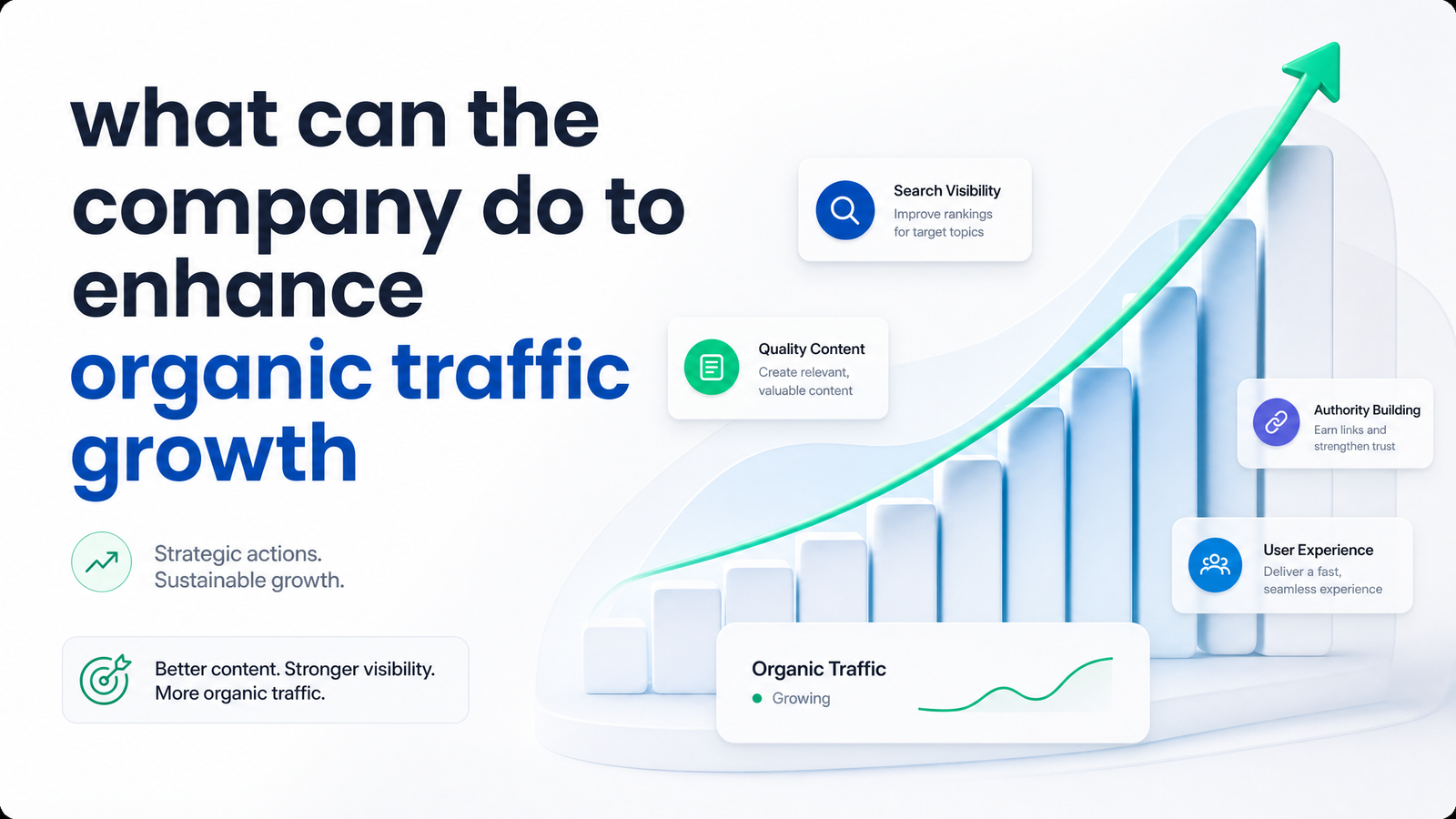
This article reframes the problem around four compounding levers: technical accessibility, topical authority, authority signals, and measurement. Treat them as a system rather than a checklist, and you'll know exactly where to put your next hour of effort.
The Four Levers That Actually Move Organic Traffic
Nearly all organic traffic growth strategies collapse into four fundamental levers. They aren't equally weighted, and they don't operate independently — each one determines whether the next can pay off.
- Technical accessibility — can search engines crawl, index, and render your pages fast enough to rank them at all?
- Topical authority — does your site demonstrate depth and coverage on a subject, or just scattered posts?
- Authority signals — do external sites vouch for your content through links and mentions?
- Measurement and iteration — are you diagnosing what's actually working before you invest more effort?
Skip a lever, and the ones after it produce diminishing returns. That's the mechanism behind the "96% of pages get zero traffic" problem: most of those pages fail at lever one or two, and no amount of link building or promotion fixes a page Google never properly indexed.
1. Fix What's Blocking Search Engines First
Technical SEO is the foundation lever because everything else depends on it. If a page isn't crawled, isn't indexed, or loads too slowly to satisfy Core Web Vitals thresholds, content quality and backlinks become irrelevant — the page isn't in the running. Crawl budget matters too: on larger sites, wasted crawl activity on low-value URLs can delay indexation of the pages you actually want ranked.
A proper site audit should surface indexation gaps, redirect chains, orphaned pages, and rendering issues before you spend another hour on content. If your team hasn't run one recently, this priority action plan for fixing technical SEO issues walks through what to fix first and why order matters. Page speed deserves its own attention too — Core Web Vitals factor directly into how Google evaluates page experience, and this Core Web Vitals fix-it playbook covers the concrete changes that move those scores.
Skipping this lever is the single most common reason teams ask how to grow organic traffic without paid ads and come up empty — they're optimizing content for pages Google barely visits.
2. Build Topical Authority, Not Just a Content Backlog
Once pages are technically sound, the next question is whether your content demonstrates topical authority — depth and coverage on a subject — rather than a random assortment of blog posts targeting disconnected keywords. Search engines increasingly reward sites that comprehensively cover a topic through interlinked clusters, not isolated articles competing for the same handful of keywords.
Topic-cluster structures — a pillar page supported by related subtopic pages, all internally linked — compound organic traffic growth over time far more reliably than one-off posts (Bravery Technology, 2026). Internal links distribute authority across the cluster, and each new supporting page reinforces the pillar's relevance for the broader topic.
The starting point is a content gap analysis — identifying what your target audience searches for that you haven't covered, and where competitors currently win. This content gap analysis framework breaks down how to find those gaps systematically rather than guessing at topics. This lever is also where AI Overviews and zero-click search change the calculus: if your content only rephrases what's already answerable in a snippet, you're competing for traffic that may never reach your site. Depth and originality matter more than volume now, not less.
3. Earn Authority Signals That Support Rankings
Backlinks and digital PR don't create rankings out of thin air — they support content that's already technically sound and topically strong. A page with no crawl issues and genuine topical depth will often outperform a competitor's page purely on the strength of a handful of relevant backlinks, because those links tell search engines the page is trusted, not just present.
Domain authority is a useful directional signal, but it's a proxy, not a goal — chasing link volume without regard to relevance rarely translates into ranking improvement. Teams that get durable results treat link building as reinforcement for content that's already earning its place, not a substitute for it. For a structured approach to prioritizing which link opportunities are worth pursuing, this link building strategy and prioritization framework is worth reading before allocating budget here.
4. Track, Diagnose, and Redirect Effort Based on Data
None of the first three levers tell you anything without measurement. Rank tracking and reporting close the loop — they're how you find out whether a stall is a technical problem, a content gap, or a links shortfall, instead of guessing and re-doing work that was never the bottleneck.
This is also where the distinction between organic traffic growth and organic traffic growth rate becomes practically important: raw traffic numbers tell you where you are, but growth rate tells you whether your effort is compounding or flatlining. If you're not sure how to calculate or interpret that rate, this guide to diagnosing organic traffic growth rate walks through the math and what different patterns indicate.
Google Search Console remains the baseline data source for this — impressions, clicks, and average position by query reveal which pages are close to breaking through versus which need a different lever entirely. Choosing the right rank tracker matters too, since tracking cadence and keyword grouping affect how quickly you catch a stall; this guide to choosing a rank tracker covers what to look for.
Why These Levers Fail When They Live in Separate Tools
Most experienced marketers already know these four levers exist. The failure point isn't knowledge — it's execution across disconnected tools. Technical audits live in one platform, content briefs get built in a doc or a separate AI writer, link building runs through outreach spreadsheets, and rank tracking sits in yet another dashboard nobody checks weekly.
This fragmented workflow creates two problems. First, delays: by the time an audit surfaces an indexation issue, the content team has already published three more pages on the same broken template. Second, blind spots: without a shared data layer, nobody notices that the pages losing rankings are exactly the ones with the worst Core Web Vitals scores, because that correlation only shows up when audit data and rank data sit in the same place.
Generic AI SEO tools that only handle one piece — just audits, or just content generation — don't solve this. They add another disconnected data source rather than removing one.
How an AI-Driven Workflow Runs All Four Levers Together
Rankevra was built around the premise that these four levers need to operate on shared data, not four separate subscriptions. As AI SEO software, it runs technical audits, content creation, publishing, and rank tracking inside one workflow, so a crawl issue detected today can inform the content brief written tomorrow, and a ranking drop can be traced back to a specific technical or content cause without exporting data between five tabs.
Practically, the audit layer flags indexation and Core Web Vitals problems and feeds that context directly into content planning — so new pages aren't built on top of unresolved technical debt. Content gap analysis and topic-cluster planning happen with visibility into what's already ranking, so publishing decisions reinforce existing authority instead of duplicating it. And because rank tracking lives in the same system, you see the effect of a technical fix or a new cluster page against a consistent baseline, not a re-imported spreadsheet.
The goal of automating SEO workflows like this isn't to remove strategic judgment — it's to remove the lag and blind spots that come from stitching together tools that were never designed to share data.
Most teams don't need convincing that they need audits, content, links, and tracking. They need those four things to stop living in separate tools with no shared context. That's a workflow problem, not a knowledge problem — and it's exactly what Rankevra is built to fix, running all four levers as one connected system instead of four disconnected habits.
Frequently Asked Questions
How long does it take to see organic traffic growth from SEO changes?
Technical fixes like indexation or Core Web Vitals improvements can show measurable movement within a few weeks once pages are recrawled. Content and topical authority gains typically take two to four months to compound, since new pages need time to be indexed, ranked, and reinforced by internal links. Link building effects are usually the slowest, often taking three to six months to fully register in rankings.
What's the difference between organic traffic growth and organic traffic growth rate?
Organic traffic growth is the raw increase in visits over a period, while organic traffic growth rate measures how fast that increase is happening relative to a previous period. A site can show growth in absolute numbers while its growth rate is declining, which signals a stall before total traffic actually drops. Tracking the rate, not just the total, catches problems earlier.
Should a small team focus on content or technical SEO first?
Technical SEO should come first, because content and links can't compound on pages that aren't properly crawled and indexed. A quick site audit will reveal whether existing pages have blocking issues; if they do, fixing those often unlocks traffic faster than writing new content. Once technical health is confirmed, shift focus to topical authority and content gaps.
Can AI tools actually replace a full SEO team for growing organic traffic?
AI tools can automate the repetitive execution work — audits, content drafts, publishing, and rank tracking — but strategic prioritization still benefits from human judgment. What AI-driven workflows change is speed and coordination: instead of a team manually stitching together five tools, one system runs the levers together and surfaces where to focus next. For small teams without dedicated SEO staff, this effectively covers the execution gap a full team would otherwise fill.
Why is my organic traffic flat even though I keep publishing new content?
Flat traffic despite steady publishing usually points to a technical or authority gap, not a content quality problem. New pages may be indexed but not ranking due to weak internal linking, insufficient topical depth around the cluster, or a lack of authority signals pointing to them. Running a rank tracker alongside a technical audit usually isolates which of those is the actual bottleneck.
How many blog posts do I need to publish to grow organic traffic?
There's no fixed number — a smaller set of well-clustered, internally linked pages covering a topic comprehensively tends to outperform a larger volume of disconnected posts. What matters more than count is whether each new page reinforces an existing topic cluster and whether the site's technical foundation supports indexing all of them. Publishing volume without topical structure is a common reason growth stalls despite consistent output.
Keep reading
- Keyword Cannibalization Prevention: A Pre-Publish ChecklistA planning-stage checklist for keyword cannibalization prevention — catch overlap before a brief is approved, not after the page is published.
- Multi-Location SEO: Scaling Pages Without Duplicate ContentA framework for multi-location SEO: build a canonical shell, hit the right unique-content ratio, and scale location pages without duplicate penalties.
- Mobile-First Indexing Checklist: Fix Content Parity GapsA practical mobile-first indexing checklist covering content, links, schema, images, and tap targets — plus how to automate parity checks with Rankevra.