Rankevra Blog
Artificial Intelligence Writing Tool: What It Is, How to
August 17, 2026
What Is an Artificial Intelligence Writing Tool?
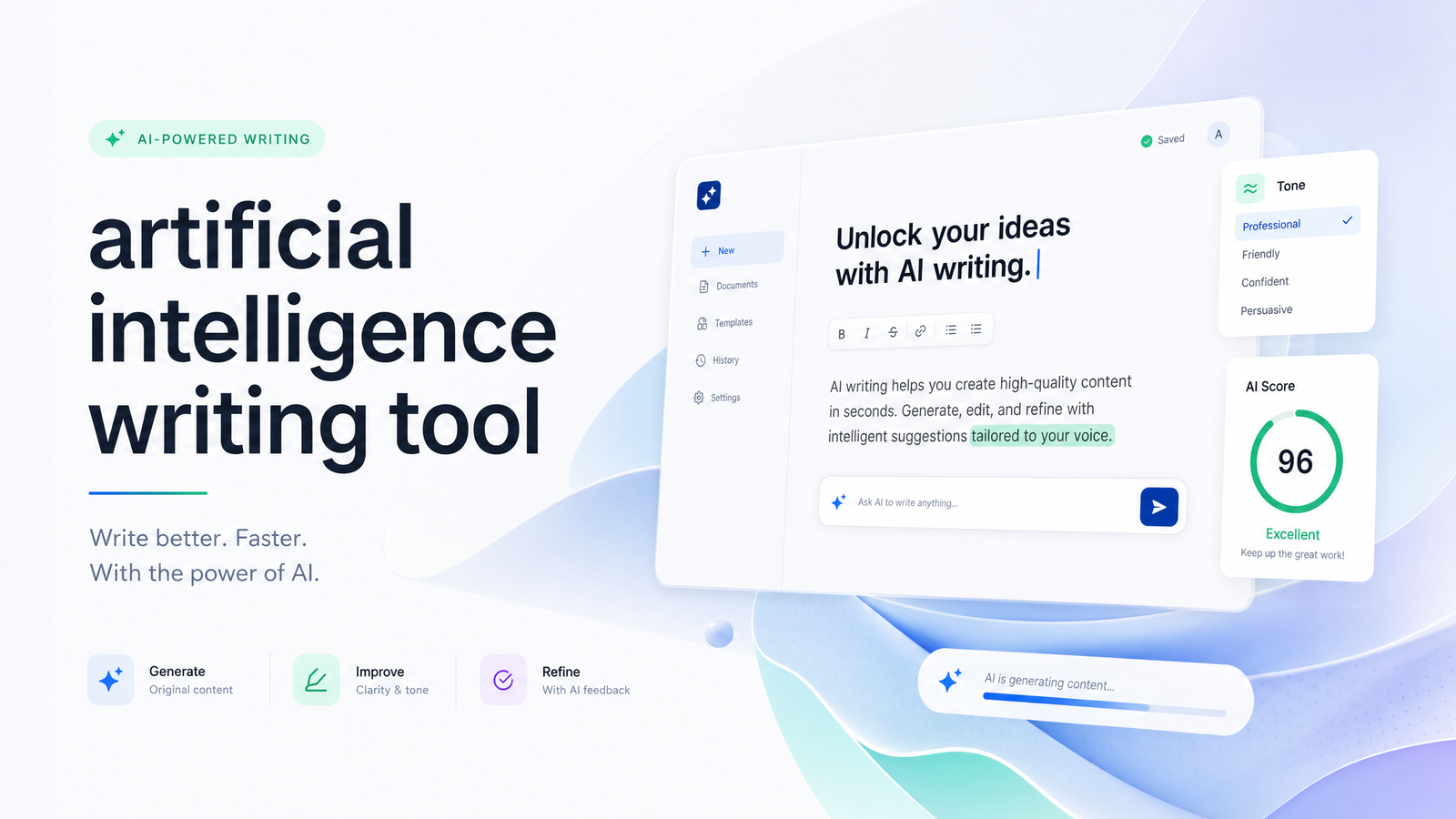
An artificial intelligence writing tool is software that uses AI — usually a large language model — to draft, edit, or optimize written content based on instructions you give it. That covers a lot of ground: a chatbot you paste prompts into, a dedicated marketing copy generator, and a full SEO content system that writes and publishes on your behalf all technically qualify as an AI content generator. The category is broad on purpose, and that breadth is why so many buyers get stuck comparing tools that aren't built for the same job.
The stakes for getting this right have gone up. According to Siege Media's AI writing statistics roundup, 97% of content marketers plan to use AI in 2026 — adoption is essentially universal. When almost everyone in your space is using some form of AI assistance, the differentiator stops being whether you use one and becomes which type you use, and how well it fits the workflow you're trying to run. A clear AI writing tool definition matters less than understanding which category solves your specific problem, which is what the rest of this guide walks through.
How AI Writing Tools Actually Work
Underneath almost every modern option is a large language model — a system trained on enormous volumes of text to predict, word by word, what a coherent, contextually appropriate response looks like. When you type a prompt, the model isn't retrieving a stored answer; it's generating one based on patterns learned during training, shaped by whatever context, instructions, or reference material you provide alongside it.
That's the core of how AI writing tools work, and it explains both their strength and their limitation. Give a model a narrow, well-specified prompt with good supporting context — target audience, key points, tone, examples — and you'll get output that reads like it was written with real understanding. Give it a vague one-liner, and it fills the gaps with generic, statistically "average" phrasing, because averaging is fundamentally what large language models writing text are doing. Tools that layer on research data, keyword targets, or brand voice profiles before generation tend to produce sharper output than a bare chat window, simply because they're feeding the model better context before it starts predicting.
The 3 Types of AI Writing Tools (and Who Each Is For)
Most confusion in this space comes from treating "AI writing tool" as one category when it's really three, each solving a different problem.
General-purpose assistants — ChatGPT, Claude, and similar chat interfaces — are conversational LLMs you can direct toward writing tasks, but writing is one of dozens of things they do. They're flexible and excellent for brainstorming, outlining, or drafting a single piece when you're willing to supply all the context and do the research yourself. They have no built-in sense of your keyword targets, your site's existing content, or how a Google-facing page should be structured.
Specialized writing and marketing copy tools, in the mold of Jasper or Copy.ai, narrow that focus. They add templates for ad copy, email sequences, and blog outlines, plus brand-voice settings and team collaboration features. This is a real step up in AI writing software comparison terms if your bottleneck is drafting volume across marketing channels — but most still stop at the draft. They don't audit your site, tell you what to write about, or push content live.
SEO-integrated writing systems close that gap. An SEO AI writing tool in this third category connects the writing step to the research and distribution steps around it: it identifies what to write based on keyword gaps and existing rankings, drafts with SEO structure built in, and hands off to publishing and tracking rather than leaving you to stitch that together across separate apps. If your content strategy is driven by search performance rather than general marketing output, this is the category built for that job.
Open-source and self-hosted generators are worth a mention too, particularly for teams with data-privacy constraints or a preference for owning their stack — the trade-offs are covered in Open Source AI Content Generator: The Honest Breakdown. If your immediate need is refreshing tired content rather than producing new pages, that's a distinct problem detailed in AI Rewriter Tools: The Framework for Rewrites That Rank.
What Google Actually Says About AI-Written Content
Google does not penalize content for being AI-assisted — it penalizes content produced to manipulate search rankings regardless of how it was made. That's the core of the Helpful Content system as folded into Google's core ranking systems: quality and originality are evaluated by what the page delivers to the reader, not by the production method behind it.
Where Google does take action is against what it calls scaled content abuse — publishing large volumes of low-value pages, AI-generated or otherwise, primarily to manipulate rankings rather than to help anyone. The distinction is intent and outcome, not tooling. A useful summary of the current guidance, including how it interacts with E-E-A-T (experience, expertise, authoritativeness, trust), is available in Google's AI Content Guidelines Explained (2026), which lays out why the "does Google penalize AI content" fear is largely a holdover from earlier, less nuanced guidance.
The practical takeaway on AI content Google policy: publishing thin, unedited, mass-generated pages was always a risk, with or without AI. Publishing genuinely useful, well-edited content that happens to start from an AI draft carries no inherent penalty. The tool isn't the variable Google is scoring — the output is.
How to Choose the Right AI Writing Tool for Your Situation
The right choice depends less on features and more on where you are and what's currently your bottleneck.
A solo blogger or side-project owner writing occasionally, without a formal keyword strategy, is usually well served by a general-purpose assistant. The overhead of a full platform isn't justified yet, and a chat-based tool with good prompting gets most of the value at minimal cost.
A content team producing marketing copy across channels — ads, emails, landing pages, social — benefits most from a specialized writing tool with templates, brand voice controls, and collaboration features. The priority here is consistency and speed across formats, not necessarily search performance.
A site where organic search is the growth engine — where rankings, keyword targeting, and technical health directly drive revenue — needs the third category: an SEO AI writing tool that treats content as one stage in a larger, measurable workflow rather than an isolated deliverable. For this reader, the best AI writing tool for SEO is the one that already knows what to write about because it's connected to your audit and keyword data, not a separate app you have to brief manually every time.
Choosing an AI writing tool ultimately comes down to matching the tool's scope to your workflow's scope. If you want the full breakdown of evaluation criteria — output quality, SEO features, integrations, pricing models — that deserves its own deep dive rather than a repeat here.
Where a Standalone Writing Tool Falls Short — and What Replaces It
Even a strong writing tool only owns one stage of the SEO process. It doesn't know your site has a crawl error suppressing rankings on twelve pages. It doesn't know which keyword gaps your competitors already exploited. It doesn't publish the piece, format it for your CMS, or tell you three weeks later whether it actually moved the needle. Each of those gaps typically gets patched with another subscription — an auditor, a keyword tool, a publishing plugin, a rank tracker — and the "juggling four tools" problem is precisely what pushes teams to look for an AI SEO workflow tool instead.
Publishing itself is a bigger risk point than most teams expect, especially once volume increases — inconsistent formatting, broken internal linking, and unreviewed batches are how good drafts turn into the kind of scaled content abuse Google actually penalizes. Building a Content Publishing Workflow That Scales Safely covers how to structure that step so growth doesn't come with that risk attached.
This is the gap Rankevra is built to close. Rather than treating writing as an isolated task, Rankevra runs it as one connected step in a single workflow: audit your site to find technical issues and content gaps, generate SEO-structured drafts targeted at the keywords those audits surface, publish directly to your site, and track rankings afterward — all in one place instead of four. For a reader who has already concluded a bare drafting assistant isn't enough, that's the all-in-one AI SEO tool alternative: one system, one login, one continuous loop from audit to ranked page.
If that matches where you are, Rankevra is worth a look — it's built specifically for teams who want the writing, the audits, the publishing, and the tracking to work as one system rather than four.
Frequently Asked Questions
Is an AI writing tool the same thing as ChatGPT?
No — ChatGPT is one example of a general-purpose AI writing tool, but the category also includes specialized marketing copy generators and SEO-integrated writing systems. ChatGPT and similar chatbots are conversational LLMs that can write on request, while other tools add templates, brand-voice settings, or direct connections to keyword and audit data that a plain chatbot doesn't have.
Will using an AI writing tool get my content penalized by Google?
No, not on its own — Google's guidance evaluates content on quality and helpfulness, not production method. The risk comes from publishing thin, unedited, or mass-produced pages meant to manipulate rankings, which Google treats as scaled content abuse regardless of whether AI was involved.
What's the difference between an AI writing tool and an AI SEO tool?
An AI writing tool focuses on drafting text, while an AI SEO tool connects that writing to the surrounding research and distribution workflow — keyword targeting, technical audits, publishing, and rank tracking. A standalone writer stops at the draft; an SEO-integrated system decides what to write based on data and follows through after publishing.
How much editing does AI-generated content need before publishing?
Most AI drafts need a human editing pass for accuracy, specificity, and voice before they're publish-ready, even when the underlying tool is strong. Editing typically means adding concrete examples, verifying facts and figures, tightening generic phrasing, and aligning the piece with firsthand expertise the model can't supply on its own.
Can AI writing tools handle long-form, in-depth articles well?
Yes, when given strong context — a clear outline, target keywords, and reference material — AI writing tools can produce solid long-form drafts. Quality drops sharply on vague, underspecified prompts, which is why tools that pull in structured research or audit data tend to outperform a blank chat prompt for lengthy, in-depth pieces.
Do I need a separate rank tracker if my writing tool includes SEO features?
Not necessarily — it depends on whether those "SEO features" include actual rank tracking or just on-page optimization suggestions. Many SEO-labeled writing tools stop at keyword suggestions and readability scoring, while a true end-to-end platform tracks rankings after publishing so you can see whether the content actually performed.
Keep reading
- Content Decay SEO: How to Detect It and Fix It for GoodLearn to detect content decay SEO issues early, rule out false positives, and build a refresh pipeline that scales — plus how to automate the whole loop.
- Headless CMS SEO: Fixing the Gaps Generic Tools MissHeadless CMS SEO breaks in three predictable places: rendering, metadata, and sitemaps. Here's the diagnostic framework to find and fix each gap.
- Google Algorithm Update Recovery: A Diagnostic FrameworkA step-by-step google algorithm update recovery framework: confirm the cause, segment the damage, benchmark against winners, and set a real timeline.