Rankevra Blog
Free Rank Tracker Software: What Each Tier Actually Gives
August 20, 2026
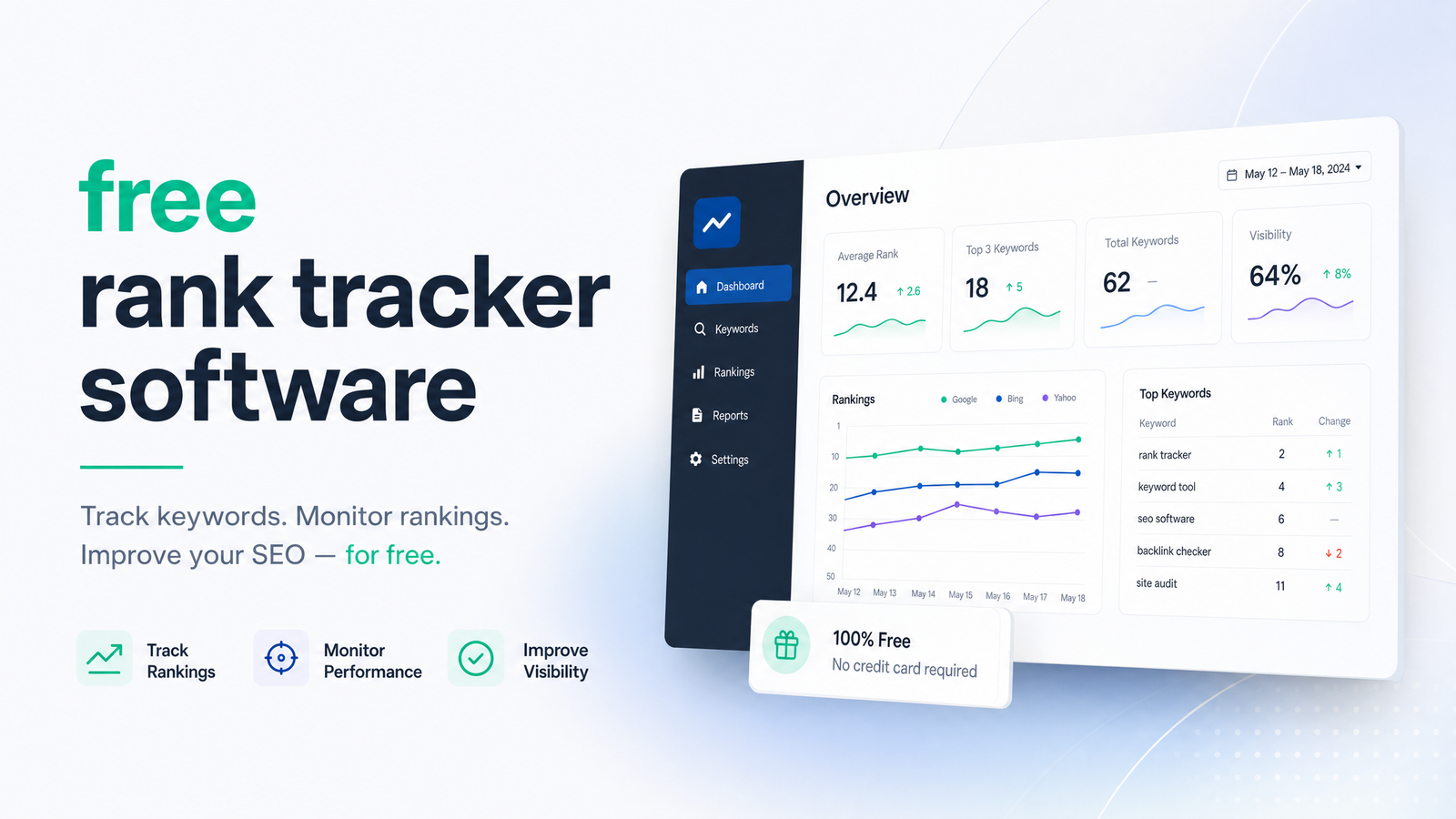
Search "free rank tracker software" and you'll land on a dozen listicles ranking 15-20 tools with near-identical five-star reviews. That's not an accident — most of those pages are affiliate content, and the glowing consensus tells you nothing about which tool fits your site. The better question isn't "which tool is best," it's "which category of free does this tool belong to, and what is it quietly not telling me?"
Free rank tracking splits into three tiers, each with a different business model and a different ceiling. Knowing which tier you're looking at before you sign up saves you from building a workflow on data that will eventually mislead you.
Why "Free Rank Tracker" Means Three Different Things
The first tier is Google-native and genuinely free: Google Search Console. No trial clock, no keyword cap, no credit card. Google built it to help site owners understand search performance, not to sell an upgrade — it's structurally limited in what it can show, not commercially limited.
The second tier is the freemium rank tracker: a real SEO product that gives away a slice of its paid engine, usually capped at 5-20 keywords with daily or weekly refresh limits. It's free forever, but the free plan exists purely as a funnel into a paid one.
The third tier is the trial disguised as free: full-featured software, unlimited keywords, real competitor data, gone in 7 or 14 days. It's the most impressive-looking option in any listicle screenshot, precisely because it's not built to stay free.
Conflating these three is why every "best free rank tracker software" roundup contradicts the next — they're not evaluating the same category, just listing whatever pays the best affiliate commission this month.
Google Search Console: The Only Genuinely Free Option — and Its Real Ceiling
Google Search Console gives you three real metrics: average position, clicks, and impressions, tied to actual Google Search data rather than a scraped simulation — a genuine advantage no other free or freemium tool matches.
The catch is in the word "average." GSC's position number is a mean across every impression a query generated over the date range, across every device, location, and SERP feature that triggered it. A keyword that hit position 3 in a featured snippet and position 14 in a plain result on a different day gets blended into one number that describes neither accurately. You can't isolate a single day's snapshot, and you can't compare last Tuesday to this Tuesday — the interface wasn't designed for that.
More importantly, GSC structurally cannot show a competitor's position. It only reports on properties you've verified, so there's no way to see whether a rival page passed you or by how much. It also has limited precision for local SEO rank tracking — city-level or "near me" variations get folded into aggregate query data rather than broken out by location, exactly the granularity local businesses need. These tips for using GSC well are worth reading — but they won't fix what the tool wasn't built to do.
Freemium Rank Trackers: What the Keyword Caps Are Really Protecting
A freemium rank tracker isn't holding back keyword slots to be stingy — the cap is the entire business model. Running rank checks means firing automated search queries against Google at scale, and that infrastructure costs money per keyword, per check, per day. A free tool that let you track 500 terms daily would be subsidizing its own competitors for nothing in return. The 5-to-20-keyword ceiling and once-a-day (or once-a-week) refresh rate are calibrated to be just useful enough to prove the product works, and just limited enough that anyone managing a real site outgrows it within a month.
That's the tell: freemium SEO tools are demos wearing a permanent-free badge. They're genuinely useful for a hobby blog with a handful of target terms, or for trialing a vendor's methodology before committing. They're not built to run a business's SEO program, and the companies offering them know it — the cap is doing its job precisely when you feel the urge to upgrade.
The Hidden Cost of Free Tracking
The sticker price of free tracking is zero. The actual cost shows up elsewhere: your time, and the quality of decisions made on incomplete data.
Piecing together a real picture with free tools usually means running GSC for average position, a second freemium tool for the 10 keywords it allows, and a manual SERP checker for the terms you're worried a competitor is gaining on — then copying it all into a spreadsheet to see anything resembling a trend. That stitching is real, recurring work, often an hour or more a week, and it scales up with the number of pages and clients you manage.
The bigger cost is decision quality. Free vs. paid rank tracking isn't really a features debate — it's an accuracy debate. Averaged, delayed, or partial data means you might miss a real ranking drop for two or three weeks until GSC's rolling average catches up, or fail to notice a competitor overtook you for a money keyword because no free tool in your stack tracks them. Rank tracking accuracy compounds: a wrong signal that leads to a wasted content refresh, a missed technical fix, or an overstated client report costs far more than any subscription fee. Nightwatch's own breakdown of free rank tracking tools makes a similar point — free tiers are fine for hobbyists, not for teams accountable to a traffic number.
A 5-Point Checklist: Do You Still Qualify for Free?
Run through these five questions honestly before deciding whether to add another free tool or upgrade to a paid one.
- Keyword count. Are you tracking more than 15-20 keywords across your site? If so, you've already exceeded what most freemium plans allow in a single account.
- Data freshness. Do you need to know about a ranking change within a day, not whenever GSC's average catches up? Time-sensitive decisions need daily or real-time data, not a rolling average.
- Competitor visibility. Do you need to see where a rival page sits for the same terms? No genuinely free tool — including GSC — shows this.
- Local precision. Do you manage local SEO rank tracking across multiple cities or service areas? Aggregate national averages will hide exactly the variation you need to see.
- Reporting hours. Are you spending more than an hour a week manually assembling rank data into a report? That hour has a cost, and it recurs every week indefinitely.
Two or more "yes" answers is a reliable signal you've outgrown free rank tracking, not that you need a different free tool. GrandRanker's comparison of free rank trackers and Konabayev's rank tracker roundup both land on the same conclusion from different angles: GSC's aggregated data is the practical ceiling of "free," and everything past it is a paid product wearing a free trial.
Where Free Tracking Fits Into a Bigger SEO Workflow
Rank position on its own is a diagnostic, not a strategy. It only becomes useful when connected to what you do next — fixing a technical issue suppressing a page, publishing content to fill a gap a competitor is winning, or flagging a client report that needs an explanation. When rank tracking lives in a separate free tool from your audits, content calendar, and publishing workflow, someone still has to manually connect the dots every week. That's the job free tools were never built to do — they show numbers, not next steps.
This is where an automated rank tracking layer built into a full AI SEO workflow changes the calculation. Rankevra ties keyword position tracking to the same system running technical audits, drafting content, and publishing it — so a rank drop doesn't just show up as a red number, it surfaces alongside the fix. If you're comparing dedicated paid trackers instead, this 2026 framework for choosing an SEO rank tracker and this keyword rank tracker evaluation guide both walk through what to weigh. And whichever tool you land on, turning raw position data into something stakeholders act on is its own skill — this guide to building an SEO reporting dashboard is worth bookmarking either way.
Frequently Asked Questions
Is Google Search Console a good enough rank tracker on its own?
For a small site tracking a handful of keywords with no competitive pressure, yes — GSC's average position, click, and impression data is free, accurate to Google's own logs, and sufficient for a general health check. It stops being enough the moment you need daily snapshots, competitor rankings, or local-level precision, none of which GSC is built to provide.
Can I track my competitors' rankings for free?
Not reliably. Google Search Console only reports on properties you own, so it never shows a rival's position, and freemium tools that do include competitor tracking usually gate it behind paid tiers or limit it to one or two competitors on the free plan.
Why do free rank trackers limit the number of keywords I can track?
Because every ranking check costs the provider money to run at scale, and the free tier exists to demonstrate the product rather than replace the paid one. The 5-to-20-keyword cap is calibrated to prove value while pushing serious users toward an upgrade.
How accurate is free rank tracking data compared to paid tools?
Google Search Console's data is accurate but averaged, smoothing daily volatility and SERP-feature-specific results into one blended number. Paid tools generally check rankings on a defined daily schedule from specific locations and devices, giving a precise snapshot rather than a rolling average.
What's the difference between a free SERP checker and a free rank tracker?
A SERP checker gives a one-time snapshot of a results page for a single keyword at the moment you run it, with no history saved. A rank tracker monitors keyword positions on an ongoing schedule and stores that history, which is what lets you see a trend instead of a single data point.
When should a small business stop using free rank tracking tools?
When two or more of these are true: tracking more than 15-20 keywords, needing daily rather than averaged data, needing competitor or local visibility, or spending over an hour a week manually compiling reports. At that point, the time and decision-quality cost of free tracking typically exceeds what a paid, automated tool would cost.
If your checklist came back with multiple "yes" answers — more than a handful of keywords to watch, a real need for daily or local data, or reporting that's quietly eating hours every week — that's the point where free tracking is costing you more than it's saving. Rankevra folds rank tracking into the same workflow as audits, content, and publishing, so you can try it without adding yet another standalone tool to your stack.
Keep reading
- Content Decay SEO: How to Detect It and Fix It for GoodLearn to detect content decay SEO issues early, rule out false positives, and build a refresh pipeline that scales — plus how to automate the whole loop.
- Headless CMS SEO: Fixing the Gaps Generic Tools MissHeadless CMS SEO breaks in three predictable places: rendering, metadata, and sitemaps. Here's the diagnostic framework to find and fix each gap.
- Google Algorithm Update Recovery: A Diagnostic FrameworkA step-by-step google algorithm update recovery framework: confirm the cause, segment the damage, benchmark against winners, and set a real timeline.