Rankevra Blog
Keyword Competitor Analysis: A Step-by-Step Framework
August 4, 2026
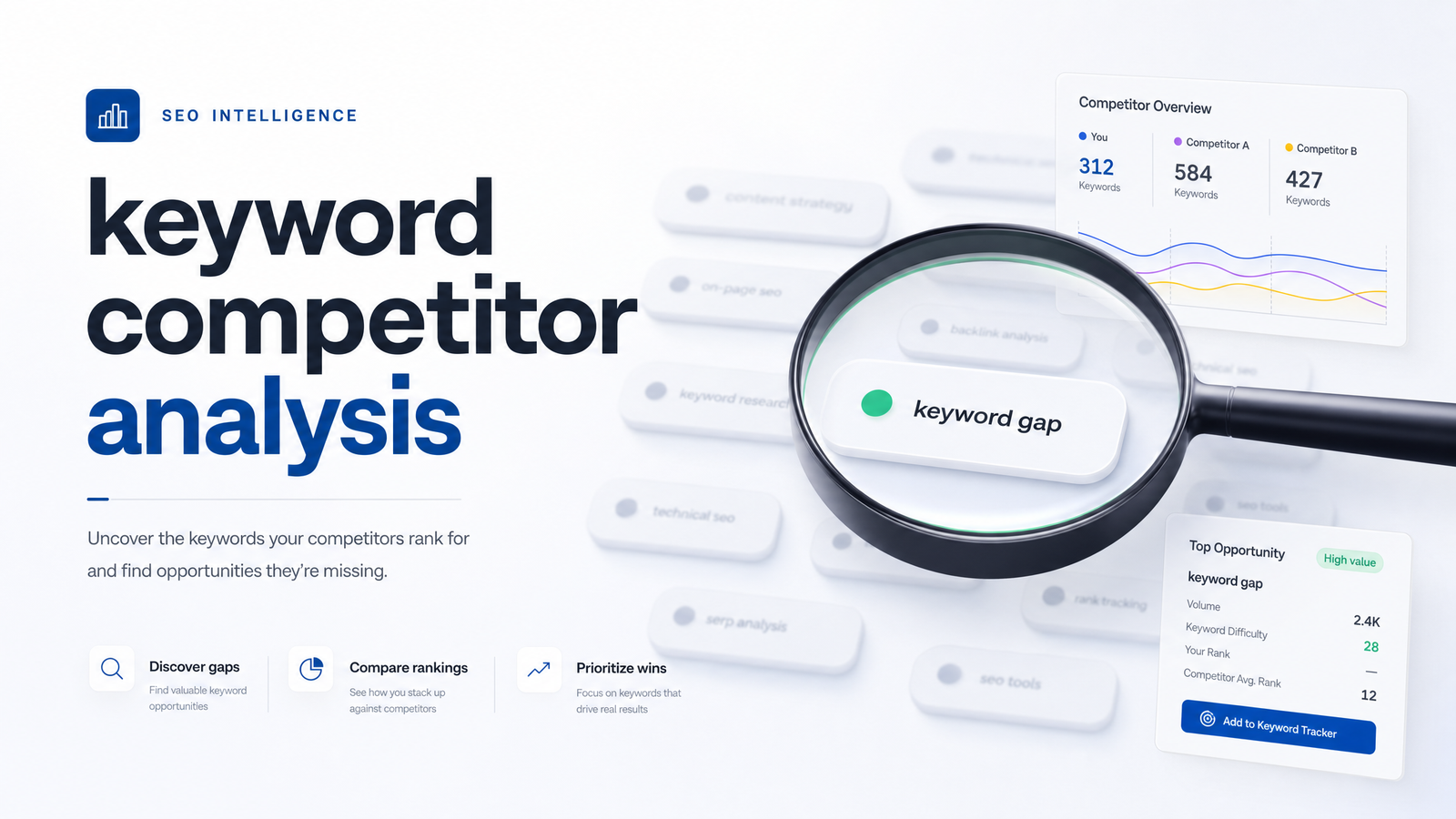
Most teams treat keyword competitor analysis as a data export problem: pull a report, get a list of "missing" keywords, done. The hard part — and the part that drives traffic — is knowing whose keywords are worth stealing, and which gaps deserve a content brief versus a shrug. This guide covers both, and shows how to close the loop so the analysis turns into published pages and tracked rankings instead of a spreadsheet nobody opens again.
What Keyword Competitor Analysis Actually Means (and What It Doesn't)
Keyword competitor analysis compares your site's rankings against sites that actually compete with you in the search results, to find terms they rank for that you don't — or rank for better. It's narrower than general keyword research, which starts from a topic or seed term and expands outward using volume and suggestions. Competitor analysis starts from an existing ranking website and works backward: if they're already getting traffic for a term, that term has proven demand and proven ranking feasibility.
It's also different from content gap analysis, even though the terms get used interchangeably. Keyword gap analysis vs content gap analysis comes down to unit of comparison: keyword gap analysis compares individual ranking terms, while content gap analysis compares topics, pages, and coverage depth across a subject area. In practice, a keyword gap often reveals a competitor has an entire content gap — three supporting articles feeding one pillar page — and the two exercises feed each other. This article focuses on the keyword layer; for the topic-level version, SEO Content Gap Analysis: A Complete Framework covers that next step.
What this framework won't do is hand you a giant spreadsheet and call it strategy. Every step below exists to narrow, not widen, your keyword list.
Step 1: Find Your Real SERP Competitors, Not Just Business Rivals
The most common mistake happens before any keyword tool gets opened: people analyze the wrong competitors. A company you compete with for customers — same pricing page, same investor deck, same sales calls — is a business rival. It is not automatically a keyword competitor. Your true SEO competitors are whoever actually occupies the search results for the terms you want to rank for, and that list is often surprising.
To find them, take 15-20 of your priority keywords — a mix of head terms and long-tail queries across your main topics — and look at who shows up in the top 10 repeatedly. A publisher, a marketplace, or a niche blog with no sales team can easily out-rank a "real" competitor if it has better content and links. This is domain competitors versus keyword competitors: domain-level competitors are who you'd list in a board meeting, keyword-level competitors are who Google actually trusts for your terms, and the second list is the one that matters here.
Aim to analyze 3-5 recurring SERP competitors, not 15. Fewer than three risks a thin, unrepresentative gap; more than five drowns you in noise from sites that only overlap on a handful of terms. If a site shows up in the top 10 for less than roughly a quarter of your tracked keywords, it's a peripheral competitor — note it, but don't build your analysis around it.
Step 2: Pull and Compare Keyword Lists to Surface the Gap
With 3-5 real competitors identified, the how-to becomes mechanical. Pull each competitor's ranking keyword list (any keyword research or SEO platform with a domain-vs-domain comparison feature will do this), then pull your own site's ranking keywords for the same period. Line the two lists up and sort into three buckets:
- Shared keywords — terms you both rank for. These matter for tracking share of voice and spotting where a competitor is creeping past your position.
- Missing keywords — terms a competitor ranks for and you don't. This is the core keyword overlap analysis output and your primary opportunity list.
- Underperforming keywords — terms you both rank for, but they consistently beat your position. This bucket often gets ignored, but it's frequently cheaper to fix than chasing brand-new terms, since you already have some relevance signal.
Before prioritizing, strip out branded terms — a competitor's company name, product names, or branded feature searches. You will never rank for "[Competitor] pricing" in any meaningful way, and including those rows just inflates your export. The exception is when a branded term reveals an unbranded pattern worth pursuing (e.g., a competitor ranks for "[Competitor] vs [Category] tools" — the underlying comparison-intent pattern is worth noting even if the exact branded phrase isn't).
What you should have left is a filtered, tagged list of missing and underperforming keywords, each with the competitor's ranking URL attached so you can see exactly what content beat you.
Step 3: Prioritize the Gap by Opportunity, Not Volume Alone
This is where most projects die. A raw export of 300+ missing keywords, sorted by search volume, produces a wish list of terms that are either impossible or not worth ranking for. You need a scoring approach that weighs four factors together:
Traffic potential — not just the exact keyword's search volume, but the combined volume of the keyword cluster it belongs to, since a single ranking page usually captures a family of related queries.
Keyword difficulty — how entrenched the current top-ranking pages are. Keyword difficulty vs traffic potential is the real trade-off: a keyword with moderate volume and low difficulty will often out-earn a huge-volume, high-difficulty term you have no realistic shot at within 12 months, especially on a newer or mid-authority domain.
Search intent — whether the query is informational, commercial, or transactional, and whether that intent matches what you can deliver. A competitor ranking a comparison page for a transactional query is a much stronger signal than them ranking a glossary entry for a broad informational term with no path to conversion.
Business relevance — does ranking for this term bring the right audience, or just traffic? A keyword can score well on the first three factors and still be a poor fit if it attracts the wrong buyer.
A simple weighted score — even a basic 1-5 scale on each factor, multiplied or summed — turns a 300-row list into a ranked shortlist of the 20-40 keywords worth briefing this quarter. Build this scoring into a repeatable competitor keyword analysis template (a shared sheet or a tool that scores automatically) so every future gap review uses the same criteria instead of gut feel.
Step 4: Turn the Shortlist Into Content and Tracked Rankings
A prioritized shortlist that never becomes a published page has produced zero ROI. This is the step most manual workflows skip, because it means moving from a spreadsheet into a content tool, then a CMS, then a separate rank tracker — three handoffs, three logins, and three places for the process to stall.
The shortlist from Step 3 should map directly into content briefs: each keyword or cluster gets a target page, a content type based on the intent identified, and a note on what the competitor's ranking page does that yours needs to match or beat. From there it needs an actual publishing pipeline rather than a doc sitting in a shared drive — see Building a Content Publishing Workflow That Scales Safely for how to structure that without introducing quality or consistency risk as volume increases.
Once content is live, rank tracking closes the loop — you need to know whether the pages you built off this analysis are actually gaining position against the same competitors you benchmarked. Best Keyword Rank Tracker: A 2026 Evaluation Framework walks through what to look for if you're tracking manually.
This is exactly the connected sequence Rankevra is built to run as one workflow instead of four disconnected tools: it identifies real SERP competitors, pulls and scores the keyword gap, generates content briefs and drafts for the prioritized shortlist, publishes them, and tracks rank movement against the same competitor set — so the analysis doesn't go stale the moment the export finishes. If you want to go broader than competitor gaps into full AI-assisted discovery, AI Tool for SEO Keyword Research: What Actually Works is a useful next read.
Common Mistakes That Make Keyword Competitor Analysis Useless
A handful of keyword gap analysis mistakes account for most wasted effort:
Treating it as a one-off project. Competitors publish new content constantly. An analysis run once at the start of the year is outdated by Q2 — new gaps open and existing ones close without anyone noticing until a traffic dip forces a review.
Ignoring search intent mismatches. Ranking for a keyword that doesn't fit what your page can deliver produces high bounce rates and no conversions, even if the position looks good in a report.
Chasing unwinnable keywords. Sorting a gap list purely by volume, then briefing the top 10 rows regardless of difficulty, wastes content budget on terms you won't rank for inside any reasonable timeframe.
No follow-through from list to publication. The gap between "we found 150 opportunities" and "we published anything" is where most SEO programs quietly lose momentum. A shortlist without an owner, a deadline, and a publishing path is a document, not a strategy.
Skipping rank tracking after publishing. Without tracking movement against the same competitor set you benchmarked, you can't tell if the content worked, needs updating, or needs to be scrapped — and building topical authority requires knowing which pieces actually moved the needle.
Frequently Asked Questions
What's the difference between keyword gap analysis and content gap analysis?
Keyword gap analysis compares individual ranking terms between your site and competitors to find missing or underperforming keywords. Content gap analysis operates at the topic and page level, comparing overall subject coverage and depth across a niche. They're complementary: a keyword gap often points to a broader content gap once you look at the pages behind the missing terms.
How many competitors should I analyze for keyword research?
Three to five recurring SERP competitors is the practical range. Identify them by checking who repeatedly appears in the top 10 across a sample of your priority keywords, rather than assuming based on brand or industry reputation. Fewer than three risks a thin gap; more than five adds noise from peripheral overlaps.
Should I include competitors' branded keywords in the analysis?
No, exclude a competitor's branded terms — their company or product names — since you have no realistic path to ranking for them. The one exception is when a branded term reveals an unbranded pattern worth targeting, such as comparison-style searches that combine a competitor's name with a category term.
How often should I re-run a keyword competitor analysis?
Quarterly is a reasonable baseline, with a faster check-in if you notice a traffic or ranking drop. Competitors publish and update content continuously, so a gap analysis run once a year will already be stale by the time you act on it.
What's a good keyword difficulty vs. traffic potential ratio to prioritize?
There's no universal number, but favor keywords where difficulty is proportionate to your current domain authority and traffic potential includes the full keyword cluster, not just the exact-match term. A moderate-volume, low-difficulty keyword you can realistically rank for within months typically outperforms a high-volume, high-difficulty term with no near-term path to page one.
Can I do keyword competitor analysis without paid tools?
Yes, to a limited degree — manually reviewing SERPs for your priority terms and noting recurring competitors is free, and some search platforms offer basic competitor visibility at no cost. However, pulling full competitor keyword lists, scoring difficulty accurately, and tracking rank movement over time generally requires dedicated software, since manual SERP checking doesn't scale past a handful of keywords.
Running this sequence by hand — competitor discovery in one tab, keyword exports in another, a prioritization spreadsheet, a content tool, and a separate rank tracker — is exactly the setup that causes gaps to go unnoticed until traffic already dropped. Rankevra runs the entire workflow end to end: it finds your real competitors, pulls and scores the keyword gap, turns the shortlist into published content, and tracks the rankings that follow, so the analysis stays current instead of dying in a spreadsheet.
Keep reading
- Keyword Cannibalization Prevention: A Pre-Publish ChecklistA planning-stage checklist for keyword cannibalization prevention — catch overlap before a brief is approved, not after the page is published.
- Multi-Location SEO: Scaling Pages Without Duplicate ContentA framework for multi-location SEO: build a canonical shell, hit the right unique-content ratio, and scale location pages without duplicate penalties.
- Mobile-First Indexing Checklist: Fix Content Parity GapsA practical mobile-first indexing checklist covering content, links, schema, images, and tap targets — plus how to automate parity checks with Rankevra.