Rankevra Blog
Niche Keyword Research Tool: A Method That Actually Ranks
July 23, 2026
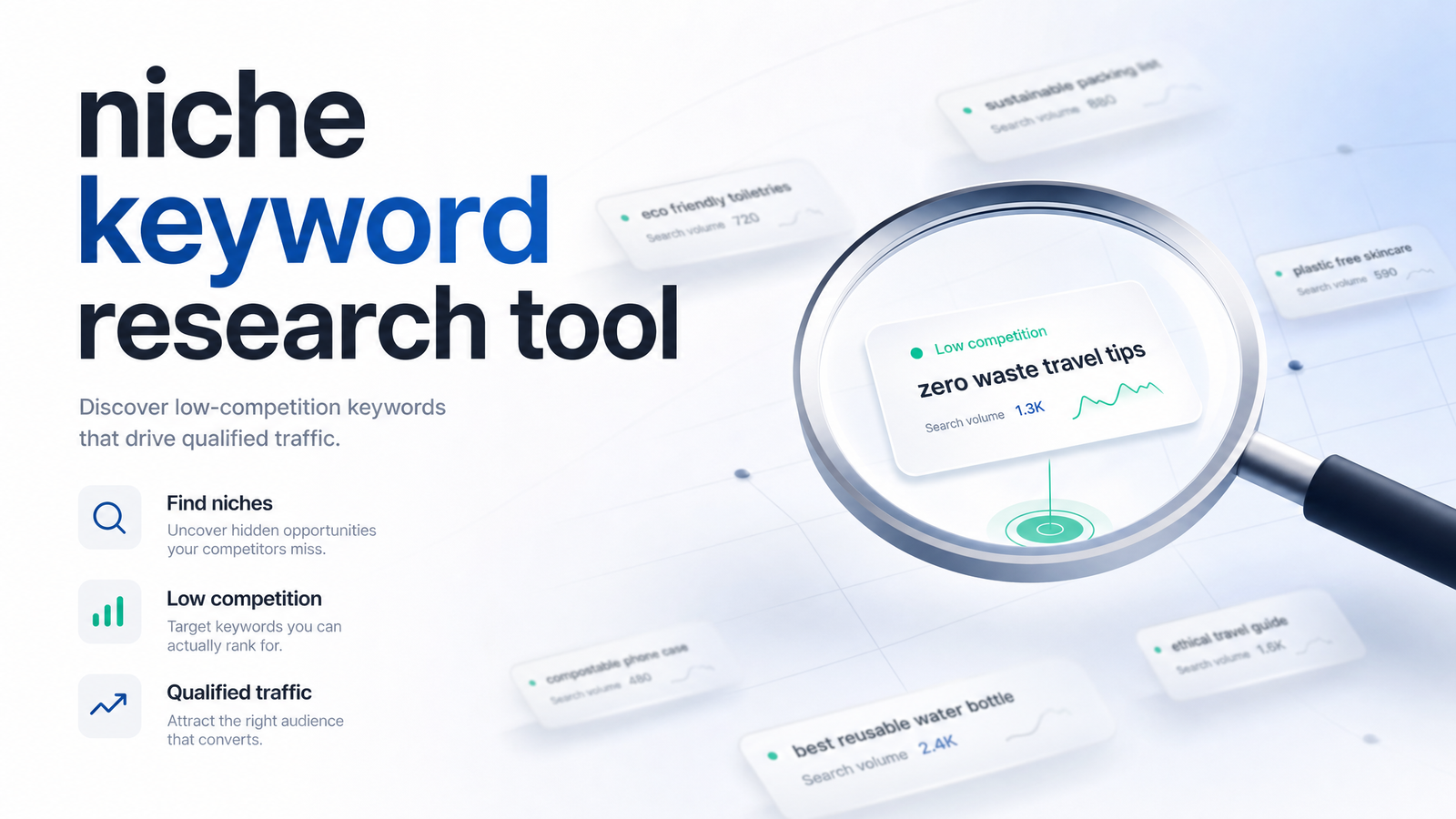
Most site owners already own a keyword tool. Ahrefs, Semrush, or a free alternative — the subscription isn't the problem. The problem is that niche keyword lists pile up in spreadsheets while the pages that should rank for them never get published. If you're searching for a niche keyword research tool, what you actually need isn't another database of search volumes — it's a way to turn niche keywords into live, tracked pages without losing momentum between steps.
This article covers the real definition of a niche keyword, why these terms convert better than broad head terms, a repeatable five-step process for finding them, and what to evaluate in a tool before adding a fifth subscription to your stack.
What Counts as a Niche Keyword (and Why It's Not the Same as 'Low Volume')
A niche keyword is a search term tied to a narrow, well-defined slice of a topic — one where searcher intent is specific enough that a single page can satisfy it completely. That's different from a long-tail keyword, which is defined by phrase length: three, four, or more words. Plenty of long-tail phrases are still broad ("best running shoes for beginners" is long-tail but still competitive). A niche keyword is narrow by topic, not just word count. "Running shoes" is broad. "Running shoes for flat feet and overpronation" is niche — it names a specific problem, a specific audience, and implies a specific answer.
This distinction matters most for smaller or newer sites. You can't out-authority an established competitor on a head term with a two-month-old domain, but you can win a niche term where the top-ranking pages are thin, outdated, or answering the wrong intent. Riff Analytics frames low-competition keywords the same way: specificity, not just phrase length, is what makes a term winnable, and increasingly that specificity shows up as full-sentence, question-based queries rather than short fragments.
Why Niche Keywords Outperform Broad Terms
Head terms get the search volume; niche and long-tail terms get the traffic. Neal Schaffer cites Ahrefs data showing that keywords with huge monthly search volume are vastly outnumbered by the long tail of low-volume, ultra-specific queries — the bulk of all searches happen in that long tail, not at the head. GetPassionfruit makes the conversion case explicit: niche and long-tail searches convert at meaningfully higher rates than broad terms, because the searcher has already narrowed their own intent before typing.
That's the real argument for low-competition keywords: not just that they're easier to rank for, but that the traffic is qualified. Someone searching "niche keyword research tool for small sites" already knows what they want; someone searching "SEO tool" is still window-shopping. BloggersIdeas frames this as part of a broader shift in keyword research — away from chasing volume and toward selecting by intent first, volume second. Ten pages ranking for tightly-scoped niche terms will often out-convert one page limping along on page two for a head term.
A 5-Step Process for Finding Niche Keywords
Manual brainstorming caps out fast — you can only think of variations you already know exist. Here's a process that replaces guesswork with a repeatable method.
1. Start from one topic cluster, not a blank page. Pick a single seed topic your site has real authority or intent to build authority in. Niche keyword research works best as an extension of a cluster, not a scattershot list of unrelated long-tail phrases.
2. Mine real questions people are asking. Google's People Also Ask boxes, autocomplete suggestions, and niche forums or subreddits surface the actual phrasing searchers use — often messier and more specific than anything you'd invent yourself. This is where you find the phrasing gap between what tools show and what people type.
3. Use AI to expand and cluster by intent. Feed your seed questions and phrases into an AI keyword research tool to generate variants, then group them by search intent — informational, comparison, transactional — rather than by superficial keyword similarity. Clustering by intent, not just shared words, is what turns a keyword list into a content plan.
4. Validate with real difficulty and volume data. AI-generated suggestions are a starting point, not a verdict. Cross-check volume and keyword difficulty (KD) against actual data, and use Google Trends to confirm a term is stable or rising rather than fading. This step separates a validated niche keyword strategy from a guess dressed up as a list.
5. Map each keyword to a specific page — not a spreadsheet row. Every validated keyword needs an owner: an existing page to update, or a new page to create. If a keyword doesn't have a clear page destination, it doesn't belong in the plan yet.
To extend this process by studying where competitors are already winning niche terms you've missed, keyword gap analysis is the natural next step.
What to Look For in a Niche Keyword Research Tool
Volume and difficulty scores are table stakes now — most tools show them, and BloggersIdeas notes that volume estimates still vary meaningfully between tools, so no single number should be treated as gospel. The real evaluation criteria go further:
- Intent classification, not just metrics. Does the tool tell you why a keyword matters — informational versus transactional — or just how big and how hard?
- Clustering by topic and intent. Can it group niche variants into a page-ready structure, or does it hand you a flat list you have to sort yourself?
- Data you can trust for validation. Are volume and KD numbers accurate enough to confirm (or kill) an AI-suggested keyword, rather than just another set of estimates to double-check elsewhere?
- A path from keyword to published page. This is the criterion most standalone tools fail. The best keyword research tool for niche sites isn't the one with the deepest database — it's the one that connects research to what happens next: content creation, publishing, and rank tracking.
That last point is the difference between a tool you research in and a workflow you actually execute through.
Why Niche Keywords Die in Spreadsheets (and How to Fix the Workflow)
Here's the failure mode nearly every team hits: they run the five-step process, end up with fifty solid, validated niche keywords — and six months later, twelve are published. The rest are still sitting in a spreadsheet tab nobody opens. This isn't a research problem; the research was good. It's a workflow problem: the keyword tool, the writer or AI content tool, the CMS, and the rank tracker are four disconnected systems, and every handoff between them is where momentum dies.
A validated keyword list has to move immediately into a briefed, optimized draft — see content optimization frameworks for what "optimized" should mean structurally — get published without a manual copy-paste into the CMS, and then get tracked so you know whether it actually ranked. Each step has its own rank tracking evaluation criteria worth understanding, but the point is that they need to happen in sequence, without friction, or they won't happen at all.
This is exactly the gap Rankevra is built to close. Instead of a keyword database you export from, Rankevra runs research, AI content creation, publishing, and rank tracking as one connected workflow — so a validated niche keyword becomes a briefed draft, then a published page, then a tracked ranking, without you rebuilding the handoff by hand every time.
Frequently Asked Questions
What exactly counts as a 'niche' keyword vs. a long-tail keyword?
A long-tail keyword is defined by phrase length — typically three or more words — while a niche keyword is defined by topical narrowness and specific intent, regardless of word count. A long-tail phrase can still be broad and competitive; a true niche keyword targets a narrow enough slice of a topic that one page can fully satisfy the searcher.
How many searches per month is considered a good niche keyword to target?
There's no universal volume threshold — a niche keyword's value comes from matched intent and low competition, not a specific number. Many worthwhile niche terms sit in the tens to low hundreds of monthly searches, but a cluster of them, each mapped to a page, adds up to meaningful traffic collectively.
Do I still need a paid keyword tool, or can AI alone find niche keywords?
AI is excellent at expanding and clustering keyword variants by intent, but it can't reliably tell you real search volume or ranking difficulty — those still require actual data. The reliable approach uses AI to generate and organize candidates, then validates them against real volume and KD data before committing a page to them.
How long does it take to rank for a niche keyword once I publish content?
Niche keywords with low competition often show initial rankings within a few weeks to a couple of months, faster than head terms because there's less established competition to outrank. Actual timing depends on your site's existing authority, content quality, and how promptly the page gets indexed and tracked.
Should I target niche keywords even if my site is already established?
Yes — established sites use niche keywords to build topical authority around a core subject, which strengthens rankings for the broader head terms too. Niche pages also capture highly qualified, high-converting traffic that head terms alone tend to miss.
Can niche keyword research still work now that AI Overviews are changing search results?
Yes, and arguably more so — AI Overviews and conversational search favor specific, fully-formed questions over short generic keywords, which is exactly what niche keyword targeting already optimizes for. Pages built around narrow, clearly-answered intent are well-positioned to be cited or summarized in AI-driven results, not just ranked in the traditional ten blue links.
Niche keyword research only pays off if the list turns into published, optimized, tracked pages — not another tab in a spreadsheet. If you want to see that whole path in one place, try Rankevra's free workflow: audit, AI content, publish, and rank tracking, connected end to end.
Keep reading
- Subdomain vs Subdirectory SEO: The Real Decision FrameworkSubdomain vs subdirectory SEO, resolved: what Google says, what migration data shows, and a 5-question framework to pick the right structure.
- Answer Engine Optimization: A Platform-by-Platform GuideAnswer engine optimization explained for ChatGPT, Perplexity, and Google AI Mode — with a practical, platform-aware framework to earn citations in 2026.
- SEO A/B Testing: A DIY Framework Using Only GSCLearn SEO A/B testing with just Google Search Console and a spreadsheet — hypotheses, page grouping, significance checks, and when to automate.