Rankevra Blog
OnCrawl Topical Authority: What It Shows and What It Misses
August 12, 2026
What People Mean by "OnCrawl Topical Authority"
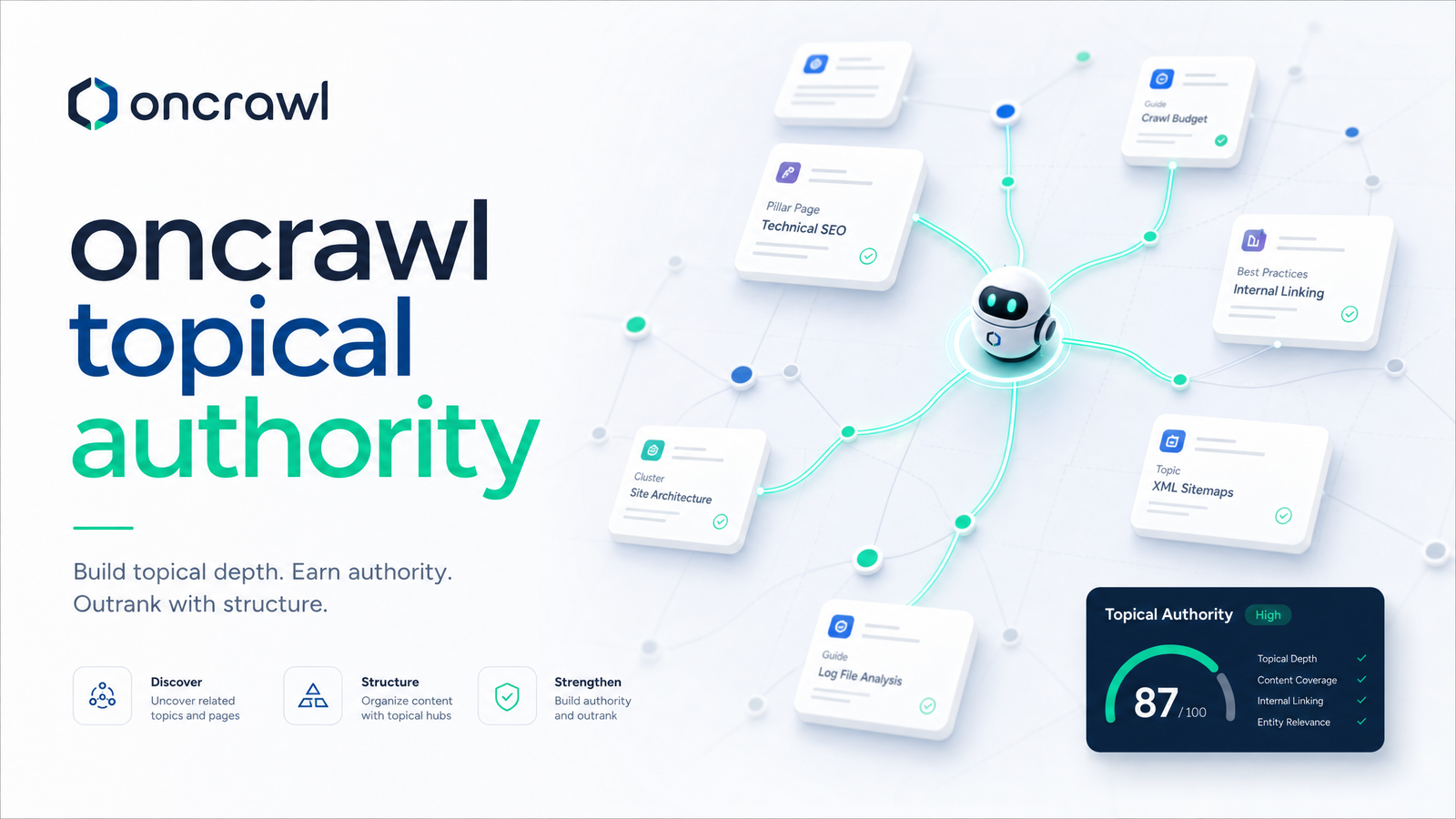
Search for "oncrawl topical authority" and you'll find no dedicated score sitting in a dashboard labeled that way. OnCrawl doesn't ship a single metric called "topical authority" — the phrase is shorthand for a cluster of things the platform does surface: semantic content analysis, crawl and log diagnostics, and published case studies where OnCrawl's team walks through oncrawl semantic seo methodology using entities, attributes, and taxonomy.
That distinction matters before you spend a subscription on the wrong expectation. OnCrawl was built as a crawler and log-analysis platform first. Its strength is technical: how a site is structured, where crawl budget goes, and how well pages match search intent at the content level. Topical authority — the idea that a site earns trust and rankings by comprehensively covering a subject — is adjacent to what OnCrawl measures, not the product's core deliverable. Understanding that gap up front saves you from assuming a crawl report will double as a content strategy.
What OnCrawl Actually Shows
OnCrawl's real value for topical authority work comes from several distinct signals, each doing a narrow job well.
Crawl depth analysis shows how many clicks it takes to reach a page from the homepage, and by extension, how well a topic hub is internally supported. If cornerstone pages sit six or seven clicks deep, that's a structural signal the topic isn't reinforced the way search engines — or users — expect a well-covered subject to be.
Orphaned and thin page detection flags pages with no internal links pointing to them, or word counts too low to justify their existence. OnCrawl's writeup on closing content gaps to improve AI search visibility ties both diagnostics directly to topical coverage: pages that are orphaned or thin can't contribute to a topic cluster even if the content itself would otherwise be relevant.
Content Lens and the accompanying Content Quality Score are OnCrawl's most direct answer to topical depth. Content Lens analyzes a page's text against expected entities and semantic fields for a subject, then scores how well the content addresses that field. It's documented in OnCrawl's own product updates as a newer capability built to move the platform beyond pure technical crawling into content-quality territory.
Query Fanout Coverage and the Ranking Queries metric round out the picture. Ranking Queries reports the number and variety of search queries a page or section already ranks for — a proxy for how broadly content is recognized as relevant to a topic, rather than just one keyword. It's a useful read on existing coverage, though it describes what's already happening rather than prescribing what to build next.
Taken together, these features give a genuinely useful technical and semantic read on a site. OnCrawl's own semantic SEO case study and its piece on multilingual topical authority both lean on entities, attributes, and ontology to explain subject coverage — a more rigorous framing than most crawler tools attempt.
Where OnCrawl's View Falls Short
Here's where the oncrawl limitations become concrete rather than theoretical.
OnCrawl doesn't build a topic or cluster map. It can tell you a page is thin, orphaned, or buried in crawl depth — but it won't tell you which subtopics competitors cover that you don't, or how to organize a pillar-and-cluster structure around a subject. That's a content-strategy task outside a crawler's job description.
It doesn't generate or rewrite content either. Content Lens will score a page against expected semantic fields, but closing that gap — writing missing sections, adding flagged entities — is still manual work in a separate editor or AI writing tool.
It doesn't track rankings by topic over time. Ranking Queries gives a snapshot of query breadth at the moment you run the report, not a trend line showing whether a topic cluster is gaining or losing visibility month over month. Rank tracking by cluster is a different category of tool.
And even its content-quality signals remain crawl-and-technical-first. Content Lens flags gaps against a semantic field, but doesn't weigh search demand, business priority, or funnel stage — the judgment calls that decide what a content team should produce next. This is the core of the topical authority gaps in an otherwise strong crawler vs content planning tool: OnCrawl audits and scores; it doesn't plan or produce.
For a broader framework on what "measuring topical authority" should actually include before judging any single tool's output, the topical authority checker guide walks through that baseline.
OnCrawl vs. Ahrefs: Two Different Lenses on the Same Metric
Comparing oncrawl vs ahrefs topical authority approaches surfaces a useful pattern: neither tool owns the full picture, because they're built to measure different layers of the same problem.
Ahrefs approaches topical authority through keywords and backlinks — which subtopics you rank for, how much organic traffic a topic cluster pulls, and how link equity flows between pages on a subject. OnCrawl approaches it through the site's own structure and content: crawl depth, orphaned pages, and semantic completeness measured against entities and attributes.
Put simply, Ahrefs tells you how the market and search engines perceive your topical footprint from the outside; OnCrawl tells you how your own site is structurally and semantically built to support that footprint from the inside. Both are partial views. For a detailed breakdown of Ahrefs' side, see Topical Authority in Ahrefs: What It Shows (and Doesn't). If the terminology still feels abstract, the plain-English topical authority definition is a good grounding point.
Turning OnCrawl's Data Into a Topical Authority Plan
A practical topical authority workflow looks like this, and it's worth being honest about where each step needs a tool OnCrawl doesn't provide.
1. Audit for structural and content gaps. Run OnCrawl (or a comparable crawler) to surface crawl depth issues, orphaned pages, and thin content flagged by Content Lens. This is where OnCrawl genuinely earns its place — see also the general breakdown in what a site audit tool checks and the deeper mechanics of log file analysis for finding crawl waste, since log data underpins much of what OnCrawl reports.
2. Map the topic against a cluster structure. Take the gaps the audit revealed and plot them against a pillar page and its supporting subtopics — the part a crawler doesn't do on its own. This is a topic gap analysis step: identify which subtopics competitors cover and your site doesn't, and where internal linking should reinforce the hub.
3. Produce content to fill the gaps. Fixing thin content isn't a crawl fix — it's writing. New pages, expanded sections, added entities the Content Quality Score flagged as missing. This is where most teams switch tools entirely, moving from an audit platform to a CMS or a separate AI writer.
4. Track rankings by topic, not just by page. Set up ongoing monitoring for how the whole cluster performs, not a single URL's Ranking Queries snapshot — visibility trends across the pillar and its supporting pages over weeks and months.
Run this manually and you're using at least three or four separate subscriptions — a crawler, a content or keyword research tool, a writing tool, and a rank tracker — each with its own login, export, and reconciliation overhead.
Why an All-in-One Workflow Beats Stitching Tools Together
Every seam between tools is a place data goes stale. An audit finding a thin page in OnCrawl doesn't automatically become a content brief anywhere; a content brief doesn't automatically become a tracked ranking cluster. Someone has to move that information by hand, and in most teams, that someone eventually stops doing it consistently.
An end-to-end SEO platform collapses that chain: audit, topic mapping, content creation and publishing, and rank tracking live in one system, so a gap identified in the audit can flow directly into a brief, then a published page, then a tracked keyword cluster — without a spreadsheet in between.
Rankevra is built around that exact ai seo workflow. It runs technical audits similar in spirit to what OnCrawl surfaces, but pairs that diagnostic layer with topic mapping, AI-assisted content generation and publishing, and rank tracking organized by topic cluster rather than isolated keywords — making it a topical authority tool in the fuller sense of the term, not just a crawler with a content-quality score bolted on.
If your current stack ends at "here's what's wrong with your site," Rankevra is designed to pick up exactly where that audit leaves off.
Frequently Asked Questions
Does OnCrawl have a dedicated topical authority score?
No. OnCrawl doesn't publish a single metric explicitly called "topical authority." What it offers instead is a set of related signals — Content Lens, Content Quality Score, crawl depth analysis, and the Ranking Queries metric — that together give a technical and semantic read on topic coverage without rolling up into one labeled score.
What is OnCrawl's Content Lens and how does it connect to topical authority?
Content Lens analyzes a page's text against the entities and semantic fields expected for its subject, then produces a Content Quality Score reflecting how completely the page addresses that topic. It connects to topical authority by revealing content gaps at the page level, though it doesn't map those gaps into a broader cluster strategy.
Can I build topical authority using OnCrawl alone?
Not fully. OnCrawl can diagnose structural and semantic gaps — thin content, orphaned pages, weak crawl depth to a topic hub — but it doesn't build a topic map, write or optimize content, or track rankings by cluster over time, all of which are necessary to actually build topical authority.
Is OnCrawl or Ahrefs better for measuring topical authority?
Neither is complete on its own; they measure different layers. OnCrawl reads a site's internal structure and semantic completeness through crawling and log data, while Ahrefs reads topical footprint through keyword rankings and backlink data, so most teams end up needing signals from both perspectives.
How do I use OnCrawl's crawl data to find topical authority gaps?
Start with crawl depth reports to see which topic hub pages are buried too many clicks from the homepage, then check orphaned and thin-page detection for content that's disconnected or under-developed. Cross-reference those findings with Content Lens scores to prioritize which pages most urgently need rewriting or better internal linking.
What should I use alongside OnCrawl to actually build topical authority?
Pair OnCrawl's audit output with a tool that handles topic mapping, content creation and publishing, and rank tracking by cluster — the three layers a crawler doesn't cover. Rankevra combines all of these into one workflow, turning OnCrawl-style technical findings into an actionable, trackable topical authority plan.
Keep reading
- Content Decay SEO: How to Detect It and Fix It for GoodLearn to detect content decay SEO issues early, rule out false positives, and build a refresh pipeline that scales — plus how to automate the whole loop.
- Headless CMS SEO: Fixing the Gaps Generic Tools MissHeadless CMS SEO breaks in three predictable places: rendering, metadata, and sitemaps. Here's the diagnostic framework to find and fix each gap.
- Google Algorithm Update Recovery: A Diagnostic FrameworkA step-by-step google algorithm update recovery framework: confirm the cause, segment the damage, benchmark against winners, and set a real timeline.