Rankevra Blog
Topical Authority in Ahrefs: What It Shows (and Doesn't)
August 10, 2026
Does Ahrefs Actually Measure "Topical Authority"?
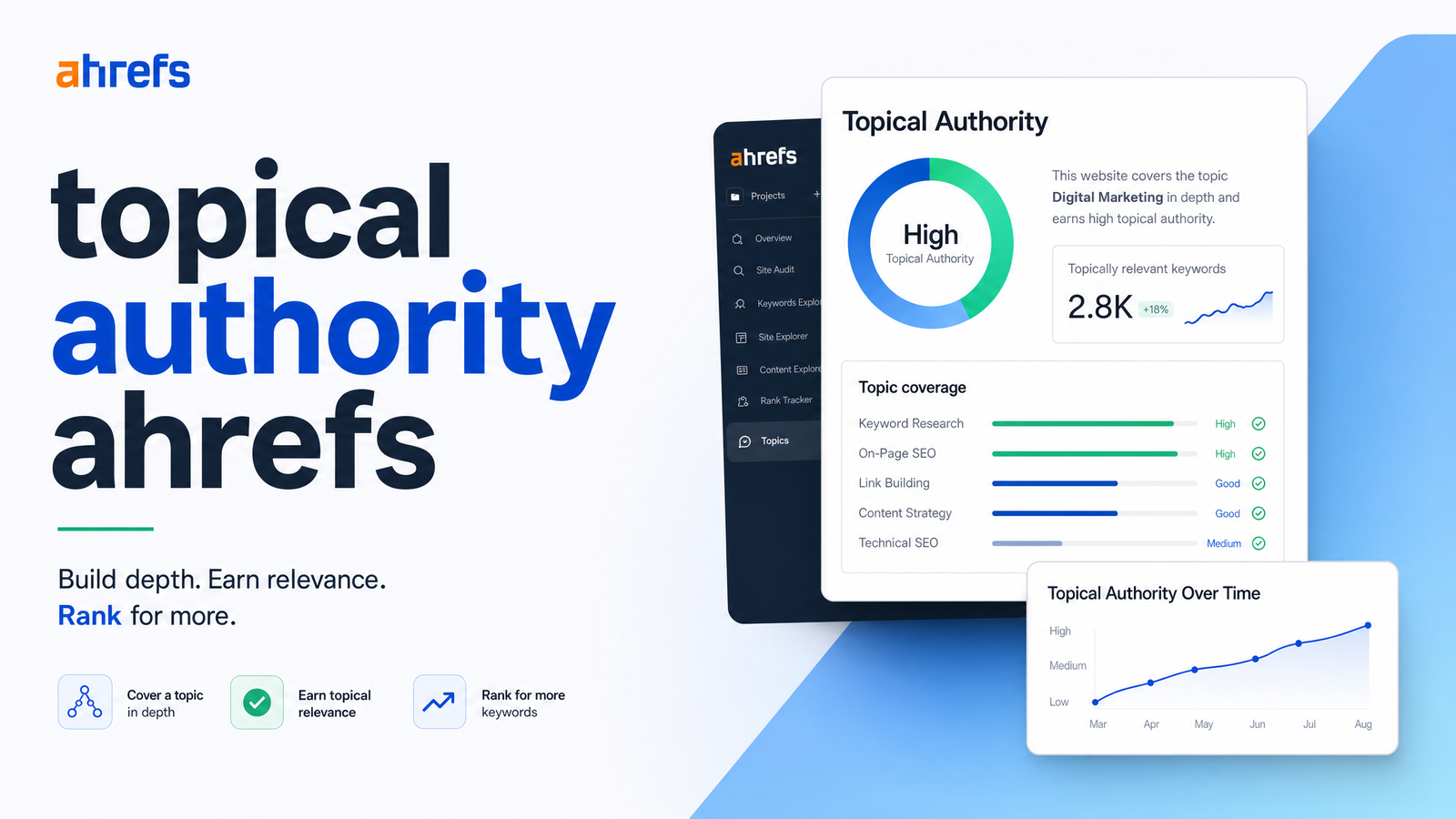
No. There is no metric inside Ahrefs labeled "Topical Authority Score." This is the single most common confusion around topical authority ahrefs searches: people assume Domain Rating (DR) is a proxy for topic-level strength, when it isn't designed to be one.
Ahrefs is explicit about this on its own website authority checker page. DR is a backlink-based authority score — it estimates the strength of a site's backlink profile on a 0-100 logarithmic scale, based on the quantity and quality of referring domains. Ahrefs itself lists topical relevance as a separate consideration when judging whether a link (or a site) actually carries authority for a given subject. Ahrefs tells you a site has strong links; it doesn't tell you whether those links, or that content, are concentrated around one coherent topic.
That distinction matters because ahrefs domain rating is often used as shorthand for "this site is authoritative," full stop. It isn't wrong, exactly — it's incomplete. A site can carry a DR of 70 and still have thin, scattered topical coverage. Another site with DR 35 can dominate a narrow niche because every page, internal link, and keyword ranking reinforces the same subject. Ahrefs gives you the backlink half of the picture. The topical half requires different tools inside the same platform — and some judgment Ahrefs can't automate for you.
Domain Rating vs. URL Rating vs. Topical Authority
Three metrics get conflated constantly, so it's worth separating them cleanly.
Domain Rating (DR) measures the strength of a site's entire backlink profile, at the domain level. It's a single number for the whole site, regardless of topic. A news publisher with DR 90 might have zero relevant authority in, say, industrial adhesives — DR doesn't care about subject matter.
URL Rating (UR) does the same job at the page level. It measures the backlink strength of one specific URL based on internal and external links pointing to it. UR is closer to topical relevance than DR because it's scoped to a page, but it's still fundamentally a link-counting metric, not a semantic one.
Topical authority is neither of these. It's the degree to which Google treats a site as a comprehensive, trustworthy source on a specific subject — built through breadth of coverage, internal linking between related pages, and consistent topical signals across content, not just links. You can read the fuller mechanics in Topical Authority SEO: The Real Framework for 2026, but the short version is: it's a coverage and relevance concept, not a backlink concept.
So when people ask about ahrefs domain rating vs topical authority, the honest answer is that they're measuring different axes entirely — "how strong are your links" vs "how complete and coherent is your subject coverage." Ahrefs' own tools do flag topical relevance qualitatively — for example, when evaluating whether a backlink is valuable, Ahrefs' guidance considers whether the linking page is topically related. That's an implicit nod that topic matters, even though no single score captures it.
If you're evaluating link-building tools generally, Best Backlink Analysis Tool: A No-BS Evaluation Framework walks through where backlink metrics genuinely help and where they mislead.
How to Approximate Topical Authority Using Ahrefs' Tools
You can't pull a single number, but you can build a reasonably solid approximation by combining four Ahrefs features. This is how to measure topical authority with Ahrefs in practice.
1. Keywords Explorer — Traffic Share and Topic Share. Run a broad seed keyword or topic cluster through Keywords Explorer, then look at the Traffic Share by Domains report. This shows which sites capture the largest slice of estimated organic traffic across all the keywords tied to that topic — not just one keyword. Growth strategist Kevin Indig has written about this exact approach in his piece on measuring topical authority, using an ecommerce example comparing Shopify and BigCommerce's traffic share across a basket of related keywords. The domain with the highest cumulative traffic share across the topic — not just one ranking — is the one with practical topic dominance. That's ahrefs topic share explained in one sentence: aggregate visibility across a keyword set, not a single ranking position.
2. Content Gap. Feed in two or three competitor URLs (or domains) that you believe have strong topical coverage, and Ahrefs' Content Gap tool will surface keywords they rank for that your site doesn't. This is one of the more useful proxies for topical completeness — it literally shows holes in your coverage relative to competitors. It won't tell you which gaps matter most for topical authority specifically (versus just traffic volume), so treat it as a starting list, not a finished plan. For a deeper method on prioritizing what Content Gap surfaces, see SEO Content Gap Analysis: A Complete Framework.
3. Content Explorer. Search a topic phrase and filter by domain or organic traffic to see how much content competitors have published on that subject and how it's performing. This gives you a rough volume-and-performance view of topical breadth — useful for spotting whether a competitor has genuinely built out a subject or just has a few strong outliers.
4. Rank Tracker — Share of Voice. Set up a tracked keyword list mapped to your topic cluster, and Ahrefs' Share of Voice metric will show your visibility trend across that whole set over time, versus competitors. This is the closest thing Ahrefs has to a topical authority trendline — but you have to build the keyword list yourself, and it only tracks what you've manually added.
Stitched together, these four reports get you a workable topical authority tool made out of Ahrefs — but note the operative word: stitched. None of these reports talk to each other natively.
What Google's API Leak Revealed: Site Focus Score and Site Radius
In 2024, a leaked internal Google API documentation set surfaced terms that gave the SEO community language for something practitioners had long suspected: Google appears to score sites on how tightly their content clusters around a core subject. Ahrefs covered this in detail in its own topical authority breakdown, highlighting two concepts from the leak: site focus score and site radius.
Site focus score, as described in the leaked documentation, appears to reflect how concentrated a site's content is around a defined subject area. A site publishing almost exclusively about one topic would trend toward a tighter, more focused score than one covering dozens of unrelated subjects.
Site radius, by contrast, seems to describe how far a given page's topic sits from the site's core focus — essentially a distance measurement between a piece of content and the site's overall center of gravity. A page far outside a site's established radius may get less benefit from the site's accumulated topical trust, even if it's well-written and well-linked.
Neither term is something you'll find as a metric in Ahrefs, Search Console, or any third-party dashboard — they're inferred concepts from leaked internal documentation, not confirmed public ranking factors. But they align closely with what practitioners already observe: sites that stay disciplined around a core subject tend to outperform sprawling, unfocused ones, even with fewer total backlinks. This is the deeper "why" behind Topic Share numbers moving the way they do, and it reinforces that chasing DR alone, without topical discipline, is an incomplete strategy.
Where Ahrefs Falls Short for Building (Not Just Measuring) Topical Authority
Ahrefs is a measurement and research tool, not a topical authority builder. Once you've used Traffic Share, Content Gap, Content Explorer, and Share of Voice to diagnose where you stand, Ahrefs hands you data exports — and then the real work starts entirely outside the platform.
Consider the actual workflow most teams run today: export Content Gap keywords to a spreadsheet, cross-reference them against existing content in a separate doc, manually cluster them into topics, brief writers, publish through a CMS, then come back to Ahrefs weeks later to re-check Share of Voice and see if it moved. Nothing in Ahrefs maps those keywords into a topic hierarchy automatically. Nothing flags which of your existing pages already cannibalize each other. Nothing generates content against the gaps it surfaced, publishes it, or loops back to re-track topic-level rank progress without you rebuilding the keyword list by hand.
This isn't a criticism of Ahrefs' core function — it's excellent at what it's built for: keyword and backlink data. But ahrefs limitations on topical authority become obvious the moment you try to run the full cycle. The manual seo workflow that results — spreadsheets bridging Content Gap exports, Rank Tracker exports, and a separate content calendar — is exactly why teams evaluating a topical authority tool checklist find Ahrefs alone doesn't clear the bar. If you want to see how the gap-to-cluster step should actually work, How to Build a Topical Authority Map covers turning raw keyword data into an actual topic structure.
Turning Ahrefs-Style Signals Into an Automated Topical Authority System
The underlying signals Ahrefs surfaces — keyword coverage gaps, traffic share by topic, competitor content breadth — are the right inputs. The problem is that Ahrefs stops at the data. Building topical authority requires acting on that data continuously: mapping topics, generating content that fills real gaps, publishing it, and re-measuring rank progress at the topic level, not just the keyword level.
Rankevra is built to automate exactly that loop. Instead of exporting Content Gap keywords into a spreadsheet, an AI-driven workflow can ingest the same category of signal — keyword coverage, gap detection, competitor breadth — and turn it directly into a topic map, generate briefs or drafts against the identified gaps, publish through a connected workflow, and track rank movement per topic cluster over time rather than per isolated keyword. That's the difference between an ai seo workflow tool and a research dashboard: one produces reports, the other closes the loop. For teams comparing what "AI-driven keyword research" should actually look like beyond Ahrefs' manual exports, AI Tool for SEO Keyword Research: What Actually Works is a useful companion read.
Frequently Asked Questions
Does Ahrefs have a topical authority score?
No, Ahrefs does not publish or display a metric called "Topical Authority Score." Its core authority metrics — Domain Rating and URL Rating — measure backlink strength, not topic-level coverage or semantic relevance. You can approximate topical authority using a combination of Ahrefs reports, but no single native score exists.
What's the difference between Domain Rating and topical authority?
Domain Rating measures the strength of a site's overall backlink profile on a 0-100 scale, regardless of subject matter. Topical authority measures how comprehensively and coherently a site covers a specific subject, based on content breadth, internal linking, and relevance — not link volume. A site can have high DR and weak topical authority in a given niche, or vice versa.
Can I use Ahrefs alone to build topical authority?
Not end-to-end. Ahrefs is strong for diagnosing gaps and measuring visibility through Content Gap, Traffic Share, and Share of Voice, but it doesn't map topics into clusters, generate content, publish it, or auto-track topic-level progress. Most teams end up manually exporting Ahrefs data into spreadsheets to manage the rest of the process.
What is Topic Share in Ahrefs and how is it calculated?
Topic Share isn't an official Ahrefs metric name — it's a practical method using Keywords Explorer's Traffic Share by Domains report across a group of related keywords tied to one topic. The domain capturing the largest cumulative estimated traffic across that keyword set is treated as having the strongest topic-level visibility, rather than judging by a single keyword ranking.
What are 'site focus score' and 'site radius' in relation to topical authority?
Site focus score and site radius are concepts that surfaced in the 2024 Google API leak, referenced in Ahrefs' own topical authority content. Site focus score appears to reflect how concentrated a site's content is around a core subject, while site radius describes how far a given page sits from that core focus. Neither is a confirmed public ranking factor, but both align with the observed advantage of staying tightly clustered around a subject rather than publishing broadly unrelated content.
Is Ahrefs Content Gap tool useful for topical authority planning?
Yes, with a caveat. Content Gap is genuinely useful for surfacing keywords competitors rank for that you don't, which highlights coverage holes relative to rivals. It doesn't prioritize which gaps matter most for topical authority specifically, so it should be treated as a raw input for planning rather than a finished topical strategy.
Topical authority isn't a score you check once inside Ahrefs — it's an ongoing system of auditing coverage, producing content against real gaps, publishing it, and tracking rank progress by topic, not just by keyword. Most teams currently run that loop by hand, exporting Ahrefs data into spreadsheets and rebuilding the process every few weeks. Rankevra automates that same cycle end-to-end, from audit to publish to track, so the work doesn't stall in a spreadsheet.
Keep reading
- Content Decay SEO: How to Detect It and Fix It for GoodLearn to detect content decay SEO issues early, rule out false positives, and build a refresh pipeline that scales — plus how to automate the whole loop.
- Headless CMS SEO: Fixing the Gaps Generic Tools MissHeadless CMS SEO breaks in three predictable places: rendering, metadata, and sitemaps. Here's the diagnostic framework to find and fix each gap.
- Google Algorithm Update Recovery: A Diagnostic FrameworkA step-by-step google algorithm update recovery framework: confirm the cause, segment the damage, benchmark against winners, and set a real timeline.