Rankevra Blog
Topical Authority Meaning: A Plain-English Definition
August 10, 2026
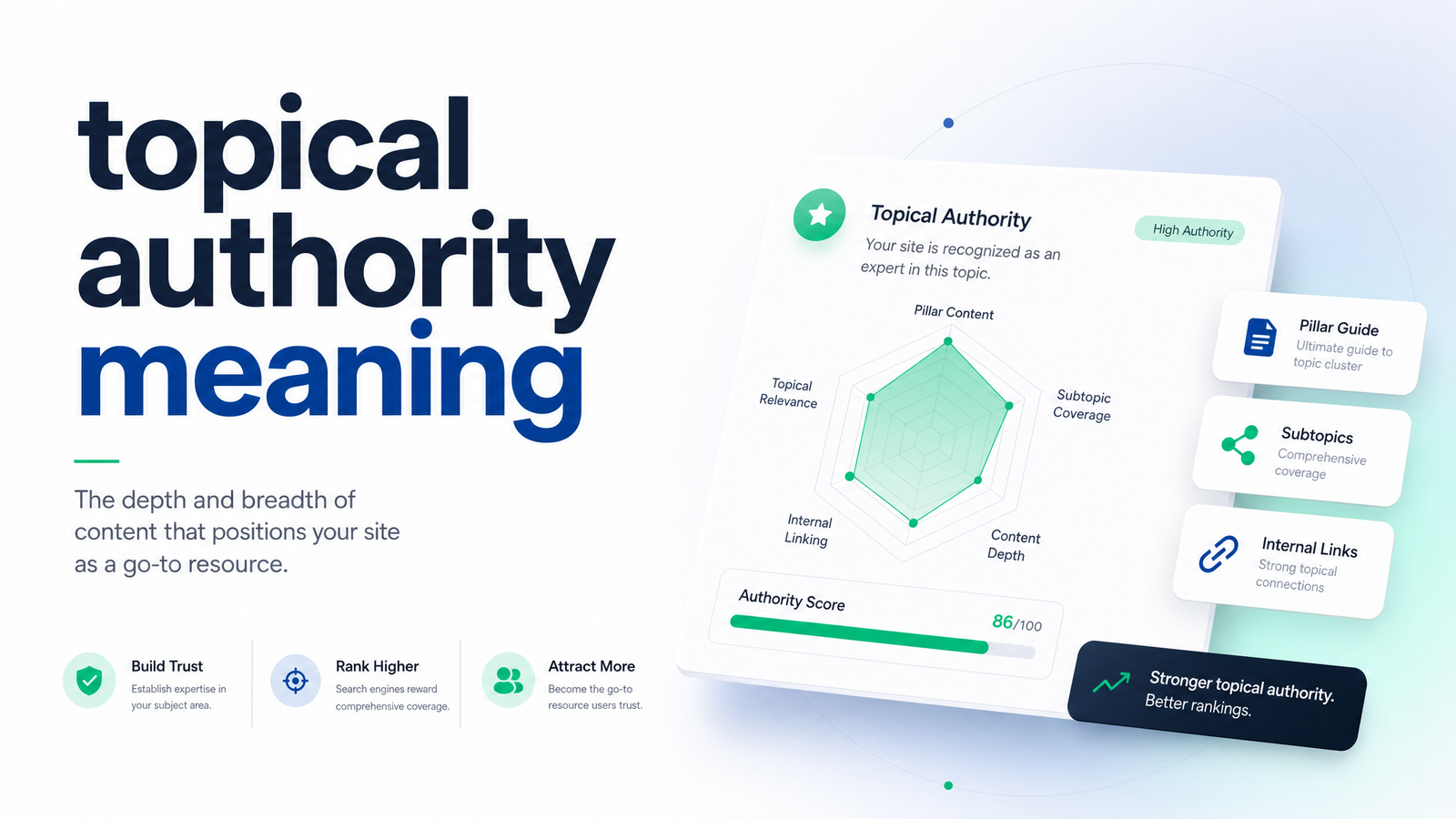
What Does Topical Authority Mean?
Topical authority means a website is recognized — by search engines and users — as a comprehensive, consistently reliable source on a specific subject, rather than a single page that happens to rank for one keyword. That's the topical authority definition in its simplest form: depth and breadth on a topic, sustained over time, not a lucky ranking.
Three ingredients matter. First, comprehensiveness: covering the subtopics, questions, and adjacent angles a researcher would expect, not just the obvious head term. Second, depth: pieces that go beyond surface-level summaries and show real understanding. Third, consistency: coverage that holds up across the site and over time, so no single "best article" is doing all the work while everything else is thin. The honest test is whether someone could land on any page in a given subject area and trust that you know what you're talking about — not just the one post that happens to rank.
Where the Term Comes From (and What Google Has Actually Confirmed)
"Topical authority" isn't a term Google invented and published in a ranking-factor document — it's an SEO industry concept built from observing how search results behave. Its roots trace to Google's 2013 Hummingbird update, which shifted ranking away from matching exact keyword strings and toward understanding the meaning behind a query — semantic search, entities, and relationships between concepts. That shift rewarded sites that clearly covered a subject in a connected way, and the SEO community started describing that pattern as topical authority.
Is topical authority a ranking factor in the strict, official sense? No — you won't find it named as one in Google's documentation. But Google has moved closer to acknowledging something like it: in 2023, reporting surfaced that Google runs a topic authority system specifically for surfacing trusted sources in News and Discover results, weighting publishers that demonstrate sustained, credible coverage of a subject over those that publish a single relevant story. That's a narrower, confirmed system rather than proof of a general "topical authority score" for all of web search — but it's meaningful evidence the underlying idea has real technical grounding, not just SEO folklore. For more on this origin story, wpseoai.com's explainer is a useful reference.
How Topical Authority Connects to E-E-A-T
Topical authority and E-E-A-T (Experience, Expertise, Authoritativeness, Trustworthiness) describe overlapping ideas from different angles: E-E-A-T is Google's Search Quality Rater framework for judging content and creators, while topical authority is the pattern of site-wide subject coverage that tends to produce high E-E-A-T signals. Search Engine Land's guide to becoming "the go-to resource on your topic" ties the two together directly.
Experience shows up as firsthand detail — specificity that only comes from actually doing the thing you're covering, repeated across your content rather than in one showcase article. Expertise is demonstrated through accuracy and depth sustained across many pieces, not a single well-researched post. Authoritativeness is largely external: other credible sites and people in your field treating you as a reference point, which is easier to earn once you've published broadly and well on a subject. Trustworthiness threads through all of it — accurate, transparent, well-sourced content across your topic cluster builds confidence a single isolated page can't. Comprehensive, consistent subject coverage is one of the most direct ways to build expertise, authoritativeness, and trustworthiness at scale.
Topical Authority vs. Domain Authority vs. Rankings
This is where most confusion starts. Topical authority vs domain authority is really a comparison between a concept and a metric: topical authority is a qualitative pattern of subject-matter depth and consistency, while Domain Authority (Moz) and Domain Rating (Ahrefs) are third-party scores built primarily from backlink profiles. A site can have a high Domain Rating from broad, unrelated link building and still have shallow, scattered coverage of any single topic. Surfer SEO's breakdown draws this contrast well: DA/DR measures link equity across the whole domain, irrespective of subject; topical authority is subject-specific and content-driven.
Ranking for individual keywords is a different confusion entirely. You can rank #1 through a well-optimized single page, strong backlinks to that page, or simply weaker competition — none of which requires topical authority. Topical authority instead shows up as a pattern: ranking well across a cluster of related terms, appearing for long-tail variations you never directly targeted, and holding those positions more resiliently through algorithm updates. One ranking is a data point; topical authority is the trend line across many related rankings.
How Search Engines and Tools Signal Topical Authority
Nobody — not Google, not a third-party tool — hands you a single "topical authority score" the way they do with Domain Rating. Instead, it's inferred from a combination of signals:
- Content depth across subtopics — how many of the relevant subtopics, questions, and entity variations within a subject you've actually published on, not just the head term.
- Internal linking patterns — whether your content on a topic links together in a logical structure, signaling to crawlers and readers that these pages form a coherent body of work rather than disconnected posts.
- Consistent publishing on a subject over time — a steady cadence of relevant content, rather than a burst followed by silence, the same pattern behind Google's news topic authority system.
- Backlinks from relevant, subject-adjacent sources — links from sites already recognized in your field carry more topical weight than the same number of links from unrelated domains.
- Entity coverage — whether your content correctly references the people, tools, concepts, and terminology a search engine's knowledge graph associates with the topic.
Most SEO tools approximate topical authority by analyzing these signals — content gaps, cluster structure, and link relevance — rather than reporting a single verified score. That's also why tools can disagree with each other; each applies its own logic to the same partial evidence. If you use Ahrefs, it's worth understanding specifically what its topical authority-adjacent metrics show — and don't, since it's a commonly misread number.
Why the Definition Matters for Your SEO Strategy
Understanding the definition changes how you plan, not just how you talk about SEO. Once you accept that topical authority is about comprehensive, consistent coverage rather than isolated wins, single-keyword content plans stop making sense — you start mapping subjects, not just search terms, prioritizing the cluster of content and internal links that support a topic rather than chasing one more high-volume keyword in isolation. It also reframes technical SEO: crawlability, site architecture, and internal linking aren't just about individual page performance — they're what allows search engines to actually perceive the topical relationships you've built.
Why Topical Authority Matters More Than Ever in SEO makes the strategic case in more depth. But the short version: a solid topical authority SEO strategy treats every new piece of content as a contribution to a larger subject footprint, not a standalone bet. That shift alone is often the difference between a site that grows steadily through algorithm changes and one that spikes and fades with individual rankings.
Once the concept clicks, the natural next question is how to build topical authority for your specific site — mapping the subtopics you're missing, structuring internal links, and sequencing content so coverage compounds instead of scattering.
Frequently Asked Questions
Is topical authority an official Google ranking factor?
No, not as a named, documented ranking signal. Google has, however, confirmed a topic authority system used specifically within its News and Discover products, which rewards publishers with sustained, credible coverage of a subject. Outside of that confirmed system, "topical authority" remains an SEO industry term describing patterns Google's algorithms appear to reward, rather than an official metric.
What's the difference between topical authority and domain authority?
Domain Authority (and Domain Rating) are third-party scores built mainly from a site's overall backlink profile, regardless of subject matter. Topical authority is a qualitative measure of how comprehensively and consistently a site covers a specific subject. A site can have a high Domain Rating from broad link building while still lacking topical authority in any one subject area.
How do you know if your site has topical authority?
The clearest signs are ranking across a cluster of related keywords rather than one isolated term, appearing for long-tail variations you never explicitly targeted, and content that holds up across an entire subject area rather than one standout page. Consistent internal linking between related pages and backlinks from other sites in the same field are supporting indicators.
Does topical authority apply to small or new websites?
Yes — topical authority is about depth and consistency within a subject, not overall site size or age. A small site that comprehensively covers a narrow niche can build topical authority in that niche faster than a larger site spreading its content across many unrelated topics.
How is topical authority different from keyword rankings?
A keyword ranking is a single data point — one page ranking for one term, which can happen through optimization, backlinks, or weak competition alone. Topical authority is the broader pattern of ranking well across many related keywords and subtopics, reflecting comprehensive coverage rather than a single successful page.
Can you have topical authority without a lot of backlinks?
To a meaningful degree, yes — comprehensive, well-structured content and strong internal linking can establish topical authority even with a modest backlink profile. That said, backlinks from other credible, relevant sources in the same subject area do reinforce authoritativeness, one of the four E-E-A-T components tied to topical authority.
Understanding the meaning of topical authority is the starting point, not the finish line — the real work is auditing where your site currently stands and identifying the subtopic gaps holding you back. For a structured approach, see the 6-step action plan or the 5-step topical authority map process, or go deeper with the full 2026 framework. If you'd rather not build that map manually, Rankevra is built to audit your existing content, cluster it by topic, surface coverage gaps, and track your topical progress — all from one AI-driven workflow.
Keep reading
- Content Decay SEO: How to Detect It and Fix It for GoodLearn to detect content decay SEO issues early, rule out false positives, and build a refresh pipeline that scales — plus how to automate the whole loop.
- Headless CMS SEO: Fixing the Gaps Generic Tools MissHeadless CMS SEO breaks in three predictable places: rendering, metadata, and sitemaps. Here's the diagnostic framework to find and fix each gap.
- Google Algorithm Update Recovery: A Diagnostic FrameworkA step-by-step google algorithm update recovery framework: confirm the cause, segment the damage, benchmark against winners, and set a real timeline.