Rankevra Blog
Paraphrase Tool: What It Does and When It Hurts SEO
August 19, 2026
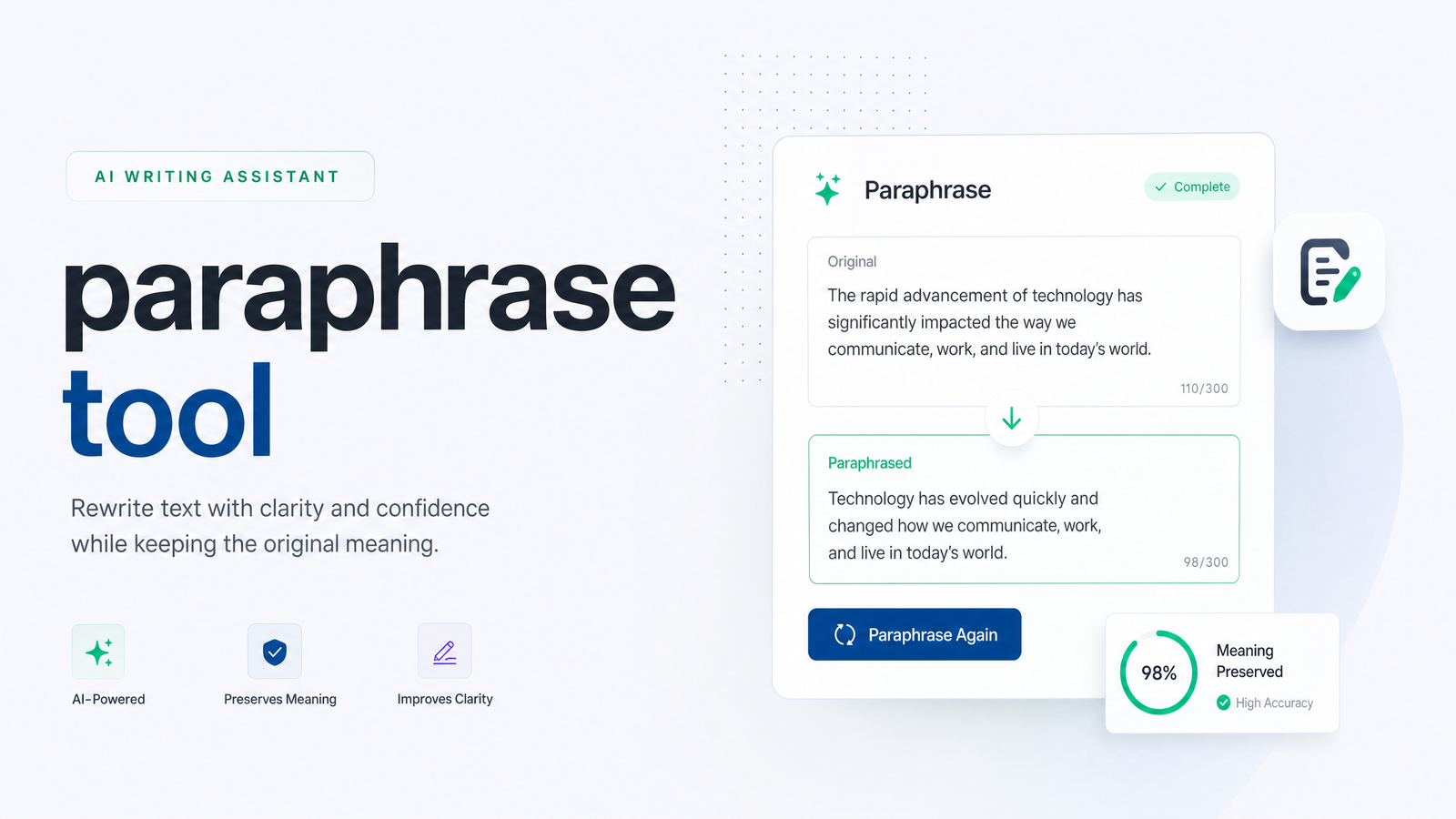
Type "paraphrase tool" into Google and you'll find plagiarism-checker sales pitches and listicles ranking near-identical tools by "accuracy score." Neither answers the question a working SEO or content lead actually has: will running text through one of these hurt my rankings, or is it a harmless shortcut?
The honest answer depends on what you're rewording and why. A paraphrase tool can save you ten minutes on a single sentence. It can also, if you lean on it to mass-produce pages, put your whole site inside a Google spam policy written specifically to catch this behavior. This article draws that line using Google's own language on scaled content abuse, and shows what a safer workflow looks like when you need to publish at volume.
What a Paraphrase Tool Actually Does
Strip away the marketing and a paraphrase tool does one narrow job: it takes text you already have and changes the wording. It doesn't research your topic, verify a claim, or add a fact you didn't already know.
There are two generations of these tools. Older, "spinner"-style tools work by synonym substitution — swapping "big" for "large," "fast" for "quick" — without real understanding of the sentence. The output is often clunky, because synonym-swapping doesn't track meaning across a paragraph.
Modern AI paraphrasing tools, built on large language models, do a more convincing version of the same job: restructuring sentences, varying phrasing, and producing grammatically clean output. Some now call this a "sentence rewriter" rather than a paraphraser, but functionally it's the same category of task: rewording input text, not generating new insight.
That distinction — rewording versus adding information — is the one to hold onto. A paraphrase tool changes how something is said, not what's true, useful, or new about it. If the input had no original value, the output won't either, no matter how fluent the AI-generated sentences sound.
Why Paraphrasing Alone Is an SEO Risk
Google has answered directly whether using a paraphrase tool is bad for SEO. Its scaled content abuse policy, part of the Search Central spam policies, targets content produced at scale where the primary goal is manipulating rankings rather than helping people — and it explicitly calls out "using AI to generate multiple pages... in bulk without adding value" alongside older tactics like spinning and scraping.
Two things about that wording matter. First, Google groups AI rewriting and old-school article spinners in the same category. There's no exemption for "it's AI, not a spinner" — as Patrick Stox's breakdown of scaled content abuse makes clear, the policy is method-agnostic. What Google's SpamBrain systems and human reviewers evaluate is intent and outcome: is this page adding something a reader couldn't already get elsewhere, or is it a reworded copy wearing fresh synonyms?
Second, this connects to duplicate content. Search engines try to identify when multiple pages say the same thing differently, since ranking ten paraphrased versions of one article defeats the point of a results page. Paraphrasing muddies exact-match duplicate detection, but doesn't fool semantic evaluation — engines increasingly compare meaning, not just strings of text. A concrete look at spun and paraphrased abuse patterns shows sites that ran manufacturer descriptions, competitor articles, or their own old posts through paraphrasing tools to generate hundreds of "unique" pages, only to see the whole batch devalued or deindexed once the pattern was identified.
The takeaway isn't that paraphrasing is forbidden. It's that Google evaluates the same signal you should evaluate yourself: does this page carry unique value, or just unique wording?
When Paraphrasing Is Actually Fine
Not every use of a paraphrase tool is a spam risk. The dividing line is scale and purpose.
Legitimate, low-risk uses:
- Rewording a single sentence you accidentally lifted too closely from a source, before publishing.
- Paraphrasing a quote from an interview or press release to match house style, while still attributing it properly.
- Adjusting a meta description or title tag that came out too similar to a competitor's, without touching page substance.
- Rewriting a boilerplate legal or "about" snippet across a few internal pages where variation, not fresh insight, is the goal.
These are editing tasks — making one page read better or avoiding a narrow, accidental collision, not manufacturing content volume.
High-risk uses:
- Running entire articles through a free paraphrase tool and publishing with light editing, at a pace no writer could sustain doing original research.
- Feeding manufacturer or supplier product descriptions through a spinner across hundreds of e-commerce pages to dodge duplicate-content flags.
- Using an article spinner (old or AI-based) to republish competitor content or your own thin pages under new wording, hoping search engines read new phrasing as new value.
If you're reaching for a paraphrasing tool because you need to hit a publishing quota rather than solve a specific wording problem, you've crossed from editing into the pattern Google's policy is built to catch. Programmatic scaling isn't inherently against the rules — but scaling wording without scaling value is exactly the failure mode a compliant approach to programmatic SEO is designed to avoid.
Paraphrase Tool vs. AI Writing Tool vs. Rewrite Workflow
These three get lumped together constantly, and picking the wrong one is where most of the risk above comes from.
A paraphrase tool takes existing text and rewords it. Input and output cover the same ground; only phrasing changes.
An AI writing tool generates new text from a prompt, brief, or set of source data — it can incorporate research, data points, or structure you specify, rather than being bound to rewording a single input document.
A rewrite workflow is broader than either: updating a page based on new information — fresh data, an updated product line, a content gap analysis, changed search intent — and restructuring the page around that reality rather than just refreshing sentences. This is what most SEO teams mean by "rewriting content for SEO," even when they reach for a paraphraser out of habit.
The practical rule: if you need to say the same thing differently, a sentence rewriter might work for a narrow edit. If you need to say something new, you need an AI writing tool fed with real inputs, or a full rewrite workflow anchored in a proper content gap analysis that identifies what's missing before anything gets generated.
A Safer Way to Scale Content Without Spinning It
Teams reach for paraphrase tools rarely out of laziness — usually it's volume pressure. Content calendars demand output, technical audits surface thin or duplicate pages needing fixes, and topical authority requires covering ground quickly. Paraphrasing looks like the fast lane. It's actually the lane that gets you flagged.
Rankevra is built around the alternative: an AI SEO workflow where content generation is informed by an actual audit of your site and topic gaps, not by rewording something that already exists. Instead of starting from a competitor's article and reworking its sentences, the workflow starts from what your site is missing — the subtopics, questions, and angles a gap analysis surfaces — and produces content built to fill that gap, then publishes it and tracks how it ranks, all in one system.
That matters for the goals behind most paraphrasing shortcuts: more organic traffic, fixed technical issues, and stronger topical authority. Traffic doesn't grow from reworded pages saying what's already ranking; it grows from pages that answer something current results don't. Technical audits catch the duplicate and thin-content problems paraphrasing tries to paper over, instead of masking them with synonym swaps. Topical authority compounds when every page adds a genuinely new angle, not when it recycles existing ones in new words.
If your team is weighing a paraphrase tool against actually solving the content gap, look at Rankevra's end-to-end AI SEO workflow instead — audit, content, publishing, and rank tracking without the "reword and hope" step in between.
Frequently Asked Questions
Will Google penalize me for using a paraphrase tool?
Not automatically — the tool itself isn't the trigger. Google's scaled content abuse policy targets the pattern of publishing reworded content at scale without adding value, regardless of whether a human, spinner, or AI tool produced it. Occasional, narrow paraphrasing carries essentially no risk; running whole pages through a paraphraser to mass-produce content does.
What's the difference between a paraphrase tool and an AI writing tool?
A paraphrase tool reworks existing text into different wording without adding new information. An AI writing tool generates new content from a prompt or data source, capable of incorporating research, structure, or facts that weren't in any single input document. If you need new value on the page, only the second category can deliver it.
Can I use a paraphrase tool to avoid plagiarism when quoting sources?
Yes — a legitimate low-risk use, provided you still attribute the original source and don't misrepresent the quote's meaning. It becomes a problem only when the "quote" is really an entire article or product description run through the same process.
Are free paraphrase tools safe to use for blog content?
They're safe for small, targeted edits — fixing an accidentally close sentence or varying a meta description — but risky as a production method for full posts. Free paraphrase tools tend to produce especially generic, synonym-heavy output, easier for readers and semantic duplicate-detection systems to spot as unoriginal.
How is paraphrasing different from rewriting for SEO?
Paraphrasing changes wording while keeping the same information; rewriting for SEO changes the page based on new information — updated data, a content gap analysis, or a shift in search intent. Rewriting can involve some paraphrasing as a mechanical step, but its purpose is adding or correcting substance, not just varying phrasing.
Can paraphrased content ever rank well in search?
Rarely, and not durably. A single reworded page might rank briefly with little competition, but pages built purely on unique wording without unique value tend to underperform or get devalued once patterns of scaled content abuse are identified. Content that ranks and stays ranked typically answers something existing pages don't, which paraphrasing alone can't produce.
Standalone paraphrasing tools can only ever deliver surface-level uniqueness — different words wrapped around the same information. Rankevra is built for the alternative: audit-informed, original content plus publishing and rank tracking in one workflow, so your team can stop paraphrasing and praying and start building pages that actually earn their rankings.
Keep reading
- Content Decay SEO: How to Detect It and Fix It for GoodLearn to detect content decay SEO issues early, rule out false positives, and build a refresh pipeline that scales — plus how to automate the whole loop.
- Headless CMS SEO: Fixing the Gaps Generic Tools MissHeadless CMS SEO breaks in three predictable places: rendering, metadata, and sitemaps. Here's the diagnostic framework to find and fix each gap.
- Google Algorithm Update Recovery: A Diagnostic FrameworkA step-by-step google algorithm update recovery framework: confirm the cause, segment the damage, benchmark against winners, and set a real timeline.