Rankevra Blog
Search Engine Basics: How Google Really Works in 2026
August 15, 2026
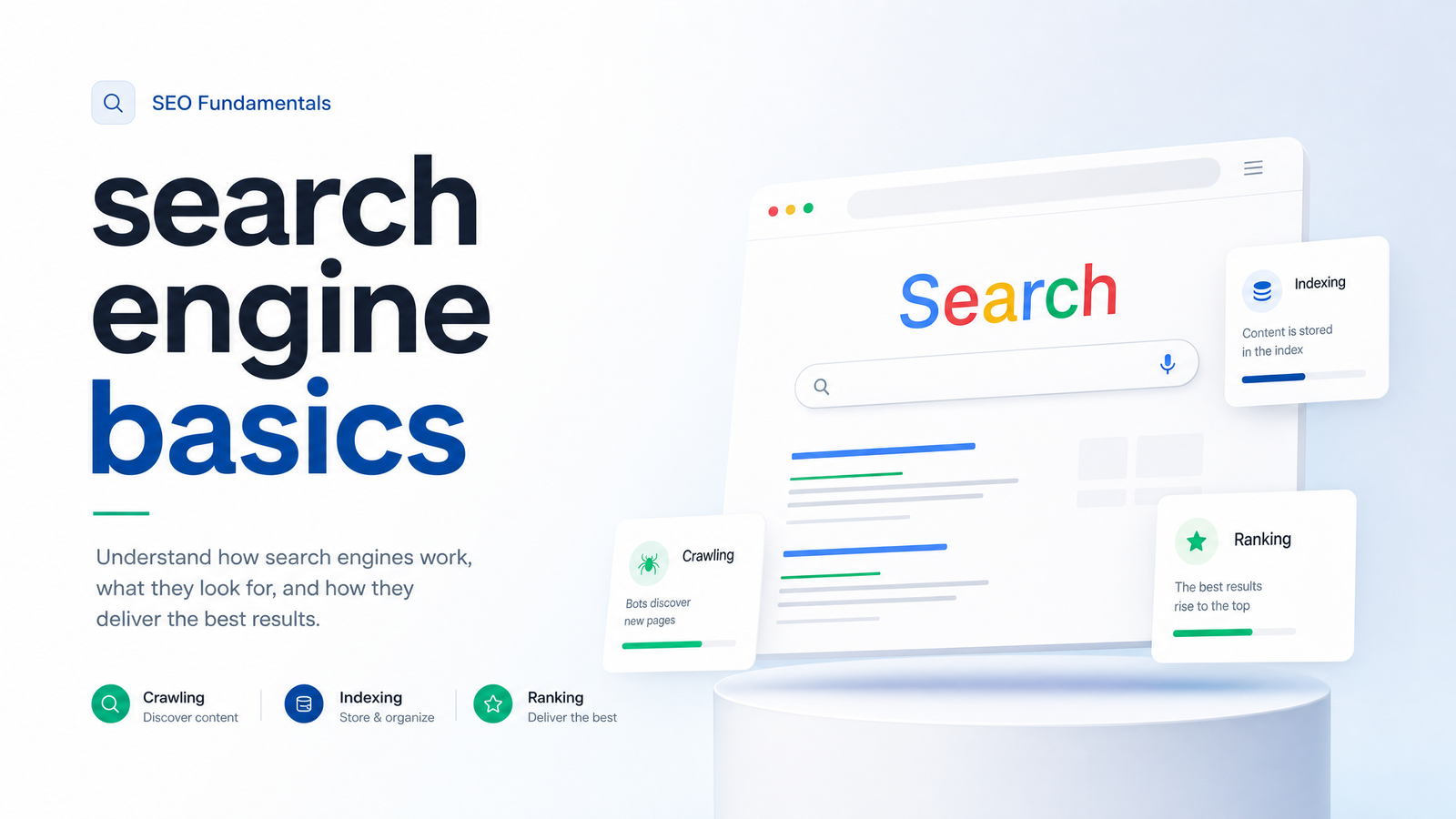
Most SEO content jumps straight to advanced tactics — topical maps, schema markup, link velocity — and leaves beginners guessing at the machinery underneath. Before any of that makes sense, you need the search engine basics: what a search engine actually does, how a page moves from "published" to "ranked," and why that process still matters when everyone's talking about AI Overviews and chatbots. This is the foundational layer everything else in SEO is built on.
What Is a Search Engine, Really?
A search engine is a system that crawls the web, stores what it finds in a searchable index, and ranks that content to answer a specific query. That's the whole search engine definition in one sentence — three jobs, done continuously, at a scale of trillions of pages.
That's different from a directory, which is a curated, human-sorted list of sites organized into categories — think of the old Yahoo directory or a niche industry listing site. A directory doesn't crawl the open web or rank pages algorithmically; it just displays what someone manually submitted. A search engine is also not the same as an AI chatbot. A chatbot like ChatGPT generates a conversational answer from a trained model, and increasingly pulls in live web results too — but the underlying retrieval still depends on an index built by crawling, the same core process search engines have used for decades.
Google holds roughly 89–91% of global search market share heading into 2026, which is why it dominates SEO conversations. But Bing still matters — it powers Microsoft Copilot's web results and holds a meaningful slice of desktop search, particularly in enterprise environments. Optimizing for "search engines" plural, not just Google, keeps your site resilient as the search landscape fragments.
How Search Engines Work: Crawling, Indexing, Ranking
Understanding how search engines work step by step removes most of the confusion beginners run into. Every query response you've ever seen from Google is the output of three sequential stages: crawling, indexing, ranking. Skip a stage, or fail one, and your page won't appear — regardless of how good the content is.
Crawling: How Search Engines Discover Pages
Crawling is the discovery phase. Automated bots — Googlebot is the best known — follow links from page to page, and also read XML sitemaps you submit, to find URLs that exist on the web. If a page has no internal links pointing to it and isn't in a sitemap, a crawler may never find it at all.
Large sites also run into crawl budget — the finite number of pages a search engine is willing to crawl on your site within a given timeframe. Sites with thousands of thin, duplicate, or low-value pages can burn through that budget before crawlers ever reach the pages you actually want indexed. This is one of the most common technical blind spots for growing sites, covered in more depth in how to fix technical SEO issues.
Indexing: How Content Gets Stored and Categorized
Being crawled is not the same as being indexed, and this is where most beginner confusion lives. Indexing is the step where a search engine stores and organizes a page's content in its database — typically structured as an inverted index, which maps words and phrases to the list of pages containing them, so a query can retrieve matches almost instantly rather than scanning the entire web in real time.
A page can be crawled and still excluded from the index for several reasons: a noindex tag, thin or duplicate content, a canonical tag pointing elsewhere, poor internal linking that signals low importance, or the page simply not clearing the quality bar the search engine applies before committing storage to it. This is why a page can be live, functional, and technically crawlable, yet invisible in search results. Checking indexing status directly — rather than assuming it — is a core habit; Google Search Console tips that actually drive action walks through exactly how to verify it.
Ranking: How Search Engines Choose What to Show First
Once a page is indexed, ranking decides its position for any given query. This is a scoring process, not a single checkbox — search engines evaluate relevance (does this page actually answer the query), authority (can this source be trusted on the topic), and experience (is the page usable, fast, and well-structured) simultaneously, then rank pages against each other for that specific search. Systems like RankBrain and BERT are part of how Google interprets query meaning and context rather than matching keywords literally, which is why exact-match phrasing matters far less than it used to.
The Ranking Factors That Matter Most, in Plain Terms
Search engine ranking factors number in the hundreds, but nearly all of them roll up into five practical categories:
- Relevance — does the page's content genuinely match search intent, using the language real searchers use, not just the keywords a brand prefers internally.
- Content quality and E-E-A-T — experience, expertise, authoritativeness, and trustworthiness. Google weighs whether content reflects real, demonstrated knowledge, particularly on topics where inaccurate information carries real-world consequences.
- Links and authority — other reputable sites linking to yours still function as a vote of confidence, and topical link relevance tends to matter more than raw volume.
- Technical health and Core Web Vitals — page speed, mobile usability, and stability metrics like Largest Contentful Paint and Cumulative Layout Shift. These don't override weak content, but poor technical health can cap how well strong content performs.
- User experience signals — clear navigation, readable layout, and content that satisfies the query without forcing a searcher to bounce back to results.
None of these factors work in isolation — a technically flawless page with thin content won't outrank a well-optimized competitor, and vice versa. Once you understand these categories, tracking how your pages actually perform against them over time matters more than guessing; see how to choose the best SEO rank tracker in 2026 for what to measure and how often.
Do the Basics Still Matter in the Age of AI Search?
Yes — and the data backs this up. AI Overviews and AI-powered answers are reshaping how results are displayed, and early 2026 data shows they're compressing click-through rates on traditional organic listings, particularly for informational queries where an AI summary can fully satisfy the searcher without a click. That's a real shift in user behavior, and it's understandably made people ask whether SEO still matters at all.
But here's what hasn't changed: AI Overviews are generated from indexed, ranked web content. Google doesn't build these summaries from nothing — it pulls from pages that were already crawled, indexed, and scored highly enough to be trusted as sources. If your page was never indexed in the first place, it can't be surfaced in an AI Overview any more than it could rank on page one of classic search. The mechanics underneath AI search are the same mechanics this article has walked through; the fundamentals haven't been replaced, they've become the entry ticket to a new display format.
This is precisely why "foundations first" is the right way to think about SEO in 2026. Chasing AI-specific tactics before your site is reliably crawled, cleanly indexed, and competitively ranked is optimizing a layer that doesn't exist yet for you. Get the basics solid, and you're positioned for both classic search and whatever AI-driven format comes next.
A Simple Starter Checklist to Apply the Basics
Turn the theory into action with a short SEO basics checklist before moving on to anything advanced:
- Verify indexing status for your important pages — don't assume publishing equals indexing.
- Submit and maintain an XML sitemap so crawlers reliably discover new and updated content.
- Fix crawl errors — broken links, redirect chains, and blocked resources that waste crawl budget or stop discovery outright.
- Target real queries, not internal jargon — write for the language your audience actually searches.
- Track rankings over time, not just once, so you can see whether changes are actually working.
For a deeper walkthrough on catching technical problems before they cost you visibility, the site audit tool guide explains exactly what a proper audit should check. And once you're ready to target queries deliberately rather than guess, AI tools for SEO keyword research that actually work is the natural next step.
How Rankevra Handles the Basics on Autopilot
Every item on that checklist is simple in concept and tedious in practice — especially at scale, and especially when you're running audits, tracking, and publishing across multiple disconnected tools. That's the exact gap an AI SEO tool is built to close.
Rankevra continuously audits your site for crawlability and indexability issues, flags the pages search engines are skipping, tracks your rankings as they move, and helps publish optimized content — all from one workflow instead of five separate logins. Rather than manually checking Search Console every week to confirm a page got indexed, or exporting rank data into a spreadsheet, you get the fundamentals monitored automatically, so your attention goes toward strategy rather than maintenance.
Frequently Asked Questions
What is a search engine in simple terms?
A search engine is a system that crawls the web to discover pages, stores relevant ones in a searchable index, and ranks them to answer a specific query as accurately as possible. It's fully automated and works at the scale of trillions of pages, unlike a manually curated directory.
What are the three main steps a search engine uses to show results?
The three stages are crawling (discovering pages via links and sitemaps), indexing (storing and organizing content so it can be retrieved instantly), and ranking (scoring indexed pages against each other for relevance, authority, and experience). A page must clear all three stages to appear in search results.
Is Google the only search engine that matters for SEO?
No — Google holds roughly 89–91% of global search share, making it the priority, but Bing still powers Microsoft Copilot's web results and retains meaningful desktop usage. Optimizing purely for one engine can leave visibility on the table as AI-powered search tools diversify where results come from.
How long does it take for a new page to get indexed by Google?
There's no fixed timeline — it can range from hours to several weeks depending on your site's crawl frequency, authority, and how easily the page can be discovered via internal links or sitemaps. Submitting the URL directly through Search Console and ensuring strong internal linking typically speeds the process up.
Do AI tools like ChatGPT and Google AI Overviews replace traditional search engines?
No — AI Overviews and similar tools still rely on crawled, indexed, and ranked web content as their source material. If a page was never indexed or well-ranked, it can't be pulled into an AI-generated answer either, which means traditional SEO fundamentals remain the foundation underneath AI search.
What's the difference between crawling and indexing?
Crawling is discovery — a bot finds a page by following links or reading a sitemap. Indexing is storage and organization — the search engine decides whether that page's content is worth adding to its searchable database. A page can be crawled without ever being indexed if it's thin, duplicate, blocked, or judged low-quality.
Ready to stop manually checking whether your pages are crawled, indexed, and ranking? Rankevra continuously audits your site's crawlability and indexability, tracks your rankings as they shift, and publishes optimized content on your behalf — so the fundamentals stay handled while you focus on growth.
Keep reading
- Content Decay SEO: How to Detect It and Fix It for GoodLearn to detect content decay SEO issues early, rule out false positives, and build a refresh pipeline that scales — plus how to automate the whole loop.
- Headless CMS SEO: Fixing the Gaps Generic Tools MissHeadless CMS SEO breaks in three predictable places: rendering, metadata, and sitemaps. Here's the diagnostic framework to find and fix each gap.
- Google Algorithm Update Recovery: A Diagnostic FrameworkA step-by-step google algorithm update recovery framework: confirm the cause, segment the damage, benchmark against winners, and set a real timeline.