Rankevra Blog
SEO A/B Testing: A Practical Framework for Real Sites
August 28, 2026
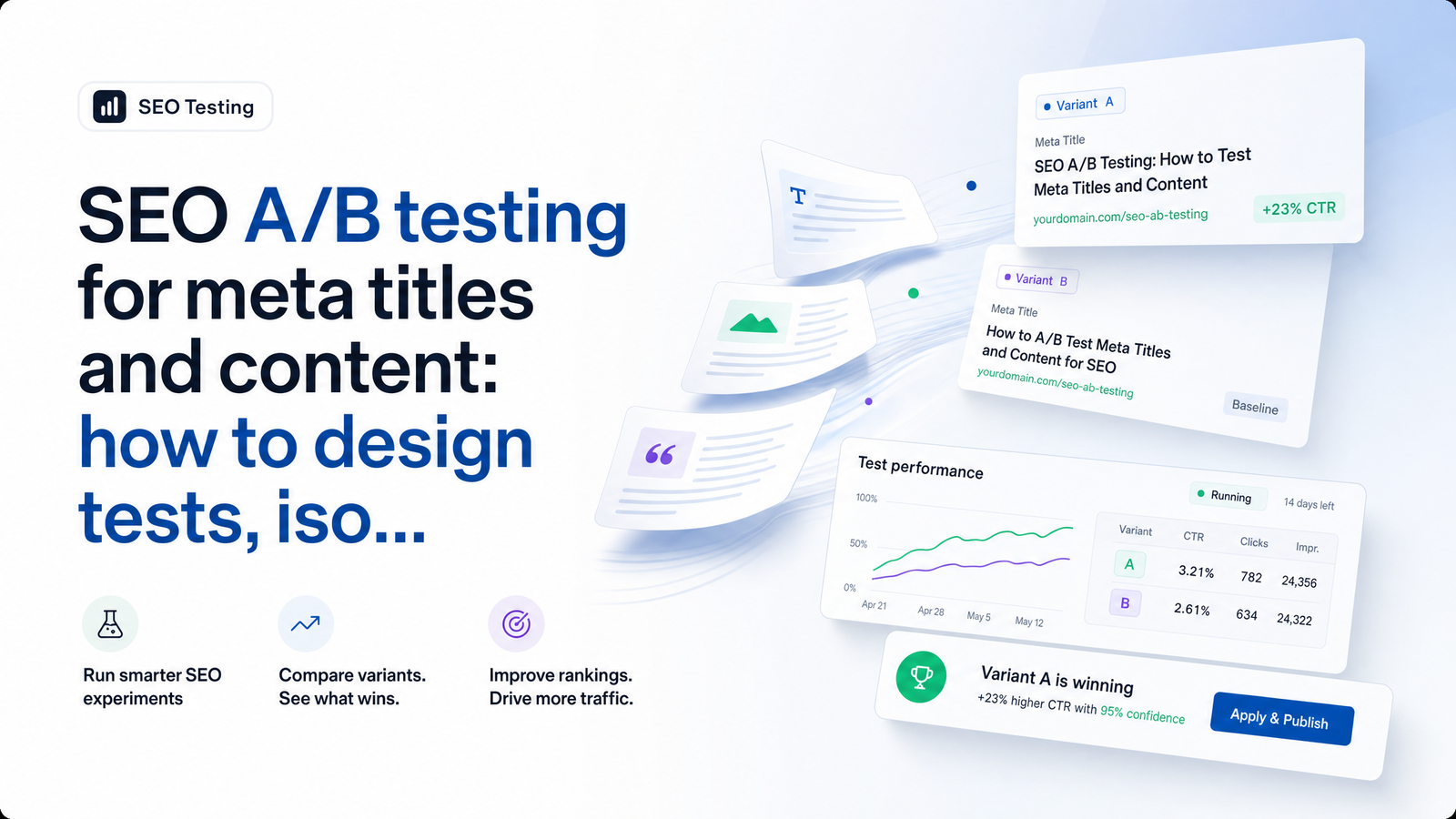
Most site owners who claim they've "A/B tested" a title tag haven't tested anything — they've made a change and watched a graph move. That's why so many SEO teams misattribute traffic swings to changes that had nothing to do with the outcome. This guide is for lean teams and normal-sized sites — not the thousands-of-pages world of enterprise platforms like SearchPilot — who want a rigorous but achievable way to run SEO A/B testing and actually trust what the data tells them.
Why Most "SEO A/B Tests" Aren't Actually Tests
A before-and-after SEO comparison works like this: change a title tag, wait two weeks, see traffic go up, declare victory. The problem is that dozens of other things happened in those two weeks too. Google may have rolled out an algorithm update. Seasonal demand may have shifted. A competitor may have dropped out of the top ten. A SERP feature may have appeared or disappeared above your listing. Any one of these could produce the exact same traffic movement you're crediting to your title change.
A controlled experiment in SEO requires something a simple before/after never has: a comparison group that experienced the same external conditions but didn't receive your change. Without that control group, you have a correlation, not a causal claim. This matters when you're about to tell a client or a boss that a specific edit drove a specific result — because if you're wrong, your reporting stops being trusted regardless of how right you eventually are.
This doesn't mean rigorous testing is only for sites with massive page counts. It means the test needs structure: a hypothesis, a control, one isolated variable, and enough time and traffic to separate signal from noise.
Designing a Test You Can Actually Trust
The core problem with adapting enterprise SEO test design to a normal site is scale — you can't run a Bayesian time-series model with statistical confidence on 40 pages the way you might on 4,000. But you can still build something defensible.
Start by grouping comparable pages: a set that share a template, similar traffic levels, similar keyword intent, and similar current ranking positions — product pages, blog posts in the same category, or location pages, for example. From that group, split into a test set and a control group SEO teams leave untouched. The split doesn't need to be 50/50; even an 8-page test group against a 12-page control group of similar pages is workable, as long as the two groups are genuinely comparable before you start.
Next, write a specific SEO hypothesis — not "let's see if this helps" but something falsifiable: "Adding the primary keyword to the first 60 characters of the title tag will increase click-through rate on the test group by at least 15% relative to the control group over six weeks." A vague hypothesis produces a vague, arguable result. A specific one gives you a clear pass/fail line before bias creeps in.
Finally, choose exactly one variable to change across the entire test group. This is where most self-run tests fall apart — someone updates the title, rewrites the meta description, and adds an FAQ block in the same edit, then can't explain which change moved the needle.
Isolating the Variable: Titles vs. Content vs. Both
Title tag changes and content changes work through different mechanisms, and conflating them is the single most common way to destroy interpretability in an SEO test.
Meta title testing primarily affects click-through rate — how often someone clicks your result when it appears in the SERP at a given position. A better title doesn't usually change where you rank; it changes how many of the people who already see you decide to click. Content changes, by contrast, primarily affect relevance signals and can move actual ranking position — rewriting a page to more thoroughly answer a query, adding depth, or restructuring for a different intent can shift where Google places you, which then indirectly changes both impressions and clicks.
Because these two levers act on different parts of the funnel, test one variable at a time. Run a title tag vs. content change test in isolation — pure title tests should leave body content untouched, and content tests should leave the title alone — before layering in a second variable. If you truly need to test both eventually, sequence them: run the title test, let it resolve, roll out or discard the change, then start a fresh content test from the new baseline. Bundling both into one edit means that if traffic moves, you'll never know whether it was the CTR effect from the title or the relevance effect from the content, and you'll be tempted to credit whichever explanation is more convenient.
What Can Wreck Your Results (and How to Avoid It)
Several confounding variables in SEO testing can quietly invalidate an otherwise well-designed test, and most are invisible unless you're watching for them specifically.
- Algorithm updates mid-test. If Google rolls out a core update or a targeted update while your test is live, any movement in either group could be the update, not your change. Check Google's official update announcements and search visibility trackers against your test window — if an update overlaps your test period, extend the test or discard the affected window rather than reporting results as clean.
- Seasonality. Comparing a test group's performance in December against a control baseline from October, for retail-adjacent queries especially, will confuse seasonal demand with your treatment effect.
- Cannibalization between test and control pages. If pages in both groups target overlapping keywords, a ranking shift in one can mechanically push the other up or down in the SERP, contaminating both sides of the comparison.
- SERP feature changes. A new featured snippet, People Also Ask block, or AI Overview appearing above your listing can suppress CTR independent of anything you changed — and can affect test and control pages unevenly if they don't share identical SERP layouts.
- Insufficient traffic or sample size. Pages with low impression volume produce CTR and ranking data too noisy to draw conclusions from within a normal test window; small absolute numbers swing wildly and look like "results" when they're really just variance.
- Running the test too short. Cutting a test off the moment you see the direction you hoped for is one of the fastest ways to report noise as a finding. Google also needs time to recrawl and re-render changed pages before any effect — real or not — even shows up in the data.
Pulling clean position and CTR data across your test and control groups over the full window matters here, which is where a dependable rank tracker earns its keep — manual spot-checks in Search Console are fine for a handful of pages, but they get unreliable fast once you're tracking two groups over several weeks.
Reading Results Without Fooling Yourself
The most common misread in SEO A/B testing is treating a CTR increase as proof of a ranking improvement, or vice versa. They are different metrics measuring different things, and confusing CTR vs. ranking position leads directly to wrong conclusions. A title change can lift CTR at the exact same average position — meaning your relevance to Google didn't change, but your appeal to searchers did. A content change can lift ranking position while CTR at that position stays flat or even drops, because a new position often comes with new SERP neighbors and different competing snippets. Pull both metrics separately from Google Search Console and evaluate them against their respective hypothesis — don't let a good number on one metric paper over a flat or negative number on the other.
Statistical significance in SEO doesn't require a statistics degree, but it does require restraint. In plain terms: a result is more trustworthy when the gap between test and control is large relative to the normal day-to-day variance you saw in the weeks before you started, and when it holds steady rather than spiking once and reverting. Enterprise platforms often use CausalImpact, Google's own Bayesian Structural Time Series model, to estimate what a page's traffic would have looked like without the change, then compare it to what actually happened — giving a confidence interval around the effect. You don't need that level of statistical machinery for a normal-sized site, but you should borrow the underlying discipline: don't call a result before you can see it persist for at least a few consecutive weeks, and be honest that a single-week spike is not a trend.
As a practical baseline, most title tests need three to six weeks of stable data — beyond however long it takes Google to recrawl the pages — before the comparison means anything, and low-traffic pages need the longer end of that range. If your test and control groups show a persistent, directionally consistent gap that's noticeably larger than the pre-test variance, you likely have a real effect. If the gap is small, inconsistent week to week, or disappears the moment you look at a longer window, you're probably looking at noise.
Rolling Out Winners Without Redoing the Work
Once a test genuinely wins, the value comes from applying the pattern — not just the single edit — sitewide. If a title formula (keyword placement, length, use of a modifier like a year or "guide") wins in the test group, apply that formula across the rest of the comparable page template, not just to the pages you happened to test.
Don't stop tracking after rollout. Confirm the effect holds at scale — a pattern that wins on eight pages should still show a similar lift when applied to eighty, but it's worth verifying rather than assuming. This is also the point where results need to go into a reporting dashboard stakeholders can see, framed honestly around what was tested, for how long, and against what control — the same evidence-based rigor worth applying any time you evaluate a ranking-factor claim, as with Core Web Vitals.
The hard part of SEO A/B testing was never coming up with a hypothesis — it's the discipline of tracking what changed, when, across which pages, and what happened to rankings, CTR, and traffic every week for a month or more. That's exactly the manual overhead Rankevra automates: audits, content publishing, and rank tracking in one system, so your test data stays organized without a spreadsheet falling out of date the moment someone forgets to update it.
Frequently Asked Questions
How long should an SEO A/B test run before I trust the results?
Most title and content tests need three to six weeks of stable data after Google has fully recrawled the changed pages, and low-traffic pages need the longer end of that range. Trust a result only once the gap between test and control groups holds steady across multiple consecutive weeks rather than appearing as a single spike.
Can I A/B test meta titles without hurting my rankings during the test?
Yes — title changes primarily affect click-through rate, not ranking position, so a title test alone is unlikely to meaningfully hurt rankings. Keep the test isolated to titles only, leaving body content and internal linking untouched, so any ranking movement you do see can't be blamed on the title change.
What's the difference between testing for CTR and testing for ranking position?
CTR testing measures whether more people click your result at the same average position, mainly driven by title and description appeal. Ranking position testing measures whether Google moves you up or down the SERP, mainly driven by content relevance and quality — the two require separate hypotheses and shouldn't be conflated.
How many pages do I need to run a valid SEO split test?
There's no fixed minimum, but you need enough comparable pages split into test and control groups to see a consistent pattern rather than one outlier page driving the result. A dozen well-matched pages split across test and control, with sufficient impression volume, can produce a defensible result even without the thousands of pages enterprise platforms use.
Does changing meta titles during a Google algorithm update ruin the test?
It can, because any movement during that window could be the update rather than your title change. If a confirmed algorithm update overlaps your test period, either extend the test until the update's impact stabilizes or discard that window from your analysis rather than reporting the result as clean.
What tools can I use to run an SEO A/B test if I don't have enterprise software?
Google Search Console is the free starting point for pulling CTR and position data on your test and control groups. Beyond that, a reliable rank tracker to monitor both groups consistently over the full test window is the main tooling requirement — you don't need a dedicated enterprise testing platform to run a valid, smaller-scale test.
Keep reading
- Content Decay SEO: How to Detect It and Fix It for GoodLearn to detect content decay SEO issues early, rule out false positives, and build a refresh pipeline that scales — plus how to automate the whole loop.
- Headless CMS SEO: Fixing the Gaps Generic Tools MissHeadless CMS SEO breaks in three predictable places: rendering, metadata, and sitemaps. Here's the diagnostic framework to find and fix each gap.
- Google Algorithm Update Recovery: A Diagnostic FrameworkA step-by-step google algorithm update recovery framework: confirm the cause, segment the damage, benchmark against winners, and set a real timeline.