Rankevra Blog
SEO for SaaS: The Framework Generic Advice Misses
August 25, 2026
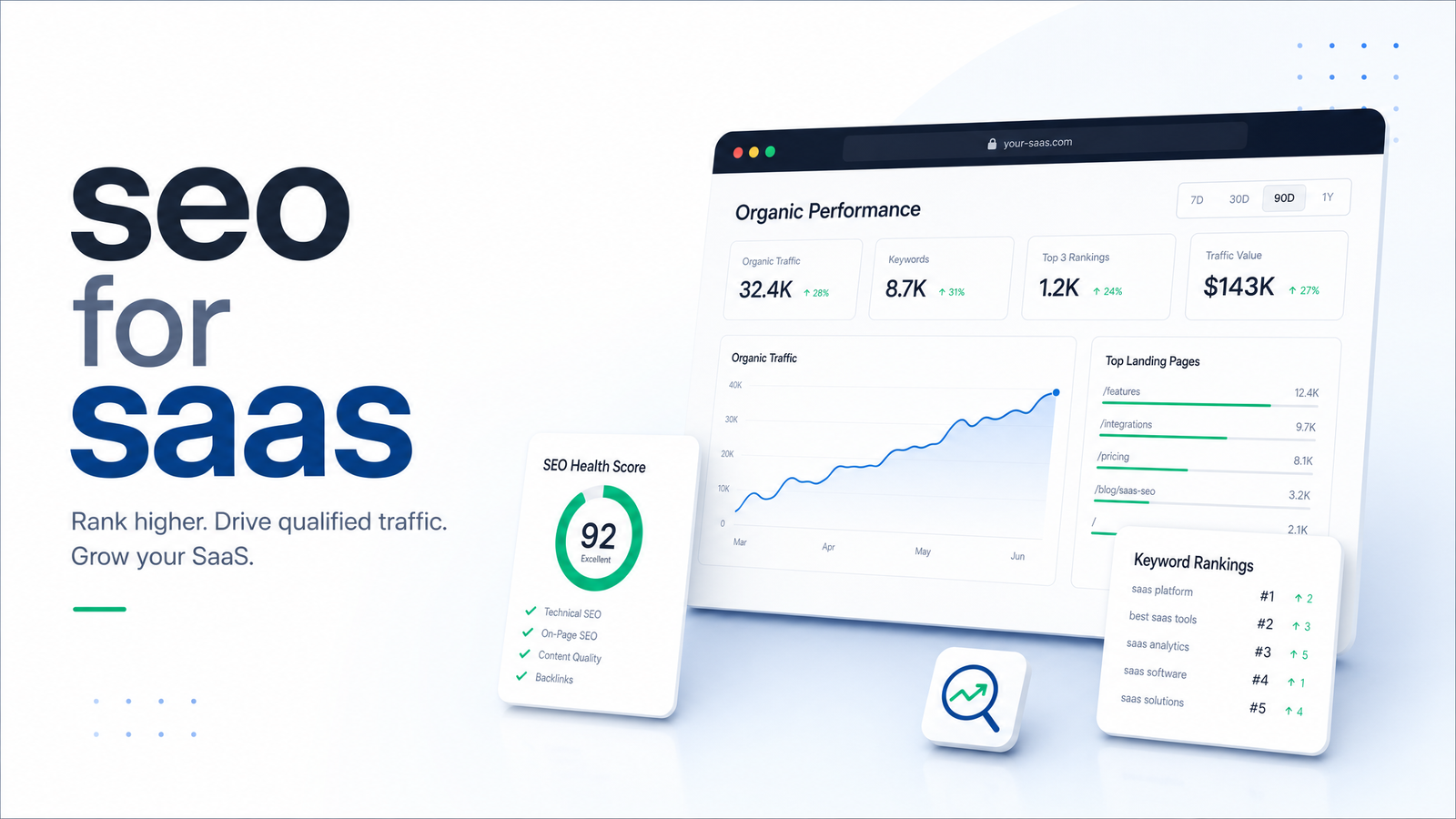
Most SaaS teams don't have a content problem. They have a mismatch problem. They publish consistently, rank for reasonable keywords, and still watch traffic climb while trial signups stay flat — because the standard SEO playbook was built for a single purchase decision, not a recurring-revenue product evaluated by five or six stakeholders over weeks or months.
Why Generic SEO Advice Fails SaaS Companies
Generic SEO advice optimizes for volume: find high-search keywords, write comprehensive posts, build links, wait. That works for a local business or a one-time-purchase ecommerce brand. It works poorly for SaaS because the B2B buying journey is long and multi-touch — buyers research alone, compare vendors quietly, loop in colleagues, and often don't fill out a form until they've already narrowed the field to two or three options. A blog post that answers "what is [broad category term]" might rank on page one and pull thousands of visits without ever reaching someone in that evaluation window.
This is also why inbound lead quality is such a persistent complaint inside SaaS marketing teams. Traffic and pipeline are treated as the same metric when they aren't even correlated most months. A saas seo strategy built around search volume alone will hit its traffic goals and miss its revenue goals, and leadership will eventually notice the gap. The fix isn't more content — it's mapping content to where buyers actually are in their decision, and treating seo for saas as a pipeline discipline rather than a publishing calendar.
Map Content to the SaaS Buying Journey, Not Just Search Volume
SaaS organic strategy needs three content types running at once, not sequentially:
Educational (TOFU) content — "how to" guides, definitions, industry explainers — builds awareness and topical footprint. It's necessary for authority but converts at low rates because readers aren't evaluating vendors yet.
Comparison and use-case content (MOFU) — "X vs. Y," "best tools for [job]," "[category] for [industry]" — reaches people actively narrowing options. This is where product-led SaaS companies tend to under-invest, treating it as a lower-priority "sales enablement" asset instead of a core SEO asset.
Decision-stage content (BOFU) — alternatives pages, pricing-comparison pages, migration guides — reaches buyers close to a decision. These pages rank for lower search volume but convert dramatically higher than blog traffic, because everyone landing on "[Competitor] alternatives" is already shopping.
The practical implication: don't wait until you've "earned" traffic to build bottom-of-funnel SEO content. SaaS comparison pages and alternatives pages should go live early, even against competitors with far more domain authority, because a handful of qualified visitors from a comparison page routinely outproduces hundreds of blog visitors in trial signups. If you're not sure which comparison and use-case pages are missing from your site relative to competitors, a structured content gap analysis will surface them faster than manual keyword brainstorming. For teams building this out stage by stage, the SaaS SEO roadmap by company stage breaks down what to prioritize at each growth phase.
Fix the Technical Layer Product-Led Sites Ignore
Technical SEO for SaaS isn't the same exercise as technical SEO for a brochure website, and treating it that way is why rankings stall even when content is strong.
The core issue: SaaS sites are rarely just a marketing site. There's usually a marketing domain, a documentation or help-center subdomain, and an app subdomain built as a JavaScript-heavy single-page application. Crawlers frequently struggle to distinguish where the marketing site ends and the app begins, especially when navigation, subdomains, or shared components bleed rendering issues across sections that should never compete with each other in search. Help center content, often thin, duplicated, or poorly structured, competes with marketing pages for the same queries and dilutes both.
Then there's speed. Dashboards, in-app widgets, and marketing pages that share components with the product often inherit the product's script weight, tanking SaaS Core Web Vitals scores on pages that should load instantly. This is a well-documented ranking factor, not a theoretical one — the evidence on Core Web Vitals' real impact on rankings shows this consistently suppresses otherwise well-optimized pages.
Getting SaaS site structure right — clean separation between marketing, docs, and app crawl paths, proper indexation rules, and a Core Web Vitals baseline that isn't inherited from the product — has to happen before content investment pays off. Rankings quietly cap out on JS-blocked or slow pages no matter how good the content is. If you're triaging where to start, this priority action plan for technical SEO fixes is a faster route than working through a generic audit checklist that wasn't built for app-adjacent sites.
Build Topical Authority Without Diluting Buying Intent
Topical authority and conversion-focused content are usually framed as competing priorities — build broad coverage to look authoritative, or build narrow comparison pages to convert. They don't have to compete if you structure content as a hub-and-spoke model.
The pillar page covers the category broadly (the "hub") and links out to supporting pages: use-case breakdowns, integration pages, and comparison content (the "spokes"). Each spoke reinforces the hub's topical relevance while doing its own conversion job. A pillar on "[category] software" can link to "[category] for [industry]," "[Your Product] vs. [Competitor]," and "[category] integrations with [tool]" — each spoke is narrow enough to target a specific buyer intent while collectively signaling depth to search engines. This also matters more now that AI Overviews and zero-click search are compressing generic informational queries; a strong hub-and-spoke structure gives you a better shot at being the cited source rather than the search result nobody clicks.
This is also how topical authority compounds instead of costing conversions: you're not choosing between broad coverage and bottom-of-funnel pages, you're using the bottom-of-funnel pages as part of the coverage. For the underlying mechanics of building topical depth that search engines and AI systems both recognize, see Topical Authority 2.0. Get the SaaS content strategy sequencing right and every new spoke you publish makes the hub — and the conversion pages around it — stronger.
Measure Pipeline, Not Just Rankings
Keyword position and traffic are leading indicators, not proof that SEO is working. The scorecard that actually matters to leadership starts with organic trial signups and demo requests, broken out by the content type that drove them — not blended together in a single "organic traffic" line.
Comparison and alternatives pages should be measured separately from blog content because their conversion rates aren't remotely comparable; a comparison page converting visitors into trials at a meaningfully higher rate than blog content is normal and expected, not a fluke. If your reporting doesn't segment by page type, you can't tell whether your traffic growth is compounding into pipeline or just padding a vanity metric.
Beyond signups, track conversion rate by content type and, where possible, revenue influence — which organic pages touched deals that closed, not just which pages got clicks. This is the difference between reporting SaaS SEO metrics leadership tolerates and reporting SaaS SEO ROI leadership funds next quarter. None of this works without reliable rank tracking tied to the pages you actually care about; if your current tracking setup is more noise than signal, this guide to choosing a rank tracker walks through what actually matters versus what's marketing fluff.
Why SaaS Teams Are Consolidating Their SEO Stack
Here's where the framework above usually breaks in practice: running it requires an audit tool to catch technical issues, a keyword or content-gap tool to find comparison-page opportunities, a writing workflow to produce drafts fast enough to matter, a CMS or publishing process, and a rank tracker to prove it worked — often four to six disconnected tools with no shared data between them. By the time findings from the audit tool make it into a content brief, and the content makes it through publishing, and rankings get checked a month later in a separate dashboard, the content velocity this framework demands has already been lost to handoffs.
This is the case for consolidating the stack. SEO software for SaaS teams needs to run technical audits, generate content briefs and drafts, publish, and track rankings from the same workspace — not because separate best-of-breed tools are bad individually, but because the coordination cost between them is what actually slows teams down. An AI SEO tool that handles the full loop — flagging Core Web Vitals and crawl issues on your app-adjacent pages, drafting comparison and hub-and-spoke content from the same content model, publishing it, and tracking the resulting rankings and trial signups in one place — is what makes seo automation actually mean something for a lean team, rather than automating one step and leaving the rest manual.
Rankevra was built around this exact loop for product-led companies: audit, draft, publish, track, without re-entering the same data into four dashboards.
Frequently Asked Questions
Is SEO worth it for SaaS companies, or should we just run ads?
SEO is worth it for SaaS specifically because of recurring revenue economics — organic customers acquired once keep paying monthly without repeat ad spend, which compounds in a way paid acquisition doesn't. Ads still make sense for immediate pipeline needs, but most efficient SaaS growth stacks run both, with SEO carrying an increasing share of demos and trials over time as content compounds.
How long does SaaS SEO take to show results?
Most SaaS companies see meaningful organic trial or demo signups within four to nine months, with technical fixes and bottom-of-funnel comparison pages producing results faster than broad topical content. Timelines depend heavily on current domain authority, technical health, and how quickly the site publishes decision-stage content versus relying only on awareness posts.
What's the difference between SEO for SaaS and ecommerce SEO?
Ecommerce SEO optimizes for transactional, often one-time purchase intent with shorter research cycles and product-page-driven conversions. SaaS SEO has to account for longer multi-stakeholder buying journeys, recurring-revenue value calculations, and technical complexity from app subdomains and JavaScript-heavy interfaces that most ecommerce catalog sites don't have.
Should a SaaS company prioritize blog content or comparison pages first?
Comparison and alternatives pages generally deserve priority even though they target lower search volume, because they convert visitors already evaluating vendors at meaningfully higher rates than blog traffic. Blog content still matters for topical authority and long-term coverage, but it should be built alongside, not before, decision-stage pages.
How many organic trial signups is 'good' for a SaaS company?
There's no universal benchmark since it depends on traffic volume, product price point, and free-trial versus demo motion, but the right target is a rising conversion rate from organic traffic to trial specifically from comparison and use-case pages, not raw signup counts. Tracking conversion rate by content type reveals whether growth is actually pipeline-relevant rather than just traffic growth.
Can a small SaaS team run this framework without hiring an agency?
Yes, provided the team consolidates its workflow instead of manually coordinating separate audit, content, publishing, and tracking tools. A small team using an integrated AI SEO platform can execute technical fixes, hub-and-spoke content, and rank tracking at a pace that would otherwise require a much larger in-house team or an agency retainer.
Running this framework manually means stitching together an audit tool, a content-gap tool, a writing workflow, a CMS, and a rank tracker — and losing time and context at every handoff. Rankevra runs audits, content briefs and drafts, publishing, and rank tracking from a single workspace, making it the fastest way to execute this framework without hiring a team. Start a free trial and see where your technical and content gaps actually are.
Keep reading
- Content Decay SEO: How to Detect It and Fix It for GoodLearn to detect content decay SEO issues early, rule out false positives, and build a refresh pipeline that scales — plus how to automate the whole loop.
- Headless CMS SEO: Fixing the Gaps Generic Tools MissHeadless CMS SEO breaks in three predictable places: rendering, metadata, and sitemaps. Here's the diagnostic framework to find and fix each gap.
- Google Algorithm Update Recovery: A Diagnostic FrameworkA step-by-step google algorithm update recovery framework: confirm the cause, segment the damage, benchmark against winners, and set a real timeline.