Rankevra Blog
SEO Optimisation Tools: Match Them to the Outcome You Need
September 2, 2026
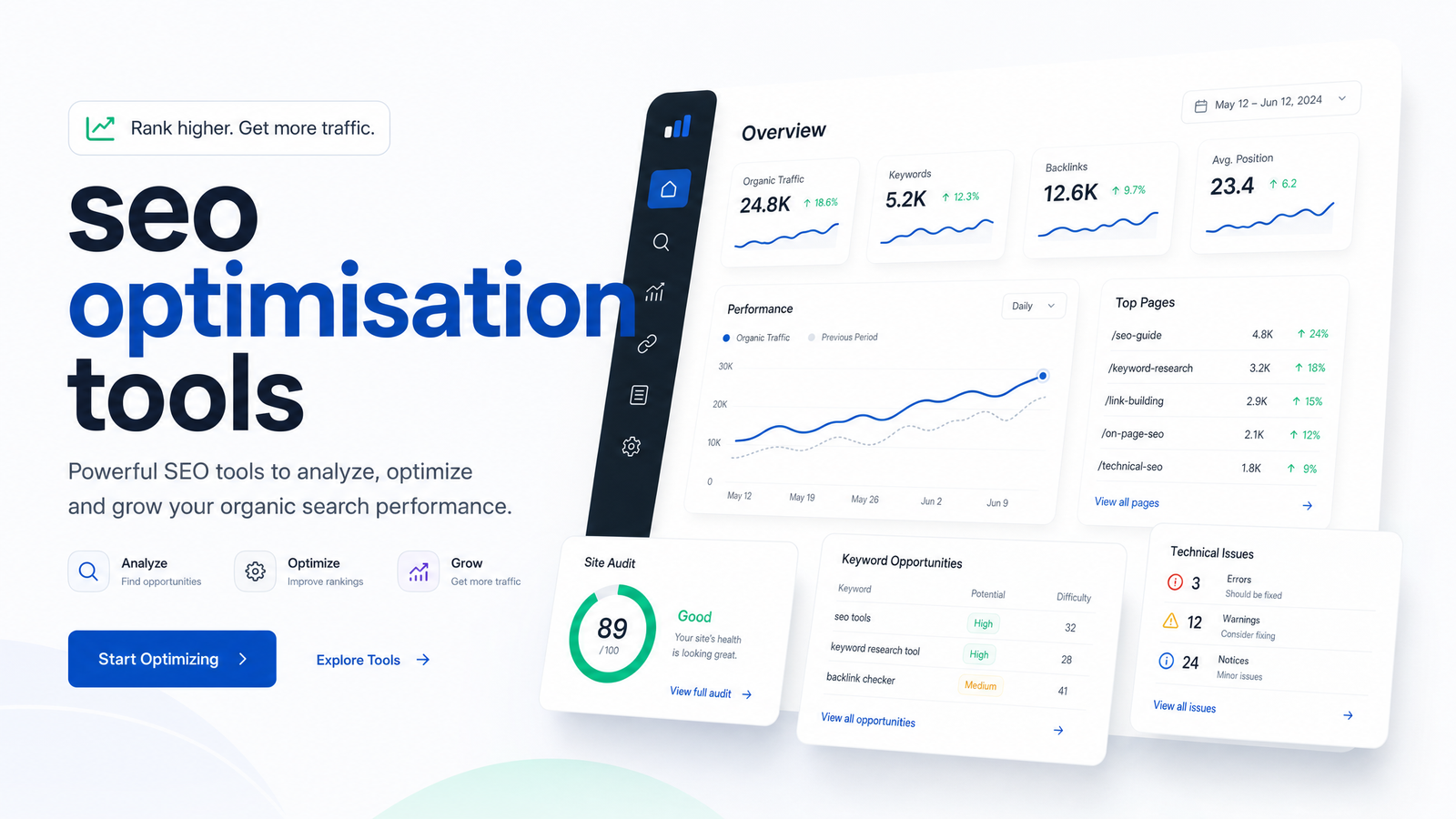
Most searches for "seo optimisation tools" return a wall of software logos sorted by category or price tier. That's backwards. The useful question isn't "what tools exist" — it's "what outcome am I chasing, and which category actually moves it." This guide works from the outcome first: organic traffic, technical health, or topical authority, then names the tool categories that serve each, and what it really costs to run them as five separate subscriptions instead of one workflow.
What Counts as an SEO Optimisation Tool Today
An SEO optimisation tool is any software that helps you find, fix, or measure something that affects search visibility — keyword research, site audits, content creation, publishing, or rank tracking. Ten years ago these were distinct product categories with distinct vendors. That line has mostly disappeared: AI has folded keyword research into content drafting, audit findings into prioritized fix lists, and rank data into reporting that used to require a separate BI tool.
That blurring is the whole reason this article exists. When categories overlap, buying decisions get harder, not easier — you end up with tools that duplicate each other's outputs and still leave gaps. If you want the exhaustive, tool-by-tool version of the landscape, the Complete 2026 Map covers it category by category. This piece takes the opposite approach: start from what you're trying to achieve, and work backward to the SEO software that actually gets you there.
Match the Tool to the Goal, Not the Other Way Around
Almost every SEO goal reduces to one of three outcomes: more organic traffic, fewer technical issues dragging down rankings, or stronger topical authority in your niche. Each has a distinct tool category behind it — and buying the wrong one for your actual bottleneck is the single most common waste of an SEO budget.
| Goal | Tool category | What it should output |
|---|---|---|
| Grow organic traffic | Keyword research, content gap, rank tracking | Prioritized keyword list, competitor gaps, ranking movement over time |
| Fix technical SEO issues | Crawl/audit tools, Core Web Vitals checkers, log analysis | Prioritized issue list with impact and fix instructions |
| Build topical authority | Content briefs, topic clustering, internal linking | Cluster maps, brief outlines, linking recommendations |
Tools for Growing Organic Traffic
If the goal is more visits, the tools that matter are keyword research, content gap analysis, and rank tracking. Keyword tools like those built into Ahrefs or Semrush surface demand and difficulty; content gap features show where competitors rank and you don't. But research alone doesn't increase traffic — you need to know whether the content you publish actually moves. That's what rank tracking is for: confirming whether your keyword bets are paying off, page by page, week by week. If you're evaluating rank trackers specifically, the rank tracker guide walks through what separates a genuinely useful one from a vanity dashboard.
Tools for Fixing Technical SEO Issues
Technical problems — broken redirects, crawl waste, slow Core Web Vitals, orphaned pages — cap how much of your content's potential ever gets realized, no matter how good the writing is. This is the job of a site audit tool: a crawler that walks your site the way Googlebot does, flags issues, and ideally ranks them by actual ranking impact rather than raw count. Screaming Frog remains the standard for manual, granular crawls; SE Ranking and similar platforms bundle crawling with monitoring. Log file analysis adds a layer most audit tools skip — what Googlebot is actually crawling versus what you think it's crawling. For a breakdown of what a proper audit checks, see the site audit tool guide; once issues are surfaced, the technical SEO action plan covers what to fix first.
Tools for Building Topical Authority
Topical authority is earned by covering a subject comprehensively and linking it together coherently, not by publishing isolated posts that happen to target keywords. The tool category here is content clustering: software that maps a pillar topic to its supporting subtopics, generates briefs for each, and recommends internal links tying them back to the pillar. Surfer SEO and similar tools handle brief generation and on-page optimization; dedicated clustering features handle the architecture. Clusters built without a linking plan tend to cannibalize each other in search results instead of reinforcing one another — the topic cluster architecture guide explains how to structure clusters so they actually compound.
The Hidden Cost of a Fragmented Tool Stack
Here's the part most buying guides skip: the real cost of an SEO tool stack isn't just the sum of the subscriptions. It's what happens between them.
A typical self-managed setup looks like this: Ahrefs or Semrush for keyword research, Screaming Frog for crawls, Google Search Console for indexing and click data, Surfer for briefs, and a separate rank tracker because the ones bundled into the research tool don't track deeply or frequently enough. That's five logins, five data models, and five places where the same URL can show a different story. Your audit tool flags a page as fine; your rank tracker shows it dropping; Search Console shows impressions falling with no obvious cause. Reconciling that by hand, exporting CSVs and cross-referencing spreadsheets, eats hours every week that should go toward actually fixing things.
This mirrors a broader martech consolidation trend: teams that once collected best-of-breed point tools are actively cutting subscriptions and folding functions into fewer platforms, not because the individual tools were bad, but because tool sprawl has its own tax — duplicate features nobody uses, onboarding costs every time someone new joins, and a growing gap between "what the data says" and "what we actually did about it." If you're already paying for three to five SEO tools, it's worth checking honestly how much of that spend is redundant coverage rather than genuine capability. The tool evaluation framework gives a more structured way to audit your current stack against real criteria rather than vendor claims.
When One AI Workflow Beats Five Separate Tools
The case for consolidation isn't just fewer invoices — it's a single data source across the whole workflow. When the tool that runs your audit is the same one that drafts your content and tracks your rankings, an issue found in the audit can inform a content brief automatically, and a ranking change can be traced straight back to a page's technical or content history without cross-referencing anything.
This is what AI has actually made possible, distinct from the hype around it: AI seo tools can now connect the dots between stages instead of just automating one stage in isolation. Audit findings feed content priorities. Content drafts get generated against verified keyword data instead of a stale export. Publishing and re-indexing happen without a manual handoff. Rank tracking closes the loop, showing which fixes and which content actually earned position gains, in the same interface where the work started.
Rankevra is built around that premise: an all-in-one seo platform where audits, AI content generation, publishing, and rank tracking run against one shared data set instead of four disconnected ones. That's the practical meaning of seo automation — not fewer clicks per task, but no reconciliation step between tasks at all. Whether a unified platform or a curated set of point tools suits you better still depends on team size and how deep you need any single category to go; the framework for choosing what works is worth reading before committing either way.
A Simple Way to Choose Where to Start
You don't need to solve all three outcomes at once. Pick based on your biggest bottleneck:
- Traffic is flat or declining despite decent content → start with keyword research and rank tracking. You likely have a targeting or visibility-into-movement problem, not a technical one.
- Rankings are inconsistent or pages aren't indexing → start with a site audit. Technical issues cap everything else, so fixing them first makes every later investment pay off faster.
- You rank for scattered terms but never dominate a topic → start with content clustering and internal linking. This is a structure problem, not a volume problem — more posts won't fix it.
This is also how to choose seo tools sensibly for a small team: buy depth in the category matching your bottleneck first, and defer the others until that one is under control. Trying to run all three motions well with under-resourced point tools usually means none of them get done properly.
Frequently Asked Questions
What's the difference between an SEO optimisation tool and an SEO platform?
A tool typically handles one function — crawling, keyword research, or rank tracking — while a platform combines several functions on shared data. The distinction matters because tools require you to manually connect findings across products, while a platform is designed so an audit result can directly inform a content or tracking action.
Do I need separate tools for technical SEO, content, and rank tracking, or can one tool do all three?
Modern AI-driven platforms increasingly handle all three well, though depth still varies by vendor. If your site is small to mid-sized, one consolidated tool usually covers enough depth in each category; very large or highly technical sites sometimes still benefit from a specialist crawler alongside a broader platform.
Are free tools like Google Search Console enough for small sites?
Google Search Console is essential but not sufficient on its own — it shows indexing status and click data but doesn't do keyword research, content briefs, or competitive rank tracking. Small sites can pair it with one broader tool rather than assembling a full paid stack, at least until traffic and complexity grow.
How is AI changing what SEO optimisation tools can do automatically?
AI now connects stages that used to require manual handoffs: turning audit findings into content priorities, generating drafts against live keyword data, and tying ranking changes back to specific fixes or publishes. The shift is less about automating a single task and more about removing the reconciliation work between tasks.
How many SEO tools does a small team actually need?
Most small teams need coverage across three functions — technical auditing, content/keyword research, and rank tracking — which can come from one consolidated platform or two to three well-chosen point tools. Needing five or more separate subscriptions is usually a sign of overlapping features rather than genuine additional capability.
What should I look for if I want to consolidate my current tool stack into one platform?
Look for a platform where audit data, content generation, and rank tracking share the same underlying data set rather than syncing via export or integration. Also check that it covers your actual bottleneck category in real depth, not just as a checklist feature added to look comprehensive.
The real choice comes down to this: hand-pick four to six point tools and spend part of every week reconciling their outputs, or run audits, content, publishing, and rank tracking inside one AI workflow that shares a single source of truth. If the second option sounds like time you'd rather spend on strategy, try Rankevra and see the unified workflow firsthand — or start with the tool evaluation framework if you want to build the case for your team first.
Keep reading
- Tag Management on Google: The Governance GuideTag management on Google explained beyond the install tutorial: GTM structure, permissions, server-side tagging, consent mode, and SEO impact.
- SEO Marketing Tools: The Complete Category Guide (2026)A clear map of every SEO marketing tools category, why stacks sprawl to 6-8 tools, and how AI-driven platforms are consolidating the workflow in 2026.
- SEO Optimization Tools: A Framework for Choosing What WorksA practical framework for choosing SEO optimization tools by workflow stage — audit, content, publishing, tracking — instead of drowning in a directory.