Rankevra Blog
SEO Optimization Tools: A Framework for Choosing What Works
September 2, 2026
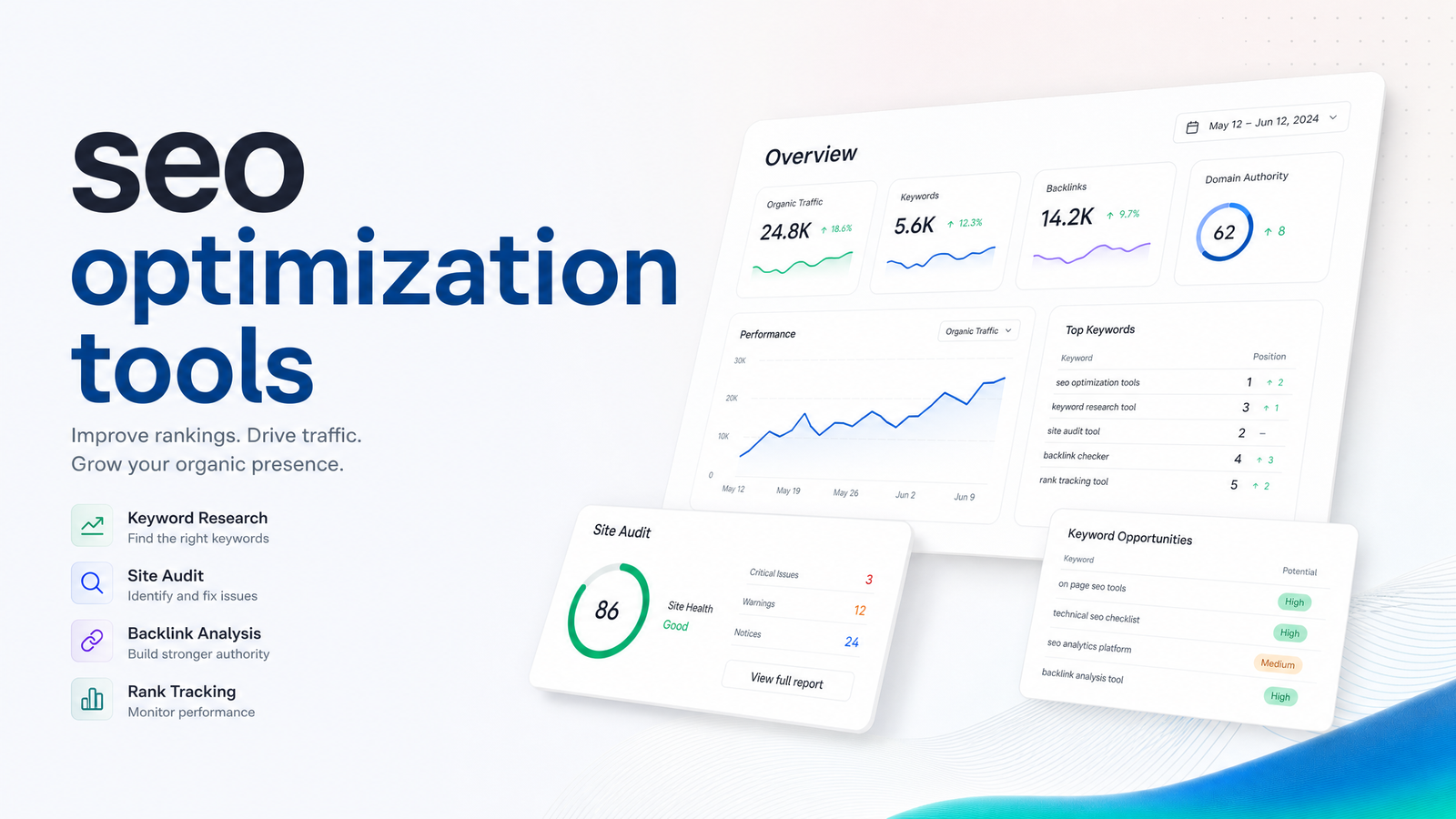
Most articles about SEO optimization tools are directories: twenty, thirty, sometimes forty products sorted into categories, with a paragraph on each. That's useful if you already know what you need. It's useless if you're a solo marketer or a three-person content team trying to figure out which categories actually matter and which are nice-to-haves you'll pay for and never open.
This article takes a different approach: a framework for evaluating any SEO optimization tool based on what it actually does in your workflow — and the case for when consolidating that workflow into one AI-driven platform beats stitching together five subscriptions.
What Counts as an 'SEO Optimization Tool' Right Now
Strip away the marketing language and SEO software falls into four functional jobs. Understanding these categories matters more than memorizing product names, because it tells you what gap you're actually trying to fill.
Audit tools crawl your site and flag technical problems: broken links, duplicate titles, slow pages, indexing errors, crawlability issues. This is diagnostic work — it tells you what's wrong, not what to write about.
Research and content tools handle keyword research, topic clustering, and increasingly, AI content generation — where you figure out what to publish and, in many modern tools, actually draft it.
Publishing tools move content from draft to live page — CMS integrations, formatting, internal linking, scheduling. It's the least glamorous category and the one most often ignored until it becomes a bottleneck.
Tracking tools monitor where your pages rank over time and how that correlates with traffic and conversions, closing the loop on whether any of the above worked.
Nearly every SEO software category is a variation on one of these four jobs, sometimes several bundled together. For the full category-by-category landscape, including tools not discussed here, the complete 2026 map of SEO tools covers that ground directly. For this article, treat those four stages as fixed reference points: audit, plan/write, publish, track.
The Hidden Cost of a Multi-Tool Stack
The real problem with running a separate tool for each stage isn't any single subscription price — it's what happens when you add them up and account for the time spent gluing them together.
A typical DIY stack might include a technical audit crawler, a keyword and content research subscription, a separate AI writing assistant, and a rank tracker. Individually, each is reasonably priced. Together, the seo tools cost adds up to a monthly bill that's easy to lose track of, especially when annual plans auto-renew quietly in the background.
The bigger cost is time. Juggling seo tools means exporting a crawl report from one platform, cross-referencing keyword data in another, briefing a writer or an AI tool in a third, then manually checking rankings in a fourth a few weeks later. Every handoff is a place where data gets duplicated, context gets lost, and reporting becomes inconsistent — your audit tool defines "issues" differently than your content tool defines "optimization," and neither talks to your rank tracker.
For a team with a dedicated SEO hire, that friction is annoying but absorbable. For a website owner or small content team without one, it's the difference between shipping optimized content every week and shipping it every month because everything takes three extra steps.
A Practical Framework for Evaluating Any SEO Tool
Before comparing specific products, apply the same five questions to anything you're considering — paid or free, single-purpose or all-in-one. This is how to choose SEO tools without getting swayed by a long feature list.
1. Does it act on data, or just report it? A crawler that tells you "47 pages have duplicate meta descriptions" is diagnostic. A tool that helps you fix those 47 pages, or at least prioritizes them by impact, is operational. Reporting without action is where a lot of SEO software quietly stalls out — you get a dashboard, not a result.
2. Does it cover more than one workflow stage? A tool that only audits, only writes, or only tracks forces you back into stack-juggling the moment you need the adjacent function. That's not disqualifying — sometimes a specialist is exactly right — but it's a cost you should count deliberately, not discover later.
3. How does it handle technical fixes specifically? Technical SEO is the category most likely to get stuck at the "here's your list of problems" stage. Look for tools that connect audit findings to a prioritized action plan rather than a flat list of hundreds of issues with no sense of what matters first. For a structured way to think about this regardless of which tool you use, see this priority action plan for fixing technical SEO issues.
4. Does content output support real E-E-A-T signals, or just keyword density? AI content tools vary enormously in whether they produce genuinely useful, experience-backed content or generic filler that happens to include your target keyword. Ask specifically how the tool handles depth, sourcing, and topical coverage — not just readability scores.
5. Is reporting consistent and unified, or fragmented by design? If you're going to make decisions from the data, you need one definition of "ranking," one definition of "issue," and one place to see both next to each other.
This seo tool evaluation criteria applies whether you're looking at a $30/month single-purpose app or a $300/month enterprise suite. Named platforms worth understanding for context: Screaming Frog is a widely used crawler for technical audits, Ahrefs and Semrush are broad research and competitive-analysis suites, and Surfer SEO focuses on content optimization scoring. Each does its category well; none alone covers all four stages.
Point Solutions vs. All-in-One: How to Decide
There's no universally correct answer — it depends on team size, budget, and how much manual coordination you're willing to do yourself.
A single-purpose tool still makes sense for a specific, narrow gap: an agency that already has a content and publishing process but needs a sharper crawler, for instance, or a large team where a dedicated SEO specialist actively wants granular control over each stage and has time to manage the handoffs. If your team already has that specialist and that time budget, an all-in-one seo tool might actually remove flexibility you're using.
Consolidating pays off in the more common scenario: no dedicated SEO hire, a marketer or founder doing SEO alongside other responsibilities, and a real cost — in dollars and hours — from maintaining multiple logins, re-learning interfaces, and manually transferring data between them. For seo tools for small teams, the calculation usually favors consolidation once you're paying for three or more separate subscriptions and still doing manual work to connect them.
Switching costs are the legitimate objection here, worth taking seriously rather than waving away. Historical ranking data, past audit baselines, and content briefs represent real invested effort. Before consolidating, check whether a platform can import or reference your existing rank history and audit findings, so you're not starting from zero. A platform that can't at least acknowledge your prior data is asking you to take an unnecessary loss on switching.
Where Rankevra Fits Into This Framework
Rankevra was built around the same four stages described above, as a single seo automation platform rather than four separate ones.
On the audit side, it runs technical crawls and turns findings into prioritized fixes rather than static reports — following the act-on-data principle from the evaluation framework. For the mechanics of what a solid technical crawl should check, see this breakdown of what a site audit tool checks.
On content, its AI seo tool component handles topic research and drafting with an eye toward topical authority — building coverage across a subject area rather than one-off keyword-stuffed pages. The AI writer workflow from brief to ranking page walks through how that drafting process is structured in practice.
On publishing, Rankevra connects drafts to a live workflow so content doesn't stall between "written" and "published" — a gap that a scalable content publishing workflow addresses in more depth.
On tracking, it monitors rankings against the same content and technical baseline established earlier in the process, so a ranking change can be traced back to a specific fix or page rather than treated as a mystery. The considerations behind choosing a rank tracker, standalone or otherwise, are covered in how to actually choose an SEO rank tracker.
None of this replaces judgment — you still decide what to prioritize and what "good content" means for your niche. It replaces the manual work of moving data between four disconnected tools.
Frequently Asked Questions
Do I need more than one SEO tool to get results?
Not necessarily one tool, but you do need all four functional capabilities: audit, content/research, publishing, and rank tracking, whether from one platform or several. What matters is coverage of the workflow, not the number of logins — a single well-built platform covering all four stages can outperform four disconnected specialist tools used inconsistently.
What's the difference between an SEO audit tool and an SEO optimization tool?
An audit tool diagnoses problems — crawl errors, duplicate content, broken links — without necessarily helping you fix them. "SEO optimization tools" is the broader category, covering audit plus the research, content, publishing, and tracking work needed to actually improve rankings, not just identify issues.
Are free SEO tools like Google Search Console enough on their own?
For basic visibility, no — Google Search Console shows indexing status, some search performance data, and manual actions, but it doesn't crawl for technical issues comprehensively, generate content, or track competitor rankings. It's a valuable free data source that pairs well with a dedicated tool, but it isn't a substitute for the audit, content, or tracking functions covered here.
How much should a small business budget for SEO tools?
It depends on stack composition, but the more relevant number is total cost across every subscription, including the time spent connecting them manually. Small teams often find that consolidating into one platform covering audit, content, and tracking costs less overall than three or four separate specialist subscriptions, once time is factored in.
Can AI SEO tools replace hiring an SEO consultant?
For execution — audits, drafting, publishing, tracking — yes, largely. For strategic judgment calls specific to a competitive niche or a complex penalty recovery, a consultant's experience still adds value an automated tool won't fully replicate. Most small teams use AI tools for the repeatable execution work and reserve consultants for harder strategic edge cases.
What should I look for before switching SEO tools?
Confirm the new tool can import or reference your historical ranking data and past audit baselines before you commit, so you don't lose continuity in reporting. Also check that it covers the workflow stages you actually use today, not just the ones its marketing emphasizes, and that support exists for migrating existing content briefs or projects.
Instead of asking which tool wins in each category, ask how many logins you actually want to manage this quarter. Rankevra was built to cover audit, content creation, publishing, and rank tracking in one connected workflow, so you're not reconciling four dashboards to answer one question. If that sounds like less overhead for the same or better results, try Rankevra and see how the consolidated version compares to your current stack.
Keep reading
- Tag Management on Google: The Governance GuideTag management on Google explained beyond the install tutorial: GTM structure, permissions, server-side tagging, consent mode, and SEO impact.
- SEO Marketing Tools: The Complete Category Guide (2026)A clear map of every SEO marketing tools category, why stacks sprawl to 6-8 tools, and how AI-driven platforms are consolidating the workflow in 2026.
- SEO Optimisation Tools: Match Them to the Outcome You NeedA no-fluff guide to seo optimisation tools: which categories drive traffic, fix technical issues, or build topical authority — and when to consolidate.