Rankevra Blog
Topic Cluster Architecture That Actually Builds Authority
September 1, 2026
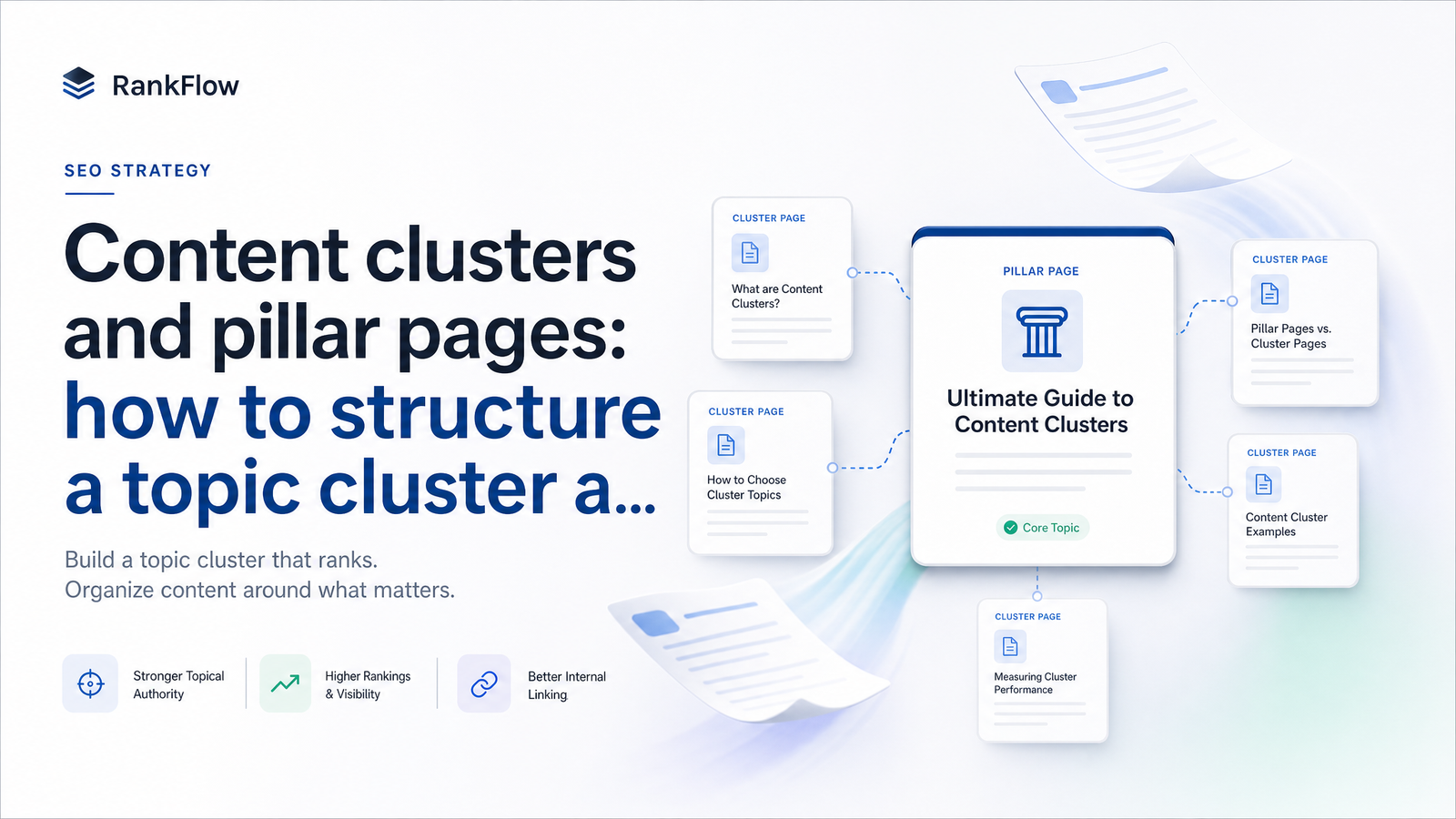
Why Most Topic Clusters Are Just Internal Links Wearing a Costume
Here's the pattern almost every team repeats: build a pillar page, write a handful of blog posts, link them all to the pillar, and wait for rankings to climb. Weeks later, nothing moves. The architecture looks right on a sitemap diagram — pillar in the middle, spokes radiating out — but Google treats it like any other collection of thin, disconnected pages.
The mistake is assuming internal links are the signal. They're not. Internal links are wiring — they distribute link equity and help crawlers discover pages, but they don't manufacture depth that isn't there. Topical authority is earned through genuine coverage: does the cluster, taken as a whole, answer every question a real user or a serious competitor would expect answered on this topic? Does each page demonstrate a distinct, well-defined slice of that topic rather than a reworded version of the pillar? Google's Helpful Content System and its broader emphasis on entity SEO reward sites that behave like a subject-matter source, not a site that has merely hyperlinked its way into looking like one.
The rest of this guide walks through how to design pillar and cluster pages so the architecture reflects real coverage — and where that process breaks down once you try to do it manually at scale.
Step 1: Define a Topic Boundary Before You Build Anything
Before naming a single cluster page, define the topic boundary the pillar will own. This is the most skipped step in pillar page strategy, and it's why so many clusters end up diluted or stunted.
A pillar topic that's too broad — "digital marketing," "SEO," "productivity" — can't be covered by any realistic cluster. You'll always be able to write another ten pages, so the cluster never reaches completeness, and each page ends up competing with the pillar itself for the same broad terms.
A pillar topic that's too narrow — "how to write a meta description for a shoe product page" — has no room underneath it. There aren't 15 legitimate subtopics; you'll end up padding the cluster with near-duplicate pages that cannibalize each other.
The practical test: a well-scoped pillar topic should naturally support 10 to 25 distinct subtopics, each with a legitimate reason to be its own page rather than a paragraph inside another one. If you can't list at least ten genuinely different angles, the topic is too narrow — broaden it one level up. If you can list fifty and still be adding more an hour later, it's too broad — narrow it until the boundary holds still.
Step 2: Map Subtopics From Real Questions, Not Guesses
Once the boundary is set, subtopics should come from evidence, not brainstorming. Subtopic mapping means finding what a real user or a competing page already treats as essential to the topic — then checking your cluster against that list, not the other way around.
Useful sources:
- Competitor content that already ranks for the pillar term — what subtopics do the top five pages collectively cover that yours doesn't?
- "People Also Ask" boxes and related searches, which surface actual query variants.
- Support tickets, sales calls, and customer questions — often the richest source of subtopics because they reflect real intent rather than search-volume guesswork.
- Search intent mapping across the cluster: does each subtopic represent someone in a different stage — learning, comparing, deciding — or is it just a rewording of the same intent?
For finding these gaps systematically rather than manually cross-referencing SERPs, see this framework for SEO content gap analysis — a deeper, more repeatable process than eyeballing competitor tables of contents.
The goal isn't a long list — it's a complete one relative to the boundary set in Step 1. A cluster with 14 subtopics that map cleanly to 14 distinct intents beats one with 25 pages that overlap.
Step 3: Size the Cluster to the Topic, Not to a Content Calendar
There's no universal number of cluster pages that "counts" as topical authority — but there is a workable range for most B2B and content-driven topics: a pillar of 2,000–4,000 words that frames the topic and links to every subtopic, supported by 15–30 cluster pages, each focused enough to rank for one distinct query cluster.
Two failure modes come from sizing the cluster around convenience rather than the topic itself:
Too few pages. A pillar with five or six thin spokes signals a topic nobody has fully explored — not depth. If Step 2 produced 20 legitimate gaps, publishing six and stopping leaves the cluster looking abandoned mid-build.
Too many overlapping pages. This is where content cannibalization creeps in. Two cluster pages both targeting "best CRM for small teams" and "top CRM tools for small businesses" aren't covering distinct subtopics — they're splitting the same intent, diluting rankings for both, and confusing which page Google should treat as canonical. Every cluster page should own one clearly separable subtopic; if two pages could be merged without losing a distinct angle, merge them.
Stop adding pages when new candidate topics start to repeat an existing angle rather than introduce a new one. That's the real signal of "enough," not an arbitrary page count.
Step 4: Build the Link Graph With Rules, Not Vibes
Once the pages exist, the link structure is what turns a stack of related articles into an actual hub-and-spoke model — but only if it follows rules rather than whatever felt natural while writing.
The pattern that works:
- Bidirectional links. Every cluster page links up to the pillar, and the pillar links down to every cluster page — not just the ones written first. A pillar that only links to five of its twenty cluster pages tells crawlers those other fifteen are less important, even if they're not.
- Cross-links between related cluster pages, not just to the pillar. A cluster is a network, not a wheel — pages covering adjacent subtopics should reference each other directly.
- Descriptive anchor text. Anchors should name the destination subtopic, not say "click here" or reuse the pillar's exact keyword every time — Google reads anchor text as a relevance signal, and generic anchors waste it.
- Click-depth limits. Every cluster page should be reachable within one or two clicks from the pillar and from main navigation. Pages buried deep in the architecture behave like orphans even if a link technically exists somewhere.
This is deliberately the short version — tactical detail on evaluating and building internal links is covered in this internal linking framework. The point worth repeating: this link graph only creates topical authority if it's connecting pages that each genuinely cover distinct ground. Link structure amplifies coverage; it can't substitute for it.
Step 5: Treat the Cluster as a Living System, Not a Launch
Most clusters that lose visibility a few months after launch don't fail because the architecture was wrong — they fail because nobody maintained it. Topics evolve, competitors publish new angles, and pages that once covered a subtopic well go stale.
A maintenance loop should check for four things on a recurring basis, not just at launch:
- Orphan pages — cluster pages that lost their inbound link when a template changed or a page was rebuilt.
- Coverage gaps — new subtopics that competitors or new search demand have introduced since the original map.
- Cannibalization — cluster pages that have drifted toward overlapping keywords as they were updated independently.
- Outdated subtopics — pages answering a version of the question that no longer matches current intent or product reality.
This is the step nearly every DIY effort skips, because it isn't a one-time project — it's ongoing content gap analysis applied to a live site instead of a fresh one. Clusters aren't "finished" the way a project is finished; they decay the moment maintenance stops.
Where This Breaks Down Without Automation
Everything above is straightforward in principle and genuinely hard to sustain by hand. Mapping 15–30 subtopics from real query data, writing briefs for each one, publishing them without breaking site quality, wiring bidirectional and cross-links with correct anchor text, and then re-auditing the whole thing every quarter for orphans and cannibalization is a lot of coordinated work — most DIY clusters stall out somewhere around page five, once the manual process can't keep pace with the plan.
This is the exact workflow Rankevra was built to automate. It audits your existing site to surface coverage gaps and orphan pages, maps subtopics from real search and competitor data instead of guesswork, generates AI-assisted content built from proper content briefs, publishes it through a safe, scalable workflow, wires the internal link graph automatically, and tracks rankings across the whole cluster so decay and cannibalization get caught before they cost traffic. It's a related but distinct pattern from programmatic SEO at volume — clusters need depth and distinctness per page, not just scale, and that's precisely what an AI SEO workflow needs to preserve while automating the busywork.
Manually mapping subtopics, drafting two dozen cluster pages, linking them correctly, and monitoring the result indefinitely is where most in-house efforts run out of time. Rankevra handles the audit, mapping, writing, publishing, and monitoring as one connected workflow, so the cluster architecture described above actually gets built — and stays built.
Frequently Asked Questions
What's the difference between a pillar page and a cluster page?
A pillar page is the broad, comprehensive overview of a topic that frames all its major subtopics and links out to each one; a cluster page covers a single subtopic in depth and links back to the pillar. The pillar answers "what is this topic and what does it include," while each cluster page answers one specific question within it.
How many cluster pages do I need before Google recognizes topical authority?
There's no fixed threshold, but most well-scoped topics need 15–30 cluster pages to demonstrate genuine coverage without overlap. The right number depends on how many distinct subtopics the topic boundary actually supports — fewer pages leave gaps, and too many overlapping pages cause cannibalization instead of authority.
Do internal links alone build topical authority?
No — internal links distribute crawl access and link equity, but they don't create depth that isn't already in the content. Topical authority comes from each page genuinely covering a distinct subtopic; links only make that existing coverage discoverable and connected.
Can a small site build topical authority in a narrow niche, or is it only for big sites?
Small sites can build topical authority effectively, often faster than large sites, because a narrow niche is easier to fully cover with fewer pages. The key is scoping the topic boundary tightly enough that 15–20 pages can realistically achieve complete coverage rather than competing against a broad topic no small site could exhaust.
How long does it take to see rankings improve after building a topic cluster?
Most clusters need three to six months of consistent coverage and maintenance before rankings and topical visibility shift meaningfully, since Google needs time to crawl, index, and evaluate the full set of pages relative to competitors. Clusters that stop expanding or stall after a handful of pages typically take longer, if they move at all.
Should product or landing pages be part of the cluster, or only blog content?
Product and landing pages belong in the cluster when they genuinely answer a subtopic a user would search for, not just as a promotional insert. Treating them as legitimate cluster members — linked and structured the same way as blog pages — is usually more effective than isolating commercial pages outside the topical architecture entirely.
Keep reading
- Content Decay SEO: How to Detect It and Fix It for GoodLearn to detect content decay SEO issues early, rule out false positives, and build a refresh pipeline that scales — plus how to automate the whole loop.
- Headless CMS SEO: Fixing the Gaps Generic Tools MissHeadless CMS SEO breaks in three predictable places: rendering, metadata, and sitemaps. Here's the diagnostic framework to find and fix each gap.
- Google Algorithm Update Recovery: A Diagnostic FrameworkA step-by-step google algorithm update recovery framework: confirm the cause, segment the damage, benchmark against winners, and set a real timeline.