Rankevra Blog
SEO Marketing Tools: The Complete Category Guide (2026)
September 2, 2026
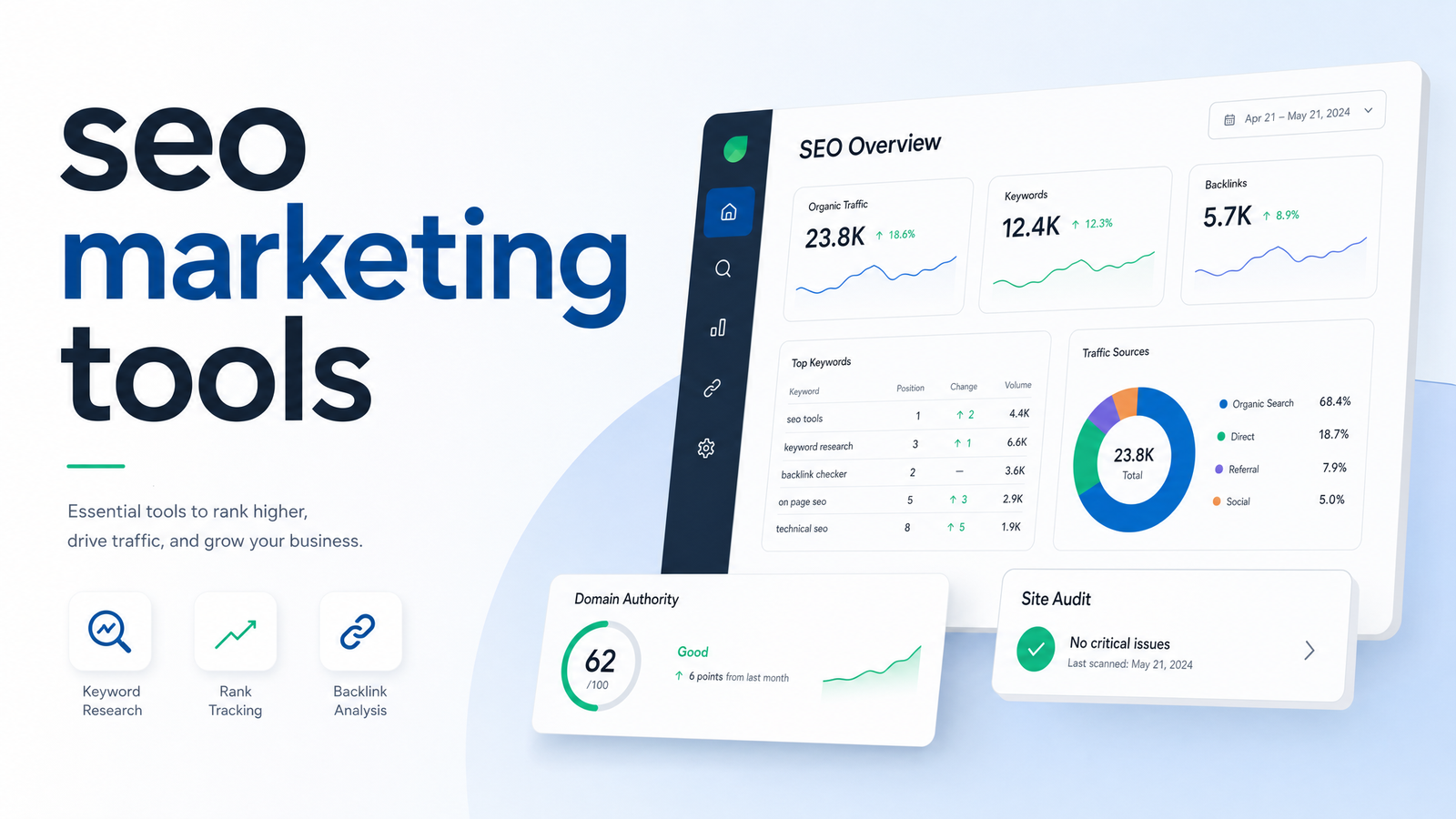
Search "seo marketing tools" and you'll get hundreds of overlapping product pages, each claiming to do audits, keywords, content, links, and reporting. Almost none tell you how the category actually breaks down, or why your team keeps adding new tabs to an already crowded browser window. This guide treats SEO marketing tools as a category problem to solve, not a list of products to compare — so you can decide what you actually need before you buy anything else.
What Counts as an SEO Marketing Tool Today
An SEO marketing tool is software built specifically to influence how a website is discovered, crawled, ranked, and clicked on in search results. That's narrower than "marketing software" broadly. Email platforms, social schedulers, and CRM systems support marketing generally, but they don't touch crawlability, keyword targeting, backlink profiles, or search visibility directly — so they sit outside the SEO marketing software category even when vendors bundle them together.
The line used to be clean: audit tools checked technical health, keyword tools found search demand, content tools helped you write, and rank trackers watched positions. AI has blurred that separation. Modern SEO marketing software increasingly does several of these jobs inside one interface — pulling crawl data to suggest content fixes, or using keyword data to draft briefs automatically. That convergence is exactly why "how many tools do I actually need" has become a harder question than it was five years ago, and it's the question this article is built to answer.
The Core Categories You'll Actually Encounter
Strip away the marketing language and the SEO tools list narrows to a handful of functional buckets. Understanding these categories — not brand names — is what lets you evaluate any tool on merit.
Technical SEO audits crawl your site to surface indexing errors, broken links, slow pages, and structured data issues. Google Search Console is the free baseline; paid audit tools go deeper on crawl frequency and issue prioritization. If this category is new to you, the dedicated audit tool guide walks through what a good crawl actually checks.
Keyword research tools estimate search volume, difficulty, and intent so you know what to target before you write anything. This is usually the entry point into paid SEO tools for marketers, since free options like Search Console only show what you already rank for, not what you're missing.
Content creation and optimization tools have expanded fastest under AI — drafting outlines, scoring on-page relevance, and flagging thin or duplicate content against top-ranking pages.
Backlink analysis tools track who links to you, who links to competitors, and which links carry real authority versus spam risk. Platforms like Ahrefs, Semrush, and Moz built their reputations largely on link index size here. For a framework on judging link data quality, see the backlink analysis evaluation guide.
Rank tracking monitors keyword positions over time, by device and location, so you can tie SEO effort to movement. The rank tracker deep dive covers what separates a reliable tracker from a noisy one.
Reporting pulls all of the above into dashboards leadership can actually read. Done manually, this is where most of the wasted hours in an SEO tool stack pile up — see the reporting dashboard guide for what to include.
For the exhaustive version of this taxonomy, including sub-categories and edge cases, the complete 2026 tool map goes further than this overview intentionally allows.
Why Most Teams End Up With Too Many of Them
Nobody sets out to run eight SEO subscriptions. It happens one gap at a time: the audit tool doesn't do keyword research, so you add a keyword tool. The keyword tool doesn't track rankings well, so you add a tracker. Reporting takes too long manually, so you add a dashboard builder. Each addition is individually reasonable; the cumulative result is a fragmented seo tool stack that nobody fully owns.
Broader martech data backs this up — research on stack size and spend shows marketing teams now run far more tools than a few years ago, while actually using only a fraction of the features they're paying for. SEO stacks follow the same pattern: teams license capability for audits, links, content, and reporting separately, then use each tool for one narrow task while the rest of its feature set sits idle.
The hidden cost isn't just subscription fees stacking up — it's the hours spent exporting a crawl report from one tool, cross-referencing it against keyword data in another, and rebuilding both in a spreadsheet before anyone can act. Tool sprawl also fragments the data itself — your rank tracker and your audit tool rarely agree on which pages matter most, because neither has visibility into the other's dataset. For a team trying to prove SEO ROI to leadership, disconnected numbers from five sources make that conversation harder than it needs to be.
The Shift Toward AI-Driven, All-in-One SEO Platforms
The SEO software category itself is large and still expanding — market forecasts put the space on a solid multi-year growth trajectory, which is part of why so many new entrants keep appearing with overlapping claims. What's changed heading into 2026 isn't just more tools, but a different kind of tool: platforms designed to automate the connective work between categories instead of adding another isolated function.
Adoption data on the AI side reinforces this. Current AI SEO statistics show a clear majority of marketers already using AI tools somewhere in their SEO workflow, with usage climbing year over year rather than plateauing. That's not AI replacing SEO judgment — it's AI absorbing the mechanical handoffs: turning a crawl finding into a content fix, or a keyword gap directly into a draft brief, without a human manually bridging three tools to get there.
This is the real definition of an all-in-one SEO platform in 2026: not a single dashboard with five tabs bolted together, but AI seo automation tools that route data between functions the way a skilled analyst would, just faster and without the copy-paste. For teams that have felt the drag of managing separate audit, content, and tracking tools, this shift is a direct answer to the sprawl problem described above.
How to Decide: Point Tools, a Suite, or an AI Workflow
There's no universally correct answer — the right setup depends on a few practical factors, not brand loyalty.
Team size and in-house skill matter first. A solo site owner or small business rarely needs a specialized point tool for every function; the overhead of managing five logins outweighs the marginal precision gained. Larger teams with dedicated technical SEOs and link-building specialists sometimes do need best-in-class depth in one category badly enough to justify a standalone tool alongside a broader platform.
Budget reality is the next filter, and it's where the free vs. paid SEO marketing tools question actually gets decided. Google Search Console remains genuinely useful and free, but it only reports what's already happening — it doesn't research competitor keywords, audit at scale, or draft content. Paid tools earn their cost by acting proactively instead of just reporting after the fact. If you're comparing the best SEO marketing tools for small business budgets specifically, the math usually favors consolidation: one AI-driven subscription covering audits, content, and tracking almost always costs less than three or four separate ones, even before counting the time saved.
How many functions you need automated, right now, is the deciding question. If you only need occasional rank checks, a lightweight tracker may be enough. If you're running audits, producing content, tracking rankings, and reporting to stakeholders on a recurring cycle, that's exactly the workload where a fragmented stack starts costing more in coordination time than any single tool costs in fees. For a structured way to weigh these tradeoffs against your specific situation, the tool-choosing framework goes deeper than this section can.
This is precisely the gap Rankevra is built to close — one AI-driven workspace that handles audits, content creation, publishing, and rank tracking without forcing you to reconcile data between separate logins.
Frequently Asked Questions
What counts as an 'SEO marketing tool' versus a general marketing tool?
An SEO marketing tool is built specifically to affect search visibility — crawling, keyword targeting, backlinks, or rankings. General marketing tools like email platforms or social schedulers support broader campaigns but don't influence how search engines index or rank a site, which is the defining line between the two categories.
What are the main categories of SEO tools a website owner actually needs?
Most sites need coverage across six functions: technical audits, keyword research, content creation/optimization, backlink analysis, rank tracking, and reporting. Not every team needs a dedicated tool for each — smaller sites often cover several categories with one consolidated platform rather than six separate subscriptions.
Why do marketing teams end up with so many overlapping SEO tools?
Stacks grow one gap at a time: each new tool solves an immediate limitation in an existing one, and the additions rarely get consolidated later. Broader martech data shows teams now run far more tools than a few years ago while using only a fraction of each tool's full feature set, and SEO stacks follow the same pattern.
What is the real cost of running a fragmented SEO stack?
Beyond stacked subscription fees, the bigger cost is time spent exporting and reconciling data between tools that don't share a common dataset — often several hours a week per team member. Fragmented data also makes it harder to prove SEO ROI to leadership, since audit, ranking, and reporting numbers rarely line up across disconnected sources.
How is AI changing what SEO software can do end-to-end?
AI is letting SEO platforms automate the handoffs between categories — turning a technical audit finding directly into a content fix, or a keyword gap into a draft brief — rather than just performing one isolated function. Current adoption data shows a clear majority of marketers already use AI somewhere in their SEO workflow, and that share is still climbing heading into 2026.
If everything above sounds like the six browser tabs you're already juggling, that's the exact problem Rankevra was built to remove. Instead of stitching together an audit tool, a keyword tool, a content editor, a rank tracker, and a reporting dashboard, you run the whole workflow from one AI-driven platform. Try Rankevra and see what a consolidated SEO stack actually feels like.
Keep reading
- Tag Management on Google: The Governance GuideTag management on Google explained beyond the install tutorial: GTM structure, permissions, server-side tagging, consent mode, and SEO impact.
- SEO Optimisation Tools: Match Them to the Outcome You NeedA no-fluff guide to seo optimisation tools: which categories drive traffic, fix technical issues, or build topical authority — and when to consolidate.
- SEO Optimization Tools: A Framework for Choosing What WorksA practical framework for choosing SEO optimization tools by workflow stage — audit, content, publishing, tracking — instead of drowning in a directory.