Rankevra Blog
Transition Word in a Sentence: Definition, Rules & Examples
August 21, 2026
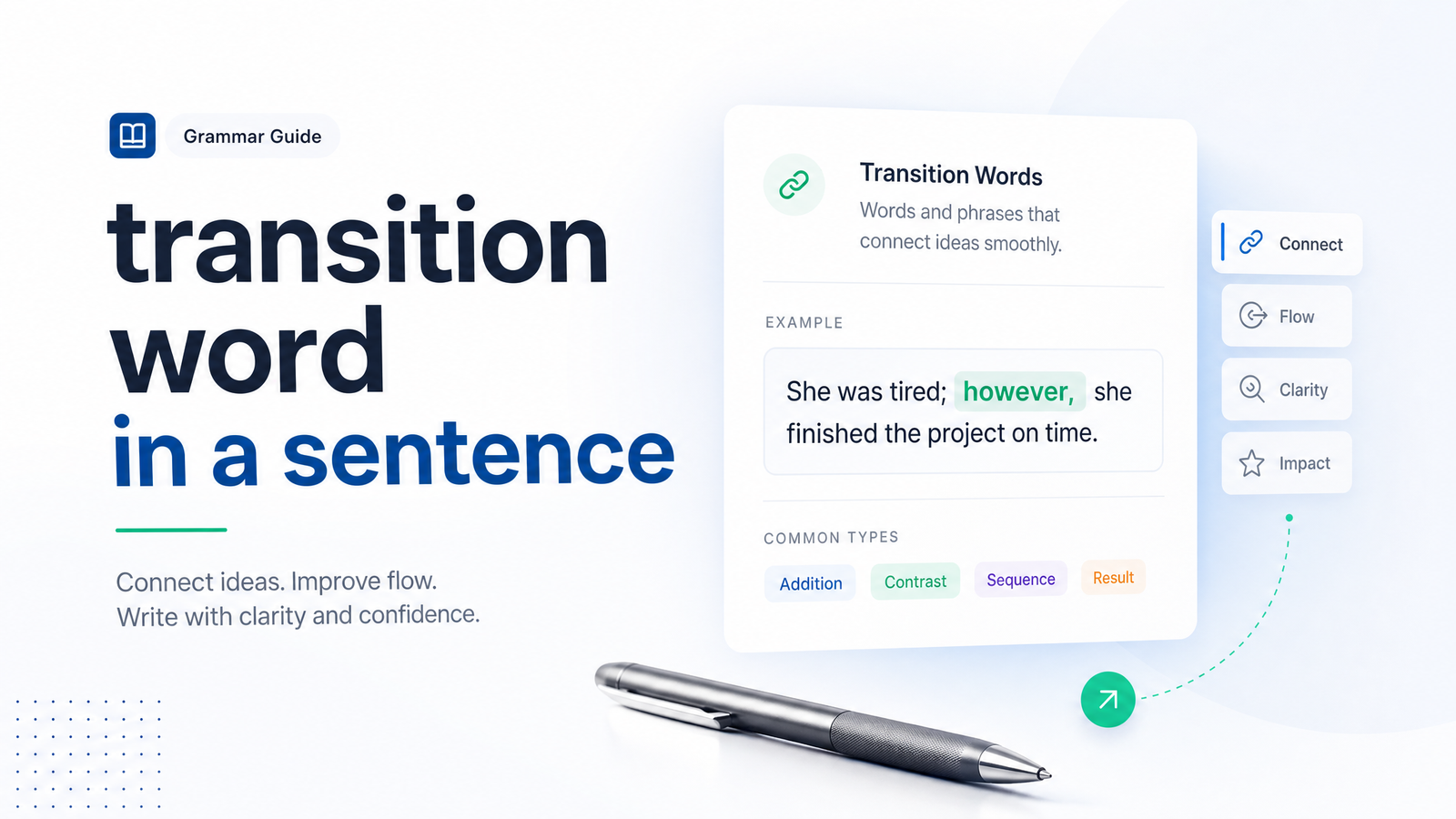
What Is a Transition Word in a Sentence?
A transition word in a sentence is a word or short phrase that links ideas together, showing the reader how one thought relates to the next — whether that's addition, contrast, cause and effect, or sequence. It's a signpost, not decoration. Without it, readers have to guess how two ideas connect; with it, the relationship is explicit.
Example: "The report was late. However, the client approved it anyway." The word "however" signals a contrast before you finish reading. Remove it, and the sentences still technically make sense, but the reader has to infer the relationship — the extra cognitive load transition words exist to eliminate.
Types of Transition Words (With Examples)
Transition words fall into functional categories based on the logical relationship they signal. Knowing the category matters more than memorizing a giant list of transition words, because picking the wrong one — using "however" when you mean "therefore" — confuses readers rather than helping them.
Addition & Sequence
These words add information or show order. Common examples: furthermore, additionally, next, meanwhile, first, subsequently.
- "The tool audits your site for broken links. Furthermore, it flags duplicate meta descriptions."
- "We updated the sitemap. Next, we resubmitted it to Search Console."
- "The writer drafted the outline; meanwhile, the editor reviewed last month's performance data."
Contrast & Comparison
These signal a shift, a contradiction, or a parallel. Common examples: however, on the other hand, similarly, conversely, nevertheless.
- "The headline tested well. However, click-through rate dropped after a week."
- "Short paragraphs improve scannability. On the other hand, they can fragment complex arguments if overused."
- "Similarly, both landing pages struggled with mobile load time."
Cause, Effect & Conclusion
These wrap up an idea or show a result. Common examples: therefore, as a result, in summary, consequently, thus.
- "Page speed dropped below 2 seconds. As a result, bounce rate fell by 12%."
- "The content matched search intent closely; therefore, it ranked within three weeks."
- "In summary, technical fixes alone rarely move rankings without content quality improvements."
These three groups cover most real-world transition word examples you'll need. A list of transition words is worth bookmarking, but understanding the category a word belongs to is what actually improves your writing.
How to Place a Transition Word in a Sentence (Rules That Matter)
Knowing how to use transition words correctly comes down to placement and punctuation — the part most listicles skip.
Beginning of a sentence. This is the most common placement, and what people mean when they ask about transition words to start a sentence. When it opens a sentence, it's almost always followed by a comma: "However, the update didn't fix the crawl errors." "Therefore, we rewrote the meta title."
Middle of a sentence. Transition words can sit between clauses, usually set off by commas on both sides: "The page, however, still ranked for its target keyword." This works well when you want the transition to feel less abrupt than an opener.
End of a sentence. Less common but valid for words like "though" or "as well": "The redesign looked cleaner. Loading speed hadn't improved, though." This softens the contrast and reads more conversationally.
The comma splice trap. A comma splice happens when you use only a comma to join two independent clauses with a transition word, instead of a period or semicolon: "The content was optimized, however it still didn't rank" is incorrect. Fix it with a semicolon ("optimized; however, it") or split it into two sentences. This is the most common punctuation error tied to transition words, and an easy one for both human editors and automated grammar checkers to catch.
Common Transition Word Mistakes to Avoid
Most transition word mistakes fall into four buckets, worth checking for specifically rather than trusting instinct alone.
Overuse. Starting every other sentence with "furthermore" or "additionally" makes writing feel mechanical and pads word count without adding meaning. If you can delete the transition word and the relationship is still obvious, it probably didn't need to be there.
Wrong category. Using "therefore" when you mean "however" reverses the logic of a passage and can mislead readers, not just sound clumsy. Check whether you're adding, contrasting, or concluding before picking the word.
Redundant pairing. Phrases like "but however" or "and also" double up on the same function and should be trimmed to one word. This usually happens when writers edit a sentence and forget to remove the original connector.
Sentence-opener monotony. Relying on the same two or three transition words to start sentences creates a repetitive rhythm readers notice, even if they can't name why the writing feels flat. Rotating between categories and placements (beginning, middle, end) keeps prose readable.
If you're revising a draft for these issues at the sentence level, it overlaps with the kind of rework covered in Rephrase: What It Means and How to Do It Safely — useful once you're adjusting more than just connector words.
Why Transition Words Matter for SEO Content, Not Just Grammar
Transition words and readability are directly linked, and this is where the topic stops being a grammar-class exercise and becomes an on-page SEO factor. Readability formulas and content checkers — the same mechanic behind tools like Yoast's readability score — count transition word density as one signal of how easy content is to follow. A page with reasonable transition word usage tends to score better on flow metrics than one written as a string of disconnected declarative sentences.
That matters because flow affects dwell time. If a reader can follow the logic of a paragraph without rereading it, they stay on the page longer, scroll further, and are less likely to bounce back to search results. Search engines don't measure "transition words" directly, but they do measure behavioral signals like dwell time and pogo-sticking, which readability quality influences. In other words, transition words' SEO value isn't about keyword density or algorithms reading your connector words — it's an indirect path through user experience and content quality signals that search engines do weigh.
This is also why content teams optimizing at scale think about transition words alongside broader sentence-level rewrites. If you're evaluating tools that touch this layer of content, Paraphrasing Tool for SEO: Safe Use Without Penalties covers how sentence-level changes interact with content quality guidelines without triggering spam signals.
Where This Fits in an AI Content Workflow
Checking every paragraph of every article for transition word overuse, comma splices, and category mismatches is exactly the kind of repetitive editorial work that doesn't scale when a content team is publishing consistently. It's a small check, but it's one of dozens that separate a rough draft from ranking-ready content — alongside heading structure, keyword placement, internal linking, and technical on-page factors.
This is the layer an AI content workflow is built to handle automatically. Rather than relying on a human editor to catch every repeated "furthermore" or comma splice manually, the workflow flags flow and readability issues as content is drafted, so writers fix them before publishing rather than after a page has already underperformed. If you want the fuller picture of how AI evaluates content quality beyond grammar mechanics, SEO AI Explained: A Framework for What It Actually Does breaks down what these systems actually check. And for teams publishing at volume, this readability check is one piece of a larger process — see Building a Content Publishing Workflow That Scales Safely for how it fits into audits, drafting, and publishing end to end.
Correct transition-word usage won't single-handedly move a page up the rankings, but it's one real, checkable part of the readability and content-quality signals that add up to ranking-ready pages. See how Rankevra's AI content workflow checks flow, readability, and structure automatically as you write — instead of catching it after publishing.
Frequently Asked Questions
What exactly is a transition word in a sentence?
A transition word is a connector — like "however," "therefore," or "additionally" — that shows how one idea relates to the next, whether through addition, contrast, cause and effect, or sequence. It signals the logical relationship between sentences or clauses so the reader doesn't have to infer it. Without transition words, writing can still be grammatically correct but harder to follow.
Can you start a sentence with a transition word like 'however' or 'therefore'?
Yes, this is grammatically correct and common in professional writing. The transition word is typically followed by a comma when it opens a sentence, as in "Therefore, the team revised the outline." This is one of the most frequent uses of transition words in both essays and web content.
What's the difference between a transition word and a conjunction?
A conjunction (like "and," "but," or "so") joins clauses within a single sentence and generally doesn't require surrounding commas. A transition word (like "however" or "therefore") connects ideas across sentences or clauses, typically needs comma punctuation, and can move to different positions in a sentence. Both express logical relationships, but they follow different grammar rules.
How many transition words should a paragraph have?
There's no fixed number, but one or two well-placed transition words per paragraph is usually enough to guide the reader without feeling mechanical. Every sentence starting with a transition word is a sign of overuse. The goal is clarity between ideas, not a transition word in every line.
What are the most common transition words used in essays?
The most common include "however," "therefore," "furthermore," "in addition," "for example," and "in conclusion." These cover the core functions of contrast, cause/effect, addition, and summary that most academic and informational writing needs. Overusing the same one or two, though, is a common weakness in essay writing.
Do transition words actually affect SEO or readability scores?
Yes, readability tools and content checkers count transition word usage as one signal of how easy content is to read, similar to how Yoast's readability score works. Better flow can support longer dwell time and lower bounce rates, which are behavioral signals search engines weigh indirectly. Transition words alone won't drive rankings, but they contribute to the broader content-quality signals that do.
Keep reading
- Content Decay SEO: How to Detect It and Fix It for GoodLearn to detect content decay SEO issues early, rule out false positives, and build a refresh pipeline that scales — plus how to automate the whole loop.
- Headless CMS SEO: Fixing the Gaps Generic Tools MissHeadless CMS SEO breaks in three predictable places: rendering, metadata, and sitemaps. Here's the diagnostic framework to find and fix each gap.
- Google Algorithm Update Recovery: A Diagnostic FrameworkA step-by-step google algorithm update recovery framework: confirm the cause, segment the damage, benchmark against winners, and set a real timeline.