Rankevra Blog
SEO AI Explained: A Framework for What It Actually Does
August 19, 2026
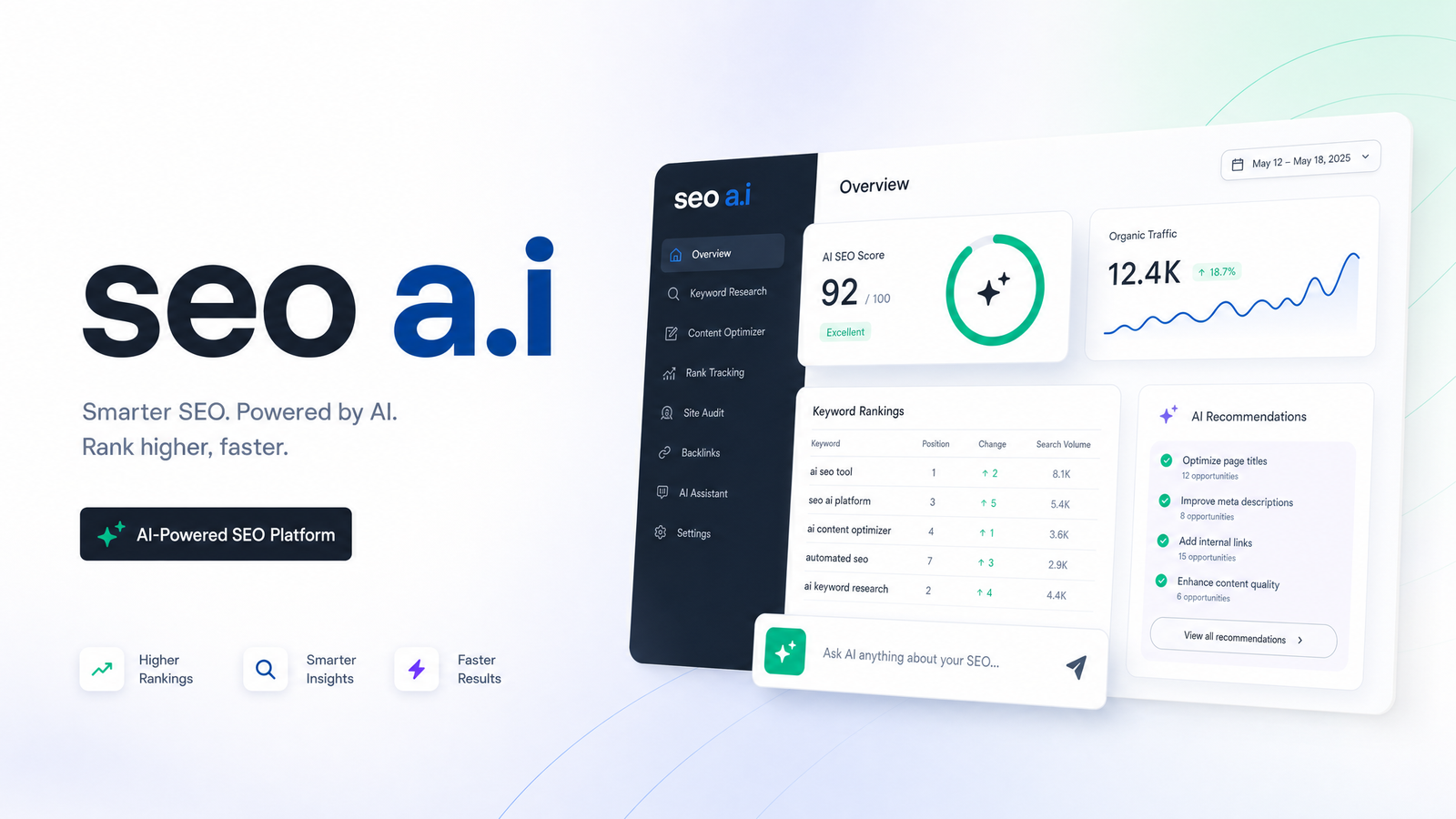
Search marketers keep asking the same question in different words: is "SEO AI" a real category, or just a label pasted onto existing tools to sound current? The honest answer is both — which is exactly why the term needs a precise definition before you trust a vendor, a workflow, or your own traffic to it.
What "SEO AI" Actually Means (and What It Doesn't)
SEO AI meaning, stripped of marketing gloss, is the application of machine learning and large language models to the mechanical and analytical work of search optimization — auditing a site, drafting and structuring content, mapping internal links, and tracking rankings — in a way that connects to your actual data and takes action, not just offers suggestions.
That's different from what most people encounter first: a single AI feature bolted onto an existing platform, or a chatbot prompt used to spit out a blog draft. Asking ChatGPT to write five title tags is AI-assisted writing, not SEO AI as a category, because it doesn't touch your site's crawl data, content graph, or rank history — it has no memory of your domain and no mechanism to act on what it produces.
The distinction matters because it determines what you can reasonably expect. A single chatbot feature can help you brainstorm. A genuine SEO AI system — sometimes described as an SEO agent — is built to run recurring tasks against live site data: crawl your pages, flag what's broken, draft content aligned to a topic cluster, publish it, and monitor how it performs. Before evaluating any tool claiming this ground, it's worth knowing which bucket it actually falls into.
Why AI Is Now Unavoidable in SEO
The shift isn't theoretical. According to current adoption data, 86% of SEO professionals now use AI in some part of their workflow — meaning manual-only SEO is already a minority practice. That adoption curve alone would justify a change in tooling, but the more consequential shift is happening in the search results themselves.
Google's AI Overviews now sit above traditional organic listings for a growing share of queries, and their presence measurably changes click behavior — the same adoption data shows meaningful CTR compression on queries where an AI Overview appears, because the answer is often delivered before a user reaches a blue link. Layer on AI Mode and the rise of zero-click search, and ranking well no longer guarantees a visit. Separate research on SERP visibility trends tracks the same pattern: a growing share of searches now resolve without any click, and visibility inside AI-generated answers is becoming a metric worth tracking in its own right, alongside classic rank position.
None of this means organic SEO is dying — it means the workflow has to cover more ground in less time: more content, tighter technical hygiene, and now visibility inside AI answers too, a discipline some call Generative Engine Optimization (GEO). Manual, siloed processes — one person auditing in a spreadsheet, another drafting in a doc, a third checking rankings in a separate tool — can't keep pace with that scope. That's the practical case for AI-assisted execution: not hype, but throughput.
Where AI Genuinely Helps in the SEO Workflow
Used well, AI earns its place in four parts of the workflow.
Technical audits. AI can crawl a site, cross-reference issues like broken links, missing schema, slow-loading templates, and duplicate content, and prioritize them by likely impact — turning a raw crawl report into a ranked action list. It's still worth understanding the underlying priorities yourself; this action plan for fixing technical SEO issues lays out how to sequence fixes so AI-flagged issues get resolved in the right order rather than the loudest order.
Content drafting. AI SEO content creation works best as a first-draft engine — structuring an article around a topic cluster, pulling in relevant subtopics, and matching search intent — with a human editing for accuracy, voice, and anything resembling a genuine opinion. Where this goes wrong is well known: generic, keyword-stuffed drafts that read like nobody wrote them, which is exactly the output pattern that gets flagged as low-quality. The fix isn't avoiding AI content, it's treating it as a draft, not a deliverable — a distinction covered in more depth in this guide to AI writing tools.
Internal linking. AI can scan your existing content library and suggest contextual links between related pages far faster than a manual audit, strengthening topical clusters and helping search engines understand site structure — a direct lever for building topical authority.
Rank tracking. This is one of the more mature use cases: automated, scheduled tracking across large keyword sets, with AI surfacing meaningful movement instead of burying it in noise. What "meaningful" should actually mean when choosing a tracker is worth a closer look — see how to choose a rank tracker.
Keyword research deserves its own mention too, since it's often where people first try AI tools and get inconsistent results; this breakdown of what actually works separates genuinely useful AI research features from repackaged autocomplete.
Where AI Should Not Run Unsupervised
The limits matter as much as the capabilities, especially on a site that generates real revenue.
Strategy calls — which markets to target, which products deserve a content investment, how aggressively to compete on a given topic — require business context AI doesn't have. E-E-A-T judgment is similarly human by nature: AI can help demonstrate expertise, but it can't hold real experience, and Google's quality guidance is increasingly explicit that content needs a credible human or organizational source behind it. Brand voice is another soft spot; AI can approximate a tone from examples, but nuance, humor, and the specific way your company disagrees with conventional wisdom tend to flatten out under automation.
Then there's structural risk. Site migrations, large-scale redirects, and sweeping content deletions are exactly the kind of high-blast-radius actions that should never run on autopilot without a review step — a bad automated redirect map can quietly tank a site's rankings before anyone notices. The AI SEO risk isn't that automation is inherently unsafe; it's that unsupervised automation on irreversible actions is a bad trade for the time it saves. Treat AI as the operator that prepares changes and executes routine ones, with a human holding sign-off on anything that touches URLs, deletions, or core strategy.
How to Tell Real SEO AI From a Chatbot Wrapper
Plenty of tools now market themselves as "AI SEO platforms" while doing very little beyond forwarding your prompt to a language model. A few quick checks separate substance from repackaging:
- Does it connect to your actual site and data? Real SEO AI pulls from your crawl data, Search Console, and rank history. A wrapper only knows what you type into it.
- Does it act, or just suggest? A genuine tool can publish a fix, push a draft live, or update a link — not just generate a paragraph you have to copy elsewhere.
- Does it cover more than one workflow stage? If it only writes and can't audit or track, you're still stitching tools together; that's the opposite of the point.
- Is there a memory of past output? Tools with no sense of what they've already audited or written for you will repeat work and contradict earlier recommendations.
For a fuller evaluation framework, including cost and scaling considerations, this guide to choosing SEO tools walks through the criteria in more depth than fits here.
Bringing It Together: One Workflow Instead of Five Tools
The pattern behind most AI SEO frustration isn't the AI itself — it's fragmentation. One tool audits, another drafts content, a third handles publishing, a fourth tracks rankings, and none share context. Every handoff is a place where priorities get lost, drafts go stale before publishing, and rank changes get noticed weeks late.
An end-to-end SEO AI workflow closes those gaps by design: the same system that flags a technical issue can draft the content to address it, publish it, and then track how it performs — with each stage informed by the last. That's the model Rankevra is built around: audits, AI content creation, publishing, and rank tracking in one connected workflow instead of five disconnected subscriptions. It's not a claim to full autonomy — it's a claim to keeping humans in charge of judgment calls while automating everything that shouldn't require one.
If the framework in this article matches how you'd like your own SEO to run, the natural next step is trying it against your own site rather than a hypothetical. Rankevra offers exactly that starting point — one workflow to audit, create, publish, and track, instead of juggling separate tools for each stage.
Frequently Asked Questions
Is SEO AI the same thing as an SEO agent?
Not quite — "SEO AI" is the broader category describing AI applied to SEO tasks, while an "SEO agent" specifically refers to a system that can take autonomous action on those tasks, like publishing a fix or drafting and scheduling content, rather than just analyzing data and suggesting changes. All SEO agents fall under the SEO AI umbrella, but not all SEO AI tools qualify as agents.
Can AI actually replace an SEO specialist?
No, not for strategy, judgment calls, or E-E-A-T decisions — AI is best suited to executing repeatable tasks like audits, drafts, and tracking, while a specialist still decides what to prioritize and how to position content. The tools that work well pair AI execution with human oversight rather than removing the human role entirely.
Will using AI content hurt my Google rankings?
Not inherently — Google has stated it evaluates content quality, not whether AI was involved in producing it, so generic or unedited AI drafts are the actual risk, not AI itself. Content that's factually accurate, edited for voice, and demonstrates real expertise tends to perform fine regardless of how the first draft was produced.
What parts of SEO should AI not be allowed to do on its own?
Site migrations, large-scale redirects, content deletions, and core strategic decisions shouldn't run unsupervised, since mistakes in these areas can cause significant and hard-to-reverse ranking damage. These are high-blast-radius actions where human review before execution is worth the extra time.
How is SEO AI different from just using ChatGPT for SEO tasks?
SEO AI tools connect directly to your site's data — crawl results, Search Console, rank history — and can act on it, while a general chatbot only works with what you type into a prompt and has no memory of your domain. That connection to real data and ability to execute changes is what separates a workflow tool from a one-off writing assistant.
Do I need separate tools for AI content and AI rank tracking, or can one tool do both?
You don't need separate tools — an end-to-end SEO AI platform can handle content creation and rank tracking within the same workflow, using shared data so tracking reflects what was actually published. Running them separately usually means duplicated setup work and slower feedback between publishing a page and knowing how it performs.
Keep reading
- Content Decay SEO: How to Detect It and Fix It for GoodLearn to detect content decay SEO issues early, rule out false positives, and build a refresh pipeline that scales — plus how to automate the whole loop.
- Headless CMS SEO: Fixing the Gaps Generic Tools MissHeadless CMS SEO breaks in three predictable places: rendering, metadata, and sitemaps. Here's the diagnostic framework to find and fix each gap.
- Google Algorithm Update Recovery: A Diagnostic FrameworkA step-by-step google algorithm update recovery framework: confirm the cause, segment the damage, benchmark against winners, and set a real timeline.