Rankevra Blog
AI Blog Writer: The 2026 Buyer's Guide to Ranking Content
August 1, 2026
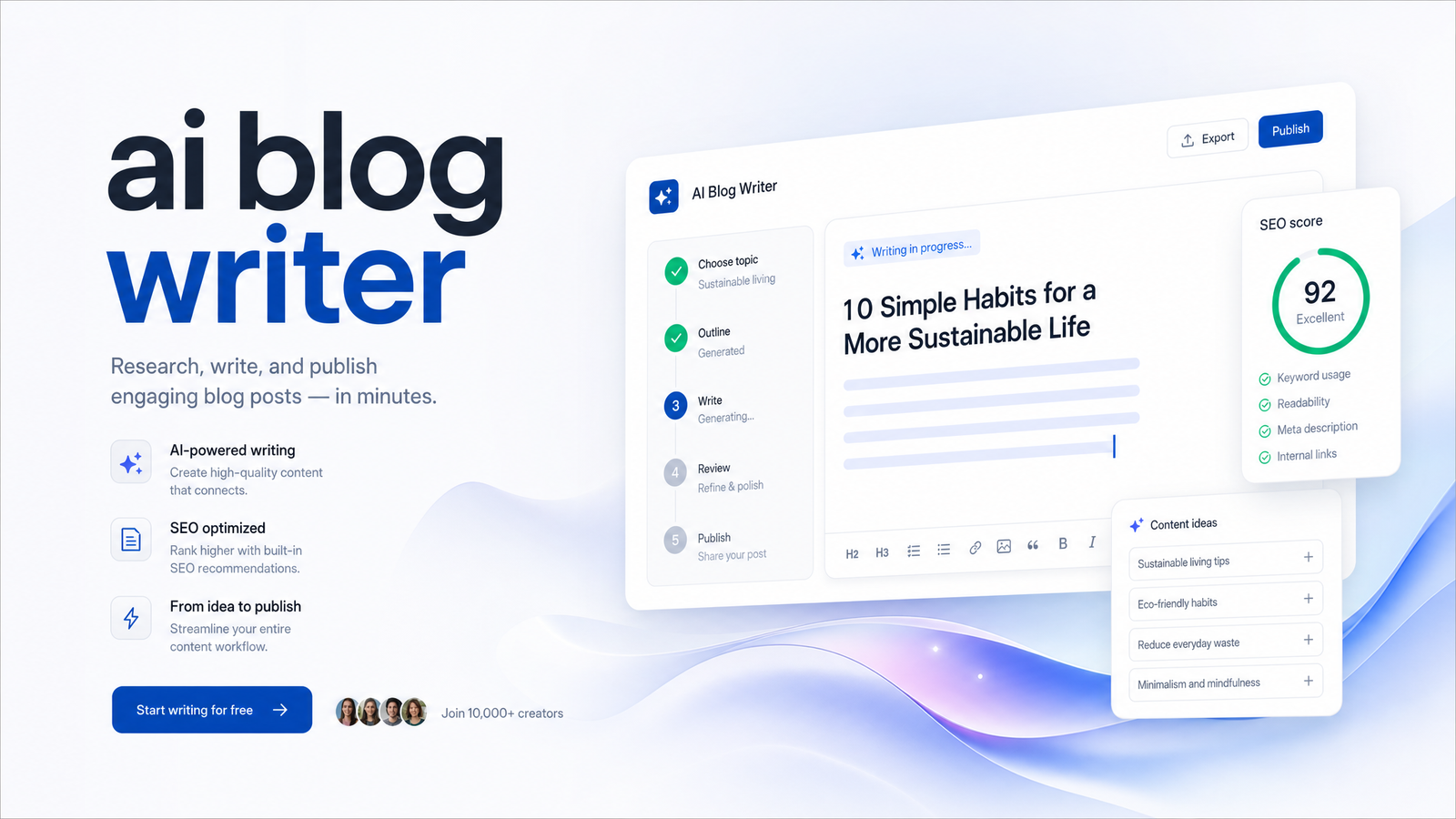
The question worth asking in 2026 isn't whether AI can write a blog post — that's settled. The real question is whether an AI blog writer can produce content that ranks, satisfies search intent, and gets published without someone babysitting every step. That's the bar that actually matters for organic traffic.
Most tools marketed as an "AI blog writer" are really just a chatbot wrapped in a nicer interface. They're fast, but fast isn't the same as effective. This guide breaks down what a purpose-built AI blog writer needs to do differently, why Google's stance on AI content changes the calculus, and how to evaluate tools before you commit budget to one.
What Is an AI Blog Writer (and What It Isn't)
An AI blog writer is software designed specifically to produce publish-ready blog content grounded in keyword data, search intent, and a structured content brief — not just a general-purpose language model responding to a prompt. A chatbot will happily generate an article on "best running shoes for beginners," but it has no idea what's currently ranking, what subtopics the top results cover, or what unique angle would make your version worth ranking above them. It's improvising. An AI blog writing tool built for SEO starts from research and works backward into a structure designed to compete.
The criteria that separate the two come down to five things: does it ground content in real keyword and SERP data, does it follow a brief rather than free-associate, does it check facts rather than hallucinate them, does it fit into a publishing workflow, and does it tell you afterward whether the content actually moved rankings. A general chatbot does none of these by default. A serious AI blog writer is built around them.
Why Most AI-Written Blog Posts Don't Rank
The common failure mode isn't bad writing — it's generic writing. AI drafts from prompt-only tools tend to read smoothly and say almost nothing that a dozen competing articles haven't already said, in roughly the same order, with no unique research or point of view. Search engines don't need to detect that a robot wrote something to deprioritize it; they just need to notice that it doesn't add anything the top-ranking pages don't already offer.
Google's Search Central guidance on generative AI content is explicit that automation isn't the problem — quality and helpfulness are what get evaluated, regardless of how content was produced. Google also recommends disclosing when content was created in an automated or AI-assisted way. So the fear that "is AI content bad for SEO" has a flat yes/no answer is misplaced. The real answer: unhelpful content is bad for SEO, and a large share of AI output happens to be unhelpful because it skips research, ignores intent, and never develops a stance.
An AI blog writer for SEO has to be judged against that bar, not against "does it sound human." Fluent-but-shallow content fails for the same reason a fluent-but-shallow human draft fails: it doesn't match what searchers actually need, and it doesn't demonstrate the experience or expertise that separates a helpful page from a filler page — the E-E-A-T thinking Google has pushed for years now applies just as much to machine-assisted content as to anything else.
What a Real AI Blog Writer Needs to Do Well
If you're comparing tools, look past the demo and check for five specific capabilities.
Keyword and intent grounding. The best AI blog writer tools start a draft only after establishing what the target query actually wants — informational, commercial, transactional — and matching structure to that intent rather than guessing. A post targeting a comparison query needs a different shape than one targeting a how-to query, even on the same topic.
Brief-driven structure. Automated blog writing software that skips the brief step is skipping the part that actually determines rankability: headings that mirror what's already working in the SERP, the subtopics competitors miss, and the questions people are actually asking. A brief is what turns "write about X" into "write the version of X that can outrank what's currently ranking."
Fact-checking and accuracy. Hallucinated statistics or invented claims are one of the fastest ways AI drafts damage credibility and topical authority instead of building it.
Internal linking. Tools that automatically suggest relevant internal links help establish topical authority across a site rather than leaving each post as an island.
Readability formatting. Scannable structure — real subheadings, reasonable paragraph length, no wall-of-text sections — still matters for both readers and how search engines parse a page's helpfulness.
Where AI Blog Writing Fits in the Full SEO Workflow
Drafting is one link in a chain, and treating it as the whole job is where most content operations lose time. The full sequence looks like: keyword and topic research, brief creation, drafting, publishing, and rank tracking. Skip or disconnect any step and you introduce friction — usually manual handoffs between a keyword tool, a writing tool, a CMS, and a rank tracker that don't talk to each other.
Solid keyword research is the input that makes everything downstream worth doing; drafting against the wrong keyword is drafting against the wrong intent, no matter how good the AI writer is. Once a draft exists, it still needs to go live through a content publishing workflow that handles formatting, metadata, and scheduling without manual copy-paste between systems. And once it's published, the only way to know if any of it worked is a rank tracker that reports back on movement — otherwise you're publishing on faith.
This is precisely why an AI writer that publishes content directly, rather than dumping a doc you then have to move elsewhere, saves real hours every week. Teams evaluating self-hosted setups should weigh the tradeoffs carefully — our breakdown of open-source AI content generators covers what you gain in control and what you give up in integration when you go that route.
Adoption data backs up how central AI has already become in this workflow rather than being an experiment. According to Siege Media's 2026 AI writing statistics, marketers are widely using AI across ideation, outlining, drafting, and editing — not just for first drafts. The tools that keep winning are the ones that fit into that full pipeline rather than only handling one stage of it.
How to Evaluate an AI Blog Writer Before You Buy
Before you commit to any AI content writer for blogs, run it through a short checklist rather than trusting the demo alone:
- Does it ground facts and cite sources, or does it generate confident-sounding claims with no basis?
- Does it follow a structured brief built from real SERP and intent analysis, or does it free-write from a single prompt?
- Does it integrate with your CMS or publishing workflow, or does it hand you a document you still have to reformat and upload manually?
- Does it connect back to rank data, so you can tell whether a published post is actually gaining position, or does it go silent after the draft is done?
- Does it handle keyword research natively, or do you need a separate subscription just to know what to write about?
Tools that fail two or more of these tend to produce isolated drafts rather than a system that compounds. The best ai blog writer for your situation is the one that closes the loop, not the one with the flashiest editor.
How Rankevra Approaches AI Blog Writing Differently
Rankevra was built around the fragmentation problem described above, rather than around drafting speed alone. Instead of stitching together a keyword tool, a chatbot, a CMS, and a separate rank tracker, Rankevra runs the full sequence in one workflow: audit your site for technical and content gaps, generate a structured brief from real keyword and intent data, draft the post grounded in that brief, publish it directly, and track how it performs afterward.
That last step is the one most AI blog writer tools skip entirely, and it's the one that actually tells you whether the content is working. An AI blog writer for SEO isn't finished when the draft is done — it's finished when you can see the ranking result and adjust. Rankevra treats drafting as one stage of a system built for topical authority and organic growth, not as a standalone novelty.
If you're tired of juggling separate subscriptions and manual handoffs just to get one blog post live, stop stitching tools together. Try Rankevra and run brief, draft, publish, and rank tracking from a single place.
Frequently Asked Questions
Does using an AI blog writer hurt my Google rankings?
No — Google evaluates content on quality and helpfulness, not on whether it was produced by AI, according to its own Search Central guidance. Content underperforms when it's generic, shallow, or unhelpful, which happens with plenty of human-written posts too. The safeguard is grounding drafts in real research and intent matching, plus disclosing automated production as Google recommends.
What's the difference between an AI blog writer and a generic tool like ChatGPT?
A purpose-built AI blog writer starts from keyword data, search intent, and a structured brief before drafting, while a general chatbot responds only to whatever prompt you type. That grounding is what determines whether the output competes with what's already ranking or just repeats it in different words. Purpose-built tools also typically integrate publishing and rank tracking, which a standalone chatbot doesn't.
Can an AI blog writer really replace a content writer entirely?
Not entirely — most teams still review drafts for accuracy, voice, and unique insight before publishing. What a strong AI blog writer replaces is the slow, manual parts of research, outlining, and first-draft writing, freeing writers to focus on judgment and editing rather than starting from a blank page.
How much does a good AI blog writer cost compared to hiring a freelancer?
Costs vary by tool and volume, but AI blog writers are generally priced as monthly software subscriptions rather than per-article freelance rates, which typically makes them cheaper at scale for teams publishing regularly. The bigger cost difference shows up in workflow time saved when a tool also handles publishing and rank tracking, not just the draft itself.
Do I still need to edit content from an AI blog writer before publishing?
Yes — even a well-grounded AI draft benefits from a human pass to check facts, sharpen the unique angle, and adjust tone before it goes live. Treat the AI output as a strong first draft built on real research, not a finished, publish-blind final version.
Can an AI blog writer handle keyword research and publishing too, or just drafting?
It depends on the tool — many AI blog writers only draft, leaving research and publishing to separate software you have to manage yourself. End-to-end platforms like Rankevra handle keyword research, brief creation, drafting, publishing, and rank tracking together, which is the setup worth prioritizing if you want one workflow instead of four disconnected tools.
Keep reading
- SEO Cannibalization Audit: Find and Fix It at ScaleLearn to run a real seo cannibalization audit: separate harmless overlap from true ranking loss, then merge, redirect, or canonicalize at scale.
- Featured Snippet Optimization: A Reverse-Engineering GuideA 4-step framework for featured snippet optimization: find winnable queries, decode the incumbent's format, rebuild it tighter, and track ownership.
- 301 Redirect Mapping: The Build-Test-Monitor FrameworkLearn how to build, validate, and monitor a 301 redirect map so URL changes preserve rankings and link equity — without a spreadsheet mess.