Rankevra Blog
AI Writer: What It Really Is and How to Choose One
August 31, 2026
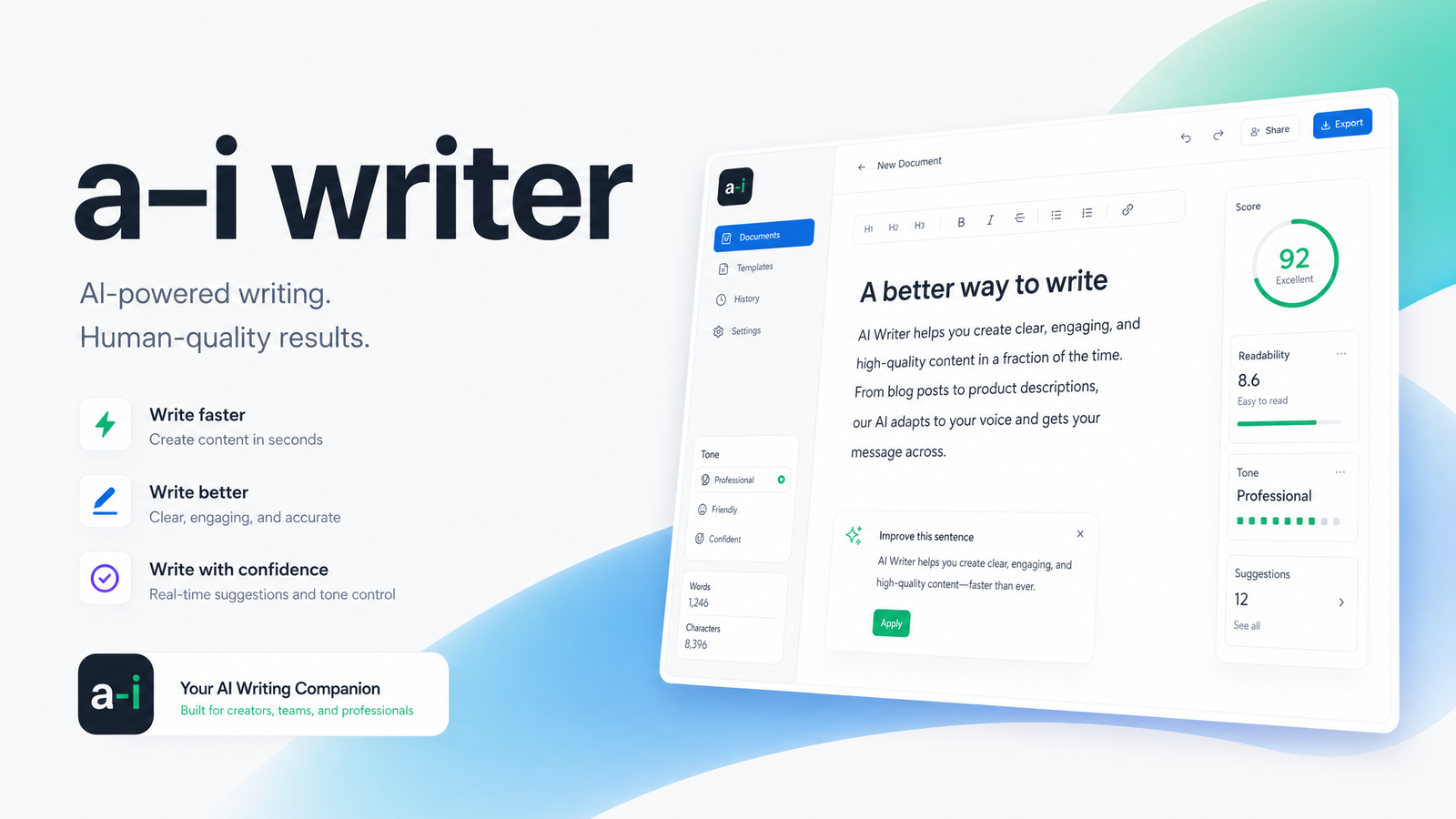
What Is an AI Writer, Exactly?
An AI writer is software built specifically to produce written content — blog posts, product pages, landing pages — using a large language model trained or prompted for that task. That's narrower than it sounds. A chatbot answers questions conversationally; an AI writer is oriented toward producing a finished, structured piece of writing you can edit and publish. And an AI writer is not the same thing as an AI content generator, which is the umbrella term covering everything from image generators to code assistants to video tools. Text happens to be one output among many under that wider umbrella.
The AI writer vs AI content generator distinction matters because it sets expectations. If you're comparing tools under the "AI content generator" banner, you'll find text, image, and audio tools mixed together, most irrelevant to a content team's actual job. An AI writing tool built for SEO content needs to do something more specific: understand a brief, follow a structure, match a voice, and produce something close to publish-ready. That's the category this article is actually about.
What an AI Writer Can (and Can't) Do for SEO
A capable AI writer for SEO earns its keep on the mechanical parts of writing. Given a decent brief, it can draft a full article, organize it under logical headings, match a target tone, and do it in minutes instead of hours. It can also produce multiple structural variations quickly — useful when you're testing angles on a competitive topic. As a production accelerant, that's real, measurable value for any content team drowning in a backlog.
What it can't do is guarantee a ranking. No AI content writer, no matter how well-tuned, can independently verify facts it wasn't given, understand your audience's actual intent the way a subject-matter expert can, or substitute for keyword and competitive research. It also can't take responsibility for accuracy — that stays with whoever hits publish.
This lines up with where Google's guidance has settled. Google's Search Central documentation has been consistent into 2026: the production method — human, AI, or a mix — isn't itself a ranking factor. What matters is whether the content is helpful, reliable, and demonstrates the experience and expertise Google's helpful content system and E-E-A-T guidance look for. Does Google penalize AI content? Not for being AI-generated. It penalizes low-value, unoriginal, or manipulative content at scale — a policy Google formalized under its scaled content abuse guidance. An AI writer used to publish shallow, interchangeable pages is the risk; an AI writer used to accelerate genuinely useful writing is not.
The Gap Most Standalone AI Writers Leave Open
Here's where most buyers get tripped up. A standalone AI writer solves one step in a much longer process and leaves the rest to you. You still need to do keyword research before you ever open the tool. You still need a content brief — target queries, intent, competitor gaps, structural notes — because an AI writer that isn't fed a strong brief will produce something generic no matter how good the underlying model is (this is the exact argument we make in our breakdown of what a proper SEO content brief looks like). After the draft, you're formatting for your CMS, adding internal links, checking schema, and eventually — separately — tracking whether any of it moved the needle in rankings.
That's tool-juggling: one subscription for drafting, another for keyword and brief data, a CMS workflow that's manual, and a rank tracker bolted on afterward. Each handoff is a place where quality slips or work gets duplicated. This is the actual argument for treating "AI writer" as one link in a chain rather than a category to shop for in isolation — a point we go into more in our piece on building a content publishing workflow that scales safely. An automated content writing tool that hands you a Google Doc and calls it done hasn't actually automated much; it's automated the easiest 20% of the job.
If your actual need is lighter than full drafting — you've got drafts already and just want cleaner phrasing or de-duplicated language — that's a different tool category entirely, closer to what we cover in our guide to sentence rewriter tools for SEO teams. Know which job you're actually hiring a tool to do.
5 Criteria for Choosing an AI Writer
Marketing pages for AI writing software tend to emphasize word count and speed. Neither tells you much about output quality. Use this checklist instead when evaluating the best AI writer for your team's actual workflow:
Brief and keyword input quality. Can you feed it a real content brief — target keyword, intent, competitor gaps, required subtopics — or does it only accept a vague prompt? Output quality is bounded by input quality; a tool that ignores structured briefs will always produce generic drafts.
Tone and brand-voice control. Does it let you define and retain a consistent voice across dozens of articles, or does every piece read like a slightly different stranger wrote it? Voice consistency matters more as volume scales.
Fact and citation handling. Does the tool flag claims that need a source, or does it invent plausible-sounding specifics with total confidence? This is the single biggest risk factor for E-E-A-T and for your own credibility.
SEO structure readiness. Does it output proper heading hierarchy, natural spots for internal links, and schema-ready formatting — or just a wall of paragraphs you have to restructure by hand?
Publishing and tracking integration. Can the draft move into a CMS and get tracked for rankings without you exporting it into three other tools? This is the criterion standalone AI writers fail most often, and it's the one that determines whether the tool actually saves time or just moves the bottleneck.
Weight these based on your actual pain point. A solo blogger might care most about tone control; an in-house team publishing at volume should weight the workflow-integration criterion heavily, because that's where hours get lost every week.
Where Rankevra Fits: an AI Writer Built Into a Full SEO Workflow
Rankevra's AI writer exists inside the workflow it's meant to serve, not next to it. An audit surfaces the technical and content gaps worth targeting. That feeds a content brief generated from real keyword and competitor data. The AI writer drafts against that brief — not a blank prompt — so structure, headings, and internal linking opportunities are already accounted for. From there, the piece publishes directly, and rank tracking picks it up automatically so you can see whether it's actually earning visibility, not just sitting in a drafts folder.
That's the difference between an AI writer and an AI SEO workflow: one produces text, the other produces a published, monitored asset. If you're evaluating AI writing tools and keep running into the tool-juggling problem described above, that's the gap worth closing before you commit to a subscription.
Try Rankevra if you want an AI writer that's already wired into audit, brief, publish, and rank-tracking — not one more draft generator you have to plug into everything else.
Frequently Asked Questions
Is using an AI writer against Google's guidelines?
No — Google's own Search Central guidance states that content production method, whether human, AI, or a mix, isn't a ranking factor by itself. What Google's helpful content system and scaled content abuse policy actually target is low-quality, unoriginal, or mass-produced content regardless of how it was made. An AI writer used to produce genuinely useful, accurate content isn't violating guidelines; using any tool to flood a site with thin, interchangeable pages is.
What's the difference between an AI writer and an AI content generator?
An AI writer is a subset of AI content generator focused specifically on producing written text like articles and web pages. AI content generator is the broader category that also includes tools for images, video, audio, and code. If you're comparing options for blog or SEO content specifically, you're shopping in the AI writer category, even though many listicles blur the two terms together.
Can an AI writer replace a human content writer entirely?
Not for strategy, fact verification, or genuine expertise, no. An AI writer can handle drafting, structuring, and formatting at speed, but it can't independently guarantee accuracy or bring the lived experience that E-E-A-T rewards. The realistic model is a human directing strategy and editing for accuracy, with the AI writer handling the mechanical first draft.
How do I know if an AI writer's output is good enough to publish as-is?
Check three things before publishing: factual accuracy of any specific claims, statistics, or names; whether the structure actually matches search intent for the target query; and whether the voice sounds like your brand rather than a generic default. If any of those three fail, the draft needs human editing before it goes live — publishing an unreviewed AI draft is the fastest way to end up with thin, unhelpful content.
Do AI writers work for technical or niche topics that need real expertise?
They can draft competently on technical topics if given a detailed, expert-informed brief, but they can't originate the expertise themselves. For genuinely specialized subject matter — medical, legal, financial, or deep technical niches — a subject-matter expert still needs to review or contribute the actual claims, with the AI writer handling structure and phrasing around that input.
Will Google know if I used an AI writer?
Google doesn't penalize content for being AI-assisted, and there's no evidence it specifically detects or flags "AI-written" text as a category. What gets flagged is the outcome: thin, unoriginal, or low-value pages published at scale, which Google's scaled content abuse policy targets regardless of the tool used to create them. Quality and usefulness are what get evaluated, not the production method.
Keep reading
- Content Decay SEO: How to Detect It and Fix It for GoodLearn to detect content decay SEO issues early, rule out false positives, and build a refresh pipeline that scales — plus how to automate the whole loop.
- Headless CMS SEO: Fixing the Gaps Generic Tools MissHeadless CMS SEO breaks in three predictable places: rendering, metadata, and sitemaps. Here's the diagnostic framework to find and fix each gap.
- Google Algorithm Update Recovery: A Diagnostic FrameworkA step-by-step google algorithm update recovery framework: confirm the cause, segment the damage, benchmark against winners, and set a real timeline.