Rankevra Blog
SEO Content Brief: What It Is and How to Build One
August 31, 2026
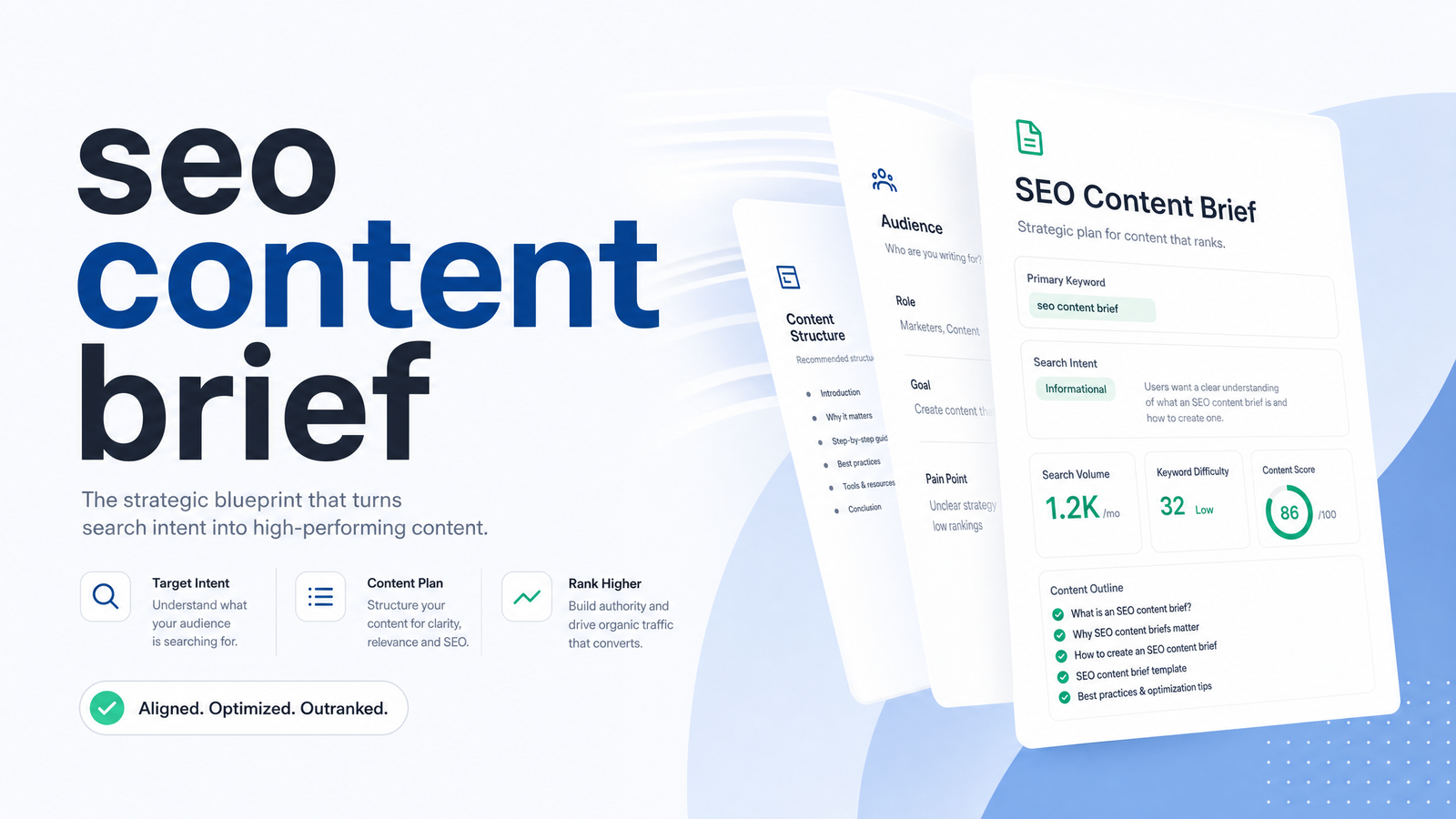
What Is an SEO Content Brief?
An SEO content brief tells a writer exactly what to cover, why it matters, and who it's for — before a word gets written. It translates keyword research and search intent into instructions a human (or AI assistant) can act on: subtopics to hit, what top-ranking pages already cover, how the piece should be structured, and what it needs to rank.
A good brief solves the consistency problem. Without one, five writers on the same team produce five different takes on a topic — some too shallow, some off-intent, some missing entities Google expects to see. No written brief means every article starts from a guess.
It's worth separating a content brief from a simple outline. An outline is just a skeleton of headings. A content brief vs outline distinction matters because a brief includes the outline plus the reasoning behind it — search intent, competitor gaps, target audience, on-page targets. An outline tells a writer what to write; a brief tells them why, which keeps content from drifting off-topic mid-draft.
What Every Effective Brief Should Include
A usable brief isn't a checklist of keyword-density rules — it's context. Core components of a genuinely useful content brief template:
- Target keyword and search intent — the primary term, its variations, and a plain statement of whether the searcher wants to buy, learn, compare, or navigate somewhere. Get this wrong and nothing else matters.
- SERP and competitor analysis — a short summary of what's ranking, what those pages do well, and where they fall short.
- Recommended word count range, not a rigid number — based on what top results actually run.
- Heading structure reflecting the logical flow a reader (and search engine) expects.
- Entities and subtopics to cover — people, tools, concepts, and related questions that signal topical depth.
- Internal linking suggestions pointing to related pages already on the site, reinforcing topical authority.
- Meta title and description drafted in advance so the writer isn't left to invent them last.
- Audience and tone notes — who's reading, what they already know, and how formal or casual the voice should be.
A concrete seo writing brief example: instead of "write 1,500 words about email marketing," a proper brief says "write for small business owners who've never used automation, cover segmentation and deliverability as core subtopics, link to our existing automation-tools guide, and match the how-to intent shown in the top five results."
How to Build an SEO Content Brief Step by Step
Knowing how to write a content brief means treating it as a repeatable process, not a one-off research task redone from scratch each time.
1. Confirm search intent first. Check what Google is actually rewarding — informational guides, product comparisons, listicles, tools. If the top ten results are all how-to guides and your plan was a product roundup, the keyword isn't a fit for that format, no matter how good the writing is.
2. Analyze the top-ranking pages. Read the top five to ten results, not just their headings. Note what they explain well, what they gloss over, and what questions they leave unanswered — that gap is often the opening for a better piece. This overlaps with a broader content gap analysis, useful when deciding which topics deserve a brief in the first place, not just how to structure one you've already chosen.
3. Extract common entities and subtopics. Look for terms, tools, and related concepts that show up across multiple ranking pages. If every top result mentions a specific technique, statistic, or related tool, that's a signal the topic is expected to be covered, not optional flavor text.
4. Structure the outline around intent, not keyword tricks. Headings should follow the order a reader would naturally want answers, informed by what's already ranking — not stuffed with keyword variants for their own sake.
5. Map internal links. Identify two or three existing pages the new article should link to, with anchor text options. This feeds directly into topical authority and shouldn't be left for the writer to figure out unassisted.
6. Set on-page targets. Draft the meta title, description, and any schema notes so the technical SEO groundwork is done before writing starts, not patched in afterward.
A Simple SEO Content Brief Template
A field-by-field seo content brief template you can copy for your next article:
- Target keyword: [primary term]
- Secondary/related terms: [2–5 variations]
- Search intent: [informational / commercial / transactional / navigational]
- Audience: [who's reading and what they know already]
- Recommended word count: [range, based on top results]
- Meta title: [draft, under 60 characters]
- Meta description: [draft, under 160 characters]
- Heading structure (H2/H3): [outline reflecting reader flow]
- Entities/subtopics to cover: [list pulled from SERP analysis]
- Internal links to include: [existing URLs + suggested anchor text]
- Competitor pages reviewed: [URLs + one-line notes on strengths/gaps]
- Tone/style notes: [formal, conversational, technical, etc.]
This structure works as a content brief for writers at any experience level — it gives freelancers and new hires enough context to write confidently without a back-and-forth before they start.
Mistakes That Make Briefs Useless
Most content brief mistakes come from over-correcting in one direction. A few recurring patterns:
Rigid exact-match keyword counts. Instructions like "use the exact phrase eight times" produce robotic prose and read as spam to readers and search engines alike. Natural keyword variation does more for rankings than repetition.
Ignoring search intent entirely. A brief built purely from keyword volume, without checking what's ranking, sends writers down the wrong format — a comparison post when the SERP wants a tutorial, for instance.
Outdated SERP snapshots. Rankings shift. A brief built from a SERP analysis done six months ago may reference competitors that have since been outranked or an intent that's since changed.
Briefs so long writers skip them. A ten-page brief for an 800-word blog post gets skimmed, not followed. Brevity that still covers intent, structure, and entities beats exhaustive detail nobody reads.
No entity or topic guidance. A brief with a keyword and word count but no direction on subtopics leaves writers guessing at depth — exactly the inconsistency a brief exists to prevent.
Why Manual Briefs Don't Scale (and Where AI Fits)
Building one thorough brief — real SERP analysis, entity extraction, an intent-matched outline, internal link mapping — takes real time even for an experienced strategist. Multiply that by twenty, fifty, or a hundred articles a quarter, and manual briefing becomes the bottleneck in the entire content operation, not the writing itself.
This is where an AI content brief generator changes the math. Instead of a person opening ten competitor tabs, reading each one, and typing up notes, an AI tool can pull the current SERP, extract shared entities and subtopics, and draft a structured brief in a fraction of the time — freeing the human to focus on judgment calls: which angle to take, which gaps to exploit, which internal links matter most.
The distinction that actually matters isn't ai generated content brief vs manual in isolation — it's whether the brief plugs into a larger workflow or dead-ends as a standalone document. A brief generator that hands you a document you still have to manually feed into a CMS, track rankings for separately, and audit for technical issues on your own solves only part of the problem. For a closer look, see this comparison of standalone brief generators versus a full connected workflow.
Rankevra builds briefs as one step inside a connected process — audit, brief, draft, publish, and rank tracking in the same system, rather than a generator you paste output out of. That matters especially for teams publishing AI-assisted content, where trust signals need extra attention; see this framework for E-E-A-T in AI content for what that looks like in practice. It also matters for teams thinking about how briefing fits into a larger publishing pipeline that scales safely rather than treating each article as an isolated task.
Not every piece needs the full ceremony. A quick internal update, a short news post, or a one-off page with no real ranking ambition doesn't need a formal brief — a short note on intent and audience is enough. Briefs earn their time cost on pieces meant to rank and compound authority over time, not on every single thing a team publishes.
Frequently Asked Questions
What's the difference between an SEO content brief and a content outline?
An outline is just the heading structure a writer will follow. A content brief includes that outline plus the reasoning behind it — target keyword, search intent, competitor analysis, entities to cover, and internal linking guidance — which is what actually keeps the writer on-target rather than just organized.
How long should an SEO content brief be?
Long enough to cover intent, structure, and subtopics clearly — typically one to two pages for a standard blog post. If a brief runs so long that writers start skimming or skipping it, it's defeating its own purpose regardless of how thorough the underlying research was.
Do I need a content brief for every blog post, even short ones?
No — short, low-stakes content like internal updates or brief news posts usually doesn't need a formal brief. Reserve full briefs for pieces meant to rank competitively and build topical authority, where intent-matching and SERP analysis actually change the outcome.
Can AI write an SEO content brief automatically, and is it as good as a manual one?
Yes, AI can analyze current SERPs, extract common entities, and draft a structured brief significantly faster than manual research, and modern tools do this with real accuracy. The main advantage isn't just speed — it's that an AI-generated brief can plug directly into a broader workflow covering audits, drafting, and publishing, rather than existing as an isolated document.
What should a content brief include for freelance writers who don't know the site?
It should include audience and tone notes, internal linking suggestions to existing site pages, and clear intent guidance, since freelancers lack the institutional context an in-house writer has. Without these, freelancers tend to guess at voice and miss opportunities to connect new content to what's already published.
How is a content brief different from a keyword research document?
Keyword research identifies which terms to target and their search volume; a content brief goes further by turning one of those keywords into a fully actionable writing plan. The brief adds intent analysis, competitor structure, entity coverage, and on-page targets — the research feeds into the brief, but the brief is what a writer actually works from.
Manually pulling this together — SERP analysis, entity extraction, outline structure, internal link mapping — for every article a team publishes stops being sustainable once volume picks up. Rankevra generates these briefs automatically as one connected step in a full audit-to-publish workflow, so content teams get consistent, intent-matched briefs without the manual research overhead on every single piece.
Keep reading
- Content Decay SEO: How to Detect It and Fix It for GoodLearn to detect content decay SEO issues early, rule out false positives, and build a refresh pipeline that scales — plus how to automate the whole loop.
- Headless CMS SEO: Fixing the Gaps Generic Tools MissHeadless CMS SEO breaks in three predictable places: rendering, metadata, and sitemaps. Here's the diagnostic framework to find and fix each gap.
- Google Algorithm Update Recovery: A Diagnostic FrameworkA step-by-step google algorithm update recovery framework: confirm the cause, segment the damage, benchmark against winners, and set a real timeline.