Rankevra Blog
Sentence Rewriter Tools: A Buyer's Guide for SEO Teams
August 30, 2026
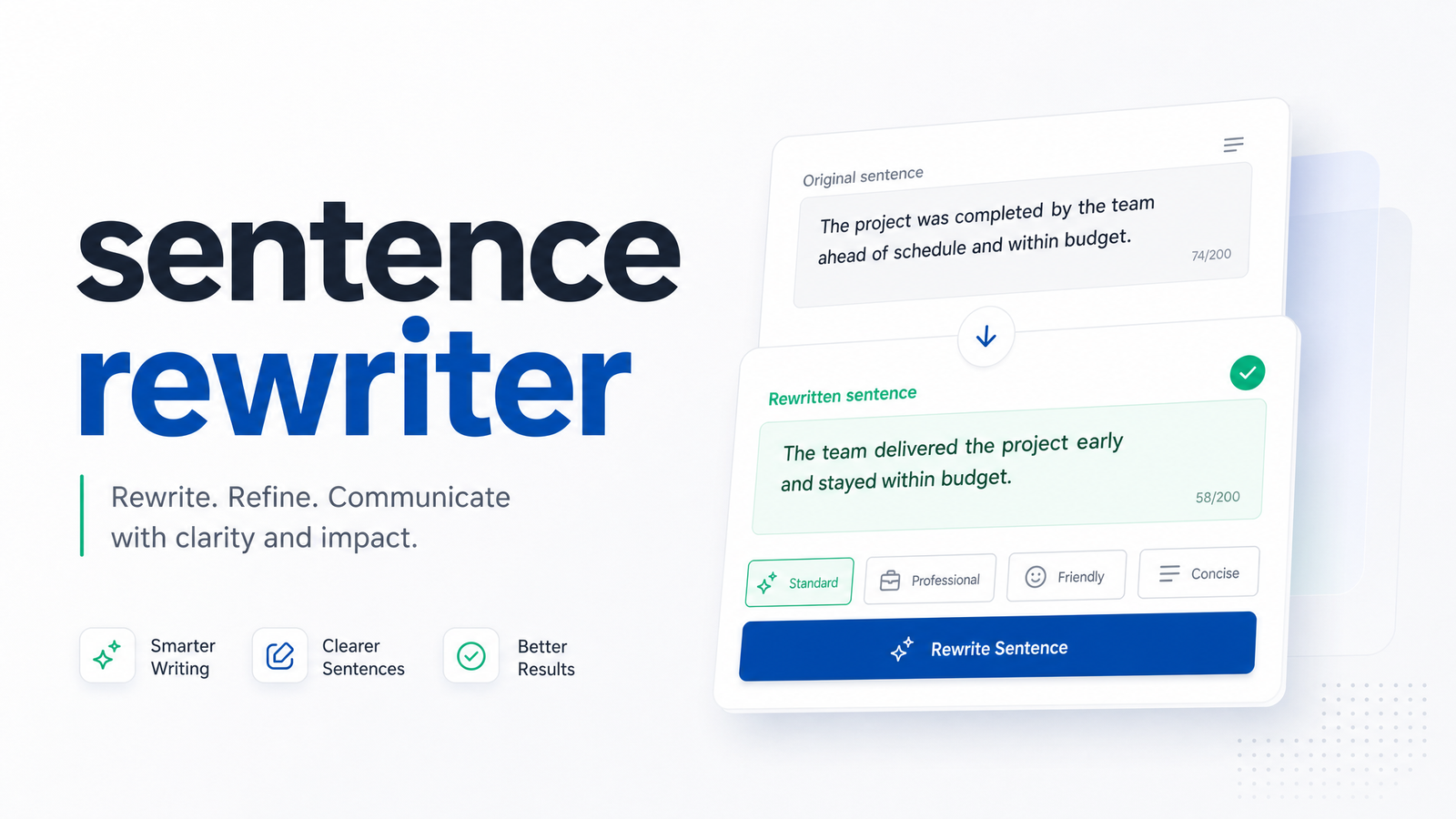
Type "sentence rewriter" into Google and you'll get two kinds of results: listicles ranking paraphrasing apps by how "human" their output sounds, and how-to guides on manually reworking a sentence for SEO. Neither answers what a marketing lead or SEO manager actually needs to know: whether installing one of these tools into a real content pipeline is safe, effective, and worth paying for.
This is a buyer's evaluation, not a paraphrasing contest. For the manual technique — restructuring a sentence by hand for search intent and readability — see Rewrite Sentence: The SEO Guide to Doing It Right. Here, we're treating the sentence rewriter as software you're deciding whether to buy, judged against the risk and workflow questions that actually determine whether it helps or hurts your rankings.
What a Sentence Rewriter Actually Does (and Doesn't)
A sentence rewriter takes existing text and produces a reworded version — swapping vocabulary, adjusting sentence structure, sometimes shifting tone — while trying to preserve the original meaning. An AI sentence rewriter uses a language model to do this more fluently than older thesaurus-swap tools, understanding context well enough to avoid the awkward synonym substitutions that made early paraphrasing tools easy to spot.
What it doesn't do is think strategically about your content. A rewriter reworks what's already on the page; it doesn't research a topic, decide what a page should cover, or determine if a piece of content deserves to exist at all. A paraphrasing tool operates at the sentence or paragraph level, with no awareness of your broader content strategy, your existing pages' interlinking, or whether the topic is already covered elsewhere on your site. Understanding this boundary up front prevents the common mistake of treating a rewriter as a shortcut for actual content strategy, rather than what it is: a narrow, useful tool for a narrow set of jobs.
Why SEO Teams Reach for One
Four situations come up repeatedly among teams evaluating this category.
The first is content refresh at scale. Old blog posts and landing pages go stale, but rewriting hundreds of them by hand isn't realistic for most teams. A rewriter speeds up the mechanical part of updating tired phrasing so an editor can focus on adding new information rather than retyping sentences from scratch.
The second is de-duplication of near-identical pages — typically location or product variants built from the same template. A city-page network for a service business, or a product catalog with dozens of near-clone variants, creates obvious duplicate content risk if every page says the same thing with the city name swapped in. Teams reach for a rewriter to differentiate the boilerplate language, though rewording alone isn't a complete fix.
The third is speeding up the editing of AI-generated drafts — smoothing repetitive phrasing or adjusting tone before a human editor does final review.
The fourth is repurposing one asset across channels: turning a blog paragraph into a LinkedIn post or an email intro without starting from a blank page each time. In all four cases, the goal is to rewrite sentences for SEO purposes without creating duplicate content problems, not to generate volume for its own sake.
The Real Risk: Rewriting Into a Google Penalty
Here's where most "best sentence rewriter" content goes quiet, because it's inconvenient for tools trying to sell you on speed and volume.
Google's spam policies explicitly address what it calls scaled content abuse: generating large quantities of pages primarily to manipulate rankings rather than to help users, regardless of whether the content is written by a human, generated by AI, or produced through automation like paraphrasing. The enforcement mechanism, SpamBrain, doesn't evaluate content at the sentence level looking for word-swaps — it evaluates patterns: many pages built from the same template, offering the same thin value, differentiated only by superficial variation. A sentence rewriter that changes wording without changing substance produces exactly this pattern.
This is the core misunderstanding to correct: passing a plagiarism checker or an AI-detection tool doesn't mean a page is safe. A rewritten page can be technically unique at the sentence level and still qualify as spun content in the sense Google's policies care about, because uniqueness of phrasing isn't the same as uniqueness of value. If ten location pages all say "we provide fast, reliable plumbing services in [city]" with only the wording reshuffled, no amount of paraphrasing sophistication fixes the underlying problem — there's no city-specific information, no distinct proof points, nothing a reader in that city couldn't get from any competitor's page.
The safer approach treats rewriting as one input into a page that also gains something real: local details, updated data, a genuine answer to a more specific question. That's also where E-E-A-T comes in — Google's framework for evaluating experience, expertise, authoritativeness, and trust applies to AI-assisted content just as much as human-written content, and a page that reads as generic or interchangeable struggles on those signals regardless of how it was produced. For a deeper framework on this, see E-E-A-T for AI Content: A Framework Beyond the Byline.
6 Criteria for Evaluating a Sentence Rewriter Tool
Marketing pages for sentence rewriter software tend to emphasize speed and "human-like" output, but those aren't the criteria that determine whether a tool is safe and useful in an actual SEO workflow. Here's what to check instead.
1. Context and meaning preservation. Does the tool understand the sentence's intent well enough to avoid subtly changing meaning while rewording it? Test it on a technical or nuanced sentence, not just a simple one — that's where cheaper tools fall apart.
2. Tone and brand voice control. Can you set a tone (formal, conversational, technical) and get consistent results across a batch, or does every output sound like the same generic default voice regardless of input?
3. Keyword and entity retention. A rewriter that "improves" a sentence by dropping your target keyword or renaming a product entity is actively working against your SEO goals. Good tools let you lock specific terms so they survive the rewrite untouched.
4. Batch and bulk capability. If you're de-duplicating fifty location pages or refreshing a backlog of old posts, one-sentence-at-a-time rewriting isn't a real workflow. Bulk processing with consistent quality across the batch is a genuine differentiator, not a nice-to-have.
5. Plagiarism and AI-detection safety. This matters less as a goal in itself and more as a floor — a rewrite that still trips plagiarism checkers hasn't actually reworded anything meaningful, regardless of what it claims about uniqueness scores.
6. Integration with the rest of the content pipeline. Does the rewritten text flow into your CMS, or does it dead-end in a text box you have to copy from? This is the criterion that separates sentence rewriter software from a full AI SEO workflow, and it's the one most comparison lists skip entirely.
Where Rewriting Fits in a Full SEO Workflow
Rewriting a sentence is a step, not a strategy. The teams that get real SEO results treat it as one stage in a sequence: audit the site to find thin, duplicate, or outdated pages; identify which ones need new substance versus a wording refresh; rewrite with context rather than blind word-swapping; re-optimize the on-page elements around the new text — titles, headers, internal links; publish; then track whether rankings actually move.
Handled as five separate tools stitched together with copy-paste, this process is slow and error-prone — you lose track of which pages were flagged, whether the rewrite addressed the audit finding, and whether rankings improved afterward. If you're de-duplicating location pages specifically, a rewriter is only part of the fix; the deeper structural approach is covered in Multi-Location SEO: Rank Every City Page Without Duplication. If your rewriting work is really about closing gaps in what a page covers rather than just changing its wording, pair it with a proper SEO Content Gap Analysis. And if you're deciding between a narrow rewriter and a tool that can also draft new sections from scratch, that comparison is laid out in Best AI Content Generator: A Criteria-Based Framework.
A safe, scaled content publishing workflow needs all of these stages connected, which is the case made in Building a Content Publishing Workflow That Scales Safely. Rankevra builds its AI sentence rewriter directly into that kind of audit-to-publish pipeline: the audit flags what needs attention, the rewrite happens with full context of the page and keyword targets, on-page elements update alongside the text, and rank tracking shows whether the change actually worked — all without exporting text to a separate paraphrasing app and pasting it back into your CMS.
Frequently Asked Questions
Is a sentence rewriter tool bad for SEO?
Not inherently — the risk comes from how it's used, not the tool itself. A rewriter used to reword thin, templated content without adding real value can trigger scaled content abuse enforcement, while the same tool used to refresh genuinely outdated content with added substance is safe and often beneficial.
Can Google tell if content was rewritten by AI?
Google doesn't primarily detect individual AI-rewritten sentences; its spam systems, including SpamBrain, look for patterns like many near-identical pages built from the same template with only superficial wording differences. Passing a plagiarism or AI-detection checker doesn't guarantee a page avoids this kind of enforcement.
What's the difference between a sentence rewriter and an AI content generator?
A sentence rewriter reworks existing text you provide, while an AI content generator drafts new content from a topic, outline, or brief with no starting text required. Teams that need both fresh drafts and ongoing refreshes typically need a broader content generator, not just a rewriting feature.
How many sentences can I safely rewrite on a page without triggering duplicate content flags?
There's no fixed number — the risk is about substance, not sentence count. A page can have every sentence reworded and still be flagged if it offers no more value than the page it was copied from, while a page with fewer rewritten sentences but genuinely new, specific information is generally safe.
Do I still need to edit AI-rewritten sentences before publishing?
Yes. Human review catches subtle meaning shifts, tone mismatches, and factual errors that automated rewriting can introduce, and it's also where the specific, page-unique details that satisfy E-E-A-T and avoid scaled content patterns actually get added.
Is a sentence rewriter enough to fix duplicate multi-location pages?
No, rewording alone doesn't resolve the underlying issue on templated location pages. It needs to be paired with genuinely location-specific content — local details, distinct proof points, unique information a reader in that city can't find on a competitor's page — as outlined in the multi-location SEO approach above.
Choosing a sentence rewriter shouldn't mean adding one more disconnected tool to your stack. Rankevra puts AI rewriting inside the same workflow as your audits, publishing, and rank tracking — so the fix for a flagged page happens in one place, not across four browser tabs.
Keep reading
- Content Decay SEO: How to Detect It and Fix It for GoodLearn to detect content decay SEO issues early, rule out false positives, and build a refresh pipeline that scales — plus how to automate the whole loop.
- Headless CMS SEO: Fixing the Gaps Generic Tools MissHeadless CMS SEO breaks in three predictable places: rendering, metadata, and sitemaps. Here's the diagnostic framework to find and fix each gap.
- Google Algorithm Update Recovery: A Diagnostic FrameworkA step-by-step google algorithm update recovery framework: confirm the cause, segment the damage, benchmark against winners, and set a real timeline.