Rankevra Blog
Anchor Text Optimization: Safe Ratios and Audit Framework
August 28, 2026
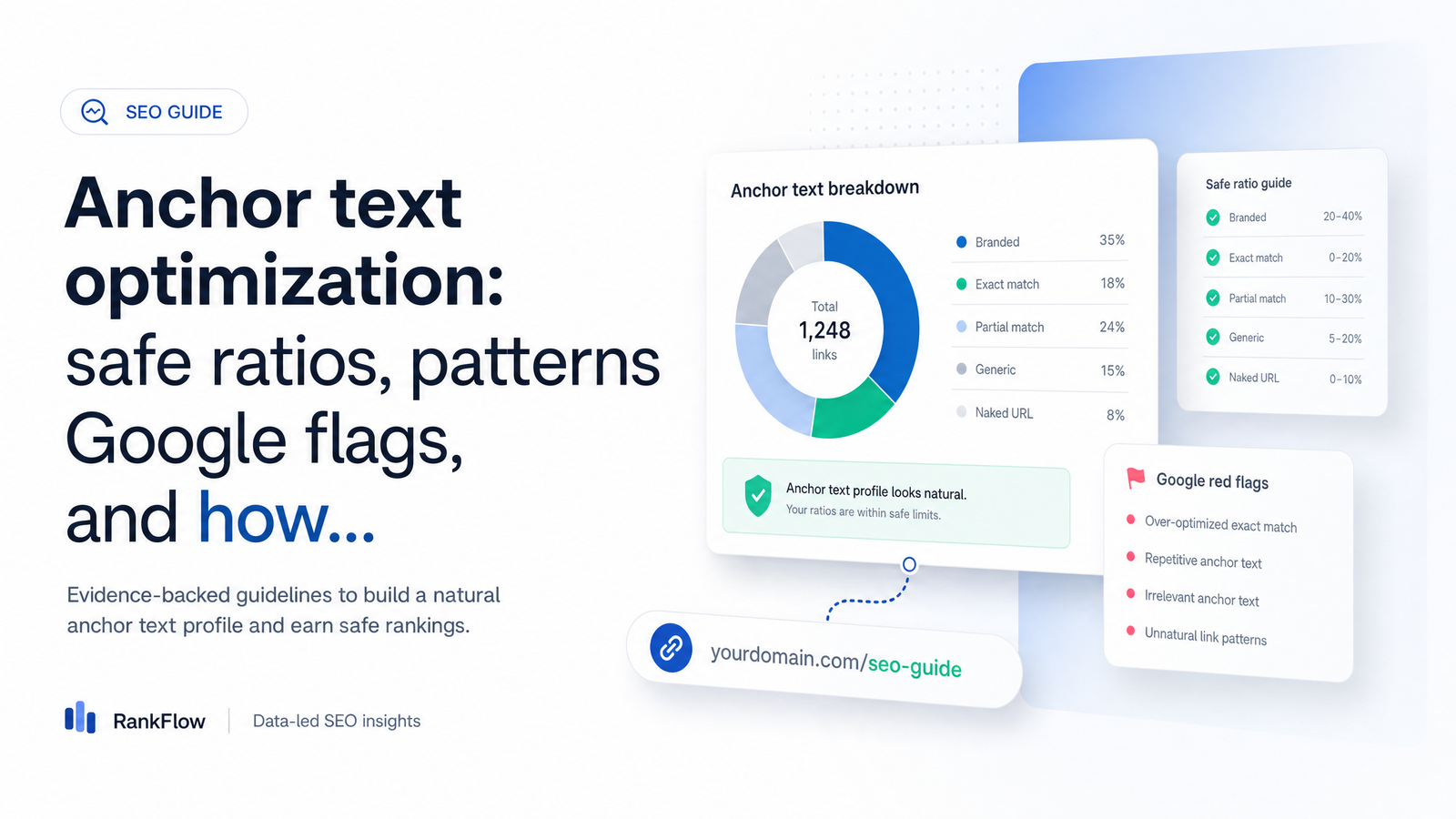
What Anchor Text Optimization Actually Means (And Why Ratios Matter More Than Keywords)
Anchor text is the clickable words in a hyperlink — "best running shoes" instead of "click here." Anchor text optimization is the practice of managing what that clickable text says across every link pointing to your site, so the overall mix looks like something a real audience would naturally produce rather than something a link-builder engineered overnight.
Google isn't scoring individual anchors for keyword relevance the way it did in 2010 — it's evaluating your entire anchor profile as a pattern. A single "cheap car insurance quotes" link isn't the problem; fifty of them pointing at the same page, from unrelated domains within a short window, is. A natural backlink profile has variety by default — brand names, raw URLs, generic phrases like "this article," and only occasionally your target keyword — because people link the way they actually write, not the way an SEO campaign optimizes.
This is why anchor text optimization is really a ratio problem, not a keyword problem. Get the distribution wrong and even legitimate links can look manufactured.
The 5 Anchor Text Types You Need to Track
Every audit starts by sorting links into five buckets. The ratios in the next section are meaningless without this classification first.
- Branded anchor text — your company or product name, e.g., "Rankevra." This should form the backbone of most profiles.
- Exact match anchor text — the precise keyword you want to rank for, e.g., "anchor text optimization" linking to this exact topic page. Powerful, but the riskiest category by volume.
- Partial match anchor (keyword-plus) — a variation that includes part of the target phrase plus other words, e.g., "guide to anchor text strategy."
- Generic anchor text — non-descriptive phrases like "click here," "read more," or "this page."
- Naked URL anchor — the literal URL as the link text, e.g., "https://rankevra.com/blog/anchor-text."
Most sites also pick up a small residual category — image alt-text links or long, sentence-style anchors — but for audit purposes, these five cover the overwhelming majority of real-world links.
Safe Anchor Text Ratios: What the Data Says
There's no single government-issued number here, but documented industry benchmarks converge on a workable range:
| Anchor type | Safe ratio range |
|---|---|
| Branded + naked URL + generic (combined) | 60–80% |
| Partial match / keyword-plus | 15–25% |
| Exact match | 0–5% |
The exact match anchor text percentage is the number to watch most closely — Linkscope's calculator methodology treats anything above roughly 5% exact match as entering risk territory, with branded, generic, and naked-URL anchors combined needing to stay at or above 60% to look organic. That 5% ceiling isn't arbitrary; it reflects how rarely real linkers use your exact target phrase verbatim rather than your brand name or a natural description.
Homepage and inner-page ratios diverge slightly. Homepages accumulate branded and naked-URL anchors naturally because people bookmark and reference the root domain by name. Inner or category pages attract more partial-match and topical anchors from content links and guest posts, so a slightly higher partial-match share there is normal — SEO Sherpa's benchmarks note this internal-page nuance explicitly. Treat the table above as a safe anchor text ratio baseline, then adjust a few points per page type rather than applying one blanket number site-wide.
Anchor Text Patterns That Get Flagged
Google's Penguin update, launched in 2012, was built specifically to devalue manipulative link schemes, and its logic hasn't disappeared — it's now folded into Google's real-time core spam systems, meaning there's no waiting period for a refresh anymore. The anchor text patterns Google flags today are largely the same signals Penguin was designed to catch:
- Exact-match dominance — a disproportionate share of links using the identical target keyword. This is the single clearest trigger for an exact match anchor text penalty.
- Sudden anchor spikes — a burst of new links using the same phrase within days or weeks, inconsistent with organic link acquisition speed.
- Identical anchors across many low-quality domains — the same exact phrase appearing on dozens of unrelated, thin, or spun sites is a textbook link spam signature.
- Over-optimized guest post anchors — contributor bios or in-content links that consistently use commercial keyword anchors instead of branded ones.
- Keyword-stuffed compound anchors — unnaturally long phrases stacking multiple keyword variants into one link, something no genuine writer produces.
- Anchor text mismatched to destination content — the anchor promises one topic while the linked page delivers another, a relevance gap algorithms and manual reviewers both catch.
None of these patterns alone is fatal. It's the co-occurrence — several clustering on the same domain or page — that tends to draw scrutiny.
How to Audit Your Existing Link Profile: A Step-by-Step Process
A proper anchor text audit doesn't require guesswork; it's a five-step data process.
- Export your backlinks. Pull a complete list of referring links and their anchor text from a reliable data source. If you haven't settled on one, this backlink analysis tool evaluation framework walks through what separates usable data from noise.
- Categorize every anchor into the five types — branded, exact match, partial match, generic, naked URL — in a spreadsheet or via a tool that tags anchors automatically.
- Calculate ratios for the whole domain and separately for your homepage and most important inner pages, since the healthy split isn't identical across page types.
- Flag risk tiers. A simple three-tier model, similar to the structure CalcBee's ratio calculator uses, works well:
- Safe: exact match under 5%, branded/generic/naked combined above 60%.
- Moderate risk: exact match 5–10%, or a noticeable recent spike in one anchor phrase.
- High risk: exact match above 10%, repeated identical anchors from low-authority domains, or anchors mismatched to page content.
- Identify the offending domains and phrases. Sort flagged links by referring domain quality and anchor pattern rather than treating every risky anchor equally.
- Decide fix vs. disavow for each flagged item — covered in the next section.
If you're unsure which columns in your backlink report actually matter, this guide to reading backlink checker reports breaks down anchor text data alongside authority and spam-score fields, so you're interpreting exports rather than just running them. A full link profile audit should also feed into your broader technical priorities — anchor cleanup is one item on a longer list, which this technical SEO action plan helps you sequence against crawl, indexing, and site-health fixes.
Fixing an Over-Optimized Profile Without Overreacting
Once you know which links are risky, resist the instinct to nuke everything. Anchor text over-optimization penalty recovery works best as a graduated response, in this order:
- Diversify future anchors first. If new content or outreach links are still being built, shift the mix toward branded and natural phrasing immediately — the fastest lever with zero downside.
- Request anchor edits on links you control. Guest posts you authored, directory listings, partner mentions — reach out and ask for the anchor to be changed to branded or generic text. These are often quick wins given your direct relationship with the site.
- Disavow only as a last resort, and only for genuinely toxic domains: spammy link networks, clearly manipulative directories, or sites with no legitimate traffic or content. Disavowing anchor text links is a blunt instrument — it tells Google to ignore the link entirely, which is unnecessary if the link is otherwise from a reasonable domain and the anchor is just slightly off.
Mass disavowal without this triage is how sites lose legitimate link equity for no ranking benefit. If your exact-match percentage is at 7% with otherwise healthy domains, that's a moderate-risk profile to dilute with future diversification — not a crisis requiring a disavow file. Reserve disavows for domains you'd never want associated with your site regardless of anchor text, and let fixing over-optimized anchor text through dilution and outreach handle the rest.
Keeping Your Anchor Profile Safe Going Forward
An audit is only a snapshot. New links keep arriving from guest posts, PR mentions, directories, and unsolicited citations, and each one nudges your ratios — usually harmlessly, occasionally not. Committing to a quarterly manual recheck is the minimum; a real anchor text monitoring habit means catching a spike within days rather than a quarter later, after Google's real-time spam systems have already noticed a pattern.
The practical challenge is that manual monitoring doesn't scale. Re-exporting backlinks, re-tagging anchors into five categories, recalculating ratios by page, and cross-checking against your last audit every time a batch of new links appears is exactly the kind of repetitive, error-prone work that gets skipped once quarterly turns into "whenever we remember." A genuinely natural link building strategy — one that earns branded mentions, editorial links, and citations organically — still needs that ongoing check to confirm the mix stays balanced, especially if you're also managing internal link anchors, which is its own related discipline covered in this internal linking tool framework.
Rather than rebuilding this spreadsheet process every quarter, Rankevra automates the audit itself — pulling backlink data, classifying anchors into the five categories, tracking ratios by page, and alerting you when a new link pushes any metric out of the safe zone. Instead of discovering an over-optimization problem three months after it started, you see it the week it happens. Rankevra folds this into the same AI-driven workflow that handles your technical audits, content production, and rank tracking, so anchor text health stops being a separate manual chore and becomes one more signal your SEO stack watches continuously.
Frequently Asked Questions
What percentage of exact match anchor text is safe for SEO?
Around 5% or lower is the widely cited safe ceiling for exact match anchors pointing to a given page. Profiles above roughly 10% exact match, especially combined with low-quality referring domains, fall into high-risk territory and are more likely to draw an algorithmic penalty.
Can too much branded anchor text hurt my rankings?
No — branded anchor text is the safest category and typically makes up the largest share of a healthy profile. Problems arise from exact-match overuse, not from having "too much" branded or naked-URL anchor text, since that pattern mirrors how real audiences link naturally.
How do I know if my site has an anchor text penalty?
Signs include a sudden ranking drop on pages with exact-match-heavy anchor profiles, combined with an audit showing exact match well above 5-10% and links concentrated on low-authority domains. Confirm it by running a full anchor text audit and checking whether the drop correlates with pages carrying the riskiest anchor patterns.
Should I disavow every over-optimized backlink I find?
No — disavow should be reserved for links from genuinely toxic or spammy domains, not every anchor that happens to be exact match. For links from legitimate sites, request an anchor text edit or simply dilute the ratio with more branded and natural anchors going forward; mass disavowal risks discarding real link equity unnecessarily.
Do anchor text ratios differ for a new website versus an established one?
Yes — newer sites naturally have fewer total links, so a single exact-match link can swing the percentage disproportionately, making conservative anchor choices more important early on. Established sites with hundreds of links have more buffer, but they also accumulate risk faster if left unchecked, since volume amplifies any bad pattern.
How often should I audit my anchor text profile?
Quarterly is the commonly recommended minimum, but continuous monitoring is better since new links can shift ratios between audit cycles. Automated tracking that alerts you to anchor spikes as they happen closes the gap that a quarterly manual check leaves open.
Keep reading
- Content Decay SEO: How to Detect It and Fix It for GoodLearn to detect content decay SEO issues early, rule out false positives, and build a refresh pipeline that scales — plus how to automate the whole loop.
- Headless CMS SEO: Fixing the Gaps Generic Tools MissHeadless CMS SEO breaks in three predictable places: rendering, metadata, and sitemaps. Here's the diagnostic framework to find and fix each gap.
- Google Algorithm Update Recovery: A Diagnostic FrameworkA step-by-step google algorithm update recovery framework: confirm the cause, segment the damage, benchmark against winners, and set a real timeline.