Rankevra Blog
How to Measure Topical Authority: A Real Scoring Framework
September 6, 2026
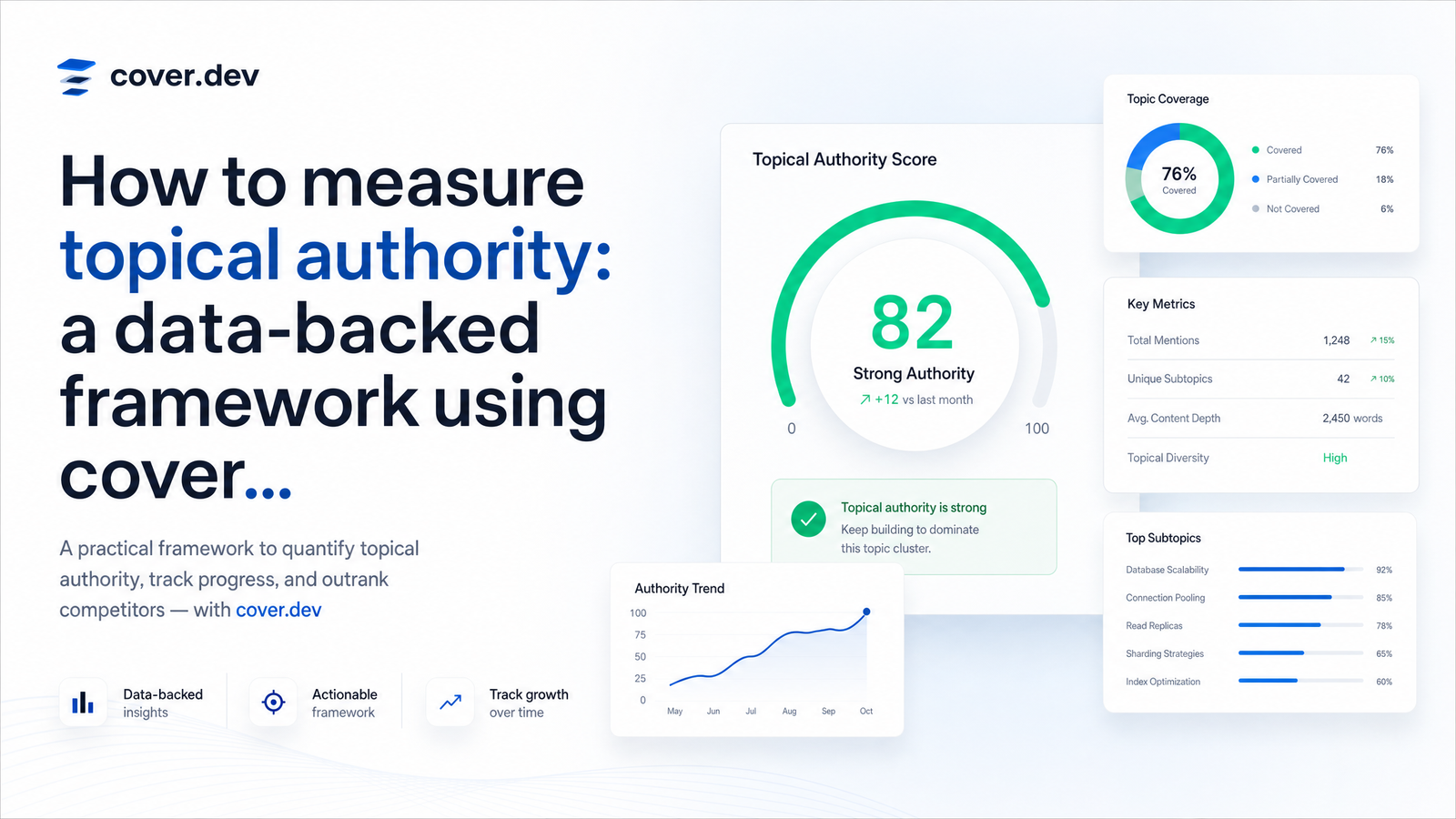
Why 'Topical Authority' Needs a Number, Not a Feeling
Every content team eventually gets asked: are we actually becoming an authority on this topic, or just publishing? Most teams answer with a feeling — "we've covered a lot of ground" — because there's no agreed way to measure topical authority the way there is for traffic or conversion rate.
Part of the problem is structural. Google has never published a topical authority metric. There's no API call that returns a score, no Search Console field labeled "authority." What we have instead are inferences from the Search Quality Rater Guidelines, the E-E-A-T concepts Google uses to explain how raters judge expertise and trust, and vendor tools that produce their own proprietary numbers. None of that is a number your team owns.
That gap is what this framework closes. Instead of borrowing someone else's black box, you build a composite score from three things you can observe: how completely you cover a topic, how well internal links distribute authority across that coverage, and how fast your rankings are moving across the topic's keyword set. Combine them, trend them monthly, and you have something concrete to show instead of a claim.
What Topical Authority Actually Measures (and What It Doesn't)
Topical authority, defined precisely, is the degree to which a site demonstrates comprehensive, well-structured, and improving coverage of a specific subject area — enough that search engines and users treat it as a reliable default source on that subject. It is not domain authority, and conflating the two is one of the most common analytical mistakes teams make.
Domain authority (or any third-party authority score) is a backlink-weighted proxy for overall site strength, applied uniformly across every page regardless of subject. Topical authority vs domain authority is a question of scope: domain authority asks "how strong is this site in general," while topical authority asks "how complete and structurally sound is this site's coverage of this specific topic." A site can have modest domain authority and still dominate a narrow topic, and a high-domain-authority site can have visibly thin coverage in a subject it's never seriously invested in.
The three components worth quantifying are completeness (do you cover the subtopics and entities that define the topic), structure (does your internal linking route authority to the pages that need it), and momentum (are your rankings across that topic's keywords actually improving, or flat). A real framework treats all three as separate, trackable inputs rather than folding them into one unexplained composite.
The Three-Part Measurement Framework
Coverage maps answer "did we cover the ground." Internal link distribution answers "does the site's structure reflect that coverage." Ranking velocity answers "is any of this actually working." None of the three alone is sufficient — a site can have great coverage with terrible internal linking, or fast-improving rankings on a narrow slice of keywords that don't represent the topic as a whole.
1. Coverage Maps: Are You Actually Complete?
A coverage map is a structured list of every subtopic, entity, and user question that defines a topic, matched against the pages you've actually published to address them. Building one starts with keyword research and SERP analysis, but a thorough map also pulls in "People Also Ask" questions, related entities, and competitor subtopics you haven't touched. This is exactly the exercise covered in SEO Content Gap Analysis: A Complete Framework, worth using as the input layer here.
Once you have the full list of subtopics, calculate completeness as a simple percentage: subtopics with a dedicated, ranking-eligible page divided by total subtopics identified. A cluster with 40 identified subtopics and 28 addressed pages sits at 70% topic coverage — a number you can report and improve, rather than a vague sense of "pretty thorough." This also exposes redundancy: if five pages target the same subtopic, your completeness percentage looks fine but your actual investment is misallocated, a distinction publishing-volume metrics hide.
2. Internal Link Distribution: Is Authority Flowing to the Right Pages?
Coverage tells you what exists. Internal link distribution tells you whether the site's structure actually routes authority to those pages. A cluster with excellent coverage but poor internal linking often behaves like disconnected pages competing with each other rather than one authoritative structure.
Two measurements matter most. First, the hub-to-spoke ratio: does your pillar page link out to every spoke in the cluster, and does every spoke link back to the hub and relevant siblings? Second, orphan detection: how many pages receive zero or near-zero internal links from other pages in that same topic. Orphan pages signal wasted coverage — content exists, but the site's structure has never told search engines or users it matters.
Quantify this as a percentage of cluster pages with healthy internal link counts (a reasonable threshold is three or more contextual internal links from other pages in the same cluster) versus pages below it. If you need a system to pull this data across dozens of pages rather than manually crawling link paths, Internal Linking Tool: The Evaluation Framework That Matters covers what to look for in a tool built for this job.
3. Ranking Velocity: Is Authority Compounding Over Time?
Ranking velocity is the rate of change in rankings across a topic's full keyword set over a defined period — not a snapshot of where one keyword sits today. A single rank check is a photo of a moving object; velocity tells you whether that object is accelerating, stalling, or reversing.
To calculate it, take the average position across every keyword mapped to the cluster at two points in time — say, 90 days apart — and express the difference as average position change per month. A cluster moving from average position 24 to 16 over three months has a velocity of roughly +2.7 positions/month; a cluster stuck at 18 both times has velocity near zero, regardless of how much content you published. This connects to what Kevin Indig has described as topic share — your visible footprint across a topic's keyword demand relative to competitors — and velocity is essentially the rate that share is growing or shrinking. Getting this cleanly across a full keyword set, not just your five favorite terms, requires consistent rank tracking; Best SEO Rank Tracker in 2026: How to Actually Choose covers what that data collection needs to look like.
Turning the Three Inputs Into One Topical Authority Score
With all three inputs quantified, combining them into a single score is a weighting exercise, not a mystery. A workable starting formula:
Topical Authority Score = (Coverage % × 0.4) + (Link Health % × 0.3) + (Normalized Velocity × 0.3)
Coverage percentage and link health percentage are already 0–100 scales from the steps above. Normalized velocity needs a scale too — for example, mapping a velocity range of -5 to +10 positions/month onto a 0–100 scale, so a strongly improving cluster scores high and a stalling or declining one scores low. The weights aren't sacred; a team that cares more about structural health than raw coverage might weight link health higher. What matters is that the weighting is explained, consistent, and applied the same way every time you recalculate — which is precisely what a vendor's proprietary score (Semrush's included) can't offer, since you can't see or adjust its internal weighting.
The output is a single number per topic cluster, trendable month over month, that you can hand to a stakeholder alongside the three components that built it. That transparency is the point: when someone asks why the score moved, you can point to the exact input that changed, rather than reciting a vendor's marketing copy.
Common Measurement Mistakes to Avoid
The most frequent mistake is treating publishing volume as a proxy for authority itself — twelve new posts in a cluster looks like progress until the coverage map shows they all target the same three subtopics and the completeness percentage barely moved. A close second is anchoring on one keyword's rank as proof of authority; a single page 1 ranking says nothing about the other 39 subtopics in the cluster.
Ignoring orphan pages is another recurring gap — teams audit rankings and content quality but skip internal link structure entirely, missing that a chunk of their "coverage" is structurally invisible to crawlers and users. And relying solely on a vendor's black-box score, without the underlying coverage, link, and velocity data, leaves teams unable to explain a score drop or defend it under scrutiny. The fix in every case is the same: keep the three inputs separate and visible, even after combining them into one number.
Automating the Score: Why Manual Tracking Breaks Down
The framework above is straightforward for one topic cluster with a spreadsheet and a free afternoon. It breaks down fast across the dozens of clusters a real content strategy requires. Coverage maps go stale as competitors publish new subtopics. Internal link structures shift with every new page. Rank data needs consistent re-pulling on a schedule, or your velocity numbers are just noise.
This is the operational reason most teams default to a single vendor number instead of building their own — not because the framework is wrong, but because stitching together content gap analysis, a crawler for internal links, and a rank tracker across many topics by hand doesn't scale. Once you have the score, the next problem is presenting it — see SEO Reporting Dashboard: What to Include and How to Build It for how to turn a trended topical authority score into something stakeholders can read at a glance.
Rankevra was built to close that operational gap directly: it audits technical and content issues, tracks rankings across full keyword sets, and maps internal linking structure inside one system, so the three inputs behind your topical authority score come from the same place instead of three disconnected tools. As an AI SEO tool built around this exact workflow, it's the practical way to keep the score current without a team of analysts stitching spreadsheets together every month.
Frequently Asked Questions
Is there an official Google topical authority score?
No, Google has never published a topical authority metric or made one available through Search Console or any public API. What Google does publish are the Search Quality Rater Guidelines, which describe E-E-A-T concepts raters use to judge expertise and trust — useful context, but not a number. Any topical authority score you see, including from third-party SEO platforms, is a proprietary estimate rather than an official Google metric.
How is topical authority different from domain authority?
Domain authority is a site-wide, backlink-weighted proxy for general strength that applies the same score across every page regardless of subject. Topical authority is scoped to a specific subject area and measures coverage completeness, internal link structure, and ranking momentum within that topic alone. A site can rank well on domain authority overall while still having thin, poorly-linked coverage on a topic it hasn't seriously invested in.
What tools can I use to track ranking velocity?
Any rank tracker capable of storing historical position data across a full keyword set, not just a handful of priority terms, can support velocity calculations. The key requirement is consistent, scheduled pulls rather than occasional manual checks, since velocity depends on comparing the same keyword set at two points in time. A unified platform that tracks rankings alongside coverage and internal link data removes the need to reconcile exports from separate tools.
How many keywords do I need to rank for before I have topical authority?
There's no fixed keyword count threshold, because topical authority depends on coverage relative to the topic's actual scope, not an absolute number. A narrow topic might be fully covered with 20 keywords, while a broad topic could require hundreds. The relevant question is your coverage percentage — how many identified subtopics have a ranking-eligible page — not a raw keyword count.
Can a small site have strong topical authority in a narrow niche?
Yes, a small site can score high on topical authority within a narrow niche if it achieves near-complete subtopic coverage, healthy internal linking between its pages, and consistent ranking improvement across that smaller keyword set. Topical authority is scoped to the topic, not the size of the site, which is why niche sites often outrank larger, higher-domain-authority competitors on their specific subject.
How often should I recalculate my topical authority score?
Monthly recalculation is a reasonable default for most content teams, frequent enough to catch ranking velocity trends and coverage gaps without reacting to short-term ranking noise. Faster-moving industries or actively expanding topic clusters may warrant a bi-weekly check, particularly on the internal linking component, which changes every time new content is published.
Keep reading
- Duplicate Content Parameters: Fix It Without Losing UTM DataLearn to diagnose duplicate content parameters in Google Search Console and fix them with canonical tags — without breaking UTM tracking or paid attribution.
- Headless CMS SEO: Why Clean Audits Still Don't RankHeadless CMS SEO problems hide behind clean audit reports. Learn why rendering, indexing, and metadata break — and how to diagnose and fix it fast.
- SEO for Content Teams: Scaling Without Losing QualitySEO for content teams breaks down at four points. Here's the system — briefs, topic ownership, a quality rubric, and author schema — that fixes it.