Rankevra Blog
Content Optimization Software: What Actually Moves Rankings
August 8, 2026
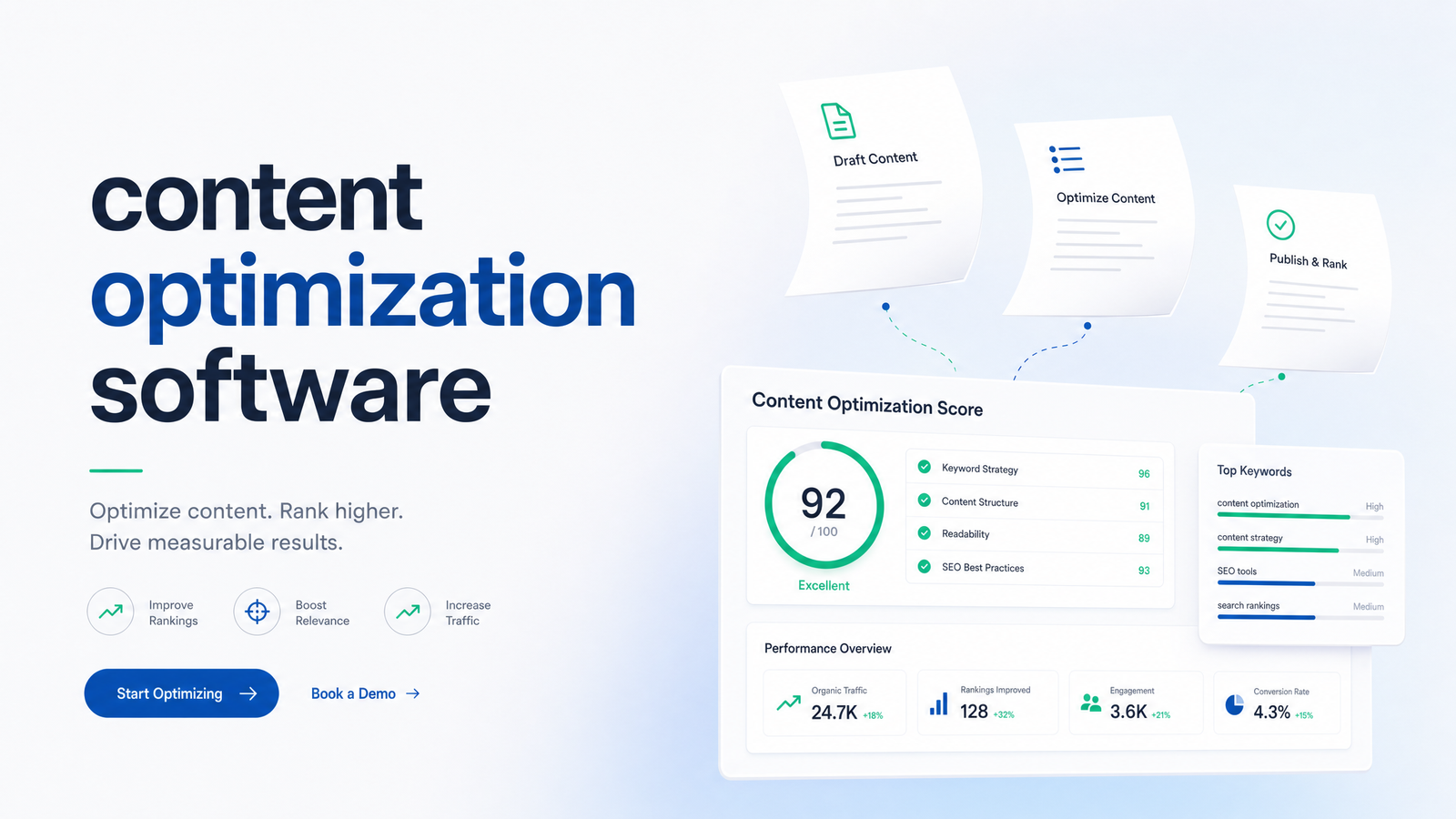
Most teams adopt content optimization software expecting a score to translate into rankings. It often doesn't — and that gap is usually a workflow problem, not a scoring problem. This article breaks down what the category actually does, how to tell real ranking signal from vanity metrics, and why an integrated workflow beats stitching together separate tools for scoring, publishing, and tracking.
What Content Optimization Software Actually Does
Content optimization software analyzes an existing draft or published page against the pages already ranking for a target query, then recommends specific changes — topics to add, structural adjustments, depth to increase — based on what search intent actually requires.
It is not an AI writer. Generation tools produce new text from a prompt; optimization software evaluates content that already exists (or exists in draft form) and tells you what's missing relative to competitors and query intent. It's also not a grammar or readability checker — Hemingway-style tools score sentence clarity and reading level, which is a writing-quality concern, not a search-relevance one.
At its core, the software compares your content against the SERP landscape for a query: which subtopics do top-ranking pages cover that yours doesn't, which entities show up repeatedly across those pages, and how thoroughly your content answers the underlying intent versus just matching keywords. The output is a content score, but the score is a summary of gaps — not the point of the exercise. The point is closing those gaps in a way that changes how a search engine (or an AI answer system) evaluates your page.
The Features That Actually Move Rankings (vs. Vanity Scores)
A 0-100 content score alone is a weak proxy for ranking improvement: the score is usually a keyword/entity density calculation benchmarked against current top results. Hit the targets and the number goes up, but that doesn't mean Google has decided your page deserves to rank higher. Plenty of teams have pushed a page to a 95/100 score and watched rankings sit exactly where they started.
The capabilities that actually correlate with movement look different:
SERP and competitor gap analysis. Real content scoring software doesn't just count keywords — it identifies which specific subtopics, questions, and angles the ranking pages cover that yours doesn't. This is the mechanism behind closing topical gaps rather than padding a document with synonyms. For a deeper framework, see SEO Content Gap Analysis: A Complete Framework.
Semantic and entity coverage. Semantic SEO looks at the relationships between concepts, not just term frequency. Good on-page SEO optimization software checks whether your content demonstrates coverage of the entities and related concepts that search engines associate with the topic — closer to how modern ranking systems actually interpret relevance.
On-page structure and internal linking signals. Heading hierarchy, how a page is chunked into extractable sections, and whether internal links connect it to a broader topic cluster all factor into how well a page can rank and hold authority within a subject area. This ties directly into topical authority — building coverage across a cluster of related pages rather than optimizing one page in isolation. See Topical Keyword Clusters: A Practical Build Framework for how that structure gets built deliberately.
None of these features produce a single tidy number as satisfying as a content score. That's precisely why teams over-index on the score — it's the easiest thing to report on a dashboard, even when it's the weakest signal in the toolkit.
Optimizing for AI Overviews Changes What "Optimized" Means
Google's AI Overviews and AI Mode summarize answers directly in the search results, which shifts optimization criteria in a specific way. Content now needs to be clearly structured, directly extractable, and backed by credible signals — generative summaries pull from pages that make it easy to identify a clean, well-supported answer to a specific question.
This is what's driving interest in answer engine optimization (AEO): writing content so that a discrete question has a discrete, well-formed answer nearby, supported by structured data and schema markup that makes the page's content unambiguous to a crawler. Content optimization for AI search still requires all the fundamentals — comprehensive topic coverage, strong entity signals, clean structure — plus an added layer of extractability and demonstrated expertise (E-E-A-T) that generative systems weigh heavily when deciding which source to cite or summarize.
AI Overview content optimization is additive, not a replacement. Google's own guide to optimizing for generative AI features confirms that the foundations — helpful, reliable, people-first content built on solid technical SEO — remain the basis for visibility in AI-generated results. Any vendor claiming AI Overviews require an entirely different playbook is overselling. It's the same playbook, with clearer structure and stronger authority signals layered on top.
Why Standalone Optimizers Create Workflow Gaps
Here's the practical failure mode most content teams run into. They score a draft in one tool, publish through the CMS separately, and check rankings in a third tool weeks later. Nothing connects those three steps. When a page underperforms, there's no data trail back to what was actually shipped versus what the score recommended — refresh decisions end up made on gut feel, not evidence.
This is the core difference between content optimization software and a content editor tool: an editor tool scores a document in isolation. A genuine workflow platform ties the score to what gets published and then to how that published page actually performs in rank tracking over time — closing the loop instead of leaving three disconnected snapshots.
The gap compounds at scale. A team publishing dozens of pages a month needs to know not just "which pages scored well at launch" but "which pages are losing rank six months later and need a refresh." Without that feedback loop, teams either refresh everything on a fixed calendar (wasteful) or refresh nothing until traffic visibly drops (too late). A repeatable system for deciding what to refresh and when — grounded in actual rank data, not guesswork — is the difference; see Content Refresh Strategy: A Repeatable System for 2026 for how that discipline should work in practice.
There's a related but distinct gap worth naming: a content brief generator that spits out a keyword list before writing starts is a planning aid, not a full workflow. It's useful early, but it doesn't score the finished draft, publish it, or track what happens after. For a direct comparison, see SEO Review Tools: Content Brief Generator vs. Full Workflow.
How to Choose Content Optimization Software: A Quick Framework
Choosing between a lightweight scoring plugin, a dedicated optimizer platform, and an all-in-one AI SEO tool comes down to how much of the workflow you want connected versus how much you're willing to manage manually. Run any candidate through this checklist:
- Data sources: Does it pull live SERP data and real competitor content, or static keyword databases? Stale data produces stale recommendations.
- CMS/publishing integration: Can you act on recommendations and publish from the same workflow, or do you export a report and re-enter everything manually?
- Refresh and re-optimization tracking: Does it flag pages losing rank and tell you what changed on the SERP, or is refreshing purely calendar-based?
- AI Overview readiness signals: Does it check for extractable structure, schema markup, and clear answer formatting — or only legacy keyword density?
- Rank tracking feedback loop: Does the score connect back to actual ranking movement over time, so you can tell which recommendations genuinely worked?
Teams researching the best content optimization software often stop at feature comparisons and skip this last point, which is the one that actually determines ROI. A tool with fewer bells and whistles but a real feedback loop between score, publish, and rank will outperform a feature-rich tool that ends at "export your report."
Where Rankevra Fits
Rankevra was built around the observation that scoring, publishing, and tracking are one workflow, not three separate purchases. Instead of generating a score and leaving you to manually publish and check rankings elsewhere, Rankevra connects content optimization directly to technical audits, publishing, and rank tracking in a single system — so a recommendation isn't just theoretical, it's tied to what actually shipped and what happened to rankings afterward.
That connection is what makes Rankevra an AI content optimization tool rather than another standalone score-and-export utility. Audits surface technical issues holding a page back; optimization recommendations address topical and semantic gaps against real competitors; publishing pushes the fix live; rank tracking reports back on whether it worked — closing the loop that most point-solution stacks never close. If you're building topical authority across a content cluster rather than optimizing pages in isolation, that same connected view extends to the strategic layer too; see AI Content Strategy: The Framework That Actually Ranks for how the planning side complements this workflow.
Frequently Asked Questions
Is content optimization software the same as an AI writing tool?
No. Content optimization software evaluates existing or drafted content against top-ranking competitors and search intent, recommending specific changes — it doesn't generate new text from a prompt. AI writing tools do the opposite: they produce original content, which then typically still needs to be scored and optimized. Some platforms combine both functions, but they're distinct capabilities. For more on the generation side, see Open Source AI Content Generator: The Honest Breakdown.
Do content scores from optimization software actually correlate with rankings?
Not reliably on their own. A high score typically reflects keyword and entity density matching current top results, but Google's ranking systems weigh many factors a static score doesn't capture, including link authority, technical health, and real user engagement. Scores are most useful as a gap-identification tool, not a predictor — the real test is whether rankings move after the recommended changes ship.
Can content optimization software help with Google AI Overviews, not just traditional rankings?
Yes, when it checks for extractable structure, clear answer formatting, and schema markup rather than only keyword density. AI Overviews and AI Mode favor content that's easy to summarize and backed by credible authority signals, an additive layer on top of core SEO fundamentals, not a separate discipline. Tools that haven't updated to check for this readiness are still optimizing for a search experience that's only part of the picture now.
How is content optimization software different from a content brief generator?
A content brief generator produces keyword and topic guidance before writing starts, functioning as a planning aid for a single piece of content. Content optimization software evaluates a finished or in-progress draft against live competitor data and intent signals, and in a full workflow platform, ties that evaluation to publishing and ongoing rank performance — a brief generator typically stops well before that point.
Do I still need a separate rank tracker if I use content optimization software?
Not if the optimization platform includes integrated rank tracking with a feedback loop back to your content scores. Running them separately means manually cross-referencing which optimizations preceded which ranking changes, which is slow and error-prone. An integrated system closes that loop automatically, showing you which recommendations actually correlated with movement.
How often should I re-optimize content after it's published?
There's no fixed universal schedule — re-optimization should be triggered by actual signals: ranking drops, SERP changes among competitors, or shifts in search intent for the target query, rather than an arbitrary calendar. Tracking rank data alongside content scores lets you catch decay early instead of waiting for traffic to visibly fall. A repeatable, signal-based refresh system is covered in Content Refresh Strategy: A Repeatable System for 2026.
Scoring a draft is step one, not the finish line — the gains compound when that score connects to what you actually publish and how it ranks afterward. Rather than stitching together a scoring plugin, a separate CMS workflow, and a third-party rank tracker, Rankevra connects audits, content optimization, publishing, and rank tracking into one workflow, so every recommendation has a feedback loop attached to it.
Keep reading
- Content Decay SEO: How to Detect It and Fix It for GoodLearn to detect content decay SEO issues early, rule out false positives, and build a refresh pipeline that scales — plus how to automate the whole loop.
- Headless CMS SEO: Fixing the Gaps Generic Tools MissHeadless CMS SEO breaks in three predictable places: rendering, metadata, and sitemaps. Here's the diagnostic framework to find and fix each gap.
- Google Algorithm Update Recovery: A Diagnostic FrameworkA step-by-step google algorithm update recovery framework: confirm the cause, segment the damage, benchmark against winners, and set a real timeline.