Rankevra Blog
How to Create Topical Authority: A 5-Step Process
August 13, 2026
What "Creating" Topical Authority Actually Means
Topical authority is built through a deliberate sequence of decisions about scope, structure, and consistency, not by publishing often enough. If you're still working out what topical authority is or why search engines reward it, our dedicated definition and strategy articles cover that. This piece answers a narrower question: what do you actually do, in order, to create topical authority starting from a thin or brand-new site?
The short version: pick a topic, map its subtopics, audit what you have, publish consistently, and interlink while tracking rankings. Each step depends on the one before it, which is why skipping ahead is the most common reason sites stall.
The 5-Step Process to Create Topical Authority From Scratch
These steps aren't a menu — they're a sequence. Writing content before mapping the cluster, or publishing before auditing what already exists, produces the scattered output that fails to register as authority. Follow the order below and treat each step as a gate the next one depends on.
Step 1: Pick One Core Topic and Draw Its Boundaries
Choose a single topic narrow enough that you could realistically cover it more completely than most competitors. A good boundary is specific and searchable: "home espresso machines" rather than "coffee," or "small business payroll compliance" rather than "HR." A bad boundary is either too broad to dominate ("marketing") or so narrow it can't support more than two or three pages.
Test your boundary by asking whether you can list 15-30 genuinely distinct subtopics within it without stretching. If you can't, narrow it further. If you can list 100, you've probably picked a category, not a topic — split it into phases and tackle one at a time. Understanding search intent here matters more than keyword volume; a topic with modest demand but coherent intent is easier to own than a broad one with mismatched intents scattered across it.
Step 2: Map the Subtopic Cluster Before Writing Anything
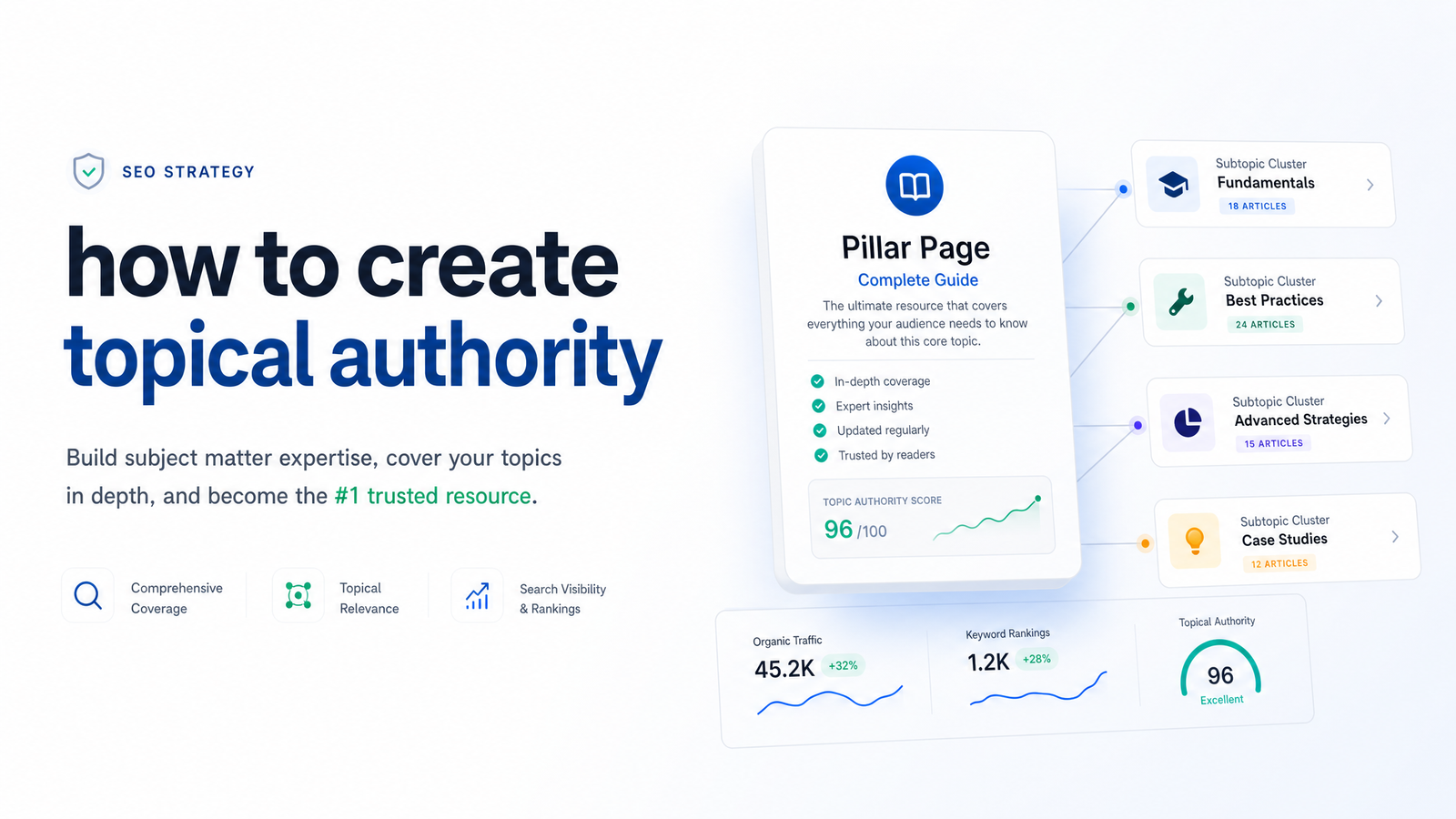
Once the boundary is set, map it — a pillar page plus supporting pages beneath it, grouped by the search intent each one serves. The pillar covers the topic at a survey level and links down to narrower pages; each supporting page answers one specific question or intent (informational, comparison, transactional) the pillar can't fully address alone.
This is where most people either skip the map entirely or make one too shallow to be useful. A workable cluster map lists every subtopic, the intent it serves, and the page type needed to satisfy it, before a single article gets written. We've covered the full mapping methodology elsewhere — worth reading before you scale past your first cluster.
Step 3: Audit What You Already Have Against the Map
If your site isn't brand new, compare the map against what already exists before writing anything. Most sites with "inconsistent" content histories aren't short on content; they have overlapping pages competing for the same intent, gaps where no page exists, and orphaned posts that connect to no cluster. Laying the map next to your existing URLs surfaces all three problems at once.
This is where a formal content gap analysis framework earns its keep — it gives you a repeatable way to classify every existing page as "keep," "rewrite," "merge," or "gap to fill," rather than guessing. Skipping this step is why some sites publish dozens of posts and still show no authority signal: they're filling gaps that don't exist while leaving real ones untouched.
Step 4: Produce and Publish on a Consistent Cadence
With gaps identified, start producing — on a cadence you can sustain, not a burst followed by silence. Erratic publishing (ten posts in a month, then nothing for three) reads to search engines the way it reads to readers: as a project that started and stopped, not authority being built. A realistic benchmark for a small team or solo operator is two to four cluster pages a month, sustained for several months, rather than a sprint.
Consistency matters more than volume here. A publishing workflow that scales safely — with briefs, review, and scheduling built in — keeps cadence steady once initial motivation fades, usually around month two or three.
Step 5: Interlink, Track Rankings, and Refine
Every supporting page should link up to the pillar, and the pillar should link back down to each supporting page — that's what turns a folder of related posts into a recognizable cluster. Sparse or arbitrary internal linking is one of the most common reasons a well-mapped cluster still underperforms, since it leaves search engines unable to see the relationships you intended.
Once pages are live and linked, rank tracking tells you which are gaining and which are stuck. Stuck pages usually need reinforcement — more internal links, a rewritten intro, or a merge with a competing page — rather than abandonment. This is the refine loop: map, produce, link, track, adjust, repeat.
How Long It Actually Takes to Create Topical Authority
Most sites see early movement — a handful of supporting pages appearing on page two or three of search results — within six to ten weeks of consistent publishing, once ten to fifteen cluster pages are live and interlinked. That's a signal, not authority. Fuller topical recognition, where the pillar and most cluster pages rank credibly and pull each other up, typically takes four to eight months of sustained output, depending on competition and how tightly you scoped the topic in Step 1.
The mistake most people make is judging the process at week four, before anything has had time to compound. If you're publishing consistently, auditing gaps rather than guessing, and interlinking as you go, give it the full timeline before concluding the approach isn't working.
Mistakes That Quietly Stall Topical Authority
A few patterns explain most stalled attempts:
- Topic sprawl. Writing about anything tangentially related instead of staying inside the boundary drawn in Step 1. This spreads relevance thin instead of concentrating it.
- Thin cluster pages. Publishing supporting pages that restate the pillar in different words rather than answering a distinct intent. Search engines and readers both notice the redundancy.
- No interlinking. Publishing solid pages that never reference each other, leaving no structural signal connecting them into a cluster.
- Inconsistent publishing. Bursts of activity followed by long gaps, which resets momentum and prevents the compounding effect authority depends on.
If growth has plateaued, check these four before assuming the topic itself is the problem.
Automating the Process With Rankevra
Every step above is straightforward individually but painful to run manually across separate tools — one for mapping, another for briefs, a CMS for publishing, a spreadsheet for tracking. That's usually where consistency (Step 4) and refinement (Step 5) quietly break down, not because the strategy was wrong but because the workflow was too heavy to sustain.
Rankevra is built as a single AI SEO tool that mirrors this exact sequence: it audits existing content against topic gaps, drafts and schedules cluster content on a set cadence, applies internal linking automatically as pages go live, and tracks rankings so you know which pages need reinforcement — all inside one workflow instead of four disconnected ones. If you're trying to automate topical authority rather than manage it by hand, that end-to-end loop is what Rankevra is designed to run for you.
Frequently Asked Questions
How many articles do you need to create topical authority?
There's no fixed number, but ten to fifteen well-mapped cluster pages plus a pillar is a realistic starting threshold for early signals on a narrow topic. Full authority usually requires ongoing expansion beyond that, since competitors and search behavior keep shifting the bar. Volume matters less than whether each page fills a distinct gap in the cluster map.
Can you build topical authority on an old or established website, or only new ones?
Topical authority can be built on either — it doesn't require a new domain. Established sites often move faster because existing pages can be folded into the cluster map rather than written from scratch, though they usually need a content audit first to find overlaps and gaps before adding anything new.
How long does it take before Google recognizes topical authority?
Early signals on individual pages typically appear within six to ten weeks of consistent, interlinked publishing. Fuller recognition across the whole cluster generally takes four to eight months, depending on topic competitiveness and how consistently you've published and linked throughout.
What's the difference between topical authority and domain authority?
Topical authority reflects how completely and coherently a site covers one specific subject area, while domain authority is a broader, backlink-driven metric describing overall site strength across all subjects. A site can have strong topical authority in one niche while having modest domain authority overall.
Do you need backlinks to create topical authority, or is content enough?
Content structure and consistency are the core drivers, but backlinks still help by reinforcing the E-E-A-T signals search engines use to trust a source. A well-mapped, consistently published cluster with solid internal linking can build meaningful authority even before backlinks accumulate, though links typically accelerate the timeline.
What's the fastest way to create topical authority without a large content team?
Automating the repetitive parts — mapping, briefing, publishing, and tracking — is the fastest route for a small team or solo operator. Tools like Rankevra combine those steps into one workflow, which removes the manual coordination that usually slows a lean team down.
Running this five-step process by hand means juggling a mapping tool, a writing workflow, a publishing calendar, and a rank tracker separately, and keeping them all in sync as the cluster grows. Rankevra automates that entire sequence — audit, content creation, publishing, and rank tracking — in one place, so building topical authority is a matter of following the process rather than managing the tooling behind it.
Keep reading
- Content Decay SEO: How to Detect It and Fix It for GoodLearn to detect content decay SEO issues early, rule out false positives, and build a refresh pipeline that scales — plus how to automate the whole loop.
- Headless CMS SEO: Fixing the Gaps Generic Tools MissHeadless CMS SEO breaks in three predictable places: rendering, metadata, and sitemaps. Here's the diagnostic framework to find and fix each gap.
- Google Algorithm Update Recovery: A Diagnostic FrameworkA step-by-step google algorithm update recovery framework: confirm the cause, segment the damage, benchmark against winners, and set a real timeline.