Rankevra Blog
Multi-Author Blog SEO: A System for Consistency at Scale
September 23, 2026
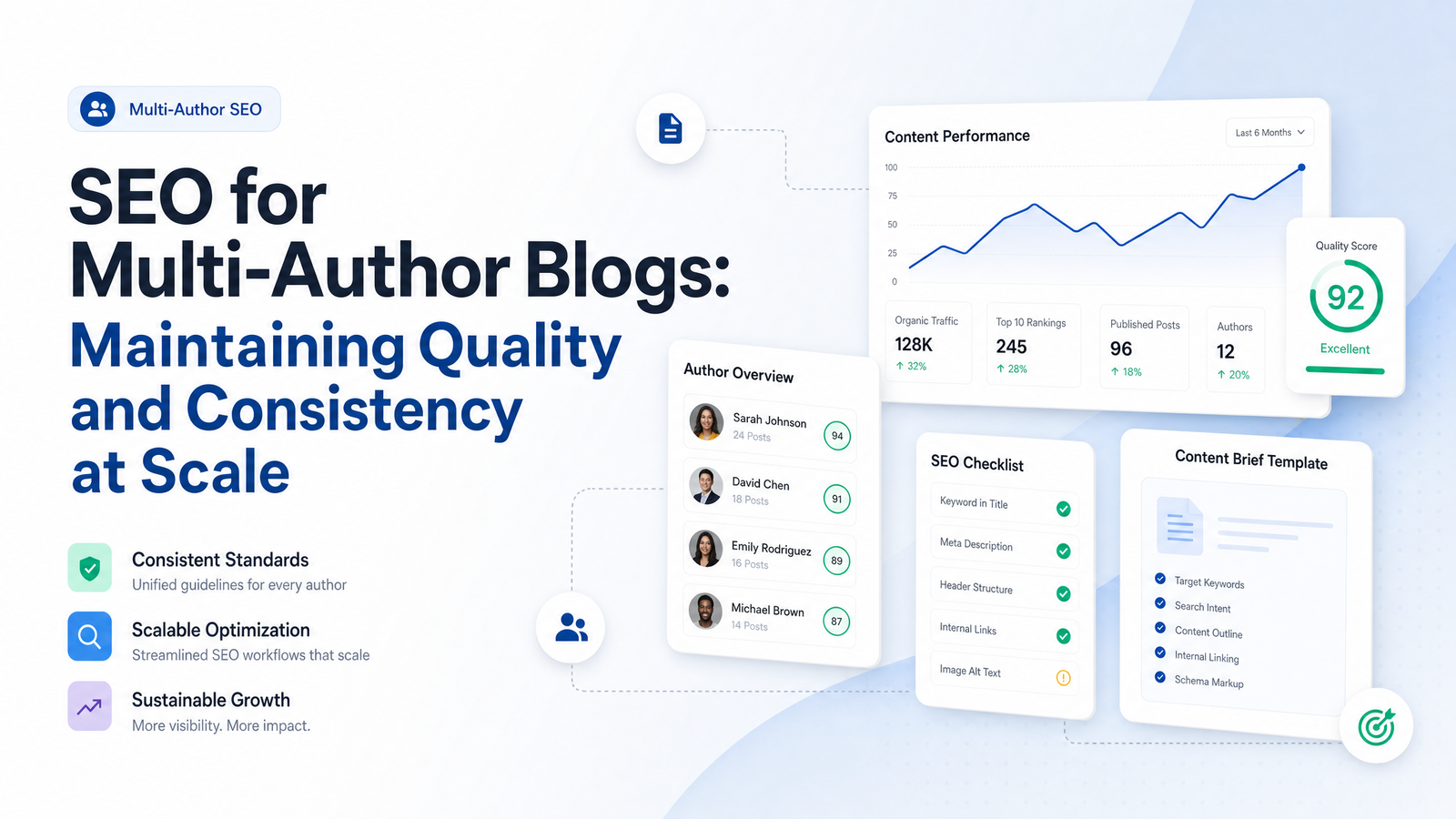
Adding contributors to a blog is supposed to help it grow. In practice, it's one of the fastest ways to quietly damage rankings — because multi-author blog SEO isn't just about producing more content, it's about producing content that reads as one credible, coherent source no matter who wrote it. Every new writer introduces variance: in tone, in depth, in technical hygiene, in how (or whether) their author identity is set up. Google's Search Quality Rater Guidelines put real weight on Experience, Expertise, Authoritativeness, and Trustworthiness, and E-E-A-T evaluation happens at both the page level and the site level. A blog with fifteen contributors and fifteen different standards doesn't look like an authority — it looks like a content farm wearing one domain.
This is fixable, but not by hiring more editors indefinitely. The failure points are specific and repeatable, which means they can be codified into a checklist and enforced with tooling instead of relying on whoever happens to be reviewing that week. Below is the diagnosis, the checklist, and the system that replaces manual policing as a team scales.
Why Multi-Author Blogs Break SEO (Even Good Ones)
More writers means more surface area for inconsistency, and inconsistency is exactly what both readers and search engines penalize. A single-author blog has a natural ceiling on drift — one person's voice, one person's habits. The moment a second, fifth, or twentieth contributor joins, content quality at scale becomes the actual challenge, separate from content quality on any individual post. A brilliant article from a new freelancer can still hurt the site if its byline doesn't match its schema, if it duplicates a topic already covered, or if it skips the internal links that tie it back to the site's topical structure.
The teams that scale contributor blogs successfully treat this as an operations problem, not a talent problem. They build the same guardrails a single strong editor would enforce intuitively, then make those guardrails explicit enough that anyone — or any tool — can check for them.
The 4 Places Multi-Author Blogs Lose Consistency
Four failure points show up again and again, and most editorial breakdowns trace back to one of them.
Author Identity and Schema Signals
Mismatched author signals are one of the fastest ways to muddy E-E-A-T on a contributor-heavy site. A post might display "Jane Doe" as the byline while its structured data still lists the site's original founder, or lists no author at all. Multiply that across dozens of posts and Google — and increasingly, AI systems summarizing search results — struggle to connect expertise claims to a consistent identity.
The fix is mechanical: every contributor gets one author page, every author page carries a matching Person schema entry, and the byline on the page always matches the "author" field in the JSON-LD. Use the sameAs property to link each author's page to their verified external profiles (LinkedIn, a personal site, relevant social accounts), which gives search engines corroborating evidence that the person is real and credentialed. On multi-contributor blogs, author schema often needs to be structured as an array of Person objects rather than a single field — getting this array right, with each object matched to its post, is a common technical stumbling block; author schema markup guidance with code examples covers the implementation details. Strong bio pages also do real work beyond schema — they should read as evidence of expertise, not just a headshot and a job title, as this breakdown of author bios that drive E-E-A-T demonstrates well.
Voice, Formatting, and Depth Drift
Even when identity signals are clean, inconsistent voice and structure make a blog feel unmanaged. One contributor writes 600-word overviews; another writes 2,500-word deep dives with different heading logic and no shared conventions. Readers notice the whiplash, and so does anyone evaluating the site for topical depth.
A lightweight content style guide solves most of this without turning writers into interchangeable robots. It should specify heading hierarchy conventions, minimum depth expectations for a given content type, tone guardrails (formal versus conversational, first-person allowed or not), formatting rules for lists versus prose, and how to handle citations and outbound links. Pair the style guide with a templated brief for every assignment — a well-structured SEO content brief does more to enforce editorial consistency upfront than any amount of after-the-fact editing, because it sets expectations before the writer opens a blank document.
Topic Overlap Between Writers
When multiple contributors research independently, they inevitably converge on the same profitable-looking keywords, producing near-duplicate articles that split ranking signals and cannibalize each other in search results. This is a planning failure more than a writing one: it happens when topic assignment isn't mapped against what's already been published or assigned to someone else. The practical fix is upstream — assign topics from a shared map rather than letting writers self-select, a process laid out in topical authority mapping for teams with multiple writers.
Publishing and Review Gaps
The last failure point is procedural. New contributors often don't know the site's internal linking conventions, so their posts publish as islands with no links in or out — weakening both the reader's path and the site's topical structure. Editorial sign-off is inconsistent because no one owns final review as contributor volume grows. And author archive pages quietly rot: a freelancer leaves, their bio goes stale, their headshot and job title no longer match reality, but the page stays live, undermining the trust signals it was supposed to build. None of these are content-quality problems in the traditional sense — they're process gaps, which is exactly why they're fixable with a checklist.
A Pre-Publish Checklist for Every Contributor Post
Every post, regardless of who wrote it, should clear the same gate before publishing:
- Byline-to-schema match — the visible author name matches the Person object in structured data, and that author has a live, accurate bio page.
- Style guide compliance — heading structure, depth, and tone match the documented standard for that content type.
- Internal link minimum — the post links to and, ideally, is linked from relevant existing content; new contributor posts are the most common source of orphaned pages, and a solid internal linking framework makes this checkable rather than a judgment call.
- Topic-overlap check — the target keyword and subtopic aren't already owned by another published or in-progress post.
- Technical QA — title tag, meta description, image alt text, URL slug, and canonical tag are all present and correctly formatted.
- sameAs and external profile check — for new contributors, their author page includes verified
sameAslinks before their first post goes live.
This list is short by design. A checklist people skip because it's exhausting is worse than no checklist at all.
Building an Editorial System That Scales Without More Headcount
A checklist works when one editor reviews five posts a week. It breaks down when a team runs twenty contributors publishing daily, because manual review becomes a bottleneck no matter how disciplined the editor is — every additional writer adds queue time, not just content volume. Somewhere between "a handful of regular contributors" and "an open contributor pipeline," the constraint shifts from writing quality to review throughput.
The way past that ceiling is converting the checklist into something semi-automated rather than something one person holds in their head. That means centralizing author data — one source of truth for every contributor's bio, credentials, and schema, so new posts pull from it instead of writers manually re-entering author fields. It means standardizing briefs so topic assignment, depth, and structure are decided before writing starts, not corrected after. And it means building the checklist into the publishing workflow itself, so a post can't go live until schema, internal links, and technical fields pass — a pattern covered in this guide to publishing workflows that scale safely.
This is precisely the layer where automation earns its keep. An AI-driven workflow can check byline-to-schema matches, flag topic overlap against an existing content map, verify internal link counts, and run technical QA on every post automatically — the exact checklist above, enforced consistently, without a human re-checking each item by hand. Rankevra builds audits, content planning, publishing, and rank tracking into one workflow specifically so multi-author teams can enforce these standards on every single post without adding an editor for every few new contributors.
Frequently Asked Questions
Do all authors on a blog need their own author page for SEO?
Yes — every contributor who publishes should have a dedicated author page with a bio, credentials, and consistent structured data. Author pages give search engines a concrete entity to associate expertise with, strengthening E-E-A-T signals across every post that writer produces. A missing or shared author page makes it harder for Google to evaluate who's accountable for the content.
Can a small team use one generic "staff writer" byline instead of individual author names?
It's workable short-term but weaker than named authorship, since generic bylines strip out the specific expertise signals that named authors with real bios provide. If a small team genuinely can't attribute posts to individuals, at minimum the "staff writer" identity should have its own consistent bio page and schema rather than shifting between different unlisted authors. As the team grows, transitioning to named bylines is worth prioritizing.
How do you fix author schema after a freelance writer leaves your team?
Update the Person schema and byline on every post that writer authored, either reassigning authorship to a current team member or keeping their profile live but clearly marked as a past contributor. Leaving an outdated author page active with stale credentials or an inactive sameAs link undermines trust signals more than removing it would. The fix should happen during offboarding, not months later during an unrelated audit.
Does a strict style guide slow down a growing content team too much?
A lightweight style guide speeds teams up rather than slowing them down, because it removes ambiguity that would otherwise require back-and-forth editing on every draft. The goal isn't rigid uniformity — it's clear defaults for heading structure, depth, and tone that writers can follow without guessing. Pairing the guide with a standardized brief for each assignment prevents most style-related revisions before they happen.
How many contributors can a blog have before manual editorial review stops working?
There's no fixed number, but most teams hit friction once review volume outpaces what one editor can thoroughly check per week — often somewhere around a dozen active contributors publishing regularly. Past that point, checklist items like schema matching, topic-overlap checks, and internal linking start getting skipped under time pressure. That's the signal to shift routine QA checks to automated tooling and reserve manual review for substantive editorial judgment.
Keep reading
- Anchor Text Optimization: A Risk-Based Guide That WorksLearn anchor text optimization as risk management: safe ratios, internal linking rules, and a 4-step audit to keep your link profile penalty-resistant.
- How to Write an SEO Content Brief That Actually RanksLearn what fields a real SEO content brief needs — format, entities, structure — and how to turn it into a published, ranking page without busywork.
- Crawl Budget Optimization: The 2026 Decision FrameworkCrawl budget optimization explained through Google's July 2026 rewrite: what changed, who it applies to, and how to fix and verify crawl waste.