Rankevra Blog
How to Write an SEO Content Brief That Actually Ranks
September 23, 2026
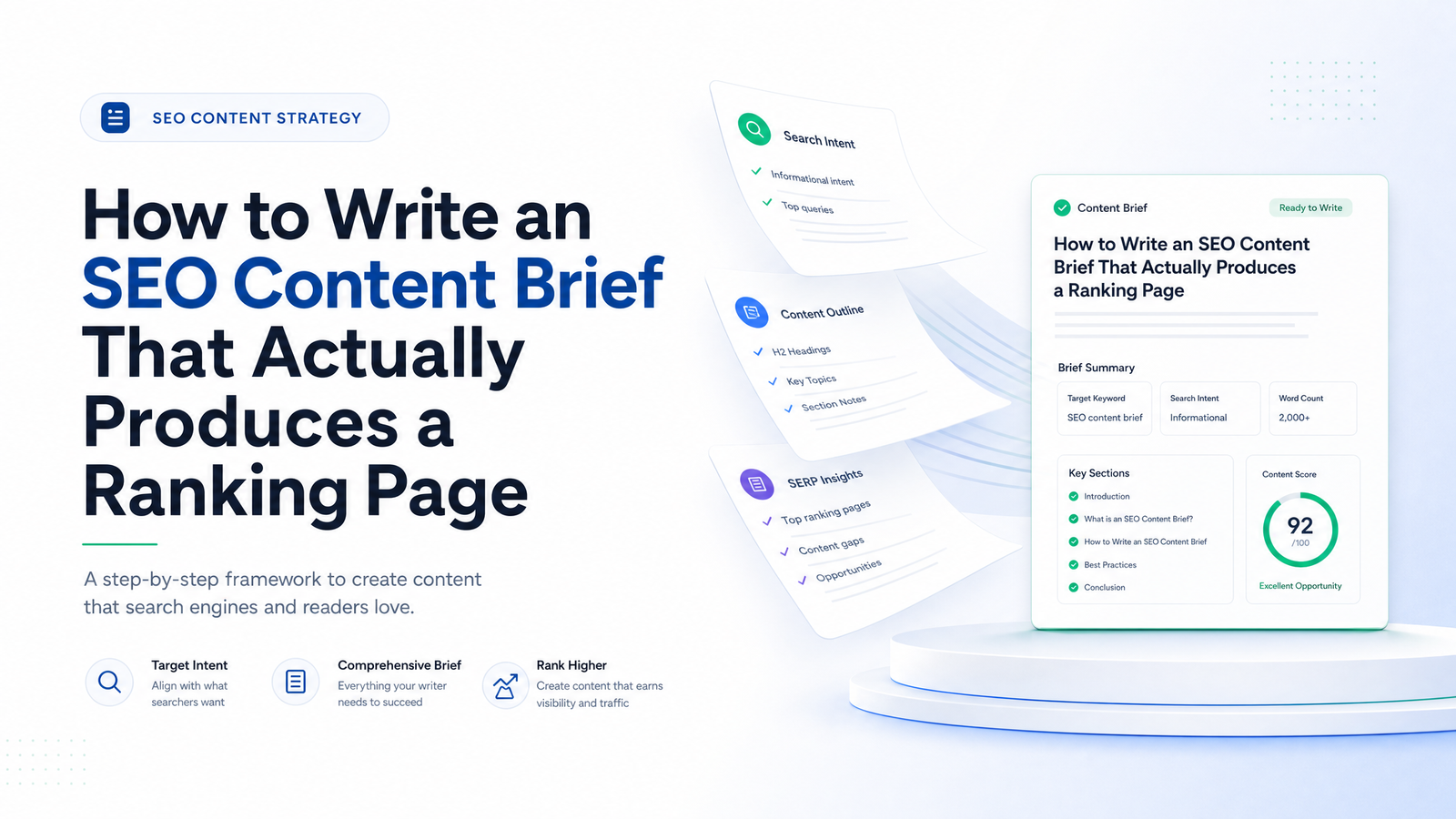
Why Most Content Briefs Don't Produce Ranking Pages
Open ten SEO content brief templates and you'll find the same three fields repeated: target keyword, word count, search intent. Hand that to a writer or an AI model and you've given them almost nothing to compete with. You haven't told them what format Google is already rewarding, which entities the top-ranking pages agree on, or what the reader is trying to accomplish beyond "find information."
This is the most common content brief mistake: treating the brief as a form to fill out rather than a decision document. A brief's job is to make every meaningful decision about the page before writing starts, so the writer or model isn't guessing at structure, depth, or scope halfway through. When a brief skips that work, the resulting page can be well-written and still fail to rank, because it was never aimed at what the SERP actually rewards.
The fix isn't a longer template. It's a shorter, sharper one that includes only the fields that change the outcome — and this article walks through which those are, in the order you should fill them in.
The Fields That Actually Determine Ranking Ability
A handful of fields separate a brief that produces a competitive page from one that produces generic filler. Everything else is optional detail.
Target keyword and secondary keywords. The primary keyword defines the topic; secondary keywords define the scope. Pull these from actual query variations and "People Also Ask" data, not guesswork — they tell you what subtopics a single page needs to absorb rather than split across multiple posts. This works best after a proper content gap analysis has already told you which topic deserves a page.
Search intent vs. the reader's actual next action. These are not the same thing, and conflating them is where briefs quietly break. Intent tells you the category — informational, commercial, navigational. The next action tells you what the reader does the moment after reading: compare two tools, book a call, download a template, switch software. A brief that only states "informational intent" leaves the writer without a landing point. One that also states "reader should leave knowing which brief field to fill in next, and considering an AI tool to automate it" gives the draft somewhere to go.
Content format matched to what's actually ranking. Before anyone writes a word, check what format currently occupies the top results: long-form guide, comparison table, listicle, tool page, video-first result. If every top-five result is a step-by-step guide and your brief calls for a short opinion piece, you're publishing into a gap that doesn't exist. Format match is one of the few brief fields with a direct, mechanical effect on ranking ability.
Target word count range grounded in SERP reality. Not a fixed number pulled from a rule of thumb, but a range derived from what's actually ranking for that query. A brief that says "1,500 words" without checking whether ranking pages average 800 or 3,000 is guessing.
Required entities and subtopics pulled from top-ranking pages. This is the field most templates skip, and it's arguably the highest-leverage one. If every page in the top ten mentions a specific tool, concept, or subtopic, your page needs to cover it too — not because of keyword density, but because its absence signals incomplete coverage to both readers and ranking systems.
Together, these fields form something closer to an actual SEO content brief template than a checklist — one where each field earns its place because it changes what gets written.
Structuring the Brief: Headings, Entities, and Internal Links
Once the fields above are filled in, the brief needs to translate that research into a heading skeleton the writer can follow without re-doing the analysis.
Scan the top-ranking pages and the "People Also Ask" box for the query, then group the recurring questions and subtopics into a logical heading order — problem framing first, mechanics next, execution last, FAQ at the end. This isn't about copying a competitor's outline; it's about noticing which structural choices show up across multiple ranking pages, a stronger signal than any single competitor's decision.
A workable content brief checklist for the structure section looks like this:
- H2/H3 skeleton with each heading mapped to a specific searcher question, not a vague theme
- The two or three entities or terms that must appear under each heading, based on what top pages cover
- A short note on which questions from PAA or "people also search for" need direct answers, and where
- Internal links chosen for a reason — linking to a page that deepens the next logical step for the reader, not just any page that mentions the same keyword
Random internal linking, added because a term happens to overlap, dilutes relevance signals instead of reinforcing them. A brief for an article like this one would purposefully link forward to execution (building a scalable publishing workflow) and upward to strategy (topical authority mapping), because those are the two directions a reader genuinely goes next — not sideways to a loosely related post.
A brief with this level of structural detail is closer to a real SEO brief example than the empty-heading templates most sites recycle. It gives the writer a map, not just a topic.
The Fields Most Briefs Waste Time On
Briefs should be brief. The point of writing one at all is to save time on the draft — if the brief itself takes longer to produce than the article, something has gone wrong.
Several fields common in "thorough" templates add length without adding ranking power:
Over-detailed buyer personas. A paragraph describing "Sarah, 34, marketing manager, drinks oat milk lattes" tells a writer nothing they can act on. A single line — who's reading, what they already know, what they're deciding — does the same job in a fraction of the space.
Exhaustive competitor teardowns. Reading all ten ranking pages top to bottom and cataloguing every sentence is busywork. What matters is the pattern across them: shared format, shared entities, shared structure. Pull the pattern, skip the play-by-play.
Keyword density targets. Counting how many times a phrase should appear per 500 words is a leftover from an older era of SEO and actively risks unnatural writing. Modern ranking systems reward topical coverage and entity presence, not repetition counts. If your brief specifies density percentages, delete that field — it does nothing today except make drafts read worse.
Knowing how to write a content brief well is as much about what you leave out as what you include. A tight brief with five decision-driving fields will outperform a fifteen-field template every time, because the writer spends their energy on the draft, not on parsing an over-engineered document.
From Brief to Published, Ranking Page
A brief, however well-built, is only half the job. It doesn't rank anything by itself — someone still has to turn those fields into a draft that matches the format, hits the required entities, follows the heading skeleton, links internally on purpose, and gets published in a way that doesn't break the rest of the site's SEO. Then someone has to track whether it actually moves.
This handoff is where most self-managed SEO workflows lose momentum. The brief lives in a doc, the draft happens somewhere else, publishing is a separate CMS step, and rank tracking is a fourth tool nobody checks weekly. Each handoff is a place for the brief's decisions to get lost or ignored.
This is exactly the gap Rankevra is built to close. Instead of writing a brief in one tool, drafting in another, and publishing manually, Rankevra's AI workflow takes the brief's core fields — keyword, intent-to-action mapping, format, required entities, internal link targets — and carries them straight through to a draft, publishes it correctly, and tracks how it performs against the keyword it was built for. If you're deciding whether to automate the brief-writing step itself rather than build every field manually, it's worth comparing approaches in content brief generator vs. full workflow — the short version is that a brief generator alone still leaves the draft, publish, and tracking steps disconnected, which is the exact gap an end-to-end workflow is meant to close.
An AI content brief generator that stops at the document hands you a better starting point but the same execution problem. The point of building the brief correctly is to make automation trustworthy — once the fields are right, publishing and tracking can run without a human re-checking every decision.
Turning the Brief Into Results
A well-built brief tells a writer or a model exactly what to compete on: the right format, the entities the SERP already demands, a heading structure grounded in real search behavior, and internal links chosen with intent. None of that matters until it becomes a live, indexed page that's actually being tracked against its target keyword. Rankevra takes that brief and runs the rest of the workflow — drafting, publishing, and rank tracking — so the fields you defined don't stall out in a document nobody acts on.
Frequently Asked Questions
What's the difference between a content brief and a content outline?
A content brief defines the strategic decisions — target keyword, intent, format, required entities, word count range — while an outline is just the heading structure derived from those decisions. The outline is one section of a complete brief, not a replacement for it. A brief without an outline is incomplete; an outline without the surrounding research is just a guess at structure.
How long should an SEO content brief take to write?
For a single article, a focused brief built around the essential fields — keyword, intent-to-action, format, entities, heading skeleton, internal links — should take well under an hour once you've already identified the topic through gap analysis. Briefs that take longer usually include low-value fields like exhaustive competitor teardowns or detailed personas that don't change the draft.
Do I need a content brief for every blog post, even short ones?
Yes, but the brief should scale down with the post. A short, low-competition post still needs a clear format match and a couple of required entities noted; it doesn't need the full research depth of a competitive pillar page. Skipping the brief entirely, even for short posts, is how content ends up misaligned with what's actually ranking.
Can AI write an SEO content brief on its own?
Yes, an AI content brief generator can pull SERP data, extract common entities, and draft a heading skeleton faster than manual research, provided it has access to real ranking data rather than generic keyword suggestions. The remaining judgment call — mapping search intent to the reader's actual next action — is where human review still adds the most value. Tools that generate the brief and then hand off directly to drafting and publishing close that gap further.
What's the most common reason a content brief fails to produce a ranking page?
Format mismatch is the most common failure — briefing a short opinion piece when every top-ranking result is a long-form step-by-step guide, or vice versa. The second most common cause is missing entities: the draft never covers subtopics that every competing page treats as mandatory, which signals incomplete coverage regardless of writing quality.
Should a content brief include competitor articles to copy from?
No — a brief should include the patterns found across competitor articles, not the articles themselves as templates to copy. Note the shared format, the entities that recur across multiple top-ranking pages, and the structural choices that repeat; copying one competitor's outline directly just reproduces their specific choices instead of the pattern the SERP is actually rewarding.
Keep reading
- Multi-Author Blog SEO: A System for Consistency at ScaleMulti-author blog SEO breaks down without systems. Get the checklist, schema fixes, and editorial workflow that keep contributor content credible.
- Anchor Text Optimization: A Risk-Based Guide That WorksLearn anchor text optimization as risk management: safe ratios, internal linking rules, and a 4-step audit to keep your link profile penalty-resistant.
- Crawl Budget Optimization: The 2026 Decision FrameworkCrawl budget optimization explained through Google's July 2026 rewrite: what changed, who it applies to, and how to fix and verify crawl waste.