Rankevra Blog
Anchor Text Optimization: A Risk-Based Guide That Works
September 23, 2026
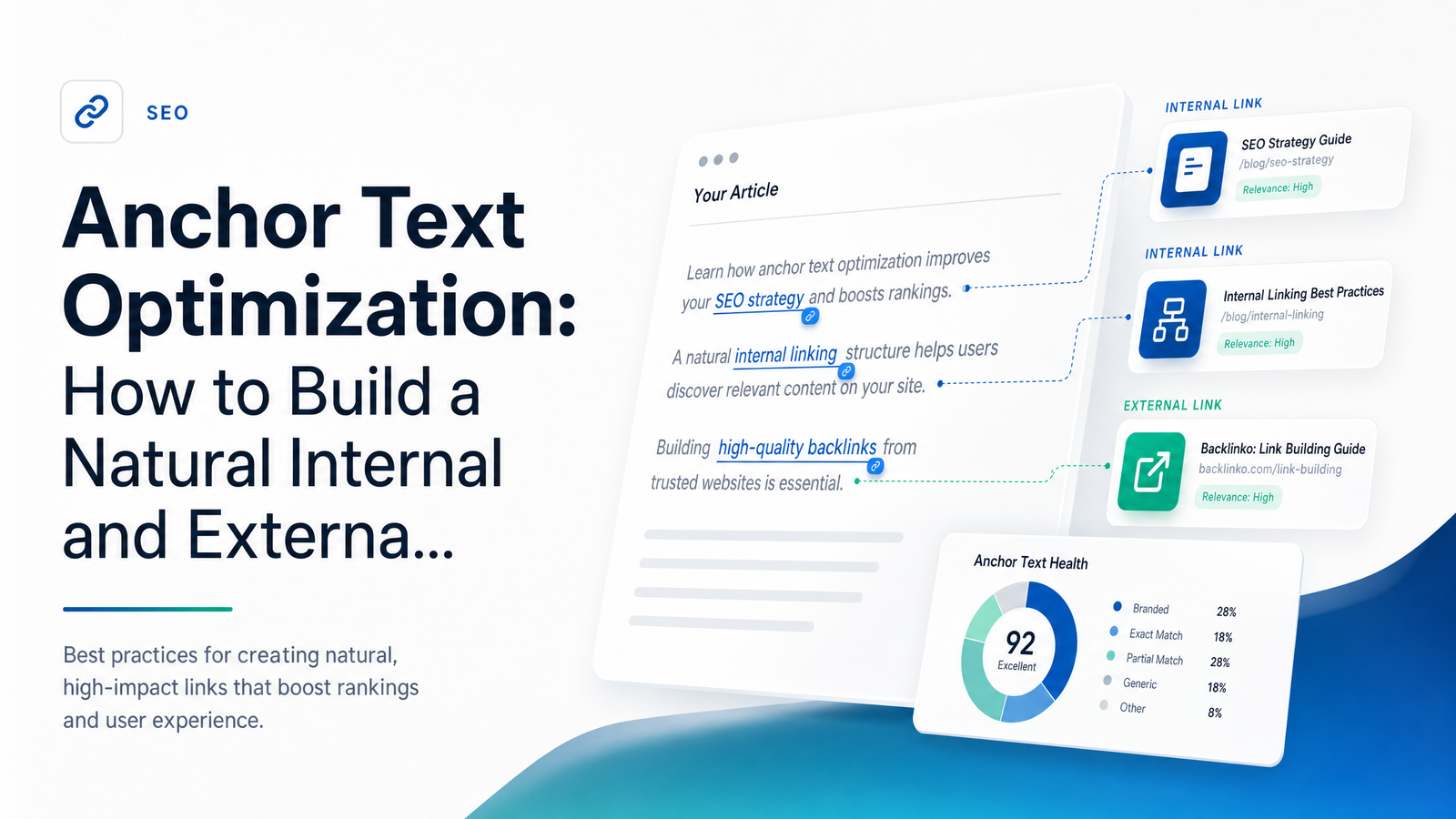
Most anchor text advice falls into one of two traps: an exhaustive glossary of anchor types with no guidance on what to do, or a rigid formula ("keep exact match under 2%!") that ignores how differently internal and external links behave. The more useful frame is risk management — internal anchor text is a lever you fully control and should optimize deliberately, while external anchor text is a signal you can only nudge, and trying to control it too tightly is what gets sites penalized.
What Anchor Text Optimization Actually Means
Anchor text is the clickable, usually underlined words in a hyperlink. It's what a user clicks, and what Google reads as a relevance signal about the linked page. This traces back to the original PageRank model, where words surrounding and inside a link helped Google infer topic and authority independent of the page's own content.
Anchor text optimization is the practice of choosing link text — both links you place internally and links you influence externally — so it accurately describes the destination page without looking engineered to manipulate rankings. The goal isn't to maximize keyword-rich anchors everywhere; it's to build a distribution that looks like it happened naturally, because in a healthy link profile, it did. Balance, not saturation, is the target.
The 6 Anchor Text Types You're Working With
- Exact match — anchor text identical to the target keyword ("anchor text optimization"). Highest relevance signal, highest risk when overused.
- Partial match — keyword plus other words ("guide to anchor text optimization"). Softer, more natural version of exact match.
- Branded anchor text — company or site name ("Rankevra"). Low manipulation risk, and dominant in naturally earned link profiles.
- Generic anchor text — non-descriptive phrases like "click here," "this article," or "learn more." Common in editorial linking.
- Naked URL anchor — the raw URL as visible text (https://example.com/page). Frequent in forums and casual citations.
- Image/LSI anchor — an image's alt text serves as anchor; LSI anchors use semantically related terms instead of the exact keyword.
Every link you have falls into one of these buckets, and the ratio between them is what a search engine — and a human evaluating your link profile — reads as organic or engineered.
Why Over-Optimized Anchor Text Gets Penalized
The mechanism traces back to the 2012 Google Penguin update, which targeted link schemes built on unnatural anchor text concentration. Before Penguin, an aggressive but common tactic was building hundreds of links using the exact same commercial keyword as anchor text — a pattern real, editorially earned links almost never produce, since natural linkers use brand names, URLs, or generic phrases far more often than a precise keyword match.
Penguin folded into Google's core ranking systems, but the signal it flagged is still active: an unnatural spike in exact-match anchor text pointing to the same page, especially from low-quality or paid sources, still triggers algorithmic devaluation and can contribute to a manual action visible in Search Console. Google's own link best practices in Search Central are explicit that links exist to help users navigate and that manipulating link schemes to influence ranking violates their guidelines.
Here's the distinction that matters most: that exact-match penalty risk applies to external, third-party links you don't fully control. It does not apply to your own internal linking. Google has never penalized a site for descriptive, keyword-relevant internal anchor text — internal links are simply how you tell Google and users what a page is about, and doing that clearly is expected, not manipulative.
A Safe, Natural Anchor Text Ratio to Target
There's no official Google percentage, but SEO tool vendors who study large backlink datasets — Ahrefs and SEMrush among them — consistently observe that healthy, non-penalized link profiles skew heavily branded and generic, with exact match a small minority. A commonly cited working benchmark:
- Branded anchors: 40–60% — the anchor type that dominates naturally earned links.
- Naked URL and generic anchors: 15–25% combined — "click here," raw URLs, "this page."
- Partial match anchors: 15–20% — descriptive phrases that include but don't exactly match your target keyword.
- Exact match anchors: 5–10% — reserved for your most important, most naturally-citable pages.
- LSI/topic-related anchors: remainder — semantically related terms reinforcing topical relevance without repeating the exact phrase.
Treat this as a sanity-check range, not a formula to hit precisely. A five-year-old site with strong domain authority can absorb a slightly higher exact-match share than a six-month-old site in a competitive niche; a branded e-commerce site naturally skews more branded than a niche B2B blog cited for how-tos. What matters is that exact match should never be the largest single category — the moment it is, you look built rather than earned.
Internal Linking: Where You Control Everything
This is where anchor text optimization stops being damage limitation and becomes a genuine growth lever, since internal links carry none of the penalty risk external links do. A few concrete rules:
Be descriptive, not generic. Linking to your pricing page with "click here" wastes a relevance signal you fully own. Use anchor text that describes the destination — "compare Rankevra pricing plans" tells users and crawlers more than "learn more."
Vary the anchor text pointing to the same page. If every internal link to your cornerstone page uses the identical exact-match phrase, you're not penalized, but you waste the chance to reinforce related subtopics and risk confusing which page should rank for which query — a subtler problem that directly feeds keyword cannibalization, where two pages compete for the same term because internal signals never differentiated them.
Keep anchors to roughly 2–5 words. Long enough to be descriptive, short enough to stay scannable and avoid diluting relevance across too many terms at once.
Tie internal anchor text to topical authority. Every internal link is a chance to reinforce how your content cluster fits together — pillar pages linking down to supporting articles with varied, descriptive anchors, and supporting articles linking back up with consistent but not identical phrasing. This is exactly the structural work covered in topical authority mapping, and it's also where manually managing internal anchor text across dozens or hundreds of pages becomes impractical — the gap an internal linking tool is built to close.
External Links: Where You Only Get to Nudge
You cannot dictate anchor text on links you don't own, and trying to is exactly the behavior that makes a profile look manipulated. When doing outreach or guest posting, the safest move is to suggest context rather than a specific phrase — offer a sentence or two of surrounding copy that naturally supports a branded or partial-match anchor, and let the publisher choose the exact wording.
If asked directly what anchor text you'd prefer, default to branded or naked-URL suggestions unless there's a strong topical reason for partial match. Asking a guest post site for an exact-match commercial anchor is one of the fastest ways to make outreach anchor text look purchased rather than earned — editors increasingly recognize the request for what it is.
Counterintuitively, a certain amount of messiness is what makes a profile trustworthy. Some links citing your raw URL, some using "this tool," some misspelling your brand name slightly, some using an unrelated anchor because the writer linked mid-sentence — that texture is what earned links look like. A backlink profile with suspiciously uniform, keyword-perfect external anchors is a red flag precisely because organic linking behavior doesn't produce uniformity.
A 4-Step Anchor Text Audit You Can Run This Week
- Pull your backlink list. Export every external backlink pointing to your domain along with its anchor text. A backlink analysis tool will do this in one report if you don't already have the data.
- Categorize every anchor by type. Sort each into branded, exact match, partial match, generic, naked URL, or LSI. Even a spreadsheet with a simple lookup formula works for a few hundred links.
- Calculate your ratios and compare against the benchmark. Total each category as a percentage of all links and check it against the branded-dominant distribution above.
- Flag over-represented anchors and decide dilute vs. disavow. If one exact-match phrase accounts for a disproportionate share of links to a single page, decide whether to earn new links with varied anchors to dilute the ratio, or — only for clearly spammy links tied to a manual action — use Google's Disavow Tool as a last resort rather than a first response.
Knowing how to categorize the raw numbers is only half the job; interpreting what a skewed ratio means for a specific page is covered in more depth in how to read a backlink tool checker report.
Keeping Your Anchor Profile Healthy Long-Term
Anchor text distribution isn't a set-and-forget metric — it shifts every time you publish a new page, earn a new backlink, or run a fresh outreach campaign. A ratio that looked healthy six months ago can drift toward exact-match overexposure after a single aggressive link-building push, and internal anchor consistency can quietly erode as new pages get added without anyone rechecking how they link to older ones.
Treating anchor text maintenance as a recurring task — not a one-time cleanup — is what keeps a natural link profile natural. That's the piece most teams skip, not from lack of understanding, but because manually tagging and recalculating anchor ratios across a growing site isn't a realistic ongoing habit for a small marketing team. Rankevra automates that recheck: its site audits flag anchor text imbalances alongside other technical issues, and its internal linking suggestions apply the descriptive-and-varied rules above automatically as you publish new content — so your anchor profile stays healthy without becoming a spreadsheet chore. Try Rankevra to put anchor text auditing on autopilot.
Frequently Asked Questions
Is anchor text still a Google ranking factor in 2026?
Yes. Anchor text remains a relevance signal Google uses to understand what a linked page is about, rooted in the original PageRank model and still active in current ranking systems. Since Penguin, unnatural concentrations of manipulative anchor text are actively devalued or flagged, so the signal now rewards natural variation rather than raw keyword repetition.
How much exact-match anchor text is too much?
There's no official Google percentage, but tool-vendor data suggests exact match becoming the largest single anchor category — commonly above 10–15% of a profile — is a red flag. A safer benchmark keeps exact match around 5–10%, with branded anchors making up the largest share instead.
Can internal linking anchor text get my site penalized?
No. Internal links are fully within your control, and Google treats descriptive, keyword-relevant internal anchor text as normal, helpful navigation rather than manipulation. The over-optimization penalty risk applies specifically to external, third-party backlinks where unnatural exact-match concentration signals a paid or manipulated link scheme.
How do I fix an anchor text profile that's already over-optimized?
Start by earning new links with varied, branded, or generic anchor text to dilute the ratio over time rather than removing existing links first. Reserve Google's Disavow Tool for clearly spammy or low-quality links tied to a manual action in Search Console, since disavowing healthy links unnecessarily can remove value rather than restore it.
Should I tell guest post sites what anchor text to use?
Avoid dictating exact-match anchor text to outreach or guest post partners, since that request itself looks manipulative to editors and to Google. Instead, provide context or a supporting sentence and let the publisher choose the wording, defaulting your own preference toward branded or naked-URL anchors.
What's the difference between partial match and exact match anchor text?
Exact match anchor text uses the target keyword phrase precisely as-is, while partial match includes that keyword alongside other surrounding words, making it read more naturally. Partial match carries a softer relevance signal than exact match but far less penalty risk, which is why it should make up a larger share of a healthy profile.
Keep reading
- Multi-Author Blog SEO: A System for Consistency at ScaleMulti-author blog SEO breaks down without systems. Get the checklist, schema fixes, and editorial workflow that keep contributor content credible.
- How to Write an SEO Content Brief That Actually RanksLearn what fields a real SEO content brief needs — format, entities, structure — and how to turn it into a published, ranking page without busywork.
- Crawl Budget Optimization: The 2026 Decision FrameworkCrawl budget optimization explained through Google's July 2026 rewrite: what changed, who it applies to, and how to fix and verify crawl waste.