Rankevra Blog
Multi-Location SEO: Rank Every City Page Without Duplication
August 29, 2026
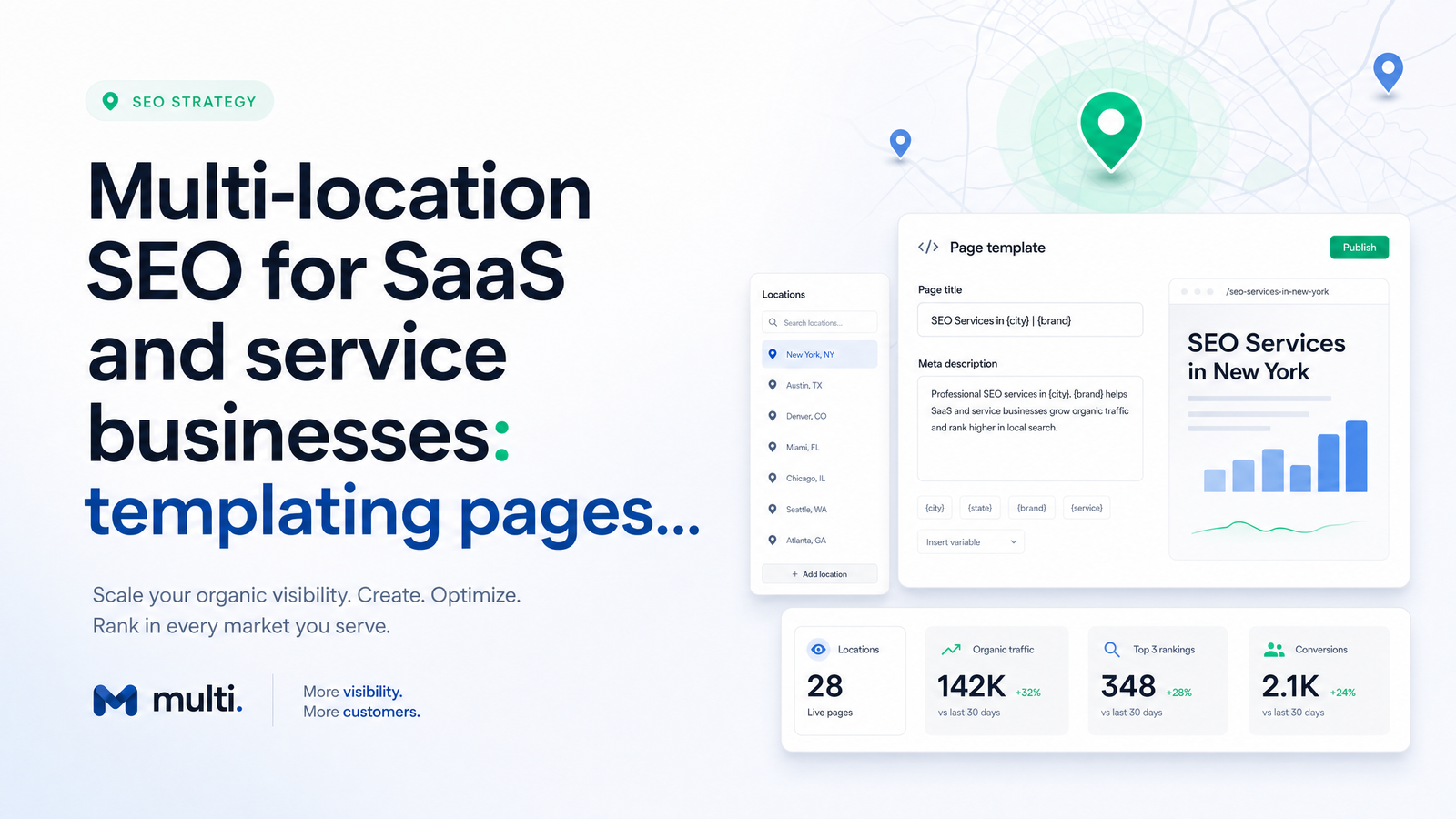
Most multi-location SEO advice collapses into one of two useless extremes: "write unique content for every page," which is impossible at 200 locations, or "just template it," which is how city pages quietly vanish from the index after a spam update. Neither treats the real problem, which is an engineering problem — deciding, slot by slot, what has to be unique on a location page and what can safely be shared.
That's the framework this article builds: a specification you can hand to a writer, developer, or AI content pipeline and get pages that rank individually instead of folding into a duplicate-content cluster.
What Google Actually Says About Duplicate Location Pages
The fear driving most multi-location SEO decisions is a myth in its strongest form and a real risk in its weaker form. Google's John Mueller has directly addressed this in office hours: near-identical content across localized pages — a plumbing company with the same service description on 40 city pages, differing only by city name and phone number — is not automatically penalized. Google expects some repetition when a business genuinely operates in dozens of markets with the same core offering. Google has clarified that duplicate content across localized pages isn't penalized outright, but the same clarification draws a hard line around one page type: service area pages for locations where you have no physical presence or verifiable local specificity still need unique, substantive content to rank at all.
That distinction matters more now than two years ago. The September 2025 spam update specifically targeted cookie-cutter location pages and templated copy, tightening what "acceptable similarity" looks like at scale. The tolerance band has narrowed — templated multi-location pages that used to skate by on thin differentiation are now more likely to get filtered together and ranked as a single competing URL instead of dozens of independent ones.
The Template Slot Framework: What Must Be Unique vs. What Can Be Shared
Think of a location page not as one block of content but as a set of slots, each with its own risk profile. Treating them uniformly — either all templated or all bespoke — is where most multi-location SEO programs go wrong.
Slots that must be unique per location:
- The opening paragraph or intro, referencing something locally specific: a neighborhood, a regional regulation, a climate factor, a local landmark used for service radius framing — not just the city name inserted into a boilerplate sentence.
- Proof elements: local reviews, local case studies, project photos tied to that market, staff or technician names if they're market-specific.
- Local business data: address, embedded map, service radius, local phone number, hours if they vary by location.
- Structured data (LocalBusiness schema) reflecting the actual entity for that location, not a copy-pasted block with swapped coordinates.
- Any pricing or availability information that genuinely differs by market.
Slots that can be safely shared:
- Core service descriptions — what the service is, how it works, general process steps. Google's guidance explicitly tolerates this when the underlying offering is identical.
- Company background, certifications, and trust signals that apply company-wide.
- FAQ content addressing questions that don't vary by geography.
- Navigation, footer, and boilerplate legal content.
The line separating these two lists is specificity, not word count. A 300-word intro that's still generic ("Looking for reliable plumbing services in [City]? Our team is here to help!") does nothing, while a 60-word intro naming an actual local detail does real differentiation work. If you're building this at real scale — 50, 100, 500 pages — see our guide on programmatic SEO for scaling pages without getting filtered for the broader system this slot logic sits inside.
Location Pages vs. Service Area Pages: A Different Risk Profile
Multi-location SEO programs almost always mix two distinct page types without realizing they carry different rules.
A location page represents a place where you have real presence — an office, a storefront, a licensed service hub, verifiable local reviews. These pages earn more tolerance for shared template structure because the local proof (address, map, real reviews) does genuine differentiation work a competitor's templated page in another city can't replicate.
A service area page represents a city or region you serve without a physical location there — common for home services, contractors, and B2B firms selling into a metro without an office in it. This is exactly the page type Mueller's clarification singles out: without a real local footprint, thin templated content is much more likely to be seen as a doorway page rather than a genuine local resource. Service area pages need meaningfully more unique content — local project examples, region-specific regulatory or climate context, named local partnerships — because they lack the local business signals to lean on.
If your location count skews heavily toward service area pages rather than staffed locations, budget more original writing time per page, not less. That's the opposite of how most teams allocate effort, since service area pages often get built last and fastest.
Technical Guardrails That Support the Content Layer
Unique-enough content is necessary but not sufficient. Multi-location programs commonly get undermined by technical decisions that dilute the pages you did differentiate or create true duplicates Google has to arbitrate between.
URLs and site structure. Each location should get its own indexable URL — a clean path like /locations/austin-tx/ — rather than a single page manipulated with URL parameters or query strings. Parameter-based location switching (?city=austin) is harder for crawlers to treat as distinct entities and makes rank tracking by city messier. A dedicated path also lets you build internal links, local schema, and backlinks pointing to one canonical target per city.
Canonicalization. With near-duplicate templates, canonical tags do more work than most teams realize, and they fail quietly. A location page pointing its canonical at the wrong URL, or inheriting a canonical from a shared template component, can silently remove pages from the index while every other signal looks fine. This is a common blind spot in standard audits — see our breakdown of canonical tag failures that basic audits miss for the specific patterns to check.
Internal linking and hub structure. A central locations hub page linking out to every city page, with each city page linking back and to 2-3 geographically nearby locations, signals that these are distinct, deliberately organized entities rather than a content farm.
Indexation monitoring. At 50+ locations, some pages will get crawled, indexed, and then quietly dropped weeks later as duplicate signals accumulate. This requires ongoing monitoring, not a one-time launch check — which is where a structured, weighted audit process pays off. Our 5-layer local SEO audit framework covers how to weight technical, content, and local-signal factors across a page set this size.
Building Topical Authority Across a Location Set
Ranking individual city pages is only half the goal; the other half is making the whole location set reinforce each other so the domain accumulates topical authority rather than each page competing in isolation. That means identifying what unique, useful content elements your competitors' location pages have that yours don't — local pricing transparency, service-specific FAQs, neighborhood-level detail — and closing those gaps systematically rather than page by page. A structured content gap analysis run against competitor location pages in each market is the fastest way to find these gaps before you scale a template that's already missing what ranks.
Agencies managing this across multiple clients face a compounding version of the same problem — dozens of location sets, each needing its own audit cadence and uniqueness checks. If that's your situation, our guide to local SEO software for agencies covers what actually matters when evaluating tools built for that scale, versus tools built for a single site.
Frequently Asked Questions
Will Google penalize my site for having similar location pages?
No, not automatically. John Mueller has clarified that similar or repeated content across genuine local pages isn't penalized outright, since some repetition is expected when a business serves many markets with the same offering. The risk rises specifically with service area pages that lack real local presence and rely on thin, templated differentiation.
How many words of unique content does a location page need?
There's no fixed word count — specificity matters more than length. A short intro naming an actual local detail (a neighborhood, a regulation, a landmark) outperforms a long paragraph that's still generic, so focus effort on the slots that must be unique rather than hitting an arbitrary word target.
Can I use one template for all my location pages?
You can template the shared slots — service descriptions, company background, non-geographic FAQs — but the intro, proof elements, local business data, and schema markup need to be unique per page. A fully shared template with only the city name swapped is exactly the pattern the September 2025 spam update targeted.
What's the difference between a location page and a service area page for SEO?
A location page represents a real physical presence with an address, local reviews, and staff, which gives it more tolerance for templated structure. A service area page covers a market you serve without a physical location there, and it needs meaningfully more original content since it lacks those local proof signals.
Should each location have its own URL or use URL parameters?
Each location should have its own indexable URL, such as /locations/city-name/, rather than being generated through query parameters. Dedicated URLs are easier to crawl as distinct entities, support cleaner internal linking, and make per-city rank tracking accurate.
How do I know if my location pages are being treated as duplicate content?
Check for pages missing from the index despite being submitted, search results showing only one or two of your location pages instead of the full set, and canonical tags pointing away from the intended URL. A structured audit that checks indexation status, canonical targets, and content similarity across the full location set will surface these patterns faster than spot-checking individual pages.
The Manual Version of This Doesn't Scale
Everything above is a repeatable checklist — audit which slots are unique, write locally specific intros, verify canonical tags, track rankings per city, and re-run the whole check every time a new location launches. Doing that by hand across 50 or 500 pages, in five different tools, is exactly the workflow that breaks down under its own weight. Rankevra automates that loop end to end: audits that flag thin or duplicate location pages, AI content generation that fills the unique slots with real local specificity instead of swapped city names, automated publishing, and rank tracking per location — so the framework stays enforced as your location count grows, not just at launch.
Keep reading
- Content Decay SEO: How to Detect It and Fix It for GoodLearn to detect content decay SEO issues early, rule out false positives, and build a refresh pipeline that scales — plus how to automate the whole loop.
- Headless CMS SEO: Fixing the Gaps Generic Tools MissHeadless CMS SEO breaks in three predictable places: rendering, metadata, and sitemaps. Here's the diagnostic framework to find and fix each gap.
- Google Algorithm Update Recovery: A Diagnostic FrameworkA step-by-step google algorithm update recovery framework: confirm the cause, segment the damage, benchmark against winners, and set a real timeline.