Rankevra Blog
Semrush Review 2026: Pricing, Limits, and a Simpler
August 31, 2026
If you've typed "Semrush" into Google, you're probably trying to figure out one of three things: what it actually does, what it really costs past the homepage price, or whether it's overkill for what you need. All three deserve straight answers, not an affiliate pitch.
Semrush is a legitimate, deep platform — but "deep" and "right for you" aren't the same thing. This article breaks down what Semrush is, what it costs in 2026, where it earns its reputation, and where solo operators and lean teams end up paying for capacity they'll never touch. Then it lays out a different way to approach the decision.
What Is Semrush, Exactly?
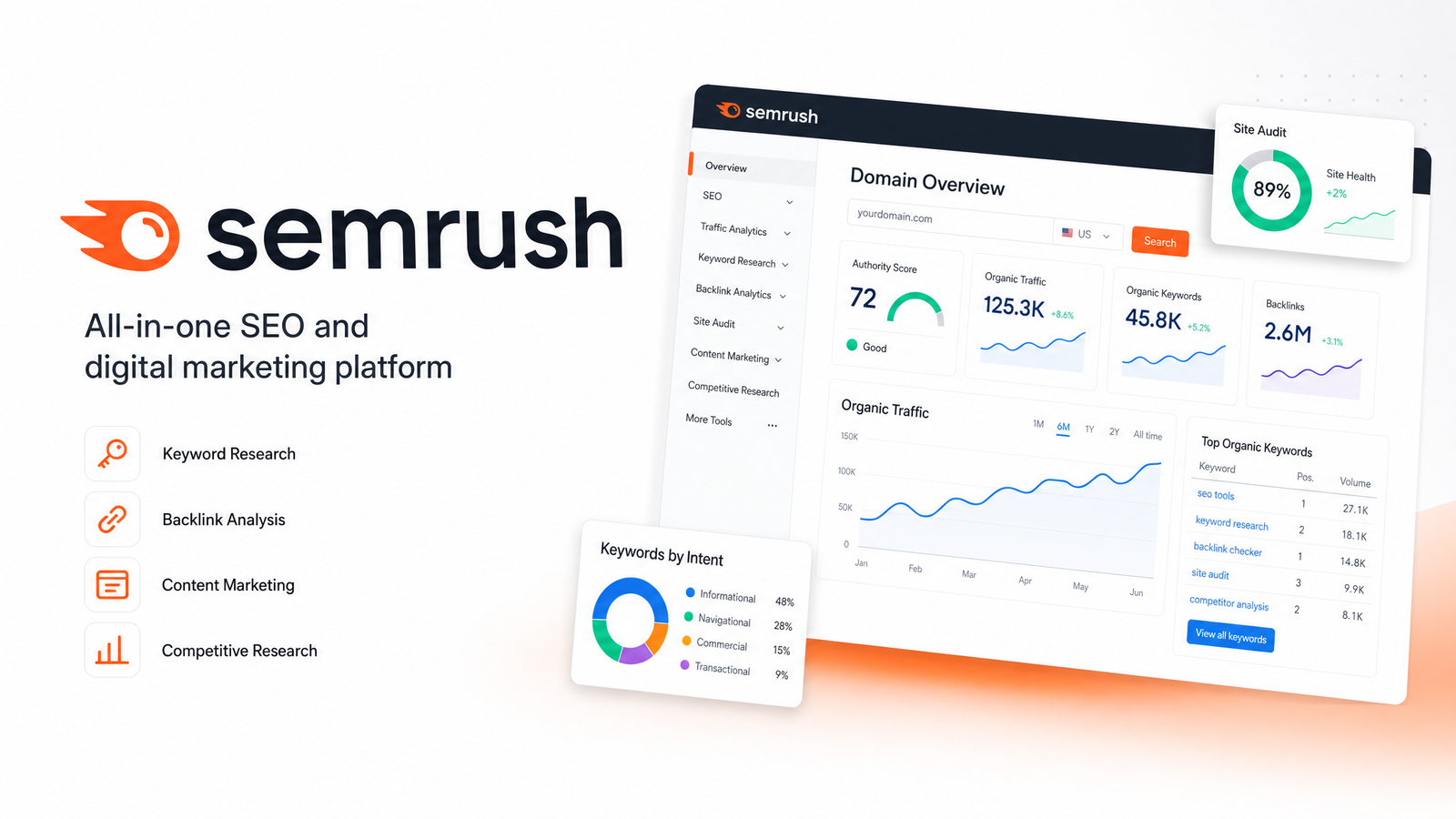
Semrush isn't one tool — it's a bundle of modules sold under a single login, built primarily for agencies and marketing teams managing several client accounts or larger sites at once. Understanding what's included matters before you compare price tags, because you're really pricing a toolkit, not a single feature.
The core Semrush toolkit covers:
- Site Audit — crawls a domain and flags technical issues (broken links, crawlability, Core Web Vitals, duplicate content)
- Keyword research and Keyword Gap — finds ranking opportunities and compares your keyword footprint against competitors
- Position Tracking — monitors daily rank movement for tracked keywords
- Backlink Analytics — maps link profiles for you and competitors
- Content and on-page tools — topic research, SEO writing assistance, content audits
- AI Visibility toolkit (part of Semrush One) — tracks how brands show up in AI-generated answers, a newer addition as search shifts toward LLM-driven results
Semrush's own SEO toolkit page lays out this breadth clearly: position tracking, keyword overview, keyword gap, and organic research all sit as separate but connected reports. That breadth is the whole pitch — and also where pricing gets complicated.
Semrush Pricing in 2026: Plans, Tiers, and Hidden Costs
Semrush restructured its lineup fairly recently, and the naming still trips people up. The core SEO plans — sometimes still referenced by their older Pro/Guru/Business names — now map roughly to tiers branded around SEO, Pro+, and Advanced, alongside a separate Semrush One bundle that folds in the AI Visibility toolkit and broader marketing features.
According to current third-party pricing breakdowns, Semrush plans in 2026 start around $139/month for the entry tier, climbing through mid- and top-tier plans that unlock more projects, tracked keywords, Site Audit crawl limits, and users. That entry price is just a starting point — real spend depends heavily on how many domains you manage and how many people need seats.
Here's where budgets get surprised:
- Per-seat pricing. Each plan ships with a limited number of user seats. Add a second team member and you're paying for an additional seat, not just splitting one login.
- Project and domain caps. Lower tiers cap tracked projects and keywords. Managing more than one or two sites often means upgrading a full tier rather than adding an incremental add-on.
- Add-ons stack up. Local SEO, additional Site Audit crawls beyond your limit, and expanded API access are frequently sold separately from the base plan.
- Semrush One changes the math again. Bundling in AI visibility tracking and broader toolset access pushes cost higher still, and it's a distinct purchase decision from the classic SEO plans.
None of this means Semrush is overpriced for what it includes — it's priced for teams that use most of what's in the box. The problem is that a lot of buyers don't.
Where Semrush Genuinely Excels
Credit where it's due: Semrush's data depth is real. The Site Audit module is thorough — it catches technical issues across large, complex sites that a lighter tool might miss, and it's a strong starting point for a first-time audit.
Competitor research is arguably Semrush's strongest single feature. The Keyword Gap tool and organic research reports show exactly which keywords a competitor ranks for that you don't, which pages drive their traffic, and where their backlink profile beats yours. For agencies pitching new clients or building competitive positioning decks, that's hard to replicate quickly elsewhere.
Independent reviews back up the strength of the data itself. A recent Semrush review notes the platform's keyword and backlink databases are among the largest available, rivaling Ahrefs and outpacing smaller platforms like Moz or SE Ranking on raw data volume. If your work depends on comprehensive competitor and keyword data across many domains, that scale is a legitimate advantage — and the reason Semrush remains the default choice for agencies running multi-client SEO programs.
Where Semrush Falls Short for Solo Operators and Lean Teams
The same qualities that make Semrush powerful for agencies create friction for a one-person operation or a three-person content team.
Single-seat pricing punishes small teams disproportionately. An agency spreading a Business-tier plan across ten client accounts and several team members absorbs the per-seat cost easily. A solo marketer or two-person shop pays nearly the same base price for a fraction of the usage.
Project and domain caps hit sooner than expected. If you manage your own site plus a couple of side projects or client sites, you can bump into tier limits fast — forcing an upgrade to a plan built for far more scale than you need.
The learning curve is real. Dozens of reports, filters, and modules mean new users often spend real time just learning where things live before they can act on the data — time a lean team doesn't have to spare.
Modules don't talk to each other in a finished way. This is the biggest structural limitation for smaller teams: Site Audit tells you what's broken, but fixing technical SEO issues is still a separate, manual step. Keyword research surfaces opportunities, but writing and publishing the content lives in different tools entirely — sometimes different Semrush modules, sometimes outside Semrush altogether. Position Tracking tells you what happened after the fact, disconnected from the audit and content that drove the change. For a large team, stitching these together with dedicated staff is normal. For a lean team, it's the whole workflow problem.
That combination — cost, complexity, and disconnected modules — is exactly why "Semrush alternative" is one of the most common searches paired with the brand name itself. It's not that Semrush underperforms; it's that plenty of people are paying agency prices for a solo workload.
Toolkit vs. Workflow: A Different Way to Think About the Decision
Most comparisons frame this as "which toolkit has more features" — Semrush vs. Ahrefs vs. SE Ranking, feature checklist by feature checklist. That's the wrong axis for a solo operator or lean team to evaluate on.
The better question is: do you need a modular data platform, or a connected workflow that moves from audit to content to publishing to tracking without you manually shuttling data between tools?
Semrush, Ahrefs, and Moz are all, at their core, modular toolkits. You still assemble the pipeline yourself: run the audit, export or read the findings, brief a writer, publish through a CMS, then check back in Position Tracking or a dedicated rank tracker weeks later to see what moved. Each step is capable — the seams between steps are where a lean team loses time.
Rankevra takes the opposite approach: instead of separate modules a team stitches together, it runs the SEO lifecycle as one connected pipeline — audit, AI-assisted content creation, publishing, and rank tracking as a single workflow rather than a set of side-by-side reports. That mirrors the argument for building a content publishing workflow that scales safely: the value isn't in any one step being flashy, it's in the steps not requiring manual handoffs. For someone managing SEO alone or with a very small team, that difference in structure often matters more than raw data volume.
This isn't an argument that Semrush's data is weak — it's an argument that data breadth solves a different problem than workflow automation does, and lean teams are usually short on time, not short on reports.
How to Decide Which Fits You
Run through this before you commit to either direction:
- You're an agency or in-house team managing multiple client accounts, need white-label reporting, and want the deepest competitor and backlink datasets available → Semrush's Pro+/Advanced tiers or Semrush One likely earn their cost, and the backlink analysis capabilities are worth the investment at that scale.
- You manage one to a handful of sites, work solo or with a very small team, and spend more time context-switching between tools than acting on the data they produce → you're likely paying for capacity built for a different kind of buyer.
- You want technical fixes, content drafts, publishing, and rank movement to flow through one system instead of four → that's the specific gap Rankevra is built to close.
If you land in that last group, it's worth trying Rankevra directly rather than adding another line item to a stack that already feels heavier than it should.
Frequently Asked Questions
Is Semrush worth it for a small business or solo site owner?
It depends on how much of the toolkit you'll actually use — Semrush's data depth is real, but its pricing and project caps are built around multi-client or multi-domain workloads. A solo owner managing one or two sites often pays for seat and project capacity they never touch, which is why "Semrush alternative" is such a common follow-up search.
What's the difference between Semrush Pro, Guru, and Business plans?
Those are the older tier names; Semrush's 2026 lineup restructures them around SEO, Pro+, and Advanced tiers, plus the separate Semrush One bundle. Each step up raises limits on projects, tracked keywords, Site Audit crawl volume, and user seats, with add-ons like Local SEO sold separately from the base price.
Does Semrush have a free version or free trial?
Semrush offers a limited free trial period rather than a permanent free tier, giving new users a window to test core modules like Site Audit and keyword research before committing to a paid plan. Full ongoing access to Position Tracking, Keyword Gap, and backlink data requires a paid subscription.
Can Semrush actually write and publish content, or just plan it?
Semrush's content tools focus on planning and assistance — topic research, SEO writing suggestions, and content audits — rather than a fully automated draft-to-publish pipeline. Publishing still typically happens through a separate CMS, one of the seams lean teams run into when moving from research to a live page.
What is Semrush One and how is it different from regular Semrush?
Semrush One is a newer, broader bundle that adds the AI Visibility toolkit for tracking brand presence in AI-generated search answers, alongside the classic SEO modules. As Search Engine Land's breakdown explains, it's positioned as a step beyond the standard SEO plans rather than a replacement, aimed at teams tracking visibility across both traditional and AI-driven search.
What's a good alternative to Semrush for someone managing SEO alone?
Rankevra is built specifically for that situation — running audits, AI-assisted content creation, publishing, and rank tracking as one connected workflow instead of separate modules you manually link together. It's designed for solo operators and lean teams who want automation over toolkit breadth.
If your core need is a modular, data-heavy toolkit for agency or enterprise-level reporting, Semrush is a reasonable and well-earned pick. But if you're a solo operator or small team who wants audits, content drafting, publishing, and rank tracking to run as one connected workflow instead of four separate subscriptions, Rankevra is built for exactly that.
Keep reading
- Content Decay SEO: How to Detect It and Fix It for GoodLearn to detect content decay SEO issues early, rule out false positives, and build a refresh pipeline that scales — plus how to automate the whole loop.
- Headless CMS SEO: Fixing the Gaps Generic Tools MissHeadless CMS SEO breaks in three predictable places: rendering, metadata, and sitemaps. Here's the diagnostic framework to find and fix each gap.
- Google Algorithm Update Recovery: A Diagnostic FrameworkA step-by-step google algorithm update recovery framework: confirm the cause, segment the damage, benchmark against winners, and set a real timeline.