Rankevra Blog
Topical Authority Backlinks: Relevance Beats DA in 2026
August 13, 2026
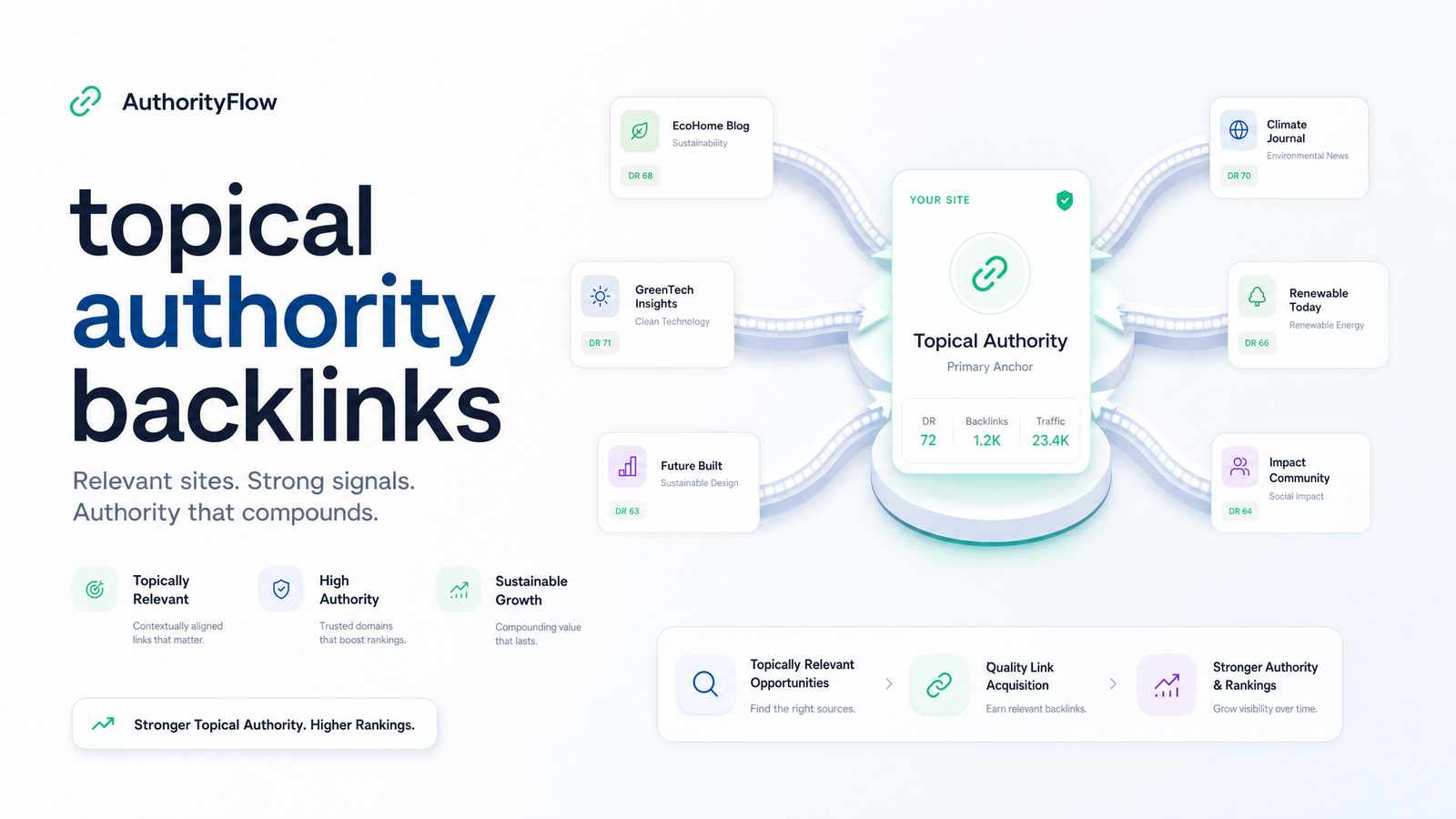
Every SEO forum eventually lands on the same argument: build topical authority through content clusters, or keep chasing high-Domain-Authority backlinks. That framing is wrong. Topical authority backlinks aren't a replacement for topical authority — they're the corroboration signal that tells Google your content clusters are trustworthy enough for other sites to reference. The real question isn't "content or links," it's which links reinforce the topic you're trying to own.
Topical Authority Backlinks vs. Regular Backlinks
A regular backlink is any link pointing at your domain. A topical authority backlink arrives from a page discussing the same subject matter, ideally pointing to content inside a defined topic cluster rather than an orphaned page or the homepage. This matters because Google's ranking systems increasingly evaluate links in context — who's linking, what they're linking about, where on your site the link lands — rather than treating every inbound link as an equal vote of confidence.
This shift has been accelerated by updates like the Google Helpful Content Update, which rewards sites demonstrating depth and consistency on a subject over sites that simply accumulate authority signals from unrelated niches. A backlink from a respected finance publication helps a finance site's topical authority. The same link pointing at a recipe blog does far less, regardless of that finance site's Domain Rating.
Does Relevance Actually Outrank Domain Authority?
Increasingly, yes. Metrics like Moz's Domain Authority and Ahrefs' Domain Rating estimate a domain's overall link strength, not its topical fit for a specific query. They're useful proxies, but proxies aren't the target. A 2025 study analyzing 18,000 backlinks found that semantically aligned placement — a link sitting in relevant surrounding content, from a topically related domain — correlated more strongly with ranking gains than Domain Rating alone. Most SEO professionals surveyed in Ranktracker's 2025 backlink statistics report now rank relevance as the single most important quality factor in a backlink, ahead of raw authority scores, with niche-relevant links estimated to be worth several times more than unrelated ones pointing at the same page.
That doesn't make Domain Authority or Domain Rating worthless — they're still reasonable filters for spam and link-farm risk. But treating them as the primary acquisition target, instead of relevance, is how teams end up with backlink profiles that look impressive in a dashboard and do nothing for the keywords they actually care about.
How Backlinks Reinforce Content Clusters
Topic clusters work because they concentrate internal links and semantic signals around a pillar page, telling search engines that a set of subtopics belongs together. Backlinks extend that logic externally: when a topically relevant site links into a cluster page, it's outside confirmation that the subtopic is worth citing, strengthening the whole cluster's credibility, not just the page that received the link.
According to Floyi's analysis of backlink relevance as a topical authority signal, topically relevant links tend to drive focused ranking gains within the cluster they support, while generic, unrelated links may lift domain-wide metrics without moving the priority pages the cluster was built to rank. This is the wasted-budget trap: an outreach campaign earning twenty links to your homepage from broadly reputable sites can look like progress while your money pages — the cluster articles targeting the keywords you actually chase — see no movement.
Related research comparing topical authority against backlinks on today's Google reaches a similar conclusion: a handful of tightly aligned, contextual backlinks can outperform a much larger set of low-relevance links, because search systems weigh semantic fit alongside link equity rather than raw count.
Signals That Determine Topical Relevance
Judge a prospective or existing backlink against concrete signals rather than gut feeling:
- Source topic alignment. Does the linking page discuss your subject matter, or an adjacent one, in real depth — not just a passing mention?
- Surrounding context. Is the link embedded in a paragraph relevant to your content, or dropped into a sidebar, footer, or generic resource list?
- Anchor text. Does the anchor reflect the actual topic of the destination page, or is it a brand name/URL with no semantic signal?
- Destination page fit. Does the link point to the specific cluster page most relevant to the linking content, or default to your homepage regardless of subject?
- Publisher's own topical footprint. Does the linking domain regularly publish in your niche, or is this a one-off guest post on an unrelated blog?
- E-E-A-T fit. Does the linking site demonstrate real expertise or experience in the subject, reinforcing rather than diluting trust signals?
None of these require a six-figure enterprise tool — just checking each prospective link against your cluster map before spending outreach time on it.
Prioritizing Link Building Across a Cluster
The most common mistake is treating the pillar page as the only worthwhile target. Pillar pages matter, but a cluster only functions as a unit if supporting articles carry enough link equity to rank for their own long-tail terms and pass relevance signals up to the pillar through internal linking.
A more effective allocation: identify which cluster pages are closest to ranking but stuck just outside the top results, and prioritize contextual link building toward those first — they convert added link equity into ranking movement fastest. Give the pillar page a steady baseline of relevant links since it anchors the cluster's authority, but don't let it absorb every outreach win by default. Deprioritize thin or redundant cluster pages until content gaps are fixed; a backlink to weak content wastes the opportunity regardless of source quality. An SEO content gap analysis will surface which subtopics are underbuilt before you commit outreach budget to them.
This is also where most teams lose track of what's happening, because backlink data, content performance, and cluster structure typically live in three different tools. Rankevra's approach folds those into a single view: it maps your topic clusters, flags the content gaps inside them, and connects that map to your backlink profile so you can see which specific pages — not just which domain — need reinforcing.
Auditing Your Current Backlink Profile for Cluster Fit
Before acquiring anything new, audit what you already have. Pull your full backlink profile and sort links not by referring-domain authority but by two questions: which cluster does the linking content belong to, and which page on your site does it point to? Links that don't map cleanly to any cluster are candidates for disavow review or, at minimum, shouldn't count toward your topical authority progress even if they're inflating your visible authority score.
For a structured walk-through of reading that data, see how to read a backlink tool checker report. If you're choosing which analysis tool to run this audit with, the no-BS backlink analysis tool evaluation framework lays out the criteria worth weighing. Because backlinks are only one input into topical authority, pair this audit with a proper topical authority checker to see where your clusters stand overall — content depth, internal linking, and link relevance together, not backlinks in isolation.
The Bottom Line on Relevance vs. Volume
Backlinks haven't stopped mattering — they've become more selective in what they need to prove. A smaller set of contextual, topically aligned links pointing at the right cluster pages will outperform a large, generic link portfolio built around domain-wide metrics. The practical shift isn't abandoning link building; it's redirecting it toward pages and publishers where topical relevance is unmistakable, and treating Domain Authority or Domain Rating as a sanity check rather than the scoreboard.
Rankevra's workflow already treats backlink relevance as one more input alongside content and cluster structure. Once it maps your site's topic clusters and surfaces the content gaps inside them, you can see exactly which pages are under-linked relative to their importance in the cluster — and point outreach or internal linking at those instead of guessing. If you're ready to stop spreading link-building effort evenly across a site and start targeting it by cluster, Rankevra is built to make that call for you.
Frequently Asked Questions
Do I still need backlinks if I'm focused on building topical authority?
Yes — backlinks remain a core input, but their job has changed. Instead of generic authority votes, they now act as corroboration signals confirming a specific cluster page deserves trust on its subject, so relevance matters more than volume.
What makes a backlink 'topically relevant' versus just high-authority?
A topically relevant backlink comes from a page discussing the same or an adjacent subject, sits in contextual surrounding content, uses semantically fitting anchor text, and points to the specific cluster page it supports. A high-authority backlink may score well on Domain Authority or Domain Rating without meeting any of those conditions.
How many backlinks does a topic cluster actually need to rank?
There's no fixed number — what matters is that the pages closest to ranking receive enough relevant link equity to break through, while the pillar page maintains a steady baseline of contextual links. A handful of tightly aligned links routinely outperforms dozens of unrelated ones.
Can a low domain authority site outrank a bigger competitor with better backlinks?
Yes, particularly when the smaller site's backlinks are topically concentrated and the competitor's are spread across unrelated niches. Semantic alignment and contextual placement have been shown to correlate with ranking gains more strongly than Domain Rating alone.
Should every article in a topic cluster get its own backlinks, or just the pillar page?
Every meaningful cluster page benefits from some relevant links, not just the pillar. Supporting articles that rank for their own long-tail terms pass link equity and topical signal up to the pillar through internal linking, so concentrating all outreach on one page under-serves the rest of the cluster.
How do I check whether my current backlinks actually support my topic or just my domain rating?
Sort your backlink profile by which cluster and which specific page each link points to, not by referring-domain authority score. Links that don't map to any defined cluster are inflating your domain-wide metrics without contributing to topical authority, and are candidates for review.
Keep reading
- Content Decay SEO: How to Detect It and Fix It for GoodLearn to detect content decay SEO issues early, rule out false positives, and build a refresh pipeline that scales — plus how to automate the whole loop.
- Headless CMS SEO: Fixing the Gaps Generic Tools MissHeadless CMS SEO breaks in three predictable places: rendering, metadata, and sitemaps. Here's the diagnostic framework to find and fix each gap.
- Google Algorithm Update Recovery: A Diagnostic FrameworkA step-by-step google algorithm update recovery framework: confirm the cause, segment the damage, benchmark against winners, and set a real timeline.