Rankevra Blog
Topical Authority Case Study: What the Data Really Shows
August 13, 2026
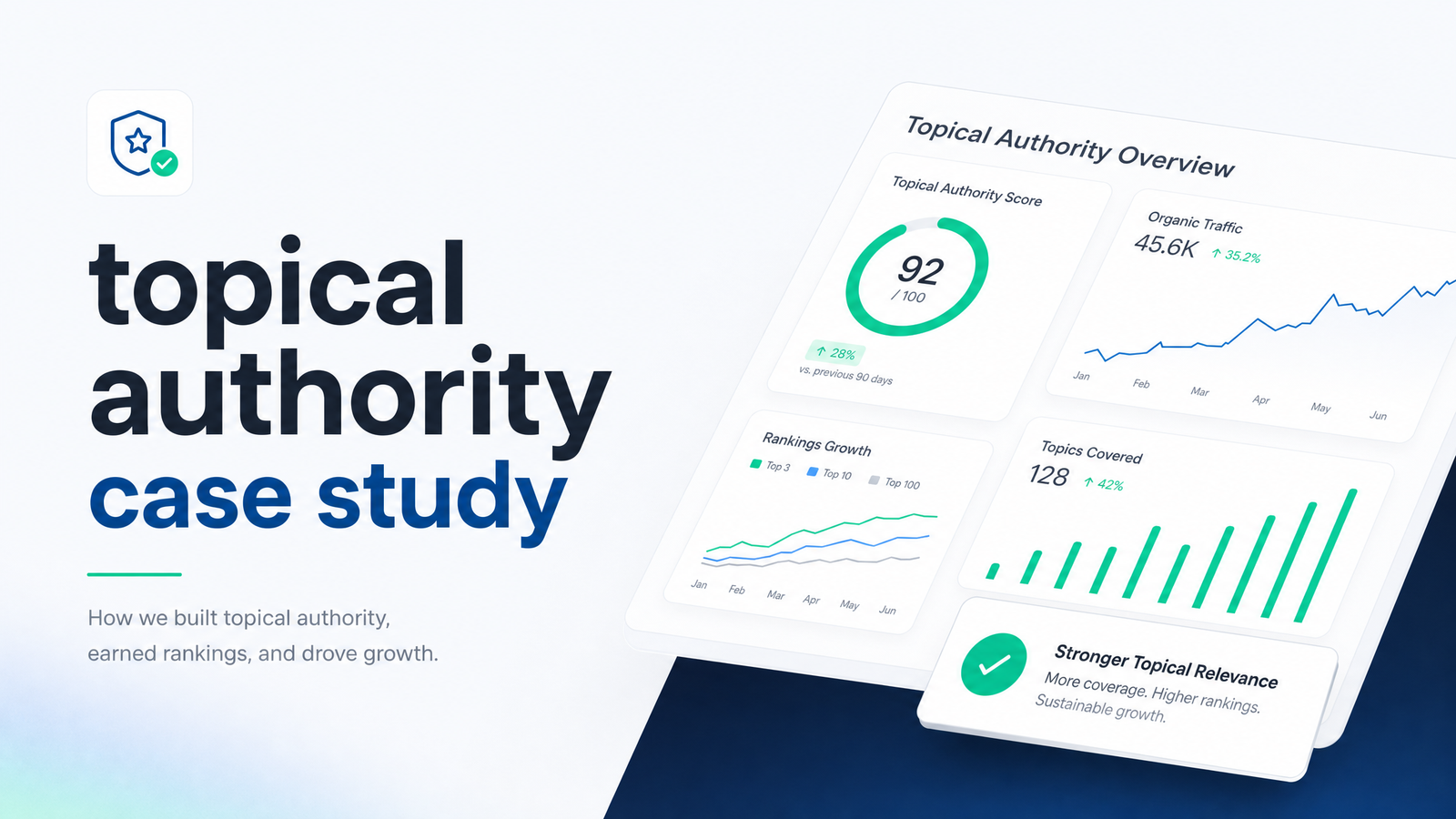
What a Real Topical Authority Case Study Actually Shows
"Topical authority" gets thrown around so often in SEO content that it's fair to be skeptical. Does covering a topic comprehensively actually move rankings and traffic, or is it a theory that sounds good in a blog post and falls apart in practice?
The honest answer depends on whether you look at frameworks or at outcomes. Most content on this subject — including plenty of Rankevra's own library — explains the mechanics: pillar pages, spokes, internal linking, hub-and-spoke structures. What's rarer is a straight look at verified, published topical authority results with actual numbers attached: percentage traffic growth, keyword counts, timeframes, referring domains.
This article does that. It pulls together three published case studies from very different starting points — a developer education platform, a law firm working with an agency, and an independent blogger — and extracts what they have in common, then turns that pattern into something you can check against your own site, without assuming you have an agency budget or six people on a content team.
Three Case Studies, Three Different Starting Points
Developer platform: 138% organic growth in 24 months. Roadmap.sh's case study, documented by Hackmamba, shows a developer education site growing organic traffic by 138% over two years by deliberately building out topic clusters around developer roadmaps and skills content, rather than publishing isolated posts. The write-up ties the growth to structured content planning plus earned backlinks accumulated as the site became a reference point in its niche — a topical authority traffic growth curve built on breadth and consistency rather than a handful of viral pieces.
Law firm: 936% organic traffic growth. Susodigital's B2C law case study is the most dramatic number in this set — a 936% increase in organic traffic, achieved by restructuring the site's content around a pillar-and-cluster hub model instead of scattered practice-area pages. The agency mapped core legal topics as pillar pages, built supporting cluster content underneath each one, and used internal linking to concentrate relevance and authority signals on the pages that mattered most for conversions. This is a topic cluster case study in the clearest sense: the structural change, not just "more content," is what the agency credits for the jump in both traffic and keyword rankings.
Independent blogger: 100x traffic through topic cluster restructuring. Not every topical authority example comes from an agency with a retainer budget. Thruuu's case study documents a solo site owner reorganizing existing content into topic clusters and seeing traffic grow 100x over a multi-year period — no large team, just a deliberate shift from disconnected posts to a mapped cluster structure, with internal linking rebuilt to reflect topical relationships that hadn't existed before.
Three different site types, three different resourcing levels, three different timeframes — and the same underlying move: stop publishing content as isolated units and start building it as an interconnected structure around defined topics.
The Pattern Behind Every Successful Case
Line these case studies up and the overlap is hard to miss. None succeeded through some proprietary trick — they succeeded by doing a small number of things consistently.
Pillar and cluster mapping came first, not last. In every building topical authority case study reviewed here, content wasn't published and then organized — it was mapped before it was written. The law firm defined its pillar topics before assigning cluster content underneath them. Roadmap.sh planned skill areas as clusters before producing the supporting material.
Internal linking did real structural work. This wasn't decorative "see also" linking. Each case tied cluster pages back to their pillar and to each other, concentrating relevance and passing authority to the pages meant to rank for competitive terms — a deliberate pillar and cluster case study pattern rather than an afterthought.
Publishing cadence stayed consistent rather than sporadic. The multi-year and multi-month timeframes in these results weren't accidents — they reflect steady output sustained over the growth period rather than a burst of content followed by silence.
Backlinks were relevance-driven, not volume-driven. The Roadmap.sh case explicitly credits earned links from within its developer niche, not links from unrelated high-authority domains. This matches Topical Authority Backlinks: Relevance Beats DA in 2026 — a link from a lower-authority but topically relevant site tends to reinforce topical relevance signals more than a generic high-DA link does.
Iteration was driven by data, not guesswork. Winning clusters got expanded; underperforming pages got revised or merged. That loop depends on watching Google Search Console data closely enough to know which cluster pages are gaining impressions but not clicks, and which are stalling entirely.
None of this is exotic. It's disciplined execution of a known structure, repeated long enough for the compounding effect to show up in the data.
How to Know If It's Working on Your Own Site
Total traffic is a lagging, noisy indicator. It goes up and down for reasons that have nothing to do with topical authority — seasonality, algorithm volatility, one page having a good month. If you want to measure topical authority rather than just watch it, track signals at the cluster level.
- Keyword count in the top 100 and top 10 for your cluster's target terms. Topical authority tends to show up first as a widening footprint in the top 100 before those terms move into the top 10. If that top-100 count is climbing steadily, the structure is working even if rankings haven't peaked yet.
- Click share across the whole cluster, not just the pillar page. A cluster that's building authority usually shows the pillar page gaining clicks alongside its supporting pages — not just one page absorbing all the traffic while the rest sit flat.
- Time-to-first-click on new cluster content. As topical authority strengthens, new pages published inside an established cluster tend to start earning clicks faster than earlier pages did when the cluster didn't exist yet.
- Referring domains pointing into the cluster, not just the site overall. A rising count of topically relevant referring domains linking into cluster pages is a stronger signal than a generic backlink count for the domain as a whole.
Watching these four signals side by side is what separates topical authority results from ordinary month-to-month SEO fluctuation. It's also consistent with the aggregate evidence in Graphite's 12-site topical authority study, which found that sites with higher topical authority reached organic search visibility faster than sites without it — a finding based on multiple sites, not a single anecdote, worth weighing alongside the individual case studies above.
Why Most Teams Take Months Longer Than They Should
If the pattern above is simple, why does it take Roadmap.sh 24 months and the law firm's agency an extended engagement to produce these numbers? Mostly operational drag, not strategic uncertainty.
A typical manual execution looks like this: run a technical audit in one tool, do keyword and content gap research in a spreadsheet or a second tool, brief and write content in a document, publish manually through a CMS, then check Google Search Console days or weeks later to see what happened — before starting the next cycle by hand. Each handoff between tools and people adds delay, and delay compounds. A content gap that should trigger a new cluster page within days instead sits in a backlog for a month. A cluster page that's underperforming doesn't get revised until someone happens to notice it in a quarterly report.
None of the case studies above ran a bad strategy slowly on purpose — they ran a sound strategy through a process that wasn't built for speed. Every topical authority case study with a long timeline has this bottleneck somewhere in its history, even when the published write-up doesn't dwell on it.
Replicating These Results Faster With an Automated Workflow
The strategic pattern is now well established — map clusters, link them deliberately, publish consistently, earn relevant links, iterate on Search Console data. What separates a fast execution from a slow one is how quickly a team can move through that loop, not whether they know the theory.
That's the specific gap an AI SEO workflow closes. Instead of running audits, content gap research, drafting, publishing, and rank tracking as four or five disconnected tools with manual handoffs between them, a single automated topical authority tool can run technical audits, surface cluster gaps, generate and structure content around a pillar model, publish it, and track keyword and traffic movement in one continuous loop. The content gap analysis framework that identifies which cluster pages are missing, and the publishing workflow practices that keep output consistent without sacrificing quality, are both steps that took the case studies above months to execute by hand — and both are steps an automated system can run continuously rather than in quarterly bursts.
Rankevra is built around exactly this loop: audit, content, publishing, and rank tracking as one connected system rather than four separate subscriptions and a spreadsheet holding it together. That's not a shortcut around the strategy in the case studies above — it's the same strategy, run without the multi-week gaps between steps that stretched those results out over 24 months.
Manual coordination across separate audit, content, and tracking tools is what turned a straightforward cluster strategy into a two-year project in more than one of these case studies. Compressing that same audit-to-publish-to-track loop into a single automated workflow is exactly what Rankevra is designed to do — start a free trial and run your own topical authority case study against your site's actual data.
Frequently Asked Questions
How long does it take to see results from a topical authority strategy?
Published case studies show timeframes ranging from several months to two years, depending on site size, niche competitiveness, and publishing consistency. Roadmap.sh's 138% traffic growth took 24 months, while the independent blogger case in the Thruuu study unfolded over a multi-year period. Early signals — like rising top-100 keyword counts — typically show up faster than full traffic or ranking gains.
How many articles or pages do I need to build topical authority in a niche?
There's no fixed number — it depends on how many subtopics your niche genuinely contains and how competitive each one is. The consistent factor across case studies isn't volume alone but comprehensive coverage of a topic area connected through a pillar-and-cluster structure with deliberate internal linking.
Does topical authority still matter with AI Overviews and AI search?
Yes — comprehensive, well-structured topical coverage helps both traditional rankings and AI-generated answer surfaces like AI Overviews, which tend to pull from sites that demonstrate depth and clear topical relationships rather than isolated pages. E-E-A-T signals, which topical depth supports, remain relevant to how these AI systems select sources.
What's the difference between a topic cluster and topical authority?
A topic cluster is the structural unit — a pillar page and its supporting content, linked together. Topical authority is the outcome that emerges when a site has built multiple well-executed clusters consistently enough that search engines recognize the whole domain as a strong source on that subject area.
Can a small site with limited budget realistically build topical authority?
Yes — the Thruuu case study shows a single site owner achieving 100x traffic growth through cluster restructuring without an agency or large team. The pattern that drives results (mapping, internal linking, consistent publishing, relevant links, data-driven iteration) doesn't require large spend, though it does require sustained execution.
What tools do I need to run my own topical authority case study?
At minimum, you need a way to audit technical SEO issues, identify content gaps, produce and publish content on a consistent schedule, and track keyword and traffic movement through Google Search Console or an equivalent. Many teams run these as separate tools with manual handoffs; an integrated AI SEO workflow like Rankevra runs the same steps as one connected system instead of four disconnected ones.
Keep reading
- Content Decay SEO: How to Detect It and Fix It for GoodLearn to detect content decay SEO issues early, rule out false positives, and build a refresh pipeline that scales — plus how to automate the whole loop.
- Headless CMS SEO: Fixing the Gaps Generic Tools MissHeadless CMS SEO breaks in three predictable places: rendering, metadata, and sitemaps. Here's the diagnostic framework to find and fix each gap.
- Google Algorithm Update Recovery: A Diagnostic FrameworkA step-by-step google algorithm update recovery framework: confirm the cause, segment the damage, benchmark against winners, and set a real timeline.