Rankevra Blog
Topical Authority in Digital Search: The 2026 Playbook
August 12, 2026
Topical Authority Isn't Just a Google Metric Anymore
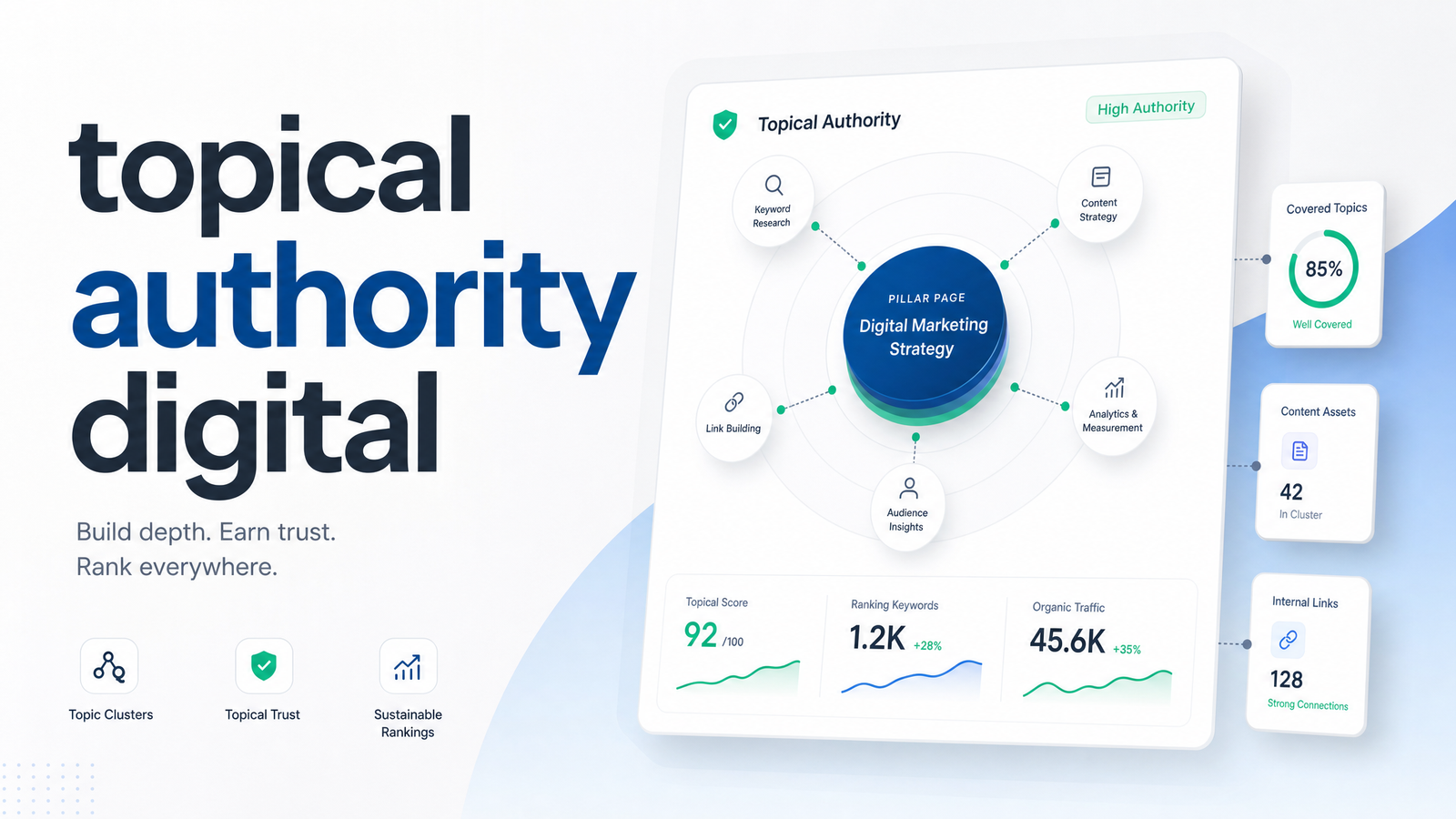
Topical authority used to mean one thing: how well Google trusted your site to rank for a subject. That still holds at the foundation — for the plain-English basics, we've covered them separately. But the practical meaning has outgrown that single-channel view. Digital topical authority today is a cross-channel asset, read by Google's ranking systems, AI Overviews, and answer engines like ChatGPT and Perplexity that decide which brands get named in a generated response. Topical authority digital reach now matters as much as ranking position, because a growing share of searches never produce a click — only a citation.
A site can rank respectably on page one and still be invisible in the answer a user actually reads, because the AI system pulled its summary from a competitor with tighter entity consistency or a more complete content cluster. Building topical authority is no longer a single-site SEO project — it's a digital-ecosystem strategy.
Why It Matters Now: AI Overviews and Answer Engines Changed the Rules
AI Overviews and chat-based search sit in front of a large and growing share of queries, with independent tracking putting their reach well into daily mainstream search behavior, per current 2026 AI search data. If a meaningful chunk of impressions now resolve as zero-click AI summaries, ranking #1 on a blue-link results page captures less value than it used to.
This is where topical authority AI search dynamics diverge from the old playbook. AI Overviews and tools like ChatGPT and Perplexity don't render ten ranked links — they synthesize one answer and choose which sources or brands to name inside it. Independent research on AI Visibility Index data across ChatGPT, Gemini, and AI Overviews suggests that sites with deep, consistent topical coverage get cited more often than sites with isolated high-ranking pages, even when those pages technically outrank the cited source on Google. AI Overviews topical authority rewards depth and consistency over one-off wins. A single well-optimized article can still rank; it usually can't get cited repeatedly on its own. The engines are pattern-matching your whole footprint on a subject, not just the URL matching the query.
For the ChatGPT-specific mechanics — what it can and can't infer from your site, and where it pulls source material — see our dedicated piece on topical authority and ChatGPT.
The Digital Signals That Actually Build Topical Authority
Both Google's ranking systems and AI models are, at their core, reading patterns of coverage and consistency. The 2024 Google Content Warehouse API leak confirmed a five-bucket framework of ranking factors, and topical depth sits inside it alongside classic signals like Core Web Vitals and E-E-A-T. The signals that move the needle in 2026 include:
- Content cluster depth. A pillar page surrounded by genuinely thorough supporting articles covering subtopics, edge cases, and related questions signals mastery a single long article can't. A structured content gap analysis shows exactly which subtopics in your cluster are thin or missing before a competitor — or an AI model — notices first.
- Entity and brand consistency. Your brand name, author identity, and core terminology need to appear the same way across your site, social profiles, third-party mentions, and ideally the Knowledge Graph. Inconsistent naming or fragmented author bios make it harder for Google and AI systems to connect your pages.
- Third-party mentions and digital PR. Independent citations — press coverage, guest contributions, industry roundups — still function as a trust signal, but the role has shifted from raw backlink count to whether credible sources talk about you in the context of your topic. That contextual mention pattern is exactly what AI models weight when deciding who to cite.
- Freshness across the cluster, not just the flagship page. Updating your pillar post while supporting articles go stale for two years tells crawlers and AI retrieval systems your coverage isn't actively maintained.
- Structured data. Clean schema markup helps machines parse entities, authorship, and relationships between pages — feeding the same E-E-A-T and Knowledge Graph signals that both classic ranking and AI summarization draw on.
It's worth separating topical authority vs domain authority, since the two get conflated constantly. Domain authority is a blunt proxy for overall link equity and site strength. Topical authority is subject-specific: a domain can carry strong overall authority yet have thin, inconsistent coverage on one topic — and lose visibility there to a smaller, more focused competitor. For a deeper look at where common Google-specific myths break down, see our piece separating topical authority myth from fact on Google.
Building Digital Topical Authority Without Tool Sprawl
Building topical authority online isn't a project you finish — it's a loop you sustain. The mechanics are simple to describe and hard to keep running manually:
- Audit existing content against the topic to find coverage gaps, outdated pages, and technical issues that quietly suppress visibility.
- Map the cluster — decide which subtopics need new content, which need consolidation, and which entities and terms need consistent appearance across the set.
- Publish on a steady cadence rather than in bursts, so the cluster grows coherently instead of arriving in disconnected waves.
- Track both classic rankings and AI citation appearances, since they no longer move in lockstep.
The problem most lean teams run into isn't understanding this loop — it's running it continuously across four or five disconnected tools: one for audits, another for content briefs, a CMS plugin for publishing, and a separate rank tracker that doesn't monitor AI citations. Every handoff between tools is where topical authority in digital marketing quietly breaks down, because gaps found in an audit rarely make it cleanly into a content calendar, and published content rarely gets checked against what's actually ranking or getting cited.
This is precisely the workflow Rankevra was built to remove friction from. Rankevra connects site audits, content creation, publishing, and rank tracking into one continuous system, so a coverage gap identified in an audit turns directly into a content brief, gets published on schedule, and then gets tracked for both ranking movement and citation appearances — without exporting spreadsheets between four logins. Publishing consistency alone is worth the effort: a scalable publishing workflow prevents the stop-start pattern that dilutes a cluster's momentum just as it starts compounding.
Mistakes That Quietly Undermine Topical Authority
Most topical authority mistakes aren't dramatic — they're small inconsistencies that compound over months.
Scattered publishing is the most common. Publishing whatever keyword opportunity looks good that week, with no relationship to a defined cluster, produces a site full of disconnected pages instead of a coherent topic footprint. Search engines and AI models both reward coverage that reads as intentional.
Orphaned pages are the structural version of the same problem. Content not internally linked into its cluster sends a weak signal about how it relates to your core topics — and if crawlers can't easily find the relationship, neither can retrieval-based AI systems trying to summarize what you know.
Ignoring freshness across supporting content, not just flagship pages, lets a cluster decay from the edges. A pillar page updated annually surrounded by five-year-old supporting posts is a mixed signal.
Chasing backlinks over coverage is the habit that dies hardest. Backlinks haven't become worthless, but a link-first strategy that neglects actual topical depth increasingly underperforms a coverage-first strategy that earns fewer, more contextually relevant mentions. Digital PR still matters — but only when mentioning you in a topic context you've actually built out, not as a substitute for that work.
Frequently Asked Questions
Is topical authority the same thing as domain authority?
No. Domain authority is a general, site-wide proxy for link strength, while topical authority measures how completely and consistently a site covers one specific subject. A high-domain-authority site can still lose visibility on a topic to a smaller site with tighter, more comprehensive coverage of that exact subject.
Does topical authority actually help you get cited in AI Overviews or ChatGPT?
Yes — sites with deep, consistent coverage of a topic get cited more often than sites with a single strong page on the same subject. AI Overviews and answer engines synthesize responses from patterns of coverage and entity consistency, not just the single top-ranking URL, so isolated wins matter less than sustained topical depth.
How long does it take to build topical authority in 2026?
There's no fixed timeline, but it builds incrementally over months of consistent publishing, not from a single content sprint. Freshness and consistency across an entire cluster matter more than the speed of any one launch, so steady, coordinated output tends to outperform bursts of activity followed by neglect.
Do backlinks still matter if I'm focused on topical authority?
Yes, but their role has shifted from raw quantity to contextual relevance. A mention from a credible source discussing your actual topic area carries more weight now than a high volume of generic links, and digital PR works best when it reinforces coverage you've already built rather than replacing it.
Can a small or new website build meaningful topical authority?
Yes — topical authority is subject-specific, not tied to overall site size or age, so a focused smaller site can out-cover a larger competitor on a narrow topic. Consistent publishing, tight internal linking, and entity consistency matter more for this than domain size.
Do I need separate tools to track topical authority across Google and AI search?
No, though many teams end up using several disconnected tools by default. A unified workflow that audits, maps content, publishes, and tracks both rankings and AI citations in one system avoids the handoff gaps that cause coverage plans to fall apart between tools.
Building digital topical authority isn't a one-time audit or a content sprint — it's a continuous loop of finding gaps, publishing against them, and watching how both Google and AI answer engines respond. If you're ready to see where your own site's topical footprint has gaps, Rankevra can run that audit and connect it directly to content, publishing, and tracking in one workflow.
Keep reading
- Content Decay SEO: How to Detect It and Fix It for GoodLearn to detect content decay SEO issues early, rule out false positives, and build a refresh pipeline that scales — plus how to automate the whole loop.
- Headless CMS SEO: Fixing the Gaps Generic Tools MissHeadless CMS SEO breaks in three predictable places: rendering, metadata, and sitemaps. Here's the diagnostic framework to find and fix each gap.
- Google Algorithm Update Recovery: A Diagnostic FrameworkA step-by-step google algorithm update recovery framework: confirm the cause, segment the damage, benchmark against winners, and set a real timeline.