Rankevra Blog
Topical Authority in Semrush: What the Score Really Means
August 24, 2026
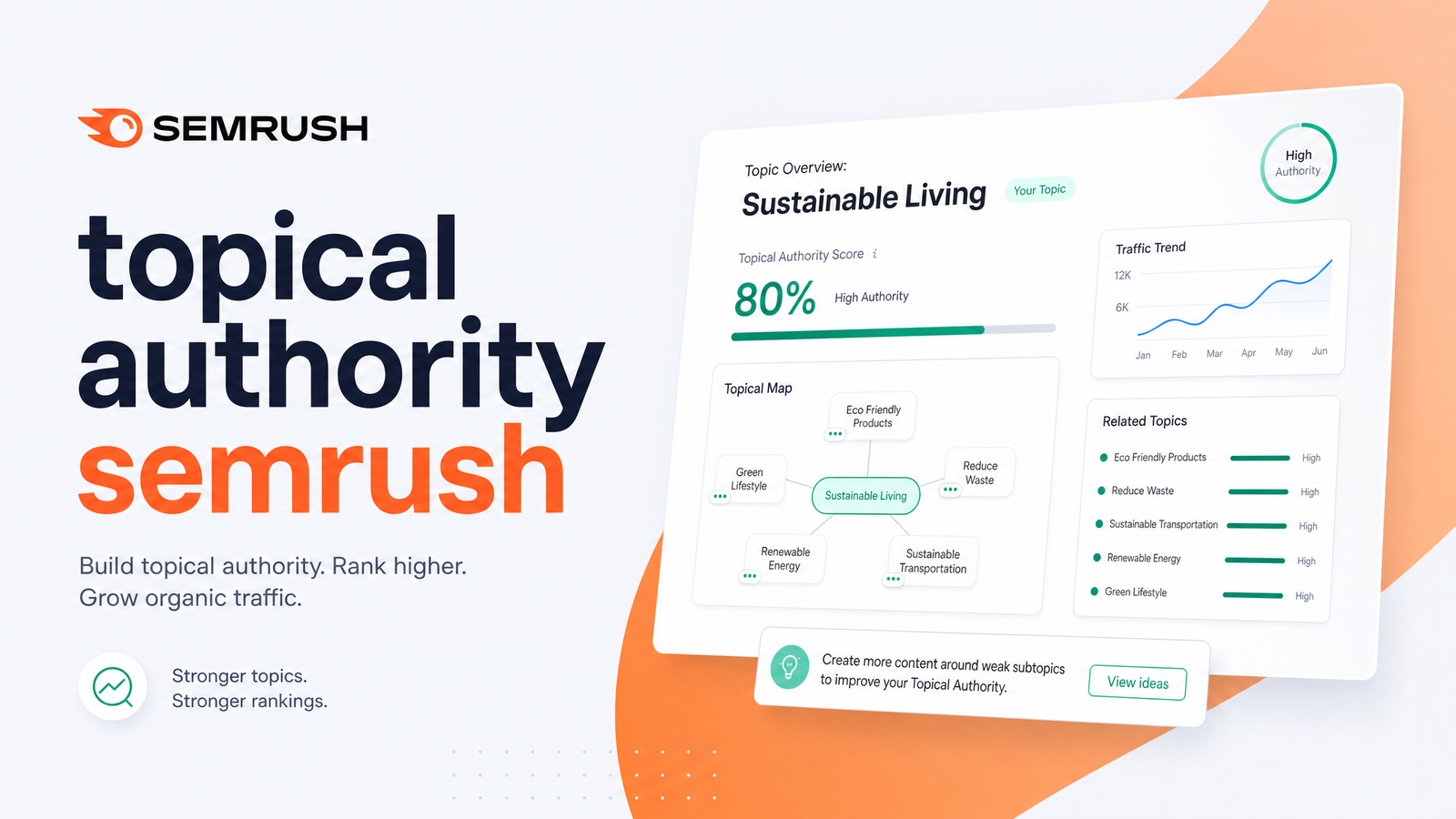
What Semrush's "Topical Authority" Score Actually Is
Type a seed keyword into Semrush's Keyword Overview tool and, alongside volume and difficulty, you'll see a label: Low, Moderate, Relevant, or High. That's the Topical Authority score, and it's easy to misread as a verdict on your whole site's SEO health. It isn't. It's a narrow, keyword-specific metric that tells you how well your domain's existing content thematically matches one particular seed term.
"Topical authority" as a broader SEO concept — the idea that a site earns rankings by demonstrating comprehensive expertise across a subject, not just by publishing one good page — is a wider strategic framework. Semrush's score is a tool-specific implementation of a sliver of that idea: a proprietary comparison between your domain's thematic footprint and the topic behind the keyword you searched. For the full conceptual framework, Topical Authority 2.0: Building Authority for AI Search covers that ground in depth. This article stays narrower: what the semrush topical authority score measures inside the tool, how it's calculated, and what to do once you have a number in front of you.
How Semrush Calculates It (and What the Labels Mean)
Semrush doesn't publish the full formula, but the mechanism is straightforward in concept: the algorithm compares the thematic profile of your domain — built from the topics your existing pages already rank for or cover — against the topic cluster surrounding the seed keyword you're checking. The closer your domain's footprint sits to that keyword's topic, the higher the score.
According to Semrush's own knowledge base, the output falls into four bands:
- Low — your domain shows little to no established relevance to this topic.
- Moderate — you have some thematic presence, but it's thin relative to the topic's breadth.
- Relevant — your domain has a reasonably solid thematic footprint here.
- High — your domain is strongly established in this topic area.
The labels aren't a ranking prediction — they're a relevance snapshot based on content you've already published. A brand-new site querying a keyword in an unfamiliar niche will almost always show Low, regardless of how strong its content strategy is going forward, because the score reflects history, not intent. If you're asking how is topical authority calculated in Semrush and expecting a transparent weighted formula, you won't get one; you get a directional signal, which is still useful if you know what to do with it.
Where the Score Shows Up in Your Semrush Workflow
The Topical Authority label threads through several parts of the platform, and knowing where to look changes how useful it is.
Keyword Overview is the primary home. Search any keyword, and the semrush keyword overview topical authority label sits near the difficulty metrics, giving you a per-keyword relevance check before you commit to targeting it.
Personalized Keyword Difficulty (PKD) is where the score becomes genuinely actionable. Standard Keyword Difficulty measures how hard a keyword is to rank for in general, based on the competing domains already ranking. Personalized Keyword Difficulty semrush adjusts that baseline using your specific Topical Authority for that keyword — if your domain has High topical authority, PKD may show the keyword as more attainable than the generic difficulty score suggests, and vice versa. Two sites can see wildly different PKD scores for the identical keyword, purely because their topical footprints differ.
Keyword Magic Tool surfaces topical authority signals when you're building out keyword lists, helping you spot which clusters you're already positioned to compete in versus which ones require groundwork first.
Organic Research rounds this out at the cluster level — rather than checking keywords one at a time, you review which topic areas your domain already ranks across, giving a broader view of where your authority concentrates versus where it's thin.
Used together, these touchpoints answer a practical question: not "is topical authority good or bad," but "which keywords should I prioritize given where my domain already has thematic weight, and which ones need supporting content before they're realistic targets."
Topical Authority vs. Authority Score: Don't Mix These Up
These two metrics share a word and get confused constantly, but they measure almost unrelated things.
Authority Score is a domain-wide (or page-wide) composite metric built from backlink profile quality, referring domain volume, organic traffic estimates, and spam signals — a single number from 0–100 acting as a rough proxy for overall site strength and trustworthiness. Semrush's own guide to Authority Score frames it explicitly as a link-and-traffic-based measure of domain health, unrelated to subject-matter relevance.
Topical Authority, by contrast, is keyword-specific and topic-specific. It ignores your backlink profile almost entirely and asks: does your existing content thematically align with this particular subject? A domain can carry a High Authority Score from years of backlinks in, say, finance, and still show Low topical authority the moment you search a keyword in an unrelated niche like home gardening. Conversely, a newer domain with a modest Authority Score can show High topical authority for a narrow niche it has published deeply and consistently within.
The semrush topical authority vs authority score distinction matters practically: don't assume a strong Authority Score means you're covered on relevance, and don't assume a weak Authority Score means your topical positioning is bad. Treating them interchangeably leads to wasted targeting decisions — chasing keywords your domain has zero thematic grounding in, just because your overall Authority Score looks healthy.
What the Score Won't Do For You
The score is a diagnostic, not a strategy — a single label reflecting a comparison that already happened. It cannot do several things people expect it to do.
It won't identify your specific content gaps. Knowing you have Low topical authority for a keyword tells you that you're thin on the topic — it doesn't tell you which subtopics, questions, or supporting pages are missing. That's a separate research step; SEO Content Gap Analysis: A Complete Framework walks through how to actually find those gaps rather than just knowing they exist.
It won't write or publish anything. The score describes a state of your existing content; closing the gap requires producing new pages, briefs, and internal links — none of which Semrush generates for you from the number itself.
It won't diagnose technical SEO problems holding a cluster back. A topic can have strong content coverage and still underperform because of crawl issues, weak internal linking, slow pages, or indexing problems — the score is blind to all of that.
It won't tell you whether your efforts are working. Topical authority is a point-in-time relevance check, not a tracking system. Once you publish new content to close a gap, you need a separate mechanism to confirm rankings actually move — something Best SEO Rank Tracker in 2026: How to Actually Choose covers in more depth.
These aren't flaws in Semrush's tool so much as scope limits worth being honest about. Treating a topical authority score as a complete plan — rather than one diagnostic input among several — is how teams end up with a folder of screenshots and no actual ranking movement.
Turning the Score Into an Action Plan
A low or moderate score is only useful if it triggers a specific sequence rather than a vague resolution to "publish more content." A workable version looks like this:
- Identify weak topics. Run your core keyword themes through Keyword Overview or Organic Research and flag which ones show Low or Moderate topical authority — these are your priority clusters, not necessarily the highest-volume ones.
- Find the actual gaps. For each weak topic, determine what's missing — subtopics, entity coverage, question-based content, supporting pages that would round out a pillar. Tools built for this (AI Tool for SEO Keyword Research: What Actually Works covers keyword-research approaches that feed this step) speed it up considerably over manual list-building.
- Produce and publish. Draft, edit, and ship the content that fills the identified gaps — ideally structured as topic clusters with a pillar page and supporting articles rather than isolated posts, since Semrush's algorithm rewards thematic breadth, not single-page depth. For the underlying formula behind why cluster structure matters, Koray Topical Authority: The Formula, Decoded and Applied breaks down Koray Tuğberk Gübür's approach to entity-driven topical coverage.
- Track rank shifts. Monitor whether the new pages actually move rankings for the target cluster, and re-check your topical authority label periodically to confirm it's trending upward.
Building topical authority with Semrush this way works, but each step traditionally happens in a different tool — Semrush for diagnosis, a separate content platform for drafting, a CMS for publishing, and another subscription for rank tracking. That handoff between tools is exactly the friction Rankevra is built to remove: it takes the diagnostic signal — weak topics, content gaps — and automates the next steps, from generating and publishing content to tracking whether rankings actually respond, inside one workflow instead of five.
Semrush's Topical Authority score is a diagnostic, not a workflow — it's excellent at telling you where your domain is thin, and it stops exactly there, handing the research, writing, publishing, and tracking back to you and whatever separate tools you've stitched together. If you'd rather run that full loop — audit, content, publishing, and rank tracking — from one system, Rankevra is built to do exactly that.
Frequently Asked Questions
Is Semrush's Topical Authority score the same as Domain Authority or Authority Score?
No. Topical Authority is a keyword-specific relevance score comparing your domain's existing content to one topic, while Authority Score (Semrush's version of what's colloquially called "domain authority") is a domain-wide composite based on backlinks, referring domains, traffic, and spam signals. A site can have a high Authority Score overall and still show Low topical authority for a niche it hasn't covered.
How do I find my Topical Authority score in Semrush?
Search any keyword in Semrush's Keyword Overview tool — the Topical Authority label (Low, Moderate, Relevant, or High) appears alongside difficulty and volume metrics. You can also see topical signals feeding into Personalized Keyword Difficulty results and get a broader cluster-level view through the Organic Research report.
What's a good Topical Authority score in Semrush?
Relevant or High generally indicate your domain has meaningful established thematic presence for that keyword's topic. There's no universal "good" threshold, though — a Moderate score on a keyword central to your business is a bigger priority to fix than a Low score on a peripheral topic you don't actually need to compete in.
Does a high Topical Authority score guarantee I'll rank?
No. It signals thematic relevance, which is one input into ranking potential, but it says nothing about your technical SEO health, backlink profile, content quality, or competitive landscape for that specific keyword. Treat it as one diagnostic signal among several, not a ranking prediction.
Can I improve my Topical Authority score without Semrush?
Yes — the underlying work is publishing genuinely comprehensive, well-structured content around a topic cluster, which improves topical relevance regardless of which tool measures it. Semrush's score is simply a way of reading that progress back to you; the actual authority-building happens through content strategy and entity coverage, not inside the software itself.
How does Topical Authority affect Personalized Keyword Difficulty in Semrush?
Personalized Keyword Difficulty adjusts the standard difficulty score using your domain's Topical Authority for that specific keyword. A domain with High topical authority may see a keyword rated as more attainable than its generic difficulty score suggests, while a domain with Low topical authority on the same keyword may see it rated as harder — reflecting that ranking difficulty is relative to your existing thematic footprint, not identical for every domain.
Keep reading
- Content Decay SEO: How to Detect It and Fix It for GoodLearn to detect content decay SEO issues early, rule out false positives, and build a refresh pipeline that scales — plus how to automate the whole loop.
- Headless CMS SEO: Fixing the Gaps Generic Tools MissHeadless CMS SEO breaks in three predictable places: rendering, metadata, and sitemaps. Here's the diagnostic framework to find and fix each gap.
- Google Algorithm Update Recovery: A Diagnostic FrameworkA step-by-step google algorithm update recovery framework: confirm the cause, segment the damage, benchmark against winners, and set a real timeline.