Rankevra Blog
Topical Authority SEO: The Real Framework for 2026
August 9, 2026
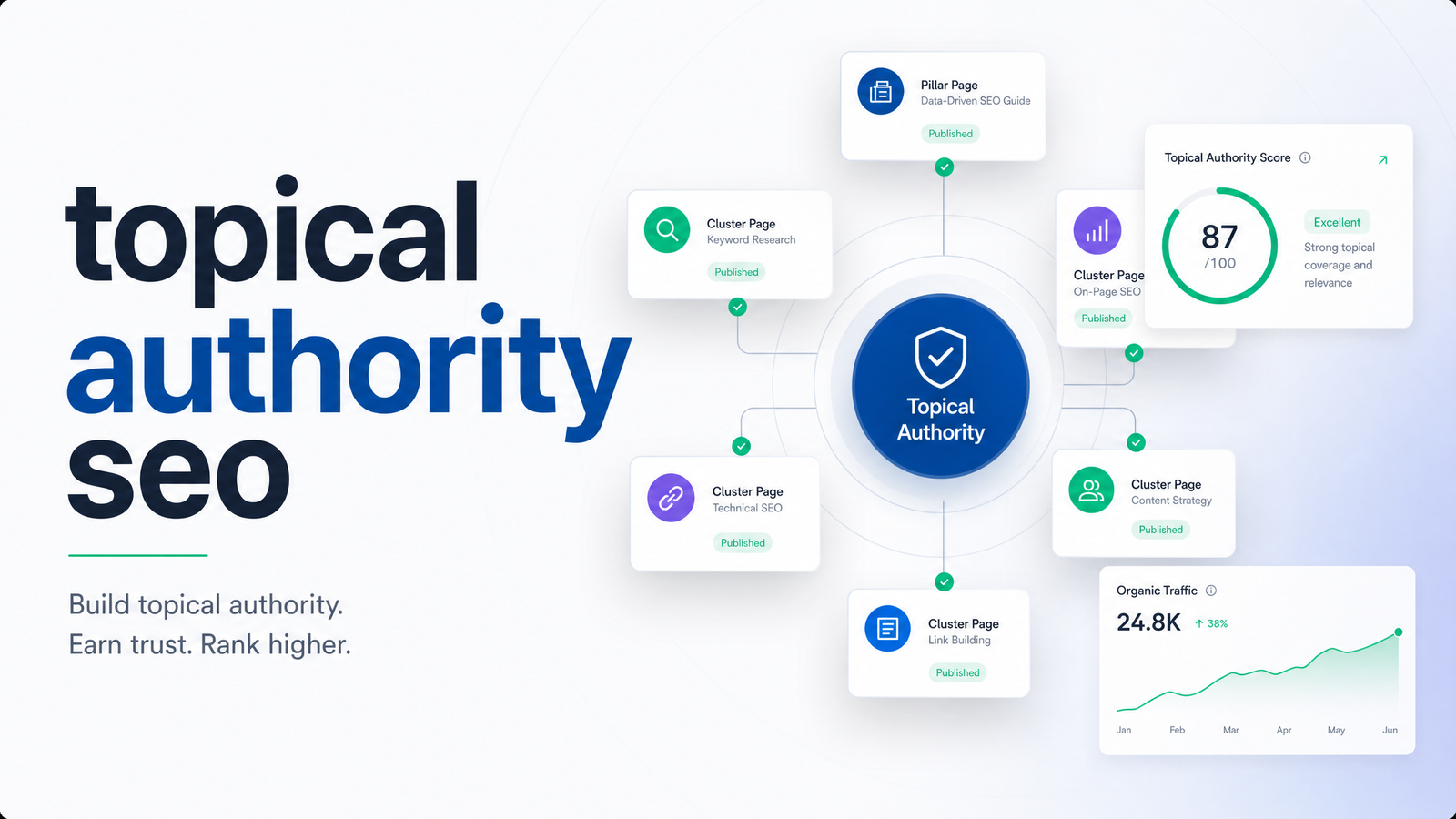
Most SEO advice about topical authority stops at the definition and never tells you what to build, in what order, or why your last twelve articles didn't move the needle. This is the version that does.
What Topical Authority Actually Means (Beyond the Buzzword)
Topical authority is Google's confidence that your site is the most complete, reliable source on a specific subject — not just the owner of one well-optimized page.
Keyword rankings measure whether one page satisfies one query. Topical authority measures whether your entire site demonstrates command of a subject across all its related questions, subtopics, and terminology. A single page can rank for a keyword through clever optimization. It cannot fake topical authority, because that signal is assessed across dozens or hundreds of interconnected pages, not one.
This is also where topical authority vs domain authority confusion usually comes from. Domain authority is a backlink-weighted popularity score — it tells you how much of the web points at your domain. Topical authority is subject-specific and content-driven: a site with a modest backlink profile but exhaustive, well-linked coverage of "commercial refrigeration maintenance" can outrank a higher-DA generalist site on refrigeration queries. Backlinks help, but they don't substitute for coverage depth.
Search has moved from matching keywords to understanding entities — people, places, concepts, and the relationships between them. Google isn't just checking if you used a phrase; it's checking if your content graph reflects genuine understanding of the topic's full scope. That shift is why publishing isolated posts, however well-written, increasingly underperforms against sites that built structured coverage.
How Google Actually Evaluates Topical Authority
Three mechanics drive how Google measures topical authority.
Entity and topic coverage. Google's systems map queries and content to entities in a knowledge graph rather than raw strings of text. A site that covers a topic's full entity set — related concepts, common objections, adjacent subtopics, terminology variants — signals expertise the way a subject-matter reference would. A site with three posts on the same head keyword, and nothing on the surrounding entities, signals shallowness, regardless of how well those three posts are written.
Internal link graph coherence. How your pages link to each other tells Google what you consider related and how confidently you can navigate a reader through a subject. A pillar page linking out to well-organized cluster content — and cluster pages linking back and sideways to each other — creates a legible structure search engines can crawl and trust. Disconnected posts with no links between them look, structurally, like a topic nobody has fully mapped. This is the mechanical core of content clusters, and it's worth reading the deeper breakdown in the internal linking evaluation framework if you want to see how link graphs are actually audited.
E-E-A-T signals. Experience, Expertise, Authoritativeness, and Trustworthiness aren't a checklist you satisfy once — they're patterns Google looks for across a body of work: consistent author or brand signals, accurate and specific information, evidence of firsthand knowledge, and content that doesn't contradict itself across pages. The Helpful Content updates pushed this from a ranking nuance to a core filter, rewarding sites built around genuine subject command and penalizing thin, keyword-driven pages produced to catch search traffic rather than answer it. Google's March 2026 Core Update reinforced E-E-A-T further, explicitly weighting comprehensive topic coverage and reliability signals over isolated on-page optimization, per Google's own Search Central guidance and independent analysis.
These three mechanics compound. Strong entity coverage without internal linking is invisible structure. Good linking without E-E-A-T is a well-organized site with no credibility signal. All three together are what "topical authority" operationally means.
The Build Framework: From Zero to a Recognized Topic Expert
You don't need hundreds of articles to start. You need a deliberate structure and the discipline to fill it in order.
1. Map the topic before you write anything. List the head topic, then every subtopic, question, and adjacent entity a genuine expert would be expected to address. This is the foundation of a topical map, and skipping it is the single most common reason DIY sites stall — they write whatever a keyword tool suggests next instead of what the topic actually requires. The AI content strategy framework covers how to turn this map into a prioritized content plan rather than a random list.
2. Structure it as pillar plus cluster. One comprehensive pillar page defines the topic broadly; cluster pages go deep on each subtopic. This is the content cluster framework in practice, and it's what gives Google a clean structural signal instead of a pile of loosely related posts.
3. Interlink deliberately, not reflexively. Every cluster page should link to the pillar, the pillar should link to every cluster page, and related cluster pages should link to each other where the reader's question naturally continues. This isn't decoration — it's the internal link graph Google reads as evidence of coherent expertise.
4. Find and close coverage gaps. Compare what you've published against what competitors ranking for the same topic already cover, and against the entity map you built in step one. Missing subtopics are missing authority, not just missing traffic. This is exactly the process detailed in the content gap analysis framework, and it's the step most DIY operators skip because it requires comparing dozens of competing pages manually.
5. Maintain and refresh. Topical authority decays if your cluster goes stale while the topic and competing content evolve. Revisit coverage quarterly, update facts, and add pages as new subtopics emerge. If your topic is broad enough to require scaling coverage across many similar page types — locations, product categories, use cases — a structured programmatic SEO approach can extend the cluster without manually producing every page from scratch.
None of these five steps individually requires hundreds of pages. A tightly scoped niche might be fully covered in twenty to forty well-mapped pages. Scope, not volume, is what determines the real number.
Why Most DIY Sites Never Get There (And How to Fix It)
The knowledge gap isn't usually the problem. Most people who've read this far already understood, roughly, that they needed a pillar page and some cluster content. The actual failure mode is operational: mapping a topic in a spreadsheet, drafting content in a doc editor, tracking gaps in another tab, checking technical issues in a fourth tool, and manually managing internal links in a fifth — and having that whole pipeline quietly break down after the third or fourth article because nobody has time to run five workflows in parallel every week.
Topical authority isn't built by isolated bursts of good content. It's built by consistent execution over months: publish, link, audit, refresh, repeat, without the process collapsing under its own coordination overhead. This is where seo workflow automation stops being a nice-to-have and becomes the actual determinant of whether a cluster ever gets finished.
Rankevra was built around exactly this gap. Instead of juggling a separate audit tool, AI writer, publishing workflow, and rank tracker, Rankevra runs the full loop as one AI SEO tool: it audits your site for technical issues, maps topical gaps against competitors, generates and structures cluster content with internal linking built in, publishes it, and tracks how rankings move afterward — all from a single workflow instead of five disconnected subscriptions. For a DIY operator without a content team, that consolidation is often the difference between a topical map that stays a plan and one that becomes a ranking cluster.
Frequently Asked Questions
Is topical authority a real Google ranking factor or just an SEO theory?
It's a real, measurable pattern in how Google's ranking systems evaluate sites, even though it isn't one single named signal in a ranking algorithm. Google assesses entity coverage, internal link structure, and E-E-A-T signals across a site's content, and the combined effect functions exactly like a ranking factor. The March 2026 Core Update further reinforced this by rewarding comprehensive coverage over single-page optimization.
How long does it take to build topical authority for a new site or subfolder?
Most sites see meaningful movement within three to six months of consistent publishing, assuming a mapped pillar-and-cluster structure and deliberate internal linking from the start. Timelines extend significantly if content is published without a topical map, since scattered posts don't compound into recognizable coverage. Competitive, high-value topics can take longer regardless of execution quality.
What's the difference between topical authority and domain authority?
Domain authority is a backlink-weighted popularity score describing the whole domain's link profile, while topical authority is a subject-specific measure of content coverage, structure, and E-E-A-T within one topic. A site can have low domain authority and still rank well within a narrow topic if its coverage and internal linking are strong. The two often correlate but aren't the same signal.
Do I need hundreds of articles to build topical authority, or can a smaller site compete?
No — the number of pages required depends on the topic's actual scope, not an arbitrary volume target. A narrow niche might be fully covered with twenty to forty well-structured, interlinked pages, while a broad topic naturally requires more. Comprehensive mapping and internal linking matter far more than raw article count.
Does topical authority still matter now that AI Overviews and chatbots answer search queries directly?
Yes, arguably more than before, because AI Overviews and chatbot answers are generated by pulling from sources that demonstrate clear, well-structured expertise on a subject. Sites with strong topical authority are more likely to be cited or summarized as the source behind an AI-generated answer. Thin, single-page content has a much harder time surfacing in these AI-driven results.
How do I know if my site already has topical authority in my niche?
Check whether your site ranks for a wide range of related queries across a topic, not just one or two head terms, and whether traffic holds steady across algorithm updates rather than spiking on individual posts. A strong internal link graph connecting pillar and cluster pages, alongside rankings on long-tail variants you never explicitly targeted, are both reliable indicators.
Building topical authority was never really a knowledge problem — it's a workflow-and-consistency problem. Most sites fail not because their owners misunderstand the concept, but because auditing, writing, linking, and tracking a full topic cluster manually, month after month, is more operational overhead than a solo operator or small team can sustain. Rankevra exists to close that gap, running the entire audit-to-publish-to-tracking loop as one connected system so the topical map you build actually becomes the ranking cluster you intended.
Keep reading
- Content Decay SEO: How to Detect It and Fix It for GoodLearn to detect content decay SEO issues early, rule out false positives, and build a refresh pipeline that scales — plus how to automate the whole loop.
- Headless CMS SEO: Fixing the Gaps Generic Tools MissHeadless CMS SEO breaks in three predictable places: rendering, metadata, and sitemaps. Here's the diagnostic framework to find and fix each gap.
- Google Algorithm Update Recovery: A Diagnostic FrameworkA step-by-step google algorithm update recovery framework: confirm the cause, segment the damage, benchmark against winners, and set a real timeline.