Rankevra Blog
Zero-Click Search: How to Measure SEO That Actually Works
August 29, 2026
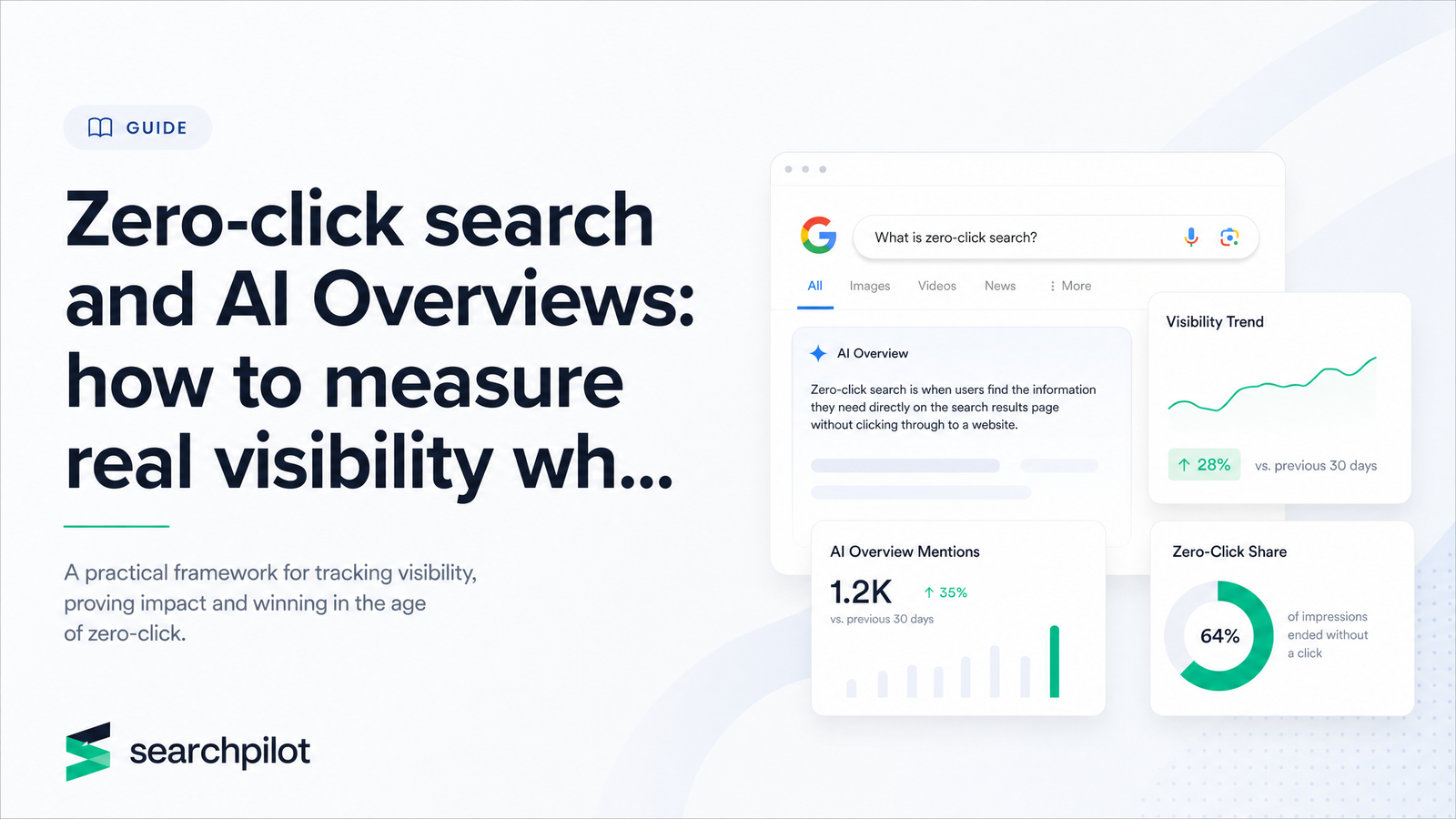
Your rankings look fine. Impressions might even be climbing. And yet organic traffic keeps sliding — and nobody can explain why. This isn't a fluke or a tracking bug in most cases. It's zero-click search reshaping what a "good" ranking even means, and it demands a different measurement framework, not panic and not denial.
What "Zero-Click Search" Actually Means Now
A zero-click search is any query where the searcher gets what they need without clicking through to a website — because Google answers it directly on the results page via a featured snippet, a knowledge panel, or now, increasingly, an AI Overview. Zero-click behavior isn't new; it's been rising for years. What's new is the acceleration curve. According to zero-click search statistics compiled for 2026, the zero-click rate has climbed from roughly 50% of searches in 2019 to nearly 65% today.
It's worth separating the general zero-click trend from AI Overviews specifically. Featured snippets and knowledge panels have quietly absorbed clicks for a decade. AI Overviews are a newer, more aggressive layer — generative summaries that synthesize multiple sources into a single answer block above traditional results, often pushing organic listings further down the page. They don't just compete for the click; they frequently remove the need for one entirely on informational queries. That matters because it changes what you can fix: a badly optimized snippet is a content problem, but an AI Overview absorbing your query is a structural shift in how that SERP behaves, regardless of how well you rank underneath it.
Why Rankings and Impressions Stopped Predicting Traffic
For most of SEO's history, the logic was simple: rank higher, get more impressions, get more clicks. That chain is broken in its final link. AI Overviews can satisfy user intent directly on the SERP, which means a page can hold position one, generate more impressions than ever, and still see clicks decline — because the user never needed to scroll past the summary.
This is showing up clearly in click-through rate data. Aggregated findings from Pew Research Center and Seer Interactive, summarized in CTR statistics on AI Overviews, show meaningfully lower organic CTR on queries where an AI Overview appears compared to standard SERPs. The gap is largest on informational queries — exactly the content type most teams have invested in for years to build authority and top-of-funnel traffic.
The practical consequence: rankings vs. clicks is now a real, trackable divergence, not a rounding error. A rank tracker showing stable or improved positions is no longer sufficient evidence that a page is performing. Impressions rising while organic CTR falls is often a sign your content is feeding an AI Overview's synthesis rather than earning a visit. If you're only watching position and impression counts, you're watching the wrong half of the funnel.
What Google Search Console's New AI Report Can (and Can't) Tell You
Google addressed part of this measurement gap in June 2026 by rolling out a dedicated Generative AI performance report inside Search Console, isolating impressions that come specifically from AI Overviews and AI Mode. Coverage from CMSWire on the launch confirms this is the first time Google has broken out AI-driven visibility as its own reporting surface, rather than folding it silently into standard organic metrics.
What it shows: impression volume for pages that appeared as a cited source within AI Overviews, segmentable by page, country, and device — useful for spotting which parts of your site are being pulled into generative answers at scale.
What it doesn't show yet: clicks or queries tied to that AI Overview appearance. As explained in Search Engine Journal's breakdown of the report, this is impressions-only data, and Google has acknowledged some aggregation quirks in how AI-sourced impressions get counted versus traditional organic impressions. In practice, you can confirm you're being surfaced inside an AI Overview, but you can't yet tell whether that surfacing led to a visit, or match it to the specific query that triggered it. Treat it as a visibility signal, not a performance metric — and pair it with the query-level view in the standard Performance report, a habit covered in practical GSC usage tips.
This is also where a lot of the GSC-vs-GA4 confusion originates. Search Console counts an impression the moment your URL appears anywhere on the SERP, including inside an AI Overview citation; GA4 only logs a session if someone actually clicks through. When those two numbers diverge sharply, it's rarely a tracking error — it's zero-click behavior showing up as a gap between "seen" and "visited." A closer comparison of why GSC and GA4 numbers disagree is worth reading if this discrepancy keeps coming up in stakeholder meetings.
The Visibility Scorecard: Metrics That Still Mean Something
If clicks alone can't validate SEO performance anymore, you need a small set of metrics that together separate "we're seen" from "we're chosen." No single number does this alone — the value is in tracking them as a set.
- Branded search volume and direct traffic. If AI Overviews are exposing your brand to more people even without a click, branded query volume and direct visits should trend up over time — a lagging but reliable signal that visibility is converting into recognition.
- AI Overview impressions trend (not absolute count). Use the new GSC report directionally — is your presence in AI Overviews growing or shrinking month over month for priority topics — rather than treating any single figure as gospel given its aggregation limits.
- Citation presence across AI surfaces. Whether and how often your domain gets cited by name in AI Overviews and AI Mode answers, tracked manually or through a monitoring tool, tells you if you're a trusted source or just indexed content.
- Rankings on conversion-intent queries. Transactional and commercial-investigation queries are far less likely to be fully answered by an AI Overview, so position here still correlates strongly with real traffic and revenue.
- Assisted conversions from organic-influenced paths. Multi-touch attribution that credits organic content earlier in the journey, even without the final click, captures value that last-click reporting misses entirely.
To measure SEO visibility properly now means resisting the urge to reduce it to one dashboard number. This is precisely the kind of framework worth formalizing into a recurring SEO reporting dashboard rather than reconstructing it from memory every reporting cycle.
What to Change in Your SEO Strategy
The measurement shift should change budget allocation, not just reporting. If informational query CTR is structurally lower now, pouring more resources into broad, top-of-funnel content that only feeds an AI Overview's synthesis has diminishing returns compared to a few years ago. That doesn't mean abandoning informational content — it means being deliberate about which topics still earn a click and which have effectively become AI training material for competitors' visibility too.
Reweight investment toward formats that are genuinely citation-worthy: original data, calculators and interactive tools, clearly structured comparisons, and content that answers a question so specifically and credibly that an AI Overview has to name you as the source rather than paraphrase you into anonymity. Structure matters as much as substance here — clear headings, direct answers near the top, and well-labeled data tables all improve citation odds.
Topical authority becomes an AI-citation lever, not just a ranking lever. Google's generative systems, like traditional search, favor sources that demonstrate consistent depth across a subject rather than one-off posts. A genuinely comprehensive topic cluster increases the odds that when an AI Overview needs a source for any subtopic within it, your domain is the recognizable, citable option — which indirectly protects the branded search and direct traffic gains described above, even as click-through on any single article declines.
Bringing It Together Without Juggling Five Tools
None of this works if the metrics live in five different places — a rank tracker for positions, GSC for impressions and the new AI report, GA4 for sessions and conversions, a spreadsheet for citation tracking, and a technical audit tool for crawl health. By the time you've manually reconciled all five, the report is stale and the discrepancies have already caused a confusing conversation with stakeholders instead of a clear one.
A unified SEO tool that pulls rank tracking, AI visibility impressions, and technical health into one recurring view solves the reconciliation problem at the source rather than after the fact. That's the design principle behind Rankevra — the end-to-end AI SEO workflow, on autopilot: audits, AI-assisted content creation, publishing, and rank tracking in one system, so the visibility scorecard above is something you check, not something you rebuild every week. If you're currently comparing rank trackers as a first step toward consolidating, this guide to choosing a rank tracker that goes beyond position-only tracking is a useful companion read.
The Manual Way vs. One View
The manual alternative is checking GSC's Generative AI report, your rank tracker, and a separate reporting tool every week, then manually cross-referencing discrepancies before you can even start the actual analysis. That's hours spent reconciling data instead of acting on it. A single dashboard that combines rank positions, AI visibility impressions, and technical SEO health removes that overhead and lets you spot real problems — a technical issue suppressing crawlability, a topic losing AI citation share — the moment they appear, not at the end of the month.
If you're tired of stitching together five tools to answer one question — are we actually being chosen, not just seen — Rankevra is built to give you that answer in one place.
Frequently Asked Questions
Does SEO still matter if searches don't result in clicks?
Yes — visibility inside AI Overviews and featured snippets still builds brand recognition, drives branded search volume, and influences purchase decisions even without a click. SEO's job has expanded from "earn the click" to "earn the citation and the click," which means the discipline is more relevant, not less, even as click-based ROI needs a broader measurement framework.
How do I know if AI Overviews are affecting my site's traffic?
Compare your Search Console impressions and rankings against your GA4 organic sessions over the same period. If impressions are stable or rising on informational queries while clicks and sessions decline, and the queries in question are ones known to trigger AI Overviews, that divergence is a strong indicator of zero-click impact rather than a ranking or tracking problem.
What is the new Google Search Console report for AI Overviews and what does it show?
Launched in June 2026, Google Search Console's Generative AI performance report shows impression volume for pages cited within AI Overviews and AI Mode, broken down by page, country, and device. It currently does not show clicks or the specific queries tied to those impressions, so it should be read as a visibility signal rather than a full performance metric.
Should I stop targeting informational keywords because of zero-click search?
No, but you should be more selective and prioritize informational content that's genuinely citation-worthy — original data, tools, and clearly structured answers — over generic explainer content. Informational content still builds topical authority, which increases your odds of being the source an AI Overview cites, even when the click-through rate on any single page is lower.
What's the difference between an impression and a click-through in the AI Overview era?
An impression means your page or brand appeared somewhere on the SERP, including as a citation inside an AI Overview, while a click-through means the user actually visited your site. Because AI Overviews often fully answer a query on the page itself, the gap between these two numbers has widened significantly, which is why impression growth no longer reliably predicts traffic growth.
How can I tell if I'm getting cited in AI Overviews without Search Console data?
Manually query your target topics and check whether your domain appears as a named source or linked citation within the AI Overview response, tracking this over time for your priority keywords. Third-party rank tracking and AI-visibility tools, including consolidated platforms like Rankevra, can automate this monitoring across a larger keyword set than manual spot-checks allow.
Keep reading
- Content Decay SEO: How to Detect It and Fix It for GoodLearn to detect content decay SEO issues early, rule out false positives, and build a refresh pipeline that scales — plus how to automate the whole loop.
- Headless CMS SEO: Fixing the Gaps Generic Tools MissHeadless CMS SEO breaks in three predictable places: rendering, metadata, and sitemaps. Here's the diagnostic framework to find and fix each gap.
- Google Algorithm Update Recovery: A Diagnostic FrameworkA step-by-step google algorithm update recovery framework: confirm the cause, segment the damage, benchmark against winners, and set a real timeline.