Rankevra Blog
Content Gap Analysis SEO: Find, Prioritize, Close Gaps
August 23, 2026
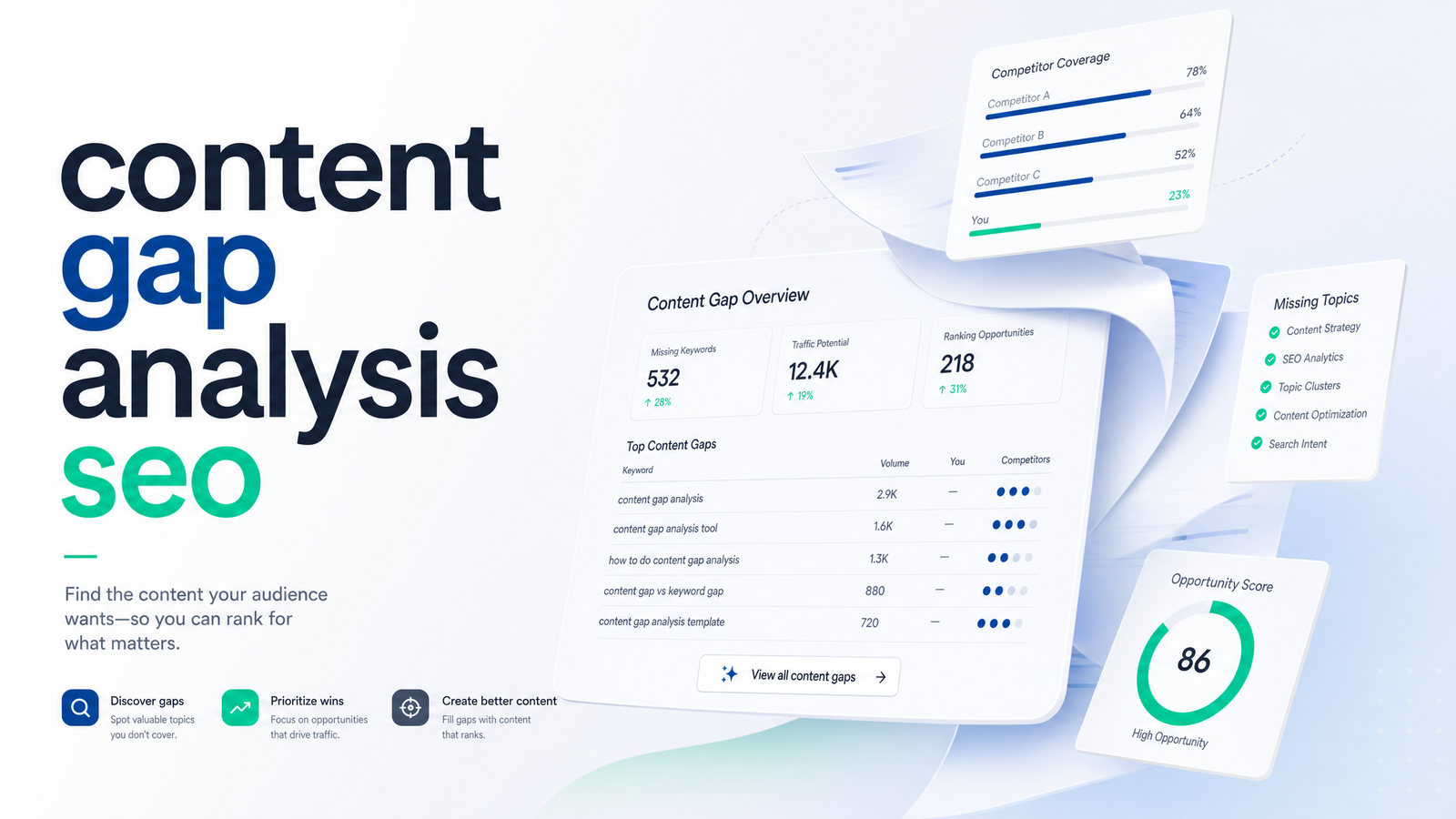
Most content gap analysis SEO work dies in a spreadsheet. Someone runs a competitor keyword gap report, exports 400 rows, color-codes a few columns, and then nothing happens — because finding gaps was never the hard part. Deciding which ones deserve a page, and actually getting that page published, is where the process stalls.
This article skips the theory pass. For the full definitional treatment — what a content gap is, why it matters, and how it maps to search intent — read SEO Content Gap Analysis: A Complete Framework. Here, we're focused on the harder 80%: prioritizing gaps correctly and closing them before the list goes stale.
What Counts as a Content Gap in 2026 (Quick Definition)
A content gap is any topic, subtopic, or question your audience cares about that your site doesn't cover as well as it should — whether that's a missing page, a thin one, or one that ranks fine in Google but never shows up when someone asks ChatGPT or Perplexity the same question. A content gap definition that only counts missing keywords is already out of date.
Content gap analysis for SEO used to be a Google-only exercise — check Search Console, check the SERP, check what competitors rank for that you don't. That's still valid, but it's no longer complete. AI Overviews and chatbot answers now pull from a narrower set of sources than a full page of ten blue links, so a page can technically rank on page one and still be invisible in an AI-generated answer. For the deep dive on definitions and edge cases, the Complete Framework piece covers it in full; this article moves straight into finding, prioritizing, and closing.
The Three Kinds of Gaps Worth Hunting For
Not all gaps are the same shape, and treating them identically is why prioritization breaks down later. There are three worth distinguishing.
Keyword gaps are the classic case: a term or phrase competitors rank for and you don't. This is what most "keyword gap analysis" tools produce, and it's useful for spotting missed queries fast. But it's a subset of a full content gap analysis, not a replacement — a missing keyword doesn't tell you whether the underlying topic matters to your business, or whether one new paragraph on an existing page would close it just as well as a new post.
Topic and depth gaps are broader: your competitor has a comprehensive resource covering six subtopics, and you have a thin post covering two. No single keyword is "missing" here — your page might even rank for the head term — but it lacks the depth that signals topical authority to search engines and readers. This is the category where clustering matters most, since depth gaps usually span a group of related queries rather than one.
AI-visibility gaps are the newest category and the one most audits still skip. A page can rank respectably in traditional search and still never get cited or paraphrased in an AI Overview, a ChatGPT answer, or a Perplexity summary. That's a real content gap even without a ranking problem, since a growing share of research and comparison queries now get answered inside the AI layer before a user ever clicks through. For a sharper read on how AI-driven keyword and topic research fits in, AI Tool for SEO Keyword Research: What Actually Works covers the identification side without duplicating it here.
A Fast, Repeatable Workflow for Finding Gaps
Here's how to do a content gap analysis without turning it into a week-long project. Five steps, run in order:
- Audit what you already have. Pull your indexed pages and Search Console performance data. Flag anything with impressions but low click-through, and anything ranking positions 8–20 — those are half-gaps, not blank pages, and often the cheapest to close.
- Pull competitor coverage. Identify three to five competitors who consistently outrank you on topics you care about, and list what they cover that you don't. This is the keyword-gap layer, and it's fastest with a dedicated tool rather than manual SERP scraping.
- Cluster by topic, not by keyword. Group the raw list into subtopics a single page (or tightly linked cluster) could own. This step turns a keyword list into a real content gap analysis — it's also where topical authority gets built or missed. Koray Topical Authority: The Formula, Decoded and Applied explains why clustering this way compounds over time instead of just filling individual keyword slots.
- Check AI Overview and LLM coverage. For your priority clusters, run the target queries through Google (checking for an AI Overview) and through ChatGPT, Claude, or Perplexity. Note whether your brand or a competitor gets cited. This is the step most audits skip, and it separates a 2026 content gap analysis from a 2019 one.
- Score by opportunity. Don't leave the list flat — that's the mistake that kills momentum, and it's the whole subject of the next section.
Each step can go deeper — the Complete Framework pillar walks through the audit and competitor-pull steps in more detail if you need it.
Prioritizing Gaps So You Don't Drown in the Spreadsheet
Content gap analysis prioritization is the step that turns a 400-row export into a workable plan, and it doesn't need to be complicated. A simple three-factor score works:
Traffic potential — estimated search volume plus, where available, how much traffic the top-ranking pages actually pull. A high-volume keyword with a dominant, unbeatable incumbent may be worth less than a modest-volume cluster with weak competition.
Business relevance — does this topic map to something you sell, support, or want to be known for? A gap that drives traffic but attracts the wrong audience isn't worth the same investment as one that feeds your funnel.
Effort — can this be closed by updating an existing page, or does it need a new one built from scratch? Effort should also account for whether the gap is a one-off or part of a larger pattern — if you're finding dozens of near-identical gaps (city pages, product variants, comparison pages), that's a signal for a programmatic approach rather than one-off drafting.
Multiply, don't just tally, these three factors — a gap that's high in traffic potential and relevance but also low effort should always jump the queue over a high-potential gap that needs a ground-up build. This is how you decide which content gaps to fix first without relying on gut feel or whoever shouts loudest in the planning meeting.
Closing the Gap: Getting From Spreadsheet Row to Published Page
Here's the actual reason most content gap analyses never turn into published content: the handoff between analysis and execution has too many seams. The gap gets found in a keyword tool, prioritized in a spreadsheet, drafted in a doc, edited in Slack threads, pasted into a CMS, and eventually — if someone remembers — tracked in a rank tracker. Every handoff is a place the project can die, and most do, quietly, without anyone deciding to kill it.
Turning content gaps into content reliably means shortening that chain, not managing it better. An automated content gap analysis workflow that stays inside one system — audit, competitor pull, clustering, AI-visibility check, drafting, and publishing — removes the handoff points where projects stall, because there's no export-and-reimport step for the plan to get lost in. This is also where a documented publishing process matters: Building a Content Publishing Workflow That Scales Safely covers the guardrails needed once you're shipping gap-driven content at volume instead of one post at a time.
This is exactly the collapse Rankevra is built around. Instead of an audit tool feeding a keyword tool feeding a doc feeding a CMS feeding a rank tracker, Rankevra runs the audit, surfaces the gap, drafts the page, publishes it, and tracks the resulting rankings — one workflow, one place to check status. If your gap analysis keeps producing spreadsheets nobody acts on, the fix usually isn't a better spreadsheet template; it's removing the steps between "we found this gap" and "it's live." Rankevra is built to close exactly that space.
Mistakes That Waste a Content Gap Analysis
A few recurring failure points show up across most audits that never pay off:
- Treating it as a one-off project. A gap analysis run once and filed away goes stale within a quarter as competitors publish and SERPs shift. Without a re-check cadence, you're planning against outdated information by the time anyone acts on it.
- Copying competitor structure instead of matching intent. Mirroring a competitor's headings doesn't close a gap if their structure was answering a slightly different question than your audience is actually asking.
- Ignoring pruning and updates in favor of new pages. Content pruning — trimming or merging weak, overlapping pages — often closes a depth gap faster than a new post, and it improves how search engines interpret the rest of your site.
- Skipping AI-visibility checks entirely. Optimizing purely for traditional rankings while AI Overviews and chatbot answers quietly capture the query misses a growing chunk of the real opportunity.
- No prioritization pass. A flat list treated as equally urgent guarantees the highest-effort, lowest-value rows get worked on first, simply because they're at the top of the export.
Frequently Asked Questions
What's the difference between a content gap analysis and a keyword gap analysis?
A keyword gap analysis compares which keywords competitors rank for that you don't — a narrower, mechanical comparison. A content gap analysis is broader: it includes keyword gaps but also topic depth, search intent mismatches, and now AI-visibility gaps, making the keyword version one input rather than the whole picture.
How often should you run a content gap analysis?
Run a full analysis quarterly, with a lighter competitor and AI-visibility check monthly for your priority topics. SERPs and AI answer sources shift fast enough that a one-time audit is stale within a few months, so treat it as an ongoing cadence rather than a single project.
Can a content gap analysis help with AI Overviews and chatbot visibility, not just Google rankings?
Yes — checking whether your priority queries trigger an AI Overview, and whether ChatGPT, Claude, or Perplexity cite your site or a competitor's, is now a standard part of a thorough content gap analysis. A page can rank well in traditional search and still be completely absent from AI-generated answers, which counts as a real gap.
Do I need separate tools for competitor research, writing, and publishing to close content gaps?
No — that's the exact chain that causes most gap analyses to stall before anything gets published. Consolidating audit, drafting, and publishing into one workflow, as Rankevra does, removes the handoff points where projects quietly die between "found" and "live."
Should I create a new page for every gap I find, or update existing content instead?
Update existing content when a page is already close — ranking in positions 8-20, or covering the topic but missing depth — since that's usually lower effort than building new. Reserve new pages for genuine coverage gaps where nothing on your site addresses the topic or intent at all.
Keep reading
- Content Decay SEO: How to Detect It and Fix It for GoodLearn to detect content decay SEO issues early, rule out false positives, and build a refresh pipeline that scales — plus how to automate the whole loop.
- Headless CMS SEO: Fixing the Gaps Generic Tools MissHeadless CMS SEO breaks in three predictable places: rendering, metadata, and sitemaps. Here's the diagnostic framework to find and fix each gap.
- Google Algorithm Update Recovery: A Diagnostic FrameworkA step-by-step google algorithm update recovery framework: confirm the cause, segment the damage, benchmark against winners, and set a real timeline.