Rankevra Blog
Content Marketing in 2026: The System That Actually Works
August 25, 2026
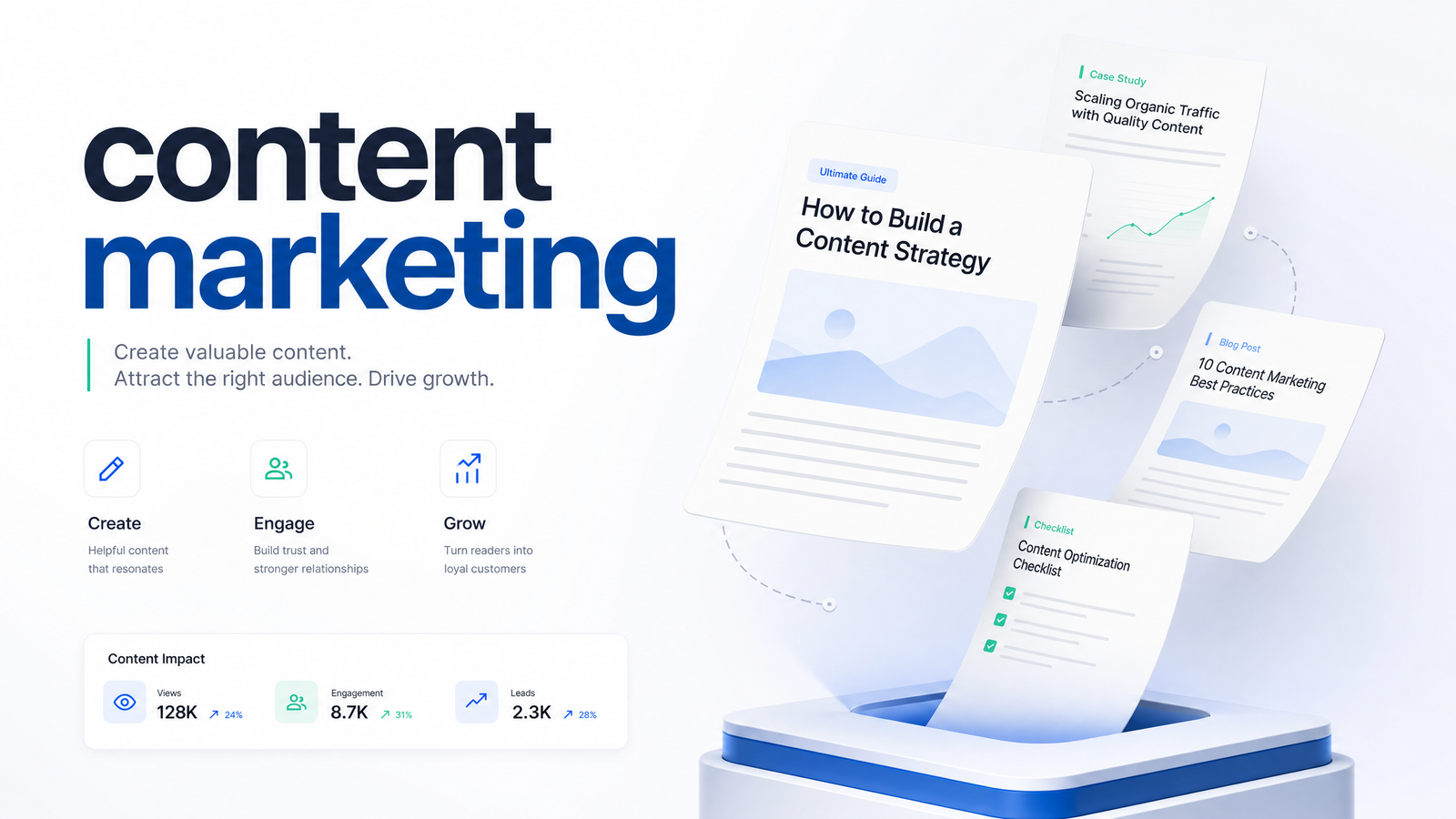
Most content marketing advice tells you to "create more valuable content." That's not wrong — it's just useless. Teams publishing three posts a week already know they need valuable content. What they lack is a system connecting strategy, production, publishing, and measurement into something repeatable. That gap, not a shortage of ideas, is why most content marketing programs plateau.
This piece skips the dictionary-definition fluff and the 40-tactic listicle. Instead, it defines what content marketing actually requires in 2026, why most programs stall before they compound, and what a lean operating model looks like when strategy and execution finally live in the same workflow.
What Content Marketing Actually Means in 2026
So, what is content marketing, stripped of buzzwords? It's the deliberate practice of attracting and retaining a defined audience by publishing material relevant enough that they choose to find you, trust you, and eventually convert — tied explicitly to business outcomes like organic traffic, pipeline, and topical authority.
That definition excludes a lot of what passes for the discipline today. Blogging is a tactic, not a strategy — a company blog with no distribution plan or intent mapping is just an archive. SEO writing, likewise, is a subset: producing pages optimized for search engines without a broader narrative or audience relationship is optimization, not marketing.
Real content marketing behaves like a system. Every asset has a job: fill a gap in the buyer's journey, answer a specific search intent, or reinforce expertise in a subject cluster. Assets connect through internal linking and topic architecture. And crucially, the system produces measurable output — rankings, traffic, assisted conversions — that feeds back into what gets made next. Without that feedback loop, you're not doing content marketing; you're publishing.
Why Most Content Marketing Programs Stall Out
Here's the uncomfortable part: teams are publishing more than ever, often with AI assistance, and still not seeing proportional traffic or leads. According to recent content marketing ROI statistics, only about 36% of marketers can accurately measure the ROI of their content programs. Nearly two-thirds of teams are producing content on faith, unable to tell leadership — or themselves — what's actually working.
The problem compounds with AI adoption. Research cited in content marketing statistics for 2026 shows 67% of marketers now use AI tools daily, yet only 19% track AI-specific KPIs. Teams have accelerated the "make more content" part of the equation without building any corresponding measurement layer. Speed went up; accountability didn't follow.
The other recurring failure is strategic: content gets published without any gap analysis showing whether it should exist at all. Teams write about what's easy or trendy rather than what's missing from their topical footprint relative to competitors and search demand. If you've never systematically mapped what you're missing, a deeper look at content gap analysis is the fastest way to stop guessing.
Add disconnected tooling — keyword research in one tab, drafts in a doc, publishing in a CMS, tracking in a fourth tool nobody checks weekly — and you get content marketing challenges that look like a production problem but are actually a systems problem.
Content Marketing vs. SEO: How They Actually Fit Together
Confusing content marketing and SEO is one of the more expensive mistakes teams make. They're not competitors, and they're not the same thing — they're layers of the same operation.
Content marketing is the substance: the ideas, arguments, data, and framing that make a piece worth someone's time. SEO is the distribution and discoverability layer that determines whether that substance ever reaches its audience — technical crawlability, structured data, internal linking, and search intent alignment. You can have brilliant content no one finds because the technical foundation is broken, and flawless technical SEO wrapped around thin, forgettable content that ranks briefly and converts nobody.
Where these layers meet is topical authority — the compounding effect of consistently publishing substantive, well-structured content across a connected subject area until search engines and readers treat you as a default reference point. That's a strategic outcome, not a single-post achievement, and it increasingly determines visibility in AI-generated answers as well as traditional rankings. See Topical Authority 2.0 for a deeper treatment of how this shows up in AI-driven search.
A Lean Content Marketing Operating Model (5 Steps)
Forget sprawling frameworks with twelve stages. A workable content marketing workflow for a small team fits into five repeatable steps.
1. Find real content gaps. Start from evidence, not brainstorming. Compare your existing coverage against competitors and actual search demand to find where you're structurally missing content your audience is searching for. This is the highest-leverage step in the process — a structured content gap analysis surfaces priorities that guesswork never will.
2. Brief with intent and entities, not just keywords. A good SEO content brief specifies the search intent behind a query, the entities and subtopics a comprehensive answer needs to cover, and the competitive pages you need to outperform — not just a keyword and a word count. Solid keyword research underpins this; see what actually works in AI-assisted keyword research for the mechanics.
3. Produce at quality and speed. This is where most teams either move too slowly to stay competitive or move fast at the cost of accuracy and voice. The brief from step two should do most of the heavy lifting here, so drafting becomes execution against a clear spec rather than a blank page.
4. Publish and interlink safely. Publishing isn't just hitting "go live." It means slotting content into your existing architecture with deliberate internal links, correct metadata, and a rollout pace that doesn't trip technical red flags. Building a content publishing workflow that scales safely covers how to do this without creating a technical SEO mess six months later.
5. Track and feed data back into step one. Monitor ranking movement and traffic on the terms you targeted, and use what's working — and what isn't — to inform the next gap analysis. A dedicated rank tracker closes this loop; without it, step one starts back at zero every quarter.
This is the content marketing process, in full, without padding. Every step exists to feed the next — that's what makes it a system instead of a task list.
Where AI Fits — and Where It Doesn't
AI content marketing skepticism is fair, but it's usually aimed at the wrong target. The question isn't whether AI can write; it's where in the workflow AI should be doing the work versus where a human needs to stay in control.
AI is genuinely strong at compressing the mechanical steps: synthesizing keyword and competitor data during research, drafting against a well-built brief, formatting and publishing at scale, and pulling ranking and traffic data into a single view instead of five spreadsheets. These are the steps where speed matters more than judgment, and where human time is currently wasted on repetitive work.
What AI shouldn't own is strategy and judgment: deciding which gaps actually matter to your business, whether a claim is accurate and defensible, and whether a piece reflects genuine expertise rather than plausible-sounding generalities. This is where E-E-A-T becomes practical rather than theoretical — search engines and readers alike are increasingly filtering for demonstrated experience and firsthand authority, something AI can't manufacture on its own. The Content Marketing Institute's 2026 trends analysis reflects this same shift: AI is reshaping content roles toward strategy, editing, and judgment, not replacing them.
The teams getting this right treat AI as the engine for the mechanical stages of the content marketing workflow and reserve human attention for the decisions AI can't responsibly make. That division, not full automation or full manual effort, is what separates AI content marketing that compounds from AI content marketing that just adds volume.
How to Measure Whether Content Marketing Is Working
You don't need a full analytics stack to know if content marketing is working — you need to track the right handful of numbers, consistently.
- Organic traffic growth on target pages, not just site-wide traffic, which can mask individual content underperformance.
- Ranking movement on the specific terms each piece was briefed for — this is the earliest, most direct signal that a page is doing its job.
- Assisted conversions, meaning where content contributed to a lead or sale even if it wasn't the last touch — this is usually where the real ROI hides.
- Contribution to topical authority, measured loosely by how much of a subject cluster you now credibly cover compared to six months ago.
These four metrics answer the ROI question far better than pageviews or social shares. Given that only 36% of marketers currently measure content ROI accurately, tracking these consistently puts you ahead of most programs by default.
Bringing It Together: One Workflow Instead of Five Tools
Everything above — the gap analysis, the intent-driven brief, fast production, safe publishing, and consistent tracking — only compounds into topical authority and real organic traffic if it runs as one connected loop. Run each step in a separate tool with no shared data, and you're back to the disconnected-systems problem that stalls most content marketing programs in the first place.
That's the practical case for an AI SEO workflow that handles audit, content creation, publishing, and rank tracking in a single system rather than five. Rankevra is built specifically to close that gap: it audits your site's technical health, builds briefs from real gap analysis, produces and publishes content, and tracks rankings — feeding each stage's data into the next automatically.
The strategy in this article isn't complicated. What kills most programs is the friction between knowing what to do and having a system that actually does it. See how Rankevra removes that friction.
Frequently Asked Questions
What is content marketing, in simple terms?
Content marketing is the practice of attracting and keeping an audience by consistently publishing material relevant to their needs, tied to measurable business goals like traffic, leads, and authority. It's a system with a feedback loop, not a single blog post or campaign — every asset should tie back to a specific gap or intent.
Is content marketing still worth it in 2026 with AI Overviews and AI search?
Yes, but the bar has moved: content needs to demonstrate genuine expertise and topical depth to earn visibility in AI-generated answers, not just rank on a results page. Programs built around topical authority and accurate, specific information are the ones showing up in both traditional rankings and AI Overviews.
How is content marketing different from SEO?
Content marketing is the substance — the ideas and value delivered to an audience — while SEO is the distribution layer that makes that substance discoverable through search. They work together: strong content with poor technical SEO won't be found, and strong SEO around thin content won't hold rankings.
How much content should a small team publish to see real traffic results?
Consistency and strategic targeting matter more than volume — a handful of well-briefed pieces targeting real content gaps each month typically outperforms a high-volume, unstructured publishing schedule. Prioritize coverage of a defined topic cluster over scattered posts across unrelated subjects.
How do you measure whether content marketing is actually working?
Track organic traffic growth on target pages, ranking movement on the specific terms you briefed for, assisted conversions, and your growing coverage within a topic cluster. These four metrics matter far more than pageviews or social shares, and only about 36% of marketers currently track them accurately.
Can AI tools handle content marketing end-to-end, or do you still need a human strategist?
AI handles the mechanical stages well — research synthesis, drafting against a brief, publishing, and pulling performance data together — but strategic decisions still need a human. Deciding which gaps matter to your business and verifying accuracy and genuine expertise are judgment calls AI can't reliably make on its own.
Keep reading
- Content Decay SEO: How to Detect It and Fix It for GoodLearn to detect content decay SEO issues early, rule out false positives, and build a refresh pipeline that scales — plus how to automate the whole loop.
- Headless CMS SEO: Fixing the Gaps Generic Tools MissHeadless CMS SEO breaks in three predictable places: rendering, metadata, and sitemaps. Here's the diagnostic framework to find and fix each gap.
- Google Algorithm Update Recovery: A Diagnostic FrameworkA step-by-step google algorithm update recovery framework: confirm the cause, segment the damage, benchmark against winners, and set a real timeline.