Rankevra Blog
Matt Diggity's Topical Authority Framework, Explained
August 13, 2026
Who Is Matt Diggity, and Why Do People Search His Name Next to "Topical Authority"?
Matt Diggity's name is attached to topical authority the way Brian Dean's is attached to link building. He built his reputation running Diggity Marketing, an agency and affiliate portfolio, then scaled it into The Search Initiative and later The Affiliate Lab, a training program that codified how his team ranks affiliate and lead-gen sites. His credibility comes from running dozens of sites through the same process and publishing the results.
That's why "matt diggity topical authority" is searched as a specific phrase rather than a generic term. Diggity didn't just popularize the idea that Google rewards sites covering a subject deeply; he packaged it into a repeatable production system with defined inputs, sizing rules, and terminology his community now uses as shorthand. Understanding his version matters if you're deciding whether to pay for his topical map service, replicate it in-house, or find a faster path to the same outcome.
The Topical Map: Diggity's Method for Full Topic Coverage
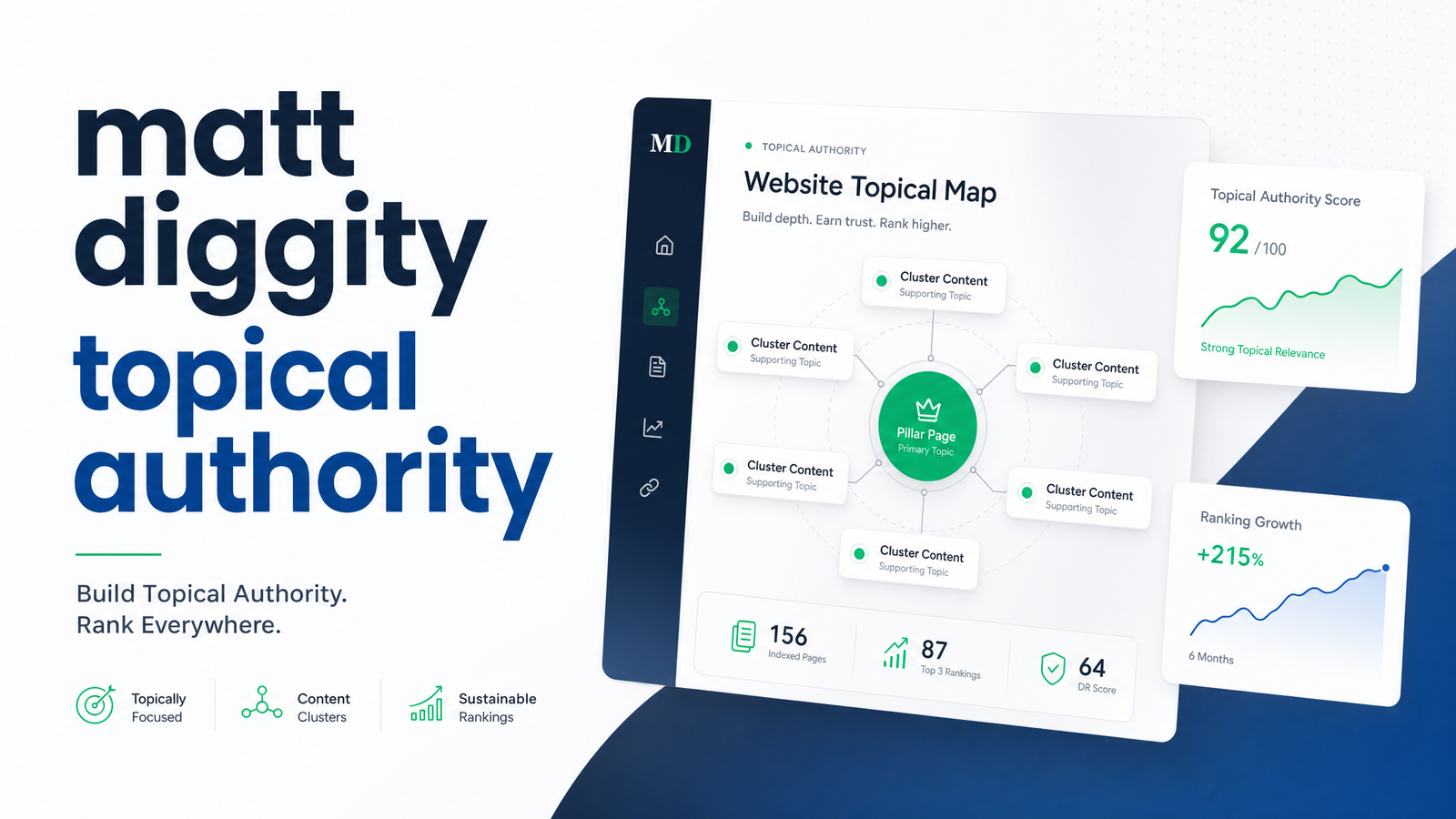
At the center of his approach is the topical map — a document listing every page a site needs to fully cover a subject, built from a single seed keyword. The logic: one article, no matter how well optimized, rarely outranks competitors alone. Google rewards sites that demonstrate breadth as well as depth, so a page needs dozens of supporting pages before it can compete for a competitive term.
Diggity's map-building process sources topics from People Also Ask boxes, related searches, competitor content gaps, and NLP-based keyword tools that surface entities and subtopics search engines associate with the seed term. According to the LeadSpring topical map service, which documents his actual production model, map size scales with niche competitiveness — roughly 100–300 pages for smaller or local niches, 300–500 for moderately competitive ones, and 500+ for broad, high-competition spaces. This isn't a content calendar with a dozen blog ideas; it's an information-architecture blueprint for an entire domain. Readers weighing whether to build one manually often start with a general framework first — our own 5-step process for creating topical authority covers the foundational version before you get into Diggity-specific terminology.
Silos, "Power Hubs," and the "Diggity" Cluster
Once the map exists, it needs structure — and this is where Diggity's terminology gets specific. A silo, in his framework, is a group of pages organized by topical relevance and interlinked so link equity and relevance signals flow toward the pages you most want to rank. His implementation is unusually disciplined: pages outside a silo's topic rarely link into it, keeping the relevance signal clean.
A Power Hub sits above the silo as a comprehensive, cornerstone-style page that aggregates and links out to the supporting content beneath it, functioning as both a user resource and an internal-linking anchor. Diggity describes this in his 60.99% traffic growth case study, where Power Hubs served as connective tissue that let Google recognize the site's authority across an entire subject rather than one page.
Then there's "a Diggity" — a term coined by his own community, explained in his post on establishing topic relevance. A Diggity cluster is a set of supporting "booster" pages built specifically to reinforce a single money page — not the whole site's topical map, but a smaller, targeted push of relevant content when that page is stuck and needs additional topical signal to break through. If you're mapping out this kind of internal architecture, pair it with a proper framework for evaluating internal linking tools, since silo structure lives or dies on how deliberately you link between pages.
The Trifecta: Topical Map + Link Building + Algorithm Awareness
Here's the part generic topical authority content usually skips: Diggity doesn't claim content coverage alone is sufficient. In his LinkedIn post on hitting SEO Authority Mode, he frames the requirement as a trifecta: a complete topical map, relentless link building, and ongoing algorithm awareness. Miss any leg, and the site stalls short of what he calls authority mode — the point where Google trusts a domain enough to rank it more easily across an entire topic, not just isolated keywords.
This matters because a lot of the topical authority conversation online implies content breadth is the whole game. Diggity's framing pushes back: when two sites reach comparable topical coverage, links still decide who wins the harder terms. His trifecta treats topical authority link building not as a separate strategy but as the second load-bearing pillar of the same system. Given how link-building advice has shifted toward relevance over raw authority metrics, it's worth reading our take on why relevance beats domain authority in 2026 alongside this section — it modernizes the second leg of his trifecta without contradicting it.
Algorithm awareness, the third leg, is less procedural and more about ongoing vigilance: tracking core updates, watching how they reshuffle rankings within a niche, and adjusting the map or link profile in response rather than treating the initial build as finished work.
Does the Diggity Method Still Hold Up in 2026?
The evidence is reasonably concrete, not just marketing copy. His own case study documents a 60.99% traffic increase attributed largely to Power Hub implementation and full topical coverage — a real, published number tied to a real site. Independent analysis backs up parts of the model too: Ansly's breakdown of how Xponent21, Canva, and Diggity Marketing saturated their niches quantifies a benchmark that shows up repeatedly across his case studies — roughly 25 articles per cluster before a subtopic reaches meaningful coverage. That's a more concrete answer than most "how many articles do I need" guides offer, though it's a benchmark, not a hard rule; competitive niches with entrenched incumbents often need more.
The limits are worth stating plainly. This is a resource- and time-intensive model. Building a 300–500-page map, siloing it correctly, writing every page to a coherent standard, and running sustained link building behind it is a multi-month, often multi-person undertaking — exactly why Diggity turned it into a paid service rather than a free framework. If you're evaluating whether that time investment is realistic for scaling a map yourself, read about programmatic SEO approaches to scaling pages without getting penalized, since a poorly executed large-scale build carries its own risk. There's also a broader industry conversation, echoed by writers like Kevin Indig, about topical authority's speed advantage — sites with genuine topical depth tend to recover faster from algorithm volatility than thin, isolated pages, even if depth alone doesn't guarantee a win against well-linked competitors.
Running the Diggity Playbook Without the Manual Grind
None of the three trifecta pillars are conceptually complicated — mapping, siloing, monitoring. What makes Diggity's model expensive and slow is that each pillar has historically required manual work: a strategist hand-building the topical map, a content team writing to spec, a technical SEO wiring internal links, and someone watching rankings and algorithm shifts across hundreds of pages.
This is precisely where an AI-driven workflow changes the economics. An AI topical map tool can ingest a seed keyword, pull PAA and related-search data, cluster it into silo-ready groups, and size the map to niche competitiveness in minutes rather than the weeks a manual service requires. Automating topical authority means connecting that map directly to content generation and publishing, so pages go live already interlinked according to the silo logic rather than being wired up after the fact — and rank tracking runs continuously against the same map, flagging where a Power Hub needs reinforcement or where a cluster is underperforming its benchmark.
Rankevra is built around exactly that loop: audits, topical mapping, AI-assisted drafting, publishing, and rank tracking in one workflow instead of five disconnected tools and a manual brief. It doesn't replace the trifecta Diggity describes — it's a way to execute all three legs of it, including the ongoing algorithm-awareness piece, without hiring an agency or waiting on a per-page service fee.
Frequently Asked Questions
What exactly is Matt Diggity's topical map, and how is it different from a normal content calendar?
A topical map is a full inventory of every page a site needs to comprehensively cover a subject, built from one seed keyword using PAA, related searches, and NLP tools. Unlike a content calendar, which just schedules posts, a topical map defines site-wide coverage and structure upfront — often 100 to 500+ pages — before any writing begins.
How many articles does Matt Diggity's approach say you need before moving to a new topic?
Independent analysis of his case studies points to roughly 25 articles per cluster as the benchmark before a subtopic shows meaningful coverage. This isn't a fixed rule — more competitive niches typically require deeper clusters — but it's the most consistent number that shows up across his published results.
What is a "Diggity" in SEO slang, and where did the term come from?
A "Diggity" refers to a small cluster of supporting booster pages built to reinforce one specific money page, not an entire topical map. The term was coined by his own community and documented in his article on establishing topic relevance, describing it as a fix for a page that's stuck despite otherwise solid optimization.
Does Matt Diggity think content or backlinks matter more for topical authority?
Neither alone — his trifecta framing states that a complete topical map, relentless link building, and algorithm awareness are all required to reach what he calls authority mode. When two sites have comparable topical coverage, he argues links decide who wins the harder keywords, so content-only strategies tend to stall.
Is Matt Diggity's manual topical map service worth it, or can I build one myself?
It depends on budget and time: the manual service, documented at $597+ through LeadSpring, delivers a professionally sized and sourced map without your team doing the research. You can build an equivalent map yourself using the same PAA, related-search, and NLP-clustering logic, or use an AI topical mapping tool to get a comparable output far faster.
How does an AI SEO tool like Rankevra compare to a manually-built Diggity-style topical map?
An AI tool like Rankevra automates the same core steps — keyword clustering, silo-ready grouping, and map sizing by niche competitiveness — in minutes instead of weeks, then connects that map directly to content drafting, publishing, and rank tracking. The underlying logic matches Diggity's framework; the difference is execution speed and having mapping, writing, and monitoring in one workflow instead of separate manual stages.
Diggity's playbook is a proven blueprint, not a secret — the topical map, the silo architecture, and the link-plus-algorithm trifecta are all documented, case-studied, and replicable. What's bottlenecked the model for years is manual labor: hand-built maps, agency-driven siloing, and per-page service fees. Rankevra automates that same mapping, drafting, publishing, and tracking loop in-house, so you can run the trifecta yourself without waiting on an agency queue.
Keep reading
- Content Decay SEO: How to Detect It and Fix It for GoodLearn to detect content decay SEO issues early, rule out false positives, and build a refresh pipeline that scales — plus how to automate the whole loop.
- Headless CMS SEO: Fixing the Gaps Generic Tools MissHeadless CMS SEO breaks in three predictable places: rendering, metadata, and sitemaps. Here's the diagnostic framework to find and fix each gap.
- Google Algorithm Update Recovery: A Diagnostic FrameworkA step-by-step google algorithm update recovery framework: confirm the cause, segment the damage, benchmark against winners, and set a real timeline.