Rankevra Blog
SEO Tools in 2026: A Framework for Choosing What Works
August 18, 2026
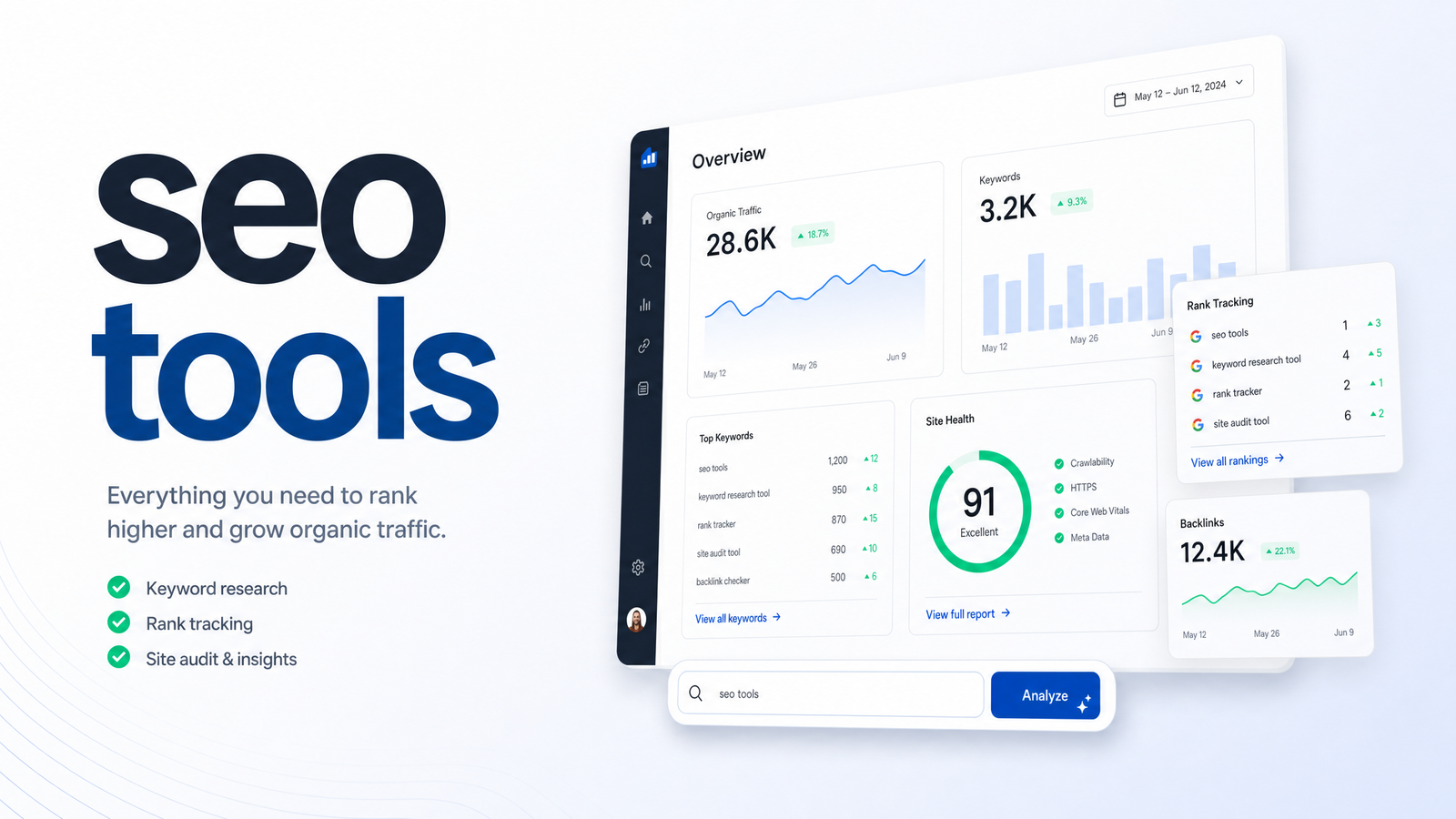
Search "seo tools" and you'll land on either a listicle ranking 25 products by feature count or a category directory that tells you nothing about your actual situation. Neither answers what matters: what do you personally need, and are you already paying for more than you use? This guide skips the rankings and gives you a framework instead — one built around what SEO tools actually do, not which logo shows up first on someone else's affiliate page.
What Counts as an SEO Tool in 2026
The category has outgrown the term. "SEO tools" once meant a dashboard that crawled your site, pulled some keyword volumes, and spat out a spreadsheet for a human to interpret. That definition still technically applies, but it no longer describes what the best SEO software does.
The more useful way to think about SEO tools in 2026 is by job, not by feature list. A tool earns its place in your stack because it does one of a handful of jobs — finding technical problems, researching what people search for, producing content, tracking rankings, analyzing links, or reporting results. Everything else is implementation detail.
What's changed is how much of each job the software now handles unassisted. Static dashboards used to surface data and leave interpretation and execution to you. AI-driven SEO software increasingly closes that loop — flagging an issue, explaining why it matters, and in some cases fixing or drafting the fix itself. That shift, more than any single feature, is why "which tool" has become a harder question than it used to be: the tools aren't just reporting anymore, they're doing work that used to require a specialist.
The 6 Jobs Every SEO Tool Stack Needs to Cover
Whatever combination of products you land on, your stack needs to cover six functional jobs. Think of these as the SEO tool categories that matter — everything else is a variation on one of them.
Technical audits. Crawling your site for broken links, indexation problems, Core Web Vitals issues, and structural errors that quietly cap your rankings. This is usually the first job teams outsource to software because manual crawling doesn't scale past a handful of pages. For what a proper crawl checks, see the site audit tool guide.
Keyword research. Understanding what your audience actually searches for, at what volume, and with what intent. AI has changed this job significantly — see the AI keyword research breakdown for what's different versus older volume-and-difficulty tools.
Content creation. Turning keyword and topic research into published pages that hold up against Google Search Console performance data over time. This job used to sit entirely with writers; it's now increasingly assisted or automated end to end.
Rank tracking. Monitoring where your pages sit for target queries and how that shifts after changes. It sounds simple until you're managing hundreds of keywords across multiple domains — the rank tracker selection guide walks through what separates a usable tracker from a noisy one.
Backlink analysis. Evaluating your link profile and your competitors', spotting toxic links, and finding link opportunities. Full breakdown in the backlink analysis framework.
Reporting. Packaging all of the above into something a client or stakeholder can actually read. The reporting software buyer's framework covers what separates useful reporting from vanity dashboards.
For the full category-by-category breakdown, including sub-categories within each job, see the complete SEO tools category guide.
The Real Problem: Tool Sprawl, Not Tool Choice
Here's what most SEO tool comparisons miss: the difficulty isn't picking the right product. It's that most teams already run four to six tools at once — an audit platform, a keyword research tool, a rank tracker, a backlink checker, maybe Semrush or Ahrefs for the overlap, plus a reporting layer stitched together in a spreadsheet.
Each subscription was a reasonable decision on its own. Together, they create a specific kind of waste: duplicated data (three tools independently crawling the same site and disagreeing on keyword counts), manual handoffs (exporting a keyword list to brief a writer elsewhere, pasting the draft into a CMS, then checking a fourth tool days later for ranking movement), and redundant spend on overlapping features you're paying for two or three times without realizing it.
This is tool sprawl, and it's distinct from tool selection. You can have the "best" audit tool, rank tracker, and content tool individually and still lose hours a week to the seams between them. Market analysis on enterprise SEO shows the same pattern at scale — consolidating point solutions into fewer platforms reduces both redundant spend and the data silos created when every tool keeps its own version of the truth. Smaller teams hit the same wall earlier, just with smaller invoices.
How to Decide: Stack of Specialists vs. One AI Platform
There's no universal answer to how to choose SEO tools, but there is a workable framework. Weigh these four variables:
Team size. A solo operator or two-person team rarely has bandwidth to manage handoffs between five logins. A 10-person in-house team with dedicated technical, content, and analytics roles can absorb that friction more easily, since different people own different tools.
Publishing volume. If you're shipping one or two pieces a month, the inefficiency of separate research and publishing tools barely registers. If you're publishing weekly or building topical authority across dozens of pages a quarter, every manual handoff multiplies.
Budget. Four to six specialist subscriptions typically cost more in aggregate than one consolidated platform covering the same jobs — before you even count the time spent reconciling data between them.
Technical complexity. Large, older sites with legacy technical debt sometimes need a best-in-class specialist audit tool that a generalist platform can't match. If your technical footprint is genuinely complex, that's a legitimate reason to keep a specialist even after consolidating everything else.
As a rule of thumb: small and mid-sized teams with moderate publishing volume and standard technical setups are the clearest candidates for all-in-one SEO tools. Large teams with specialized technical needs or enterprise compliance requirements sometimes still need point solutions for one or two jobs — but consolidating the rest into one platform usually still pays off.
What AI Changed in SEO Tools
The category shift worth understanding, separate from any specific product, is that AI SEO tools stopped being purely diagnostic. A traditional tool would tell you a page was thin, missing internal links, or targeting the wrong keyword — then leave the fix to you. AI-driven SEO software increasingly performs the fix: drafting the rewritten section, generating internal links, or producing a content brief with the gaps already filled in.
That's a meaningful change in what "using an SEO tool" means day to day. Audits move from a list of problems to a set of actioned or semi-actioned fixes. Keyword research moves from a spreadsheet of volumes to a prioritized content plan. Rank tracking moves from a weekly check-in to an ongoing signal that triggers content updates automatically. None of this replaces judgment — you still decide what ships — but it collapses the distance between finding a problem and fixing it, which is exactly the gap that used to require stitching multiple tools together manually.
Where Rankevra Fits
Rankevra was built around the six-job framework above, not as another specialist tool to add to an already crowded stack. Instead of separate logins for audits, keyword research, content drafting, publishing, and rank tracking, Rankevra runs them as one connected AI SEO workflow: it audits your site, identifies the fixes and content gaps worth prioritizing, drafts and publishes the content, and tracks how rankings move afterward — all against the same underlying data instead of five disconnected exports.
That matters most for the teams described in the decision framework above — website owners, marketers, and content teams managing SEO themselves who don't have a dedicated ops person to babysit handoffs between tools. If your current stack already covers the six jobs but across four or five subscriptions, Rankevra is built to replace that sprawl with a single workflow rather than add a sixth tool to the pile.
Frequently Asked Questions
What's the difference between an SEO tool and a full SEO platform?
An SEO tool typically handles one job — auditing, tracking, or research — while a platform combines several jobs into one connected workflow with shared data. The practical difference shows up in handoffs: a single tool requires you to export data and move it elsewhere to act on it, while a platform carries the data through audit, content, and tracking without manual transfer.
Can I get by with free SEO tools like Google Search Console alone?
Google Search Console covers indexing status and real search performance data well, and it's genuinely sufficient for very small sites with minimal competition. Once you need competitive keyword research, backlink analysis, or systematic rank tracking across many terms, free tools stop covering the gap and paid software becomes necessary.
How many separate SEO tools does a small team actually need?
A small team needs all six jobs covered — technical audits, keyword research, content creation, rank tracking, backlink analysis, and reporting — but that doesn't require six separate subscriptions. Many small teams can run all six through one consolidated platform rather than stitching together specialist tools for each.
Is it worth switching from several specialist tools to one all-in-one platform?
It's usually worth it once you're paying for four or more overlapping subscriptions and spending regular time on manual handoffs between them, such as exporting keyword lists or pasting content between systems. Teams with unusually complex technical needs or very high publishing volume in one specific area may still benefit from keeping one specialist tool alongside a consolidated platform.
How has AI changed what SEO tools can actually do?
AI shifted SEO tools from reporting problems to actively fixing them — drafting content, generating internal links, and prioritizing fixes instead of just listing issues for a human to act on. This narrows the gap between diagnosis and execution, which used to require moving data between multiple separate tools manually.
What should I look for first when comparing SEO tools?
Start with which of the six core jobs — audits, keyword research, content, rank tracking, backlink analysis, reporting — the tool actually covers well, rather than its feature count or price. Then check whether it shares data across those jobs or requires manual exports, since that determines whether it reduces or adds to your existing tool sprawl.
Tool sprawl has a real cost: four to six subscriptions, none talking to each other, data that disagrees between platforms, and hours lost every week manually moving keyword lists, drafts, and ranking reports between tools that were never designed to connect. Rankevra was built as the alternative — one AI-driven workflow that runs audits, content creation, publishing, and rank tracking together instead of across separate logins. If your current stack has grown past what you can reasonably manage, it's worth seeing what running all of it in one place actually looks like: Rankevra.
Keep reading
- Content Decay SEO: How to Detect It and Fix It for GoodLearn to detect content decay SEO issues early, rule out false positives, and build a refresh pipeline that scales — plus how to automate the whole loop.
- Headless CMS SEO: Fixing the Gaps Generic Tools MissHeadless CMS SEO breaks in three predictable places: rendering, metadata, and sitemaps. Here's the diagnostic framework to find and fix each gap.
- Google Algorithm Update Recovery: A Diagnostic FrameworkA step-by-step google algorithm update recovery framework: confirm the cause, segment the damage, benchmark against winners, and set a real timeline.