Rankevra Blog
Topical Authority Generator: What It Actually Does
August 12, 2026
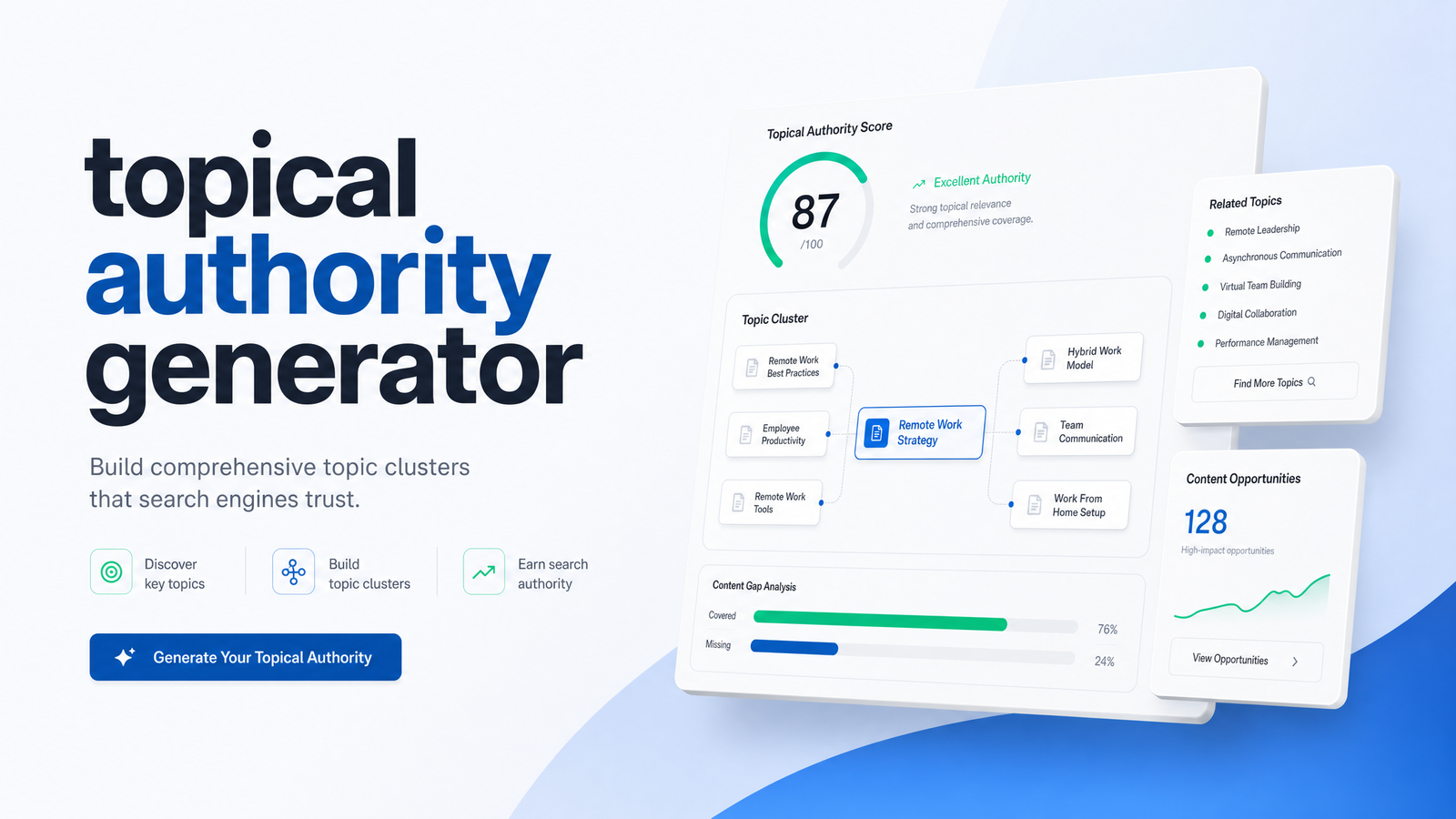
Type "topical authority generator" into a search bar and you'll mostly get articles explaining why topical authority matters, or manual checklists telling you to build a spreadsheet yourself. Almost nothing describes the actual software category — what a generator produces, what it needs to run, and how to tell a real one from a keyword-list tool wearing an AI label. This article stays strictly in that lane.
If you want the conceptual groundwork first, Topical Authority Meaning: A Plain-English Definition covers that separately.
What a Topical Authority Generator Actually Is (and Isn't)
A topical authority generator is software that takes a seed topic or domain and outputs a structured cluster map — a pillar page, its supporting subtopics, the search intent behind each one, and a prioritized content plan built to cover a subject the way a genuine expert would, not the way a single keyword target would.
That's meaningfully different from a keyword-list tool, which gives you terms sorted by volume and difficulty but no sense of how those searches relate, which belong under the same pillar, or what order to publish them in. A one-off AI writer is a different gap: it can draft an article on demand, but it has no model of your site's topic coverage and no opinion about what to write next.
Real topical authority software sits above both. It's the layer that decides structure — what the cluster looks like, where the gaps are, how the pieces reinforce each other — before a single sentence gets written. An AI topical authority tool worth the name treats content as a system of interlinked pages competing for a subject, not a queue of isolated briefs.
This matters because ranking algorithms increasingly reward sites that demonstrate depth across a topic, not just sites that happen to rank one page well. A generator's job is to make that depth achievable without hand-building the map yourself.
The Inputs It Needs to Work
A generator is only as accurate as what you feed it. At minimum, it needs:
- A seed topic or domain. Either a broad subject you want to own, or your existing site so the tool can infer what you already cover.
- Competitor topic coverage. The tool needs to see what ranking competitors have published across the subject, not just which keywords they rank for, so it can spot where their coverage is deeper than yours.
- Existing site content. Without this, a generator can't tell a genuine content gap from a topic you've already covered under a different URL or heading.
- Search intent data. Volume and difficulty alone don't tell you whether a query wants a definition, a comparison, or a buying decision — and intent mismatches are a common reason "covered" topics still don't rank.
The competitor-coverage piece is easy to underweight. Comparing keyword lists tells you what to target; comparing topic coverage tells you where your depth actually falls short. For the full framework, see SEO Content Gap Analysis: A Complete Framework. A generator essentially automates that gap analysis and folds the output straight into the map, rather than leaving it as a separate research step you interpret manually.
How It Turns a Seed Topic Into a Cluster Map
This is the actual "generation" step — what separates software from a manual spreadsheet exercise — and it happens in a few distinct stages.
First, semantic clustering. Instead of grouping keywords by shared words, the tool groups them by shared meaning and search intent, so "how to build topical authority" and "topical authority strategy" land in the same cluster despite little surface vocabulary overlap. Human grouping in a spreadsheet tends to follow obvious word overlap and misses semantically related queries phrased differently.
Second, pillar/subtopic hierarchy. Clustering output gets organized into a structure: one pillar page representing the broad topic, and subtopic pages beneath it that each answer a narrower question the pillar can't fully cover alone. This is what a topical authority map generator is actually mapping — not a flat list, but a tree.
Third, intent tagging. Each node gets labeled by what the searcher wants — informational, commercial, navigational, transactional — so the eventual brief matches the right format to the right query instead of writing a how-to guide for a buyer-intent search.
Fourth, prioritization. Not every subtopic deserves equal effort. A working generator ranks nodes by opportunity (volume, competition) and structural importance (how many other subtopics link back to it), so you know what to publish first rather than staring at fifty briefs with no order.
The output is a map you could theoretically execute by hand — but a generator produces this structure in minutes on data a human would need days to compile and reconcile.
From Map to Published, Ranking Content
A cluster map is only half the job. This is where most tools in this space stop — and where the difference between a genuine generator and a glorified spreadsheet exporter becomes obvious.
A complete workflow takes each mapped node and automatically produces a content brief: target intent, suggested structure, related subtopics to internally link, and the on-page elements the piece needs to compete — content brief automation doing what a strategist would otherwise do node by node.
From there, a real generator can move into drafting, on-page optimization (headings, internal links back to the pillar and sibling subtopics, metadata), and publishing directly to the site — either automatically or through an approval step. This is what it means to automate topical authority building end to end rather than just automate the research phase.
Publishing at this pace introduces its own risk: pushing dozens of pages live without pacing or review can trigger quality signals you don't want. Building a Content Publishing Workflow That Scales Safely covers the guardrails worth putting in place — release pacing, review gates, internal linking discipline — regardless of which tool handles publishing.
For teams planning to scale a cluster into hundreds of pages — comparison pages, location pages, templated variants — Programmatic SEO: How to Scale Pages Without Getting penalized is the natural next step once the core cluster is live and performing.
How to Tell If It's Actually Working
Give a generated cluster 60 to 90 days before judging it — organic content needs time to index, get crawled repeatedly, and settle in rankings. After that window, check these signals rather than trusting a dashboard's vanity score:
Coverage breadth. Are you now ranking, even on page two or three, for a meaningfully wider set of queries across the topic than before — not just the one keyword you originally targeted?
Ranking movement across the cluster, not just the pillar page. A working cluster shows multiple subtopic pages climbing together over time; a pillar that ranks well while every subtopic stays flat suggests the map wasn't well-connected or the content underneath is weak.
Internal link density. Pillar and subtopics should link to each other consistently. Thin internal linking is one of the most common reasons a technically complete cluster fails to transfer authority between its own pages.
Indexation. Check that the pages Google actually indexed match what you published — content sitting unindexed after 90 days signals a quality or crawl-budget problem, not a ranking timing issue.
These are signals, not proof by themselves, and rank tracking needs to be read across the whole cluster's performance, not any single URL. For a dedicated framework on measuring this properly, see Topical Authority Checker: How to Actually Measure Yours.
Choosing the Right Generator
Run any tool you're evaluating through this checklist before committing:
- Does it map, brief, publish, and track in one workflow — or does it hand you a spreadsheet and leave drafting, publishing, and measurement to separate tools?
- Does clustering use semantic and intent signals, or just shared keywords and volume?
- Does it compare your site against competitor topic coverage, not just competitor keyword lists?
- Can it publish directly with internal linking built in, rather than exporting briefs you still have to hand off to a writer and a CMS?
- Does it track ranking movement across the whole cluster, not just the pillar URL, so you can actually validate results?
A tool that satisfies all five is rare — most solutions were built for one stage of this workflow and bolted a feature onto another. That's the exact gap Rankevra was built to close: seed topic in, cluster map generated, briefs written, content published, and rankings tracked across every page in the cluster, inside one workflow instead of four disconnected tools.
Frequently Asked Questions
Can AI really generate topical authority, or does it just create content?
AI can generate the structure — the cluster map, intent tagging, and prioritization — that makes topical authority achievable, but authority itself is earned once real users and search engines respond to published, interlinked content over time. Treat the tool's output as scaffolding, not the finished authority itself.
What's the difference between a topical authority generator and a keyword clustering tool?
A keyword clustering tool groups search terms by similarity and stops there. A topical authority generator goes further: it builds the pillar/subtopic hierarchy, tags intent, prioritizes what to publish first, and in complete versions, produces briefs and publishes the content. Clustering is one step inside a generator's broader workflow, not the end product.
How long does it take to build topical authority using an automated tool?
Most teams need 60 to 90 days after publishing before ranking movement across a cluster becomes meaningful to evaluate. The map itself can generate in minutes, but search engines need time to crawl, index, and reassess a site's depth on a topic. Faster publishing pace can compress this somewhat, but not eliminate the indexing and trust-building lag.
Do I still need a human editor if I use a topical authority generator?
Yes, for quality control and brand voice, even when drafting and publishing are automated. Automation handles structure, research, and volume reliably; human review catches factual errors, tone mismatches, and judgment calls the tool can't make. Most teams keep a lightweight approval step rather than removing editorial oversight entirely.
Will a generated topic cluster work for a brand-new website with no existing content?
Yes — a generator can build a full map from a seed topic and competitor coverage alone, without needing existing site content as an input. New sites benefit most, since there's no legacy content to reconcile against the new structure, and the map can dictate the site's information architecture from the start.
How is a topical authority generator different from a content brief generator?
A content brief generator produces individual briefs on request, one topic at a time, with no view of how they connect. A topical authority generator decides the cluster structure first — what topics exist, how they relate, and what order to tackle them — then generates briefs for each node as part of that larger map. Briefs are an output of a generator's process, not the whole process itself.
If you're managing all of this across separate keyword tools, a writing assistant, a CMS, and a rank tracker, that's exactly the friction a real generator is meant to remove. Rankevra maps your seed topic into a full cluster, drafts and publishes the content, and tracks rankings across every page from one dashboard — start free and see the map it builds for your first topic.
Keep reading
- Content Decay SEO: How to Detect It and Fix It for GoodLearn to detect content decay SEO issues early, rule out false positives, and build a refresh pipeline that scales — plus how to automate the whole loop.
- Headless CMS SEO: Fixing the Gaps Generic Tools MissHeadless CMS SEO breaks in three predictable places: rendering, metadata, and sitemaps. Here's the diagnostic framework to find and fix each gap.
- Google Algorithm Update Recovery: A Diagnostic FrameworkA step-by-step google algorithm update recovery framework: confirm the cause, segment the damage, benchmark against winners, and set a real timeline.