Rankevra Blog
Why Topical Authority Matters More Than Ever in SEO
August 10, 2026
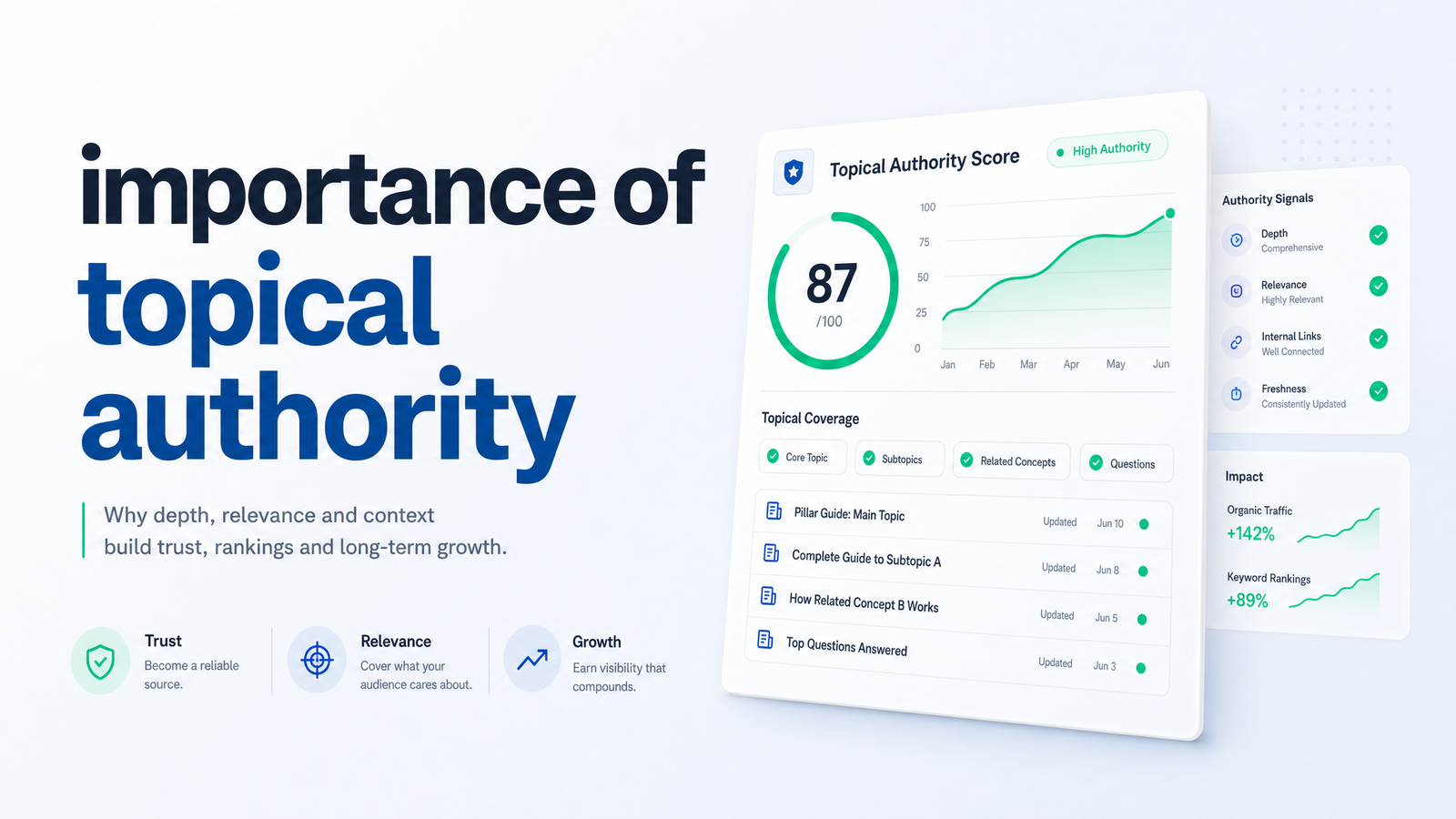
Most articles about topical authority assume you're already sold and just want the playbook. This one starts a step earlier: is this a real ranking mechanism, or another phrase agencies use to justify a bigger content budget?
The short answer is that the importance of topical authority is now backed by documented evidence — patents, antitrust trial exhibits, and observable ranking behavior — not just SEO folklore. Here's what that evidence shows, what it costs you to ignore it, and where it fits next to domain authority, E-E-A-T, and the AI Overviews reshaping search.
What Topical Authority Actually Means (In One Paragraph)
Topical authority is the degree to which Google (and increasingly, AI search systems) trust a site as a comprehensive, credible source on a specific subject — not just a single keyword. It's built by covering a topic's full breadth: core concepts, related subtopics, common questions, and the connections between them, usually organized into topic clusters that link to each other with clear intent. A site with topical authority on "email marketing" doesn't just rank for that phrase; it ranks for dozens of adjacent queries because it has demonstrably mapped the whole subject. What is topical authority, in short, is topic-level trust earned through depth, not a single optimized page.
The Evidence: Why Google Rewards Topical Depth
The claim that topical authority is a ranking factor used to rest mostly on correlation and anecdote. That's changed. Google's own patents describe systems that group content into topical clusters and weight internal links differently based on topical relevance — a mechanism WordStream cites directly as evidence that link-weighting isn't purely about authority passed link-by-link, but about how well a page fits within a site's broader topical structure.
The 2024 DOJ antitrust trial added something SEO folklore never had: leaked internal documents and testimony. As Kevin Indig's analysis of the trial exhibits lays out, Google's internal systems track signals abbreviated as ABC — Anchors, Body, Clicks — to assess topicality at both the page and site level. This is Google's own engineers describing, under oath, mechanisms that reward sites for consistent, well-linked topical coverage. NavBoost, the click-based reranking system also surfaced in that trial, reinforces the same pattern: pages that satisfy topic-specific intent get rewarded with sustained visibility, not just an initial ranking bump.
Algorithm update behavior corroborates the documents. Core updates increasingly reward comprehensive coverage over isolated optimization. Whitehat SEO's ranking factors analysis cites First Page Sage data quantifying topical authority's weight in the algorithm, and points to the June 2025 Core Update specifically favoring sites with broad, connected topical coverage over sites with individually optimized but disconnected pages. Put together, this is a topical authority ranking factor with a patent basis, a documented internal mechanism, and observable update behavior — three independent lines of evidence pointing the same direction.
What You Lose Without It
Sites that skip topical authority and rely on one-off, keyword-targeted posts tend to hit a ceiling that no amount of on-page tweaking fixes. That's the practical difference between topical authority vs keyword targeting: keyword optimization can get a page ranking, but without surrounding topical support, that ranking is fragile and capped.
Concretely, here's what thin coverage costs you:
- Capped rankings. A single strong page competing against a competitor's full topic cluster is fighting with one hand tied — Google has less evidence you're the authoritative source, so it hedges by ranking you below sites with deeper coverage.
- Weak internal linking equity. Without a cluster of related content, there's nothing substantial to link to or from, so link equity has nowhere to flow and pages stay isolated.
- Low trust signals. Comprehensive coverage is one of the practical ways Google infers expertise; a handful of disconnected posts doesn't build that impression, however well-written each one is.
- Core update vulnerability. Sites with thin topical coverage are disproportionately hit during core updates, because they're the exact profile these updates are tuned to demote.
- Exclusion from AI Overviews and LLM citations. AI-generated answers tend to pull from sources that demonstrate depth on a subject, not single pages optimized for one query.
These risks compound. A site that never builds structural depth doesn't just plateau — it becomes increasingly exposed every time Google refines its core algorithm.
Topical Authority vs. Domain Authority (Why They're Not the Same)
One persistent point of confusion is treating topical authority as a function of overall site strength. It isn't. Domain authority (or Google's internal equivalents) reflects a site's general trust and backlink profile across everything it publishes. Topical authority is subject-specific — it's entirely possible for a smaller, newer site with a modest backlink profile to outrank a much larger, higher-authority domain on a particular topic, simply because it has covered that topic more completely and coherently.
This is the practical heart of topical authority vs domain authority: authority isn't one number that travels with a domain wherever it goes. A large publisher with strong domain authority overall can still lose visibility on a niche topic to a smaller site that has built a tighter, more comprehensive cluster around it. That's good news for smaller teams — competing on topical depth is a more accessible lever than trying to out-earn backlinks from a much bigger competitor.
How Topical Authority Shapes AI Search Visibility
The concern that AI Overviews and zero-click search make content investment pointless gets the mechanism backwards. AI Overviews and LLM-based answer engines don't invent their citations from nowhere — they pull from sources that demonstrate depth and internal consistency on a topic, which is exactly what topical authority produces.
Topical authority AI Overviews visibility works on a similar logic to traditional ranking: an AI system synthesizing an answer favors sources it can cross-reference across multiple related pages on the same domain, because that consistency reads as reliability. A single well-optimized page, disconnected from any broader coverage, is a weaker citation candidate than a site whose cluster of content reinforces the same claims from multiple angles. AI search visibility, in other words, rewards the same structural depth that traditional rankings do — arguably more, since these systems have even less patience for shallow, single-page authority claims. Zero-click search doesn't remove the value of topical depth; it shifts where that depth gets cited.
What Building Real Topical Authority Requires
Once the "why" is settled, the practical build has a few core components, each deserving its own dedicated treatment rather than a rehash here:
- Content mapping — laying out the full topic landscape before you publish anything, so clusters have structure from the start. The 5-step topical authority map process is a direct next step for this.
- Content gap analysis — identifying exactly which subtopics and questions your existing content is missing relative to what ranks. The complete framework for SEO content gap analysis covers this in depth.
- Internal linking — connecting cluster content deliberately so topical relevance and link equity both flow correctly between pages.
- Consistent publishing — building out coverage steadily rather than in bursts, since consistency itself is one of the signals tracked internally.
- Tracking and measurement — knowing whether your topic clusters are actually gaining ground, not just guessing.
If you want the fuller how-to picture, Topical Authority SEO: The Real Framework for 2026 is the natural next read once you've accepted the underlying case.
Why This Is Hard to Do Manually — and Where Rankevra Fits
None of these components is difficult in isolation. The problem is running all of them together, continuously, without letting any one piece slip. Content mapping goes stale as competitors publish. Gap analysis needs re-running every time the SERP shifts. Internal links need auditing as clusters grow. Rank tracking needs to happen per-topic, not just per-keyword, to actually tell you whether your authority is building or stalling. Most teams manage this across four or five disconnected tools — a rank tracker, a content brief generator, a CMS, an audit tool — and the coordination overhead is often what kills the strategy before the content even gets a chance to work.
Existing tools also have real limits worth knowing before you rely on them. If you've tried to gauge what topical authority looks like in Ahrefs, you've likely noticed it shows proxies — traffic, keyword counts — rather than a direct measure of topical depth or structural completeness. Knowing what a topical authority tool should actually check is worth reviewing before you assume any single metric tells the full story; the 5-point checklist that matters is a useful gut-check.
This is the gap Rankevra is built to close. Instead of stitching together separate tools for audits, gap analysis, content creation, publishing, and rank tracking, Rankevra runs the entire AI SEO workflow as one connected system — automatically identifying coverage gaps, mapping clusters, drafting and publishing content against that map, and tracking how each topic cluster performs over time. It's built to automate topical authority the way the evidence above suggests it actually needs to be built: continuously, structurally, and measured against real topic coverage rather than isolated keyword wins.
Frequently Asked Questions
Is topical authority an actual Google ranking factor or just an SEO theory?
It's a documented mechanism, not just theory. Google's patents describe topical cluster weighting in internal links, DOJ trial exhibits revealed internal ABC (Anchors, Body, Clicks) signals used to assess topicality, and core update behavior — including the June 2025 update — has visibly favored comprehensive topical coverage over isolated keyword optimization.
How is topical authority different from domain authority?
Domain authority reflects a site's overall trust and backlink strength across everything it publishes, while topical authority is specific to how completely a site covers one subject. A smaller site with modest domain authority can outrank a much larger competitor on a specific topic if its coverage of that topic is more thorough and better structured.
Can a small or new site build topical authority faster than a big competitor?
Yes, because topical authority isn't gated by overall site size or backlink volume — it's earned through focused, comprehensive coverage of a specific subject. A smaller site that maps a topic fully and links it coherently can out-compete a larger domain that has only scattered, disconnected content on that same subject.
How long does it take to see ranking benefits from building topical authority?
There's no fixed universal timeline, but the benefits are cumulative rather than immediate — clusters typically need consistent publishing and internal linking over several months before Google recognizes the site as a comprehensive source. Sites that publish sporadically or leave clusters half-built tend to see slower, weaker gains than those that build out coverage systematically.
Does topical authority matter for AI Overviews and AI search tools, not just Google?
Yes — AI Overviews and LLM-based search tools favor sources that show consistent, cross-referenced depth on a topic, not single optimized pages. A site with a well-built topic cluster gives these systems more corroborating content to cite, making it a stronger candidate for AI-generated answers than a page with no supporting context around it.
Do I need a content team to build topical authority, or can one person do it?
A large team isn't required, but consistency and structure are — which is hard to sustain manually as a solo operator juggling audits, gap analysis, and publishing schedules. This is precisely why automated workflows exist: they let one person maintain the continuous mapping, gap analysis, and publishing cadence that topical authority requires without needing a full team.
Topical authority is difficult to build manually because it demands continuous auditing, content gap analysis, coordinated publishing, and topic-level rank tracking all working in sync — not a one-time project. Rankevra runs that entire workflow as one connected AI-driven system, so you can build topical authority systematically instead of guessing your way through disconnected tools.
Keep reading
- Content Decay SEO: How to Detect It and Fix It for GoodLearn to detect content decay SEO issues early, rule out false positives, and build a refresh pipeline that scales — plus how to automate the whole loop.
- Headless CMS SEO: Fixing the Gaps Generic Tools MissHeadless CMS SEO breaks in three predictable places: rendering, metadata, and sitemaps. Here's the diagnostic framework to find and fix each gap.
- Google Algorithm Update Recovery: A Diagnostic FrameworkA step-by-step google algorithm update recovery framework: confirm the cause, segment the damage, benchmark against winners, and set a real timeline.